
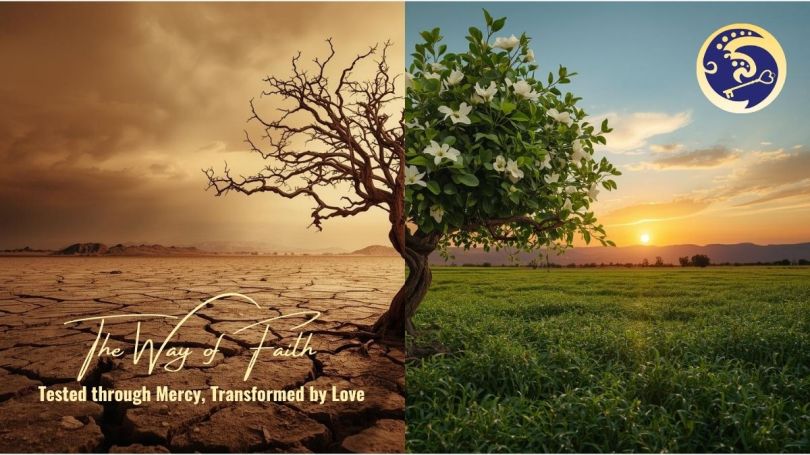
We all carry burdens we refuse to name, yet we often mistake our spiritual journey for a performance. The prophet Isaiah forces us to confront this: What if our most fervent prayers are, to God, simply a heavy burden (1:14)? Our way of faith is not found in the rituals we repeat, but in the inner transformation that begins with honest reckoning. These readings reveal how works without faith are a scarlet-stained futility, but they also unveil the path of renewal through confession. When we embrace mercy, we receive the power of love and forgiveness, preparing us to make the decisive leap of following Jesus.
The Foundation: Lectionary Texts for Reflection
- Isaiah 1:10–18: The Reckoning and the promise of purification.
- Psalm 32:1–7: The joy of confession and forgiveness, unsealing mercy’s flood.
- 2 Thessalonians 1:1–12: The endurance of growing faith amid affliction.
- Mark 10:46–52: Bartimaeus’s cry and the leap of response.
I. The Weariness: Laying Down the Mask
From burden to authenticity.
Inner Posture: Awareness of hypocrisy.
Movement Phrase: The soul grows weary of pretending holiness.
If the exhaustion we feel is not from the difficulty of our life, but from the spiritual lie we maintain, then the path to renewal begins here. We are invited not as performers, but as the weary ones, to lay down the mask of false piety. The soul grows weary of pretending holiness.
The prophet Isaiah points to the divine sigh: “I am weary of bearing them” (1:14). God is not weary of our sin, but of our inauthenticity. We have become so adept at the motions of our way of faith that we’ve forgotten its meaning. This is the quiet, daily form of Christian hypocrisy.
The Apostle Paul, writing to the Thessalonians, offers a vision of what genuine, unwearying faith looks like. He commends them not for their rituals, but for a tested faith “growing abundantly” amid affliction (2 Thess. 1:3). Their love is increasing, not as effort, but as overflow. He prays that God will “fulfill by his power every good resolve and work of faith” (2 Thess. 1:11). This is the promise: Not our frantic striving, but divine presence fueling what endures.

Invitation: What resolve stirs in you, unspoken, waiting for such power?
Refrain: Faith births love. Love births justice.
But unmasking is only the beginning. Awareness without repentance still withers; the soul must face what its silence has hidden.
II. The Reckoning: Facing the Abomination (Isaiah 1:10–18)
From hypocrisy to confession.
Inner Posture: Honest confession.
Movement Phrase: When I kept silent, I dried within.
We move from the fatigue of pretense to the necessary shock of the reckoning. We must face the spiritual cost of hiding our true state, accepting that our works without faith are what God finds burdensome. When I kept silent, I dried within. This phrase captures the internal cost of the hypocrisy Isaiah is about to name.
A. The Prophetic Renaming (The Fire of Recognition)
Isaiah begins with a devastating act of renaming: “Hear the word of the Lord, you rulers of Sodom; listen to the law of our God, you people of Gomorrah!” (1:10). This is the prophet’s gut-punch. We, the covenant people, are labeled for cities consumed by their own moral decay. The sin of Sodom and Gomorrah wasn’t hidden vice alone; it was a profound spiritual blindness—a prosperity that felt no obligation to the poor.
Invitation: In this renaming, what hidden Sodom lingers in your governance of self—of time, of words, of withheld mercy?
B. The Vain Offering (The Futility of Unrooted Works)
This hypocrisy leads to the central crisis: “What to me is the multitude of your sacrifices?… Your hands are full of blood” (1:11, 15). God rejects all the outward rituals because iniquity poisons the air. The vast accumulation of our works of faith is rendered futile if our inner transformation hasn’t aligned our heart with justice. Deeds detached from the heart’s truth are echoes in an empty chamber—resounding, yet rootless.
The Refrain: Faith births love. Love births justice.
Yet divine judgment is never the final word. Even as Isaiah names our desolation, mercy waits in the next breath. The Psalmist teaches us how grace begins — not in defense, but in confession.
III. The Release: Confessing the Heart’s Truth (Psalm 32:1–7)
From silence to song.
Inner Posture: Receiving mercy.
Movement Phrase: Truth demands its voice.
The spiritual journey pivots here, at the hinge of confession. We move from condemnation to the forge where guilt yields to grace. Confession unseals the flood of grace.

A. The Cost of Concealment (The Wasting Silence)
The Psalmist articulates the precise internal cost of living under the burden exposed by the prophet. When I kept silent, I dried within. This phrase perfectly captures the barren weight of unacknowledged sin: “my bones wasted away… my strength was dried up as by the heat of summer” (Psalm 32:3-4). Inauthentic faith is this exhaustion. It is why the first step toward renewal is simply speaking the truth.
Invitation: Where in your silence does the heat rise, drying what once flowed freely?
B. The Cleansing Fire (The Forgiveness Freely Given)
The moment of release is simple and instantaneous: “Then I acknowledged my sin to you, and I did not hide my iniquity; I said, ‘I will confess my transgressions to the Lord,’ and you forgave the guilt of my sin” (Psalm 32:5).
The Theological Hinge: The fire that razed Sodom becomes, in mercy, the forge that purifies the heart—ashes transfigured to gold, pretense to truth. We are covered by divine embrace: “Happy are those whose transgression is forgiven” (Psalm 32:1). We are no longer defined by the scarlet of our past, for God declares: “if your sins are like scarlet, they shall become like snow” (Isaiah 1:18). This is the power of love and forgiveness.
The Refrain: Faith births love. Love births justice.
The silence that once drained the Psalmist now gives way to the shout of faith. What was inwardly confessed now becomes outwardly embodied.
IV. The Response: Leaping into the Way (Mark 10:46–52)
From sight to following.
Inner Posture: Faith embodied.
Movement Phrase: He threw off his cloak and followed the Way.
A forgiven heart does not sit still; it shouts, it springs, it follows. Bartimaeus, the blind beggar, embodies this final stage of our way of faith.
A. The Bold Cry (The Heart’s Unsilenced Plea)
Bartimaeus began to shout: “Jesus, Son of David, have mercy on me!” (Mark 10:47). He prioritized his need over the crowd’s rules.
The Theological Hinge: Isaiah’s Sodom burned because blindness reigned in the powerful; Bartimaeus’s physical blindness is healed because he had spiritual sight. He recognizes mercy in Christ and voices the plea that the self-righteous refused to speak for the poor.
Invitation: What mercy do you cry for, louder than the world’s silencing?
B. The Surrender and Healing (The Way Made Visible)
When called, Bartimaeus made a definitive choice: “So throwing off his cloak, he sprang up and came to Jesus” (Mark 10:50). The cloak was his beggar’s chain. To cast it off was faith’s decisive surrender: no more hiding in the old sin.
Jesus honored the source: “Go; your faith has made you well” (Mark 10:52). The outward act was merely the visible evidence of the inner transformation. The story is incomplete without the following: “Immediately he regained his sight and followed Jesus on the way.” This is the key to all works of faith. Justice becomes not a duty, but love in motion on this spiritual journey.

The Refrain: Faith births love. Love births justice.
The one who follows on the Way becomes the sign of what faith fulfilled looks like. Bartimaeus’s leap becomes our lifelong walk — love made visible.
V. The Fulfillment: Living Love in Motion
From action to enduring love.
Inner Posture: Love enduring.
The cycle is complete: Isaiah wrenched open the abomination; the Psalm forged the release; Bartimaeus leapt into the Way. We are no longer Sodom’s heirs, burdened by scarlet-stained futility, but snow’s—made clean by surrender and empowered by love enduring, tested through mercy as Paul envisions. The goal is not just to feel forgiven, but to let that forgiveness drive us. As Paul prayed, God can fulfill in you “every good work of faith” (2 Thess. 1:11).
Final Challenge
Pause here: Confess the silence in your heart, not to earn, but to receive the boundless love and forgiveness. Then rise: Seek justice not as frantic striving, but as the forgiven one’s quiet command. Let your heart become the clean altar where mercy kindles every act of love.
Contemplative Sending
Go now—washed, forgiven, and aflame with faith that does not tire. Amen.
The Final Echo (Closing the Cycle):
Faith births love. Love births justice. And justice, lived in mercy, returns us again to faith.
 Divine Presence: Letting the Infinite flow in my life