
A few weeks ago, in a message titled “Living with Truth,” we looked at Amos 8 and Psalm 15, seeing how God despises exploitation and steadies those who live with integrity. We saw that an upright heart is not just a moral ideal, but a firm foundation in a shifting world. Today, as we turn our gaze once more to the prophetic words of Amos, and the poetic truths of Psalm 113 and 1 Timothy 2, we are invited to go even deeper. We are called to see God’s heart for justice not merely as a set of ethical rules or a social program to be enacted, but as a profound act of spiritual worship—a natural, unavoidable overflow of a life lived in His divine presence.
From Presence to Practice: Living a Life of Justice
Consider a scene right here in Panama City: A maid earns about $450–$650 a month. Her days are defined by a quiet, relentless rhythm—hands calloused from brooms, mops and detergents, a body weary from endless tasks. Her labor is a testament to her strength, but her circumstances hold her captive. If she spoke English, her reality could be transformed by a new opportunity: a job with foreigners, offering higher wages and new possibilities. In some cases, the opportunity to work in a business, not just a home.
On the surface, this is a beautiful story of economic mobility. But what if it’s also a story of a deeper, spiritual transformation—a journey from being overlooked to being fully seen, from feeling defeated to embodying the dignity with which God created her? This new role could be the stepping stone she needs, a way to move into an office position and grow professionally.
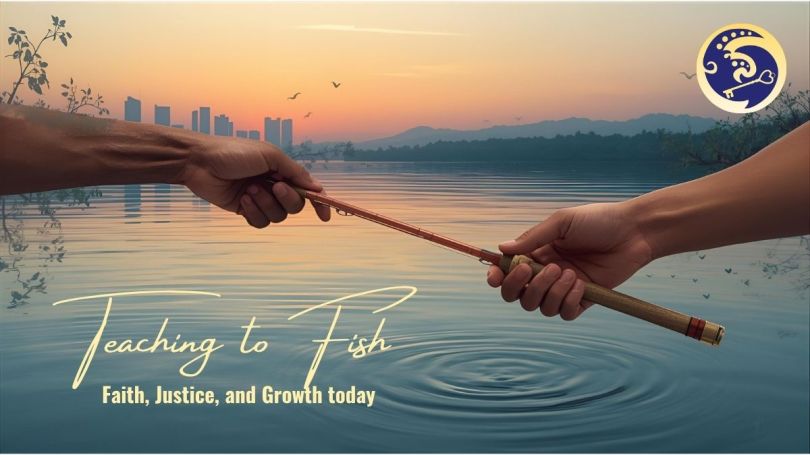
We are called, above all, to love our neighbor as ourselves. But sometimes, in our well-intentioned outreach, we stop at handing out fish—a meal, a bag of clothes, temporary aid. We address the immediate symptoms of poverty without looking to the root cause. What if God is calling us to a deeper form of love—not just to teach our neighbors to fish with practical skills, but to teach them to live by the Spirit? To live with the Fruit of the Spirit—love, joy, peace, patience, kindness, goodness, faithfulness, gentleness, and self-control? Practicing God’s presence in our work, in our relationships, and in our communities is how we truly empower others, for it is in our spiritual overflow that we find the capacity to reflect His heart and lift the lowly from the dust to dignity.
Let’s explore how the virtues of justice, the power of prayer, and the grace of reconciliation are not just things we do, but things that grow from a place of deep spiritual worship, transforming minimum-wage struggles into futures of hope.
Faith and Finance: Practicing Presence in the Economy
Amos 8 delivers a searing, prophetic warning to those who “trample the needy” with dishonest scales, exploiting the poor for something as trivial as a pair of sandals ($2.50 in those days, according to some commentators).

This wasn’t just a business crime; it was a profound spiritual betrayal. It was a failure to see God’s image in the very people they were exploiting. In their relentless pursuit of profit, they created a moral and spiritual gap—a chasm between themselves and those they were created to love. They lost the ability to practice God’s presence in their transactions, turning human beings into commodities.
Contrast this with the story of Dan Price, the CEO of Gravity Payments, who in 2015 made a startling decision. He slashed his own $1 million salary to ensure every employee, from the lowest-paid clerk to the most experienced developer, earned at least $70,000. This man is not perfect, but his business model has shown us it’s possible to build a business to foster employee well-being.
We see this emphasis not as a clever business strategy; But an act of profound spiritual integrity. It becomes an outward expression of a heart that was practicing generosity and kindness, where a side-effect is a flourishing company which far outweighs the financial cost. We can model our business on what it means to truly love your neighbor as yourself in a corporate setting. This decision isn’t just about money; it’s about dignity and mutual respect.
In a similar fashion, Fundación Microfinanzas BBVA provides training and micro-loans to women who would never be able to access traditional bank loans. Their stories of success are not just about a loan, but about a woman who used that small loan to start a sustainable business—a local market stall, a small bakery, a sewing business—and became a pillar in her community.
These stories show us that when we act with integrity and love, we create opportunities for dignity and self-sufficiency, turning a simple loan into an instrument of God’s grace. It is a powerful example of how a practical business model can be an expression of spiritual conviction.
From Dust to Dignity: Living the Fruit of the Spirit
Psalm 113 paints a glorious, almost unbelievable, picture of God. He is “enthroned on high,” yet He “stoops down to look” at the heavens and the earth (Psalm 113:4-6). This is the great paradox of God: He is infinitely high, yet He condescends to be intimately involved in our lives. The Psalm continues this breathtaking thought: God raises the poor from the dust and seats them “with princes” (Psalm 113:7-8). This isn’t just a metaphor for a better life; it is a spiritual truth. Justice is a form of worship, an act of love that mirrors God’s own heart, transforming our neighbors from being forgotten to being honored.

In Panama City, CAPTA, a program by Fundación Calicanto, empowers marginalized women. Their training focuses on vocational skills, but the true transformation happens on a deeper level. It is a work of building self-esteem and confidence—a rebuilding of the inner person. This is where the spiritual and the practical beautifully intersect.
From a spiritual perspective, we can see that the professional skills they teach are not merely a checklist for a job; they are an invitation to live with the Fruit of the Spirit. They are a spiritual path in themselves.
Think about it:
- Professional communication becomes an act of kindness and gentleness, a way of building up instead of tearing down. It’s an expression of inner peace that makes our words steady and our intentions clear.
- Time management becomes a practice of peace and self-control. It is a spiritual discipline that brings order to chaos and frees us to be present in our work.
- Emotional intelligence becomes a manifestation of love and patience. It is an acknowledgment that our neighbor’s struggles are real and that we can meet them with empathy.
- Dress code becomes a reflection of self-worth and inner dignity. It is a way of honoring God by honoring the temple of the Holy Spirit.
By teaching these, we are not just preparing someone for a job; we are teaching them to practice God’s presence in every part of their lives, transforming the exploited poor into Psalm 113’s princes.
Prayer in Action: Aligning Our Hearts with God’s
1 Timothy 2 urges us to pray for all people, especially those in authority, so that we may live “peaceful and quiet lives in all godliness” (1 Timothy 2:1-2). This is not a call to be passive; it is a call to be grounded. Prayer is not a passive wish; it is an active alignment of our hearts with God’s will. It is the fuel for our action.
Daniel’s life is a perfect example. He prayed faithfully three times a day in exile, facing the threat of the lion’s den, yet his prayer life was the spiritual foundation that allowed him to maintain his integrity and influence kings. His prayers weren’t just an escape from his circumstances; they were a way of maintaining his relationship with God, allowing him to be a transformative presence in a pagan nation.
In Haiti, SALT Microfinance is a powerful, modern example of prayer leading to action. They blend savings groups, vocational training, and Bible teaching in a holistic approach to empowerment. A testimonial from a woman named Elashe shows how a small loan helped her start a small store, a business that grew so much that she was eventually able to help her children move to the United States to pursue their dreams. This is what happens when prayer shapes our vision, leading to tangible, life-changing results.
Here in Panama, INADEH trains thousands in vocational skills, a tool for breaking the cycle of poverty. Let’s join our Wednesday night online prayer group to lift up the leaders of these organizations and our neighbors in Santa Ana and El Chorrillo.
For our church: Prayer is where empowerment begins, but it should never end there. It should lead us to ask the question: what is God calling us to do? Could we offer a health workshop, teaching nutrition as an act of loving our neighbor with our knowledge? Even if you are unable to teach, you can pray every Wednesday, asking God to guide our leaders and neighbors. This is how we blend faith and action, shaping peace and justice through empowered lives.
Bridging the Divide: The Journey of Reconciliation
1 Timothy 2:5 proclaims Christ as the “one mediator” between God and man. This is the heart of the Christian faith. Justice, then, is His gospel in action, the visible fruit of a reconciled life, bridging the divides of our broken world. The parable of the Good Samaritan is not just a lesson in kindness; it is a story of radical reconciliation. A Samaritan, despised by the Jewish people, crossed ethnic and class barriers to show mercy (Luke 10:25-37), binding the wounds and restoring dignity to a man who had been cast aside. His compassion was an act of grace that mirrored the mediation of Christ.

In Panama, the AES Panamá Foundation trains youth with technical and English language skills. Similarly, WeGrow Panama mentors young women in STEAM fields. These programs are not just about job training; they are about bridging divides and restoring relationships. They create a space where people can see beyond class and background to find a shared sense of dignity and purpose. They are a powerful image of Christ’s work of reconciliation in our city.
No matter how big or small our involvement, this is how our church can build bridges, not walls, across economic and cultural divides. These acts of reconciliation are a physical embodiment of Christ’s mediation, transforming our community with opportunity and hope.
Conclusion: From Being to Doing
Acts 4:32-35 shows the early church sharing so that “no one was in need.” Their community was a testament to justice and accountability. Like SALT’s savings groups or AES’s training, we can empower, not enable.
The true work of justice begins not with a strategy, but with a spiritual posture. It begins by practicing God’s presence in every area of our lives, allowing His love, His kindness, and His peace to flow through us and into the world around us. When we seek Him first, the actions of justice become a natural, beautiful overflow of our hearts.
This is the very essence of what the scriptures we explored today call us to: to be a people who, like the “upright” in Psalm 113, are lifted from the dust of our own spiritual poverty to reflect God’s justice. It is to live with integrity, rejecting the dishonest scales of Amos, and to be grounded in prayer, as 1 Timothy teaches, so that our lives become a visible testimony to God’s love and reconciliation.
My question for you today is not what you will do, but what you will become. How is God inviting you to practice His presence and cultivate His fruit in your life today? How will that inner transformation spill over into an act of love for your neighbor, an act of justice that reflects the very heart of God?


 Divine Presence: Letting the Infinite flow in my life