I recently discovered some of the works and thoughts of the Russian writer, novelist and philosopher Fyodor Dostoyevsky. He was an Orthodox Christian with a deep faith, a faith which had “a strong emphasis on giving Christian love a social application”. But what I really have treasured have been two quotes that I have found in his writings.
Do not be daunted by the enormity of the world’s grief. Do justly — now. Love mercy — now. You are not obligated to complete the work, but neither are you free to abandon it.
— authorship unknown
As I see here in Panama wave after wave of Venezuelans arriving, running from the disaster in their country, I realise that it is hard for us to welcome them with open arms. People here feel threatened by the mass migration wave that has hit Panama – “there are too many of them”. Crimes rates have increased over the past three years. Housing has become more expensive. Unemployment has increased. The cost of living has gone up.
Over the past weeks, I have spent a lot of time thinking about money, beliefs and actions. Much of this was spurred by some coaching and heart work that I was doing writing in my journal, getting a clearer view of the life that I want to live and the calling that I have.Read More »
So one of the books that I’m reading at the moment is “In Tune with the Infinite“, by Ralph Waldo Trine. I am loving this book! Hard to believe it was originally written some 115 years ago – it’s easy reading! But what I really love about the book is that he focuses on Oneness with God, every moment of each day. Life hasn’t always been this way: I haven’t always valued being present and being aware of Presence or oneness with God.
I am much more comfortable with the terms he uses to refer to God than with those of some other books, but my awareness of the names we use to refer to God are also a reflection of the image we have created of how and what God is.
Is God personal or simply a Presence?
I really struggle with identifying where I stand on this? Maybe because I think God is both! God is God (omnipotent & omnipotence; omniscient & omniscience; omnipresent & omnipresence): why must we put God in a box and a definition?
A bit of background:
I grew up in a fundamentalist (of course, we didn’t call ourselves that!) group, where Mum & Dad worked as missionaries. Now when I look at the “do’s” and “don’ts”, the corporal punishment expected to be given (i.e. my parents were looked down on if they didn’t punish), and the control over how everyone lived their lives, I wonder how close to being a “cult” we were. Thankfully, Mum & Dad got kicked out of the mission, although it was heartbreaking and earth-shattering at the time. It was all I knew. Then we moved back to New Zealand, where I discovered that we were Presbyterian.
How does a Presbyterian end up in a fundamentalist group? Trying to save the world! I have to hand that to Mum & Dad: they truly believed that they were doing God’s will and this was the best that they can be. And I will say this for them: every time I go back to Soloy or Tolè, they are remembered by everyone with great love and affection. They positively impacted people’s lives. And in some cases, literally saved lives (mum was an RN and midwife, so in the boondocks with no EMTs or hospitals, sometimes mum was everything). And dad was love. He loved these people with his heart. If I had just an ounce of the amount of love that dad has for the world, I would be a great person! Do I disagree with some of dad’s opinions? Yes. But I can agree to disagree with him!
By 17 I had “left” the church: blame it on the hormones, the rebellious years, starting University and living the student life. But, the explanation that I gave to myself – as does every self-righteous 17 year old – is that I was sick of the hypocrisy. And by hypocrisy I mean: you know I go out drinking on Friday & Saturday night, and you want me to come to church on Sunday morning and pretend to be a good Christian. I would much rather sleep in and sleep off the hangover!
Reality, which I came to face years later, is that I was mad at God, at Christians, at the mission (especially leadership), and at “organized religion”. I didn’t know enough then to be able to think through all of those things or actually verbalize it yet. So, it was much easier just to be a rebellious teenager that no longer wanted to go to church with my parents.
Forgiveness & moving on
At 21, in the midst of an existential crisis, my flatmate leant me a book she had just finished reading as she went through her separation & divorce that had really helped her: Louise Hay “You can heal your life“. I read it through once. And then I read it through a second time, and did all the assignments as it suggested. And my happy (well, actually, miserable at the time) little bubble finished bursting! I literally packed a weekend bag and my dog (you can’t cry if you don’t have a dog to hug!), borrowed a friend’s bach in Kaiaua (pronounced: Ky-ow-ah), and went off to say goodbye to my demons! I spent the better part of 3 days grieving and forgiving. Letting go. And coming to terms with “what do I believe now?”.
I realized that I blamed God for everything: everything that had been done by so-called Christians in God’s name was God’s fault! A child’s view? Perhaps. But also the consequence of the way I was brought up!
My broken heart and broken dreams and broken family all tumbled out. I came to terms with everything that I blamed Mum & Dad for: and came to an understanding of how they were also victims to some extent of what had happened. And I realized, as a young adult, that they were human. They had done the best they could with what they had and they knew. They were not perfect: they could have done things differently, but they didn’t know any different. They protected me to the best of their ability, they same way they looked after my sister and brother. And for all 3 of us, it hadn’t been enough. We were hurt and broken. But so were they! Life had dealt them a beating and they were lucky to still be standing! I’ll write about all of that another day!
And most importantly, I started to forgive myself!
Twenty years growing up in Christianity and I had to learn from Louise Hay what forgiveness and letting go meant! I’ve read somewhere that tears contain healing properties. I must have completely healed my body in those 3 days with all the tears I cried!
Who & what is God?
Having said that, after that weekend, I came away with a view of God as an impersonal entity that was not involved in the daily affairs of men. I was done with Christianity! God and I were good, insofar as I no longer blamed God for how I had reacted to everything that had happened to me over the past 20 years. Man-made situations were simply that: created by other men & women who had claimed to be acting on God’s behalf. And I was done with organised religion and others telling me what God had said and how to read and interpret the Bible.
And so there I stood, happily: standing on my own two feet. Responsible for my life and the life I wanted to have. Not some rebellious teen that didn’t want to go to Church on Sunday morning because she wanted to sleep off last nights drinks, but someone who simply decided that God was “out there” and not “in my heart”. Religion was organized to control and manipulate us, but each person had to decide for themselves what they believed.
I was suddenly comfortable talking to Mum & Dad about God and beliefs and life in generally without feeling guilty that I was living differently from what they believed. I built a new relationship with Mum & Dad: one that to this day is amazing! They’ve done a great job of growing up.
And so, for the better part of the next 15 years, I was a happy agnostic. I am totally responsible for my life and being, and God may exist, but it has nothing to do with me personally.
Living as a happy agnostic
So, as a happy agnostic, at 23, I came back to Panama to say “goodbye” to the ghosts and ghouls of the past, to forgive and let go of any last vestiges that might be in my subconscious. The plan: spend 3 months on holiday in Panama and then move to the UK to go backpacking for a year while I decided to do with life. But free and clear of anything that I was still hanging on to, because I always felt in New Zealand that I was in the wrong place. Something was still hanging onto me that wouldn’t let me move forward with life.
Of course, life never quite goes as planned: twenty-one years later and I am still in Panama. It is still home!
When I stepped out of the airport doors (which was air conditioned), and I was struck by the hot, humid air, something inside said “Welcome home”. And so, in a second, I changed my mind. I am not going to stay 3 months, I’m going to get a job and stay for 2 years. That plan isn’t the one that happened either. I’m still here!
Living in a predominantly Catholic country, where I would venture to say that the vast majority are non-practicing, it’s easy to be agnostic. No one is worried here about what church you do or don’t go to; no one worries about your “salvation” or what you personally believe. There’s superstition, possibly more than your fair share. I adopted a black cat – so I was definitely a witch! And I let people believe it, if that was what they wanted to think. It’s just a cat! But if you want to assign my cat some supernatural powers, so be it.
As I stand up here this morning, I am reminded about why Jeremiah said to God “I don’t know how to speak; I am only a child”. Well, maybe not a child, but Mum & Dad are sitting in the congregation listening, and I feel like a child. Are they going to like what I said? What are they going to say in the car on the way home?
Like Jeremiah, I feel that there is something important to share this morning, for the strengthening, encouragement and comfort of each one of you. So, with some fear and trembling, I dare to ask “Does your religion forget God?”
When I read Luke 13: 10-17, titled: A Crippled Woman Healed on the Sabbath, I wonder whether I am the crippled woman or the Synagogue ruler.
For a moment, I want to consider the crippled woman. Luke tells us:
She was crippled by a spirit (other translations mentions that it was a spirit of illness or infirmity). This doesn’t mean demon possession: it’s more like the torment that Job endured when Satan afflicted his body.
For 18 years she’s been suffering!
She’s bent over, unable to straighten up – Now, If you get Ankylosing Spondylitis (a chronic progressive form of arthritis distinguished by inflammation and stiffness) today’s medicine can relieve the pain, but not actually cure the condition.
She was in the synagogue on the Sabbath
Finally, she was standing somewhere at the back, because Jesus had to call her forward.
I wonder how this spirit of illness attached itself to her: did it start attacking her slowly, surreptitiously, taking over her health a little at a time, so that she didn’t notice it at first? Or did it crash in and knock her over and out, that she was overpowered and unable to fight back? For 18 years, she lived with this condition, probably in reluctant acceptance… something uncomfortable, but irreversible.
Sighing: “Oh well, this is my lot in life, I’ll just have to live with it”.
“It’s been this way for so long, I’ve learnt to live with it. In fact, I’m almost beginning to notice the benefits of this condition: SEE – I have a really good view of the floor for sweeping and mopping, it’s easy to do the laundry and the washing, I can pick up the kids clothes and toys easily, I don’t bump my head much on the low-handing doors or cupboards, preparing the food over the wood fire is effortless, and all the rest of the household chores are easily handled from here. I know I shouldn’t complain: there are a lot of others that are much worse off than me. Overall, I’d say I’m doing pretty well: But, sometimes I wonder what the blue sky looks like, and I miss seeing rainbows.”
Is that why she wasn’t rushing to ask Jesus to heal her? Had she lost hope, over the 18 years? Maybe she’d prayed about it, when she was first afflicted by the pain and the spirit of illness, but there was no answer, and she decided that God was much too busy with other people and other problems and hers was just a little problem.
While there is the possibility that she relished her infirmity and felt that she was better than others, or she enjoyed feeling sorry for herself, I don’t think this was her view. Given her reaction to the healing, “she straightened up and praised God”, I think she’d given up hope, but there was just that tiny, small, almost unspoken wish, that MAYBE, just maybe, Jesus will notice me and say or do something. Maybe she was too scared or nervous or ashamed to ask for healing or speak to Jesus.
What we know is that she had the courage to step up and come forward. When Jesus called her, not knowing whether he would call her to bless her, to question her, to rebuke her, or to speak with her, she came forward. What do I do when Jesus asks me to step forward? Do I cower in the background, hoping he’s talking to someone else? Do I hide behind another? Or do I walk forward to receive his Word and his healing touch? What do you do when Jesus speaks to you? Do you even realise that it is Jesus speaking? Or think, “oh, he’s talking to someone else”?
Or maybe you’re so overcome by the problem, the weight on your shoulders, your human condition that you can’t drag yourself into Church. And you say to yourself, I went to Church last week, and he wasn’t there and he didn’t talk to me, so why’s it going to be any different this week? Are you busy looking at the earth? Stooped over? Looking down, instead of looking up? Are your eyes fixed on God or on your own condition and its results?
Let’s have a look at the Synagogue ruler:
We know that he was INDIGNANT about Jesus healing on the Sabbath. I remember reading somewhere that righteous indignation is usually 1% righteous and 99% indignation. He’s so indignant, in fact, that he doesn’t even address Jesus and directs his speech to those present: “There are 6 days for work: so come and be healed on THOSE days, not on the Sabbath.” Was the synagogue ruler right? We know that the rules about the Sabbath are repeated or clarified 12 times throughout Exodus, Leviticus, Numbers and Deuteronomy.
Exodus 20 “Remember the Sabbath day by keeping it holy. Six days you shall labour and do all your work, but the seventh day is a Sabbath to the Lord your God. On it you shall not do any work…” Exodus 23 “ … so that your ox and your donkey may rest, and the slave born in your household… may be refreshed.” Chapter 34: “… you shall rest; even during the ploughing season and harvest you must rest.” And Exodus 35: “Do not light a fire in any of your dwellings on the Sabbath day.” In Leviticus 23: “a Sabbath of rest, a day of sacred assembly. You are not to do any work; wherever you live…” In Numbers we read of a man found collecting fire wood on the Sabbath, who Moses had stoned outside the camp, “as the Lord commanded Moses”. This was SERIOUS! The Sabbath was to be kept holy, set apart for God.
But the real nitty gritty rules, how to put it into practice, were rules made by man (yes, probably the lawyers)… These clarified that “rest” meant you couldn’t walk more than about 1.5 km from your home, but if you left food for 2 meals at the 1.5 km mark, you could walk another 1.5 km on from that point, since it was now your “dwelling”.
And yet we also find in the Bible, exceptions to this rule:
Leviticus 24:5-9 – the Levites were to present to God fresh bread EACH day, including on the Sabbath, for which they were to light fires and cook, even on the Sabbath.
In John 7, verses 22 and 23 we find that it was acceptable for a baby boy to be circumcised on the Sabbath
And in Matthew 12 we read that if a sheep falls into a pit, any owner would pull it out.
The Mischnic tractate “Sabbath” has precise definitions for the purpose of determining what was allowable and not allowable on the Sabbath. And I’m sure that the synagogue ruler had memorised them all! We all know his kind: they’ve been in and around churches for decades. He doesn’t see this healing as an “act of God”, but rather a natural act of healing (that somehow must therefore be work). How much criticism, condemnation is there in churches, excluding the possibility that it is God working the miracle, healing, restoration or freedom from bondage?
So, we have the crippled woman and the synagogue leader; now let’s have a look at Jesus:
I find it curious that the woman was not up the front, looking to get healed. Jesus singled her out of the crowd, and called her forward. He must have known that this was going to get a rise and reaction out the Pharisees, scribes or other synagogue leaders. I believe he was taking the opportunity not just to heal her, but to bring restoration as well by confronting a problem.
The synagogue leader plays right into his hands and overreacts. Just when the woman is praising God (not Jesus, but God), the synagogue leader steps up and tells everyone that the healing services in this church will only be held from Sunday through Fridays. “There won’t be any healing services held on the Sabbath. It’s NOT God’s will that anyone be healed on the Sabbath.”
And so Jesus, the Lord of the Sabbath, that same Lord that has already said previously in another synagogue and to another group of Pharisees that the Sabbath was made for man, and not man for the Sabbath, confronts him with: “You hypocrites!”
I don’t know about you, but I might be a little embarrassed, maybe even a little offended! I’m standing in MY synagogue, in front of MY friends and cronies, I’m the big fish in this little pond, and this guy (that I probably hadn’t even invited to come and teach) steps up to the microphone, takes over the teaching, and on top of that calls this woman forward from the back, who is OBVIOUSLY a sinner, (in case you hadn’t heard, she’s crippled by a SPIRIT), and he heals her, ON THE SABBATH.
To make matters even worse, Jesus insinuates that this woman has as MUCH right as I do to salvation and freedom? He categorically states that she is a daughter of Abraham! As if she was somehow at the same level as the sons of Abraham.
Without mincing his words, Jesus asks if this woman, whom SATAN (not herself through her sin) has kept bound for 18 long years, doesn’t have the right to be set free on the Sabbath day from what bound her? (I’m sure the synagogue ruler wanted to say: “Well, maybe, but Not in MY church!”).
So, I come back to the question that I started with: Does your religion forget God?
The 10 Commandments, they start with “You shall have no other gods before me” and “You shall not make for yourself an idol in the form of anything…”. I’m certain that the synagogue leader firmly believed that he had no idols or any other gods. He knew the laws and followed them religiously. And I imagine that in the crippled woman’s house, we would have found no idols or other images.
And yet, in a way, each of them had something that held their attention, that defined them:
The woman was burdened, weighed down under the circumstances of her life. She was living in defeat, possibly sapped on strength and vitality. I imagine she felt like an outcast, maybe a hunchback, and probably in pain. Probably the vertebrae of her spine were fused together. And so, she’s come to accept this bondage – she accepts her condition. She forgets that God is over and above all, even though she still somehow clings to that slender thread of belief that somehow, in the synagogue, she will still find the answers. But she has given-in; she’s no longer asking God to be bigger than the problem. The problem is obviously bigger than God.
The synagogue leader, on the other hand, has a god or idol that is much easier to identify (at whom we can point the finger): his ego, his knowledge of the scriptures, ME, ME, ME. I AM. I KNOW, I OBEY, I FOLLOW. He wants to keep control of the synagogue: he wants everyone to obey and follow the law the way he does. His way.
And just because we don’t assist religious temples dedicated to nonexistent deities, we think we are free from idolatry as well. Our biggest idol, in secular society today, is what encourages us to worship ourselves: greed, jealousy, self-indulgence, selfishness, pleasure, pride, arrogance, injustice, self-pity, hate, anger, and such like. We work for money, for pleasure, for power, for importance, for a sense of self-worth or self-importance. Our lives are centred and revolve around ME, MY FAMILY, MY JOB, MY CAREER, MY FEELINGS, MY SALARY, MY RAISE, MY REPUTATION, MY IMPORTANCE, MY EFFORTS, MY HOUSE, MY DECISIONS, MY WAY… and even go so far as to be about MY GOOD WORKS, MY MISSIONS EFFORTS, MY CONTRIBUTIONS, MY INTERPRETATION OF THE BIBLE, MY WALK OF FAITH, MY SUFFERING, and so on.
How far is my religion from actually loving and serving the Almighty God? What do I need to be freed from, like this woman, to be like Jeremiah and accept that before God formed me in the womb, He KNEW me and set me apart for a special purpose even before I was born? Am I living in the freedom that I have through the salvation of Christ Jesus? Or am I still focused on the idols or bondage and burdens of my life? Am I fulfilling my calling in Colossians 3: 12-15: “Put on then, as God’s chosen ones, holy and beloved, compassion, kindness, lowliness, meekness, and patience; forbearing one another and, if one has a complaint against another, forgiving each other; as the Lord as forgiven you, so you also must forgive. And above all these put on love, which binds everything together in perfect harmony. And let the peace of Christ rule in your hearts, to which indeed you were called in the one body. And be thankful.”
From personal experience I can tell you that when I started to examine my life, and identify those IDOLS that I put ahead and are more important than God, it startled me. There were the obvious idols: my ego and pride, my career as a lawyer, my intellect, my achievements, my relationships… Susy (my Chihuahua) – on a pedestal of love. My finances and my business – because we all know, my professional life and my relationship with God are mutually exclusive, right? God is for Sundays and devotional time each morning or evening, and then from 8 to 5 I work and am a professional. There’s no reason for the two to overlap or meet! I tithe my money to the Church, and what I do with the rest of it is mine to decide, right? What does Christ mean he wants to be Lord of ALL?
On the one hand, I know that Jesus came to bring liberty to the captives and healing to the sick, as well as to save each man from sin. He wants us to be His followers. But, for some reason, we overlook that this means a radical life-changing experience. Galatians 3:3 warns all Christians not to be foolish “… After beginning with the Spirit, are you now trying to attain your goal by human effort?” The Holy Spirit was sent to help us, so that we wouldn’t rely on our human effort alone, becoming self-centred.
God asks us to put HIM first, Lord of ALL… we are each faced with a decision: Do I trust God enough to hand over my business? Do I really trust Him? Who is God that I should trust Him? What does it really mean to hand over my life, my finances and business to God?
This life-changing decision is now about asking God for His opinion and His permission, and there is no longer any sphere or area of life which is exclusively MINE, where God doesn’t have a part! It means that before I go to work each day, I put the day before Him in prayer and ask Him for His strength and guidance, rather than depending on my own wisdom. I must have the courage to do things differently: look at problems, issues and people from His perspective, not mine.
When we decide to put God first in our lives, as Jesus would have us do, we realise that it’s no longer MY synagogue, or MY burdens and bondage, but that we are to live under HIS freedom. We are to show His love to every man, woman or child, not just those that we believe deserve it or are entitled to it. He is an equal opportunity freedom fighter.
Jesus knows that it’s not ONLY our possessions that may get in the way of our relationship with God, but also our self-pity, our sense of self-worth, our hopelessness, our piousness, our knowledge and human intellect.
At the end of the day, Jesus is looking for all of us to accept His deliverance, to have a new identity, and to give the praise to whom it is really due: to God, as the crippled woman did and those that saw her healing. Having a personal relationship with Jesus, being His follower, means living in freedom from bondage and trusting in Him, so that it is no longer I (or me) but Christ working through me. He would have us all say, as we did in our prayer of confession at the beginning of the service, with the security that we trust Him in every area of our lives:
In you, O Lord, I have taken refuge; let me never be put to shame. Rescue me and deliver me in your righteousness; turn your ear to me and save me. Be my rock of refuge, to which I can always go; give the command to save me, for you are my rock and my fortress. For you have been my hope, O Sovereign Lord, my confidence since my youth. From birth I have relied on you; you brought me forth from my mother’s womb. I will ever praise you. (Psalms 71: 1-6)
A friend is someone who knows all about you and still loves you.


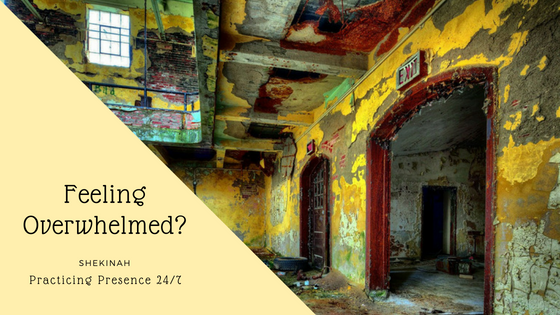





 Divine Presence: Letting the Infinite flow in my life