5 Ways to Reflect the Spirit of Jesus’ Birth in your Life

When we look at the life and death of Jesus there are many lessons that stand out. But today, I invite you to reflect on these 5 ways that you can practice the presence of Spirit in your life, based on Jesus’ birth.

Revised common lectonary, luke, hebrews, jesus' birth, Christmas, spirit, divine presence, presence of spirit

Today’s reading from Luke demonstrates to us the joy and rejoicing of Mary and Elizabeth, as well as John the Baptist’s reaction to first meeting Jesus while in the womb.

We’re told that Elizabeth was filled with the Holy Spirit immediately.

These are the first two ways that we reflect the spirit of Christmas and Jesus’ birth in our lives:

  • Rejoicing
  • Filled with the Spirit

Rejoicing in the Christmas Spirit

If only it were as easy as I make it sound. Rejoice!

Many try to imitate this Christmas spirit with dopamine and serotonin substitutes:

  • Shopping sprees
  • Parties
  • Giving gifts
  • Novelty: Loads of new toys and things to do

All of these mimic that feeling of rejoicing, but once Christmas is over and we enter the New Year, we slump. They were just substitutes for true joy.

True joy, on the other hand, is from the inside out. Mary responds to Elizabeth’s greeting with these words: (1:47)

my spirit rejoices in God my Savior

This is a spiritual joy, not a dopamine rush. It’s not dependent on circumstances or the latest buzz.

Before this, however, we read that Mary proclaims:

My soul magnifies the Lord.

In order to reach this level of spiritual joy, Mary focused on praise and worship. What is your focus and praise?

Where attention goes, energy flows.

Where is your focus? Does this create spiritual joy for you? 

Filled with the Spirit

Secondly, as I mentioned, Elizabeth was filled with the Spirit. She had a moment of enlightenment as she spoke to Mary and blessed her. 

But the fruit of the Spirit is love, joy, peace, patience, kindness, goodness, faithfulness, gentleness, self-control… (Galatians 5: 22-23)

Is your spiritual focus on being filled with the Spirit and growing these fruit as a natural outcome of your spiritual practice?

When you squeeze a lemon, you get lemon juice. If you are squeezed and pressured in life, what naturally flows out of you?  Is it love, joy, peace and patience?

It’s when you are under pressure that you naturally see what fruit you have.

And the spirit of Christmas calls us to be filled with the Spirit.

The purpose of Christ’s coming

The final three ways that we can reflect the spirit of Jesus’ birth in our lives are all related to the purpose of Christ’s coming to this world. 

Hebrews 10 mentions that sacrifices and burnt offerings are not what the Creator desires to see from us. Jesus also said that he had not come to  do away with the law or change it, but to fulfill it.

And yet, our sacrifices and burnt offerings are not what is desired. So, what does the Creator desire from us?

Love the Lord thy God…

Love the Lord your God with all your heart, with all your soul, and with all your mind, and with all your strength.

Mark 12: 30

So, what is your heart set on? What rules your emotions and feelings? Neuroscience tells us that our heart governs our desires. It’s not a rational thought governed from the mind – but rather something that is felt and hoped for. 

But our mind and thoughts are also covered by this rule to Love God. It’s not just with your heart, but also with your mind. Are your thoughts governed by your love for God? What do you spend all your time thinking and worrying about?

As I said above, where attention goes, energy flows. Is your attention placed on your love of God?

Once again, we are called to love God with all our soul – it’s a spiritual love of God, not just thoughts and feelings.

Finally, there’s a physical love of God: what we actually do. Do your actions reflect your love of God?

This takes us naturally into the second part of Jesus’ teaching:

Love your neighbour…

The second is this: ‘You shall love your neighbor as yourself.’ There is no other commandment greater than these.

Mark 12: 31

The first commandment is to love God, and the second ones tells us to love others as much as we love ourselves.

The spirit of Christmas often shows up in churches and communities as giving to those less fortunate than us. Especially in colder climates, where the homeless battle extreme cold, Christmas is a time for sharing basic necessities and life-saving goods. 

But as you reflect on this season, how will you express your love for others and those around you?

As Jesus taught us, your neighbour can be anyone, including marginalised social groups or immigrants.

Thy will be done…

Perhaps the biggest challenge of the season is to accept that the real message in Christ coming to earth is these four words:

Thy will be done…

We read this in the text from Hebrews, where the author tells us

I have come to do your will…

It’s not about offerings and sacrifices, but understanding the Creator’s will in your life. Not looking at how this is expressed for the person sitting beside you, but rather accepting that your life has a plan and a purpose.

Exclusively yours.

How will you fulfill this purpose?

Are you willing to look at what this purpose for your life is and then put all of your heart and soul into living with purpose?

Is your daily prayer: “Thy will be done”?

It’s easy to get caught up in plans and executing good ideas. But are those good idea a reflection of the Creator’s will for your life? Are you in alignment with your purpose?

When you tune into your heart’s desire, what do you heart? Is your heart’s desire to live your best life for yourself? Or are you willing to focus your energy on letting your heart’s desire be what God has for you?

When you take action, who guides and leads those actions?  What is the driving motivation behind you?

Reflecting the purpose of Christmas in your life

So, in these coming days, I invite each and every one of us to delve into:

Rejoicing in a life filled with the Spirit, where your heart, mind, soul and strength are focused on loving God and your neighbour as yourself. In this way, saying “Thy will be done” starts to come naturally for each of us. 

Sermon: Rejoicing in Sufferings

READINGS:

  • Romans 5: 1-8
  • Matthew 9:35 – 10:8
  • Psalm 100

REJOICING IN SUFFERINGS

I invite you to think for a moment about that Olympian champion, the one that sat on the sofa every day watching TV, checking their internet, and reading books.  The one that slept in every morning, had a full cooked breakfast, eating anything they wanted, when they wanted, partying with their friends any time they liked, and taking it easy. On the day of the meet, the simply went out and effortlessly won gold because they were just the best.

What do you mean you never heard of that guy?  Apparently it’s not that easy to be an Olympian Gold Medalist! There may be suffering involved on the road to glory: it takes work, effort, consistency, perseverance, and faith to become perfect and complete, lacking nothing! Rapid success stories happen, true. But the reality is that most “overnight successes” come at the end of years of hard work and those witnessing the “success” part too readily assume the “overnight part.”

Joy comes in spite of our pain! To have joy in spite of difficulties and struggles  is not to deny pain; it is to recognize that they can co-exist. The same way a pregnant mother can go through the agony of childbirth and still have joy in thinking about what is to come. She knows that there is a beautiful light and life at the end of these painful hours.

This morning, Paul says that we are to “Rejoice” in Suffering!  And the reason that Paul gives for this is that suffering produces “endurance”: in other words

  • intestinal fortitude
  • grit
  • perseverance
  • stamina
  • tenacity
  • gutsiness
  • resilience

Paul  goes on to say that this endurance will produce character, and character produces hope, and out of hope comes an outpouring of love into our hearts.

James 1, verses 2 to 4 say something similar:

My brethren, count it all joy when you fall into various trials, knowing that the testing of your faith produces patience. But let patience have its perfect work, that you may be perfect and complete, lacking nothing.

I want to talk  this morning about cultivating resilience, which enables us to remain positive and focused. Resilience is a quality that allows some people to be knocked down by life and come back stronger than ever – they rise from the ashes, rather than letting failure overcome them and drain their resolve: a basic ingredient for happiness. So, Paul tells us to “rejoice in our sufferings” – note: he doesn’t say you will only suffer once.  There will be sufferings – did you hear the S? And yet, we are to rejoice, because this is how we learn and grow!

Paul says suffering will lead to endurance, and this will, in turn, lead to having character (that is, who you really are, when all the layers are peeled away – when no one else is looking!).  Said another way:  suffering produces steadiness, steadiness produces reliability, and reliability produces hope.  If we prove ourselves to be reliable, even in the face of hardship – there is hope!

How many of you here today have survived every day of your life so far in spite of the ups and downs?

Amazing! You have survived everything that life has thrown at you so far!  Every one here today is a survivor.  But here’s the challenge: it is not enough just to be here – you should be better for it!  Better equipped, greater patience, more understanding, a higher level of emotional intelligence, empathy for your fellow man or woman.  How do you make this happen, faster and easier on yourself and those around you?

For starters, I would say that the first step is acknowledgement: recognizing that you are in a situation that is outside of your comfort zone and that makes you feel that you are under threat.  The reason I say this is that when you are in denial, “this isn’t happening to me”, it’s impossible to actually act!  You can’t make any decisions about something that isn’t happening to you!   So, step one is admitting that you have a situation.

But I invite you to be careful in your choice of words: transform “hardship” into “challenge”, giving yourself the possibility of seeing opportunity and to make this a productive situation. What do you want life to look like on the other side of this adversity? Remember: your success rate so far is 100%: how will you come out of this one?

Step two, is getting a handle on your emotions.  The signs of a resilient person is that when they are in a difficult situation, they keep calm, evaluate things rationally, and come up with a plan, and so they can act.  The biggest emotion we have to face is fear – fight or flight or lizard brain (paralyzed by fear, shutting down).  Imagine how many times the word “fear” is dealt with in the Bible!  John 14: 27 says

Peace I leave with you; my peace I give you.  … Do not let your hearts be troubled and do not be afraid.

Or Joshua 1:9

Have I not commanded you? Be strong and courageous.  Do not be afraid; do not be discouraged…

Or even Psalm 23: 4

Yea, though I walk through the valley of the shadow of death, I will fear no evil

Our human response is we try to hide our fear – we mask it:

  • with anger (anger feels much more powerful than fear!);
  • with frustration (“I don’t know what to do” sounds better than “I know what to do, but I’m too scared to do it”);
  • with stoicism (I’m bearing this – rather than getting off my butt and doing something about it, because I would hate to make a decision and be wrong).

When you identify your fear or fears, you can then identify the possibilities that lie on the other side: opportunities. Managing  emotions requires that we grow deeply in emotional intelligence – so much to learn from difficult circumstances!

The third step in resilience is a little crazy: you need to be delusional! And by that I mean: you need to set the bar to recovery WAY HIGH! Crazy successful people and people who survive tough situations are all overconfident. And by overconfident I mean… a delusional sense of self-worth.  But wait!! – wasn’t step one and step two about acknowledging where you are and what you are feeling?  Yes. But now I am asking you to go all out in believing:

I can do all things through Christ who strengthens me…

Yes, you need to clearly understand and acknowledge the situation, but be overconfident about YOUR ability to get yourself through and out of the situation successfully.  Remind yourself of your strengths and accomplishments. Remember: so far your success rate at making it through difficult days and situations is 100%.What does successful look like this time?

Step 4 in the process is something continual: Preparation.  Whether you are in a difficult situation or not, you should always be in preparation.  Luke 12:35 reminds us:

Be dressed in readiness, and keep your lamps lit.

And likewise, 2 Timothy 4:2

… be prepared, in season and out of season…

It’s impossible to prepare for the unknown, but we can constantly improve ourselves, practicing good habits and overcoming our bad habits.  Habits are what will come through in times of difficulty.  Think of common habits you have: breathing, walking, putting on your seat belt…

When I was 22, I spent 7 hours preparing and training for the most important 10 seconds of that day.  I arrived at 8 a.m., with a group of about 20 other people, and we trained, over and over and over again, lying on the floor, standing up, hanging from harnesses in the air… and when they felt that we were actually ready, they put us all in an airplane, with parachutes on our backs.  And when we reached an altitude of over 3,000 feet, one by one, we jumped out of the plane.

I have complete amnesia about those first five seconds of the jump – no sense of falling, no sense of the wind rushing past my face, nothing!  All I remember is my security check: arms in position, knees bent, one thousand, two thousand, three thousand, four thousand, five thousand, Check (over my right shoulder), check (over my left shoulder).  Parachute properly deployed!  We were static line jumping, in our first solo jumps from the plane.  I do remember the last 5 vital seconds of the experience – the landing.  There are really only 10 seconds in a jump that are the most important:  the first 5 and the last 5:  making sure your chute is open (otherwise releasing that chute and deploying the reserve – if that happens, go back to step one!), and landing on the ground.  You don’t want to collapse your chute 3 stories up in the air, otherwise you could break both femur’s as you plummet down straight onto your legs! But we spent 7 hours preparing for those 10 seconds – and hardly any time at all on how to actually control your parachute, turns and having fun.  Just pay attention to your headset and what the instructor is saying and you’ll be fine.

What does your preparation for the hard times in life look like? Does it bring you hope?  I had hope as I jumped out of the plane – not one, but two parachutes on my back, and knowing that I knew exactly what to do if there was a problem with the first one.  I was as ready as I could be.  There is an amazing adrenaline rush on the other side of fear!

Step five, is kind of obvious: hard work! Whatever the situation is that is bringing you suffering, there are things you will need to do! Whether it is the loss of a loved one, loss of a job, a drop in income, or the ending of a relationship, there is work to be done. After acknowledging the situation, and facing your fear or pain or loss, and getting delusional about your ability to survive this, relying on all the preparation that you have brought to this moment in your life: you have to actually stand up and do what needs to be done!

Proverbs 14:23 reminds us:

All hard work brings profit, but mere talk leads only to poverty.

It’s not enough to talk about what needs to be done and what you are going to do. You actually have to do it! I understand the desire just to stay in bed and pull the covers up over your head and give in to mind-numbing sleep!  I am sure that we have all been there – plagued by the depression.  Step one:  get up!   Take the first step!

Survivors take great joy from even their smallest successes. That is an important step in creating an ongoing feeling of motivation and preventing the descent into hopelessness.”

It is those small victories that carry you forward – one more step, one more challenge, one more day.

And finallyhelp: there’s a time to receive help and there’s a time to help others. Having caring, supportive people around you acts as a protective factor during times of crisis. It is important to have people you can confide in. And sometimes, in our most challenging moments, what our souls and spirits need is to reach out and help others. It is when we find a sense of purpose in our lives that we transform the most. For example:

After her 13-year-old daughter was killed by a drunk driver, Candace Lightner founded Mother’s Against Drunk Driving (MADD). Upset by the driver’s light sentence, Lightner decided to focus her energy into creating awareness of the dangers of drunk driving.

I’m thankful for her impact – she reached me, as a teenager, teaching me two important lessons: never drive drunk and never, ever get in the car with a drunk driver.  So, I was usually the designated driver.  Candace Lightner will never know me, or the thousands of teenagers whose lives she saved: but she made a difference! Are you making a difference?

This is where we find hope and an outpouring of love in our hearts!

choose life, thy will be done, have it your way, doubting God, painful trial, you are suffering, rejoice, overjoyed, god, goddess, dazzling, radiant, immortal creature, energy, joy, wisdom, love, boundless power, mere human beings, God has been making it grow, earthly life, all religions are true, a better Christian, child of God, relationship with God, personal transformation, eternal life, gift of forgiveness, omnipotent, onmiscient, ever-present God, no other gods, loving God, walking in His ways

Choose life

C.S. Lewis said:

“There are two kinds of people: those who say to God, “Thy will be done,” and those to whom God says, “All right, then, have it your way”. ”

For those of us who have a hard time saying “Thy will be done” C.S. Lewis identifies:

We may be thinking about those verses in 1 Peter chapters 4 & 5 that say:  “Beloved, do not be surprised at the painful trial you are suffering… but rejoice that you participate in the sufferings… so that you may be overjoyed when His glory is revealed.”  “… those who suffer according to God’s will should commit themselves to their faithful Creator and continue to do good.”   “and the God of all grace, who called you to His eternal glory in Chris, after you have suffered a little while, will Himself make you perfect, strong, firm and steadfast.”

C.S. Lewis goes on to say:

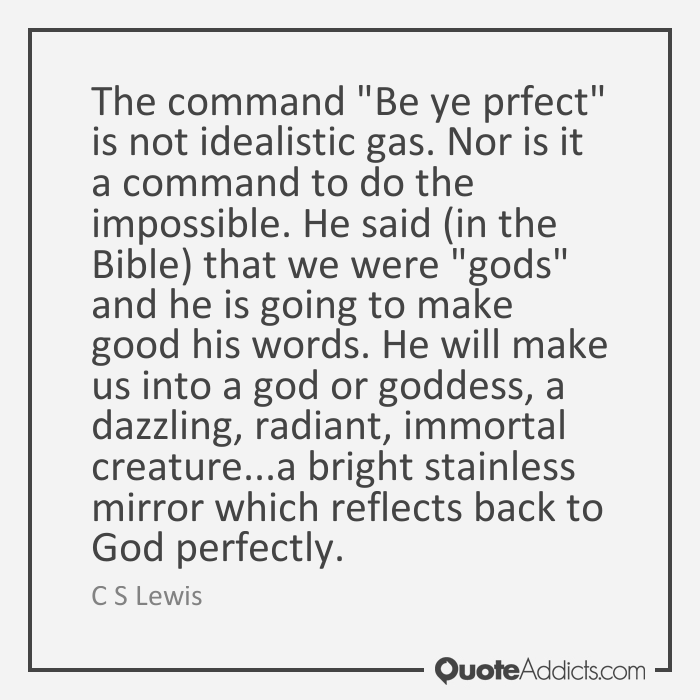
“If we let Him–…we can prevent Him, if we choose–He will make the feeblest and filthiest of us into a god or goddess, a dazzling, radiant, immortal creature, pulsating all through with such energy and joy and wisdom and love as we cannot now imagine, a bright stainless mirror which reflects back to God perfectly (though, of course, on a smaller scale) His own boundless power and delight and goodness. The process will be long and in parts very painful; but that is what we are in for. Nothing less.”
cslewisOur 4 lectionary readings have a common theme: they demonstrate to us how simple and yet profound the choice presented in the Bible is.

1st Corinthians 3, verses 3 to 7:

You are still worldly.  For since there is jealousy and quarrelling among you, are you not worldly?  Are you not acting like mere humans? For when one says “I follow Paul” and another “I follow Apollos” are you not mere human beings?  What, after all, is Apollos? And what is Paul? … I planted the seed, Apollos watered it, but God has been making it grow.  So neither the one who plants nor the one who waters is anything, but only God, who makes things grow.

We are not to get caught up this earthly life, or on whose teachings we follow, who is right or wrong.

Gandhi said:

“all religions are true … So we can only pray, if we are Hindus, not that a Christian should become a Hindu … But our innermost prayer should be (that) a Hindu should be a better Hindu, a Muslim a better Muslim, a Christian a better Christian.”

Spiritual maturity is being able to admit “God makes me grow” – not what I do. I am not “trying” to become a “child of God”: I already am a child of God. We have all been redeemed and bought with a price.  Our objective is not to win salvation; our objective is to become more Christ-like.  As my relationship with God evolves, I realise that salvation, sanctification and justification is about personal transformation.  I am not looking forward to eternal life when I die: eternal life began the day that I accepted God’s free gift of forgiveness.

But, am I allowing God to work in me or holding Him back?  Do I love myself and God enough to become a dazzling, radiant, immortal creature, pulsating all through with such energy and joy and wisdom and love as I cannot now imagine? Or am I caught up in this world?

In my adventure of getting to know the omnipotent, omniscient, ever-present God, Deuteronomy 30: verses 15 to 20 sheds light on my relationship with God.  Deuteronomy means “the second giving of the law.” In this Book, Moses repeats the law of God for those who will cross the Jordan into the Promised Land.

If you recall, before going up Mount Sinai to receive the 10 Commandments, Moses challenged the Children of Israel with the basic rules. Exodus 23:25 “Worship the Lord your God and His blessing will be on your food and water.  I will take away sickness from among you, and none will miscarry or be barren in your land.  I will give a full life span.”  And so, in Exodus 24: 3: “they responded with one voice, “Everything the Lord has said, we will do.

A couple of days later, while Moses is up on Mount Sinai getting the 10 Commandments, these same people ask Aaron to make them the golden calf.  Who here can honestly say they’ve never done this? “Everything the Lord has said, we will do” except for the “no other gods”, or whatever your favourite exception is.  We promise God one thing, and days later have completely failed.

So, here we have Moses, in Deuteronomy 30, repeating the law of God to the new generation; he offers them a choice:

See, I set before you today life and prosperity, death and destruction.  For I command you today to love the Lord your God, to walk in His ways and to keep His commands, decrees and laws… This day I call heaven and earth as witnesses against you that I have set before you life and death, blessings and curses.  Now choose life, that you and your children may live, and that you may love the Lord your God, listen to his voice, and hold fast to Him.  For the Lord is your life…

This passage is about my relationship with God, not about material prosperity. No magic formula for worldly success.  Nor was this was some “altar call”.  This was a call to surrender, each new morning, to Him.  “Choose life” refers to loving God, hearing Him, walking in His ways, keeping His torah, holding fast to Him and not going astray (each morning, each moment of each day).  It’s a radical difference – a life-style choice.

Psalms 119, verses 1 to 8 remind us.

1-     Blessed are they whose ways are blameless, who walk according to the law of the Lord.

2-    Blessed are they who keep His statutes and seek Him with all their heart.

3-    They do nothing wrong; they walk in His ways.

4-   You have laid down precepts that are to be fully obeyed.

5-    Oh, that my ways were steadfast in obeying your decrees!

6-    Then I would not be put to shame when I consider all your commands.

7-    I will praise you with an upright heart as I learn your righteous laws.

8-    I will obey your decrees; do not utterly forsake me.

Even David, a man after God’s own heart, admits that he is NOT perfect in obeying God’s decrees.  He feels put to shame when he considers God’s commands.  “I’d love to say I am obeying fully, but I’m messing up”.  If we are truly honest with ourselves, obeying God’s Word is challenging.  It’s a very high standard!  The Bible is the mirror in which we see our own inadequacies.

David admits he’s still learning God’s law, and finishes with “I will obey your decrees; do not utterly forsake me.”  Don’t give up on me God; I’m going to keep on trying.  We know David had some serious slip-ups in keeping God’s commandments.

He coveted his neighbour’s wife.

He committed murder.

So, how is it that he’s the man after God’s own heart? Well, firstly, although he obviously went through a period of rebellion (more than just a couple of months… maybe more than a year). He was far, far from God.  Yet, when Nathan confronts him, he repents.  There is true remorse, grief and shame.  There is a certain tenderness that comes with this repentance.  Surrender.

We see it again in Peter, who rejecting Christ 3 times, realises his rejection and rebellion, and goes out weeping bitterly.  Somehow, having reached the bottom, Peter was able to put aside his pride, accept Jesus’ forgiveness: was able to bow down and surrender.

Sai Baba said:

“Give up all bad qualities in you, banish the ego and develop the spirit of surrender.”

As a child of God, in our walk to become more Christ-like, we have to understand the importance of the spirit of surrender to God:  “Choosing life.”

Jesus makes it clear, in the sermon on the mount, that it’s not about legalistic fulfilment of the law.

It’s not enough just to know the law.  Last week we read: “let your righteousness surpass that of the Pharisees”.  Pharisees followed the letter of the law; even added a few for good measure. What have we humans done with God’s law?

Let’s see:

The Law of Moses established that we should fulfil our oaths:  Human interpretation says: “if I don’t make an oath, I don’t exactly have to tell the truth”.

Likewise, with respect to divorce:  what was “objectionable” enough about a woman to warrant divorce?  There were different views between various rabbinic schools:

One said:  A man may not divorce his wife unless he has found unchastity in her, for it is written, Because he hath found in her indecency in anything.

Another said: [He may divorce her] even if she spoiled a dish for him, for it is written: Because he hath found in her indecency in anything.

And yet another: Even if he found another fairer than she, for it is written (and this translation is a little more liberal than “because he had found in her indecency in anything), And it shall be if she find no favour in his eyes.”

And so Jesus explains that the true meaning of the law is to honour God, not just with your actions, but also with your thoughts, your motives and your attitudes.  What does it mean to “Choose Life”? Even Gandhi taught:

Before the throne of the Almighty, man will be judged not by his acts, but by his intentions.  For God alone reads our hearts.

These rules from the Sermon on the Mount are deeper and more personal than the laws of any country.  It delves deep into the innermost part of man, where only God sees.

We may think that our “thought life” is our own, hidden from others.  We indulge in “my thoughts” –save a little space, some room, for us to live in our little indulgences.  This hypocrisy of a secret thought life! – One way on the inside and another on the outside – This deep corruption and confusion is not “choosing life”.

We see another example of this when Jesus rebukes us for holding onto our anger, rather than choosing the higher way.   What do I choose to do with my anger?  Do I deal with it?  Buddhist teachings warn:

“Holding on to anger is like grasping a hot coal with the intent of throwing it at someone else; while holding it, you’re getting burned.”

Jesus says there is no real point in priding myself on the fact that I have never actually killed someone. Why? Well, because unresolved anger leads us to sin: saying “Raca” (empty head) or “you fool” (moron) – My angry, thoughtless words KILL my relationships, chipping away at the trust and love.

Jesus values our earthly relationships – important enough that he says we should leave worshipping God and go and make things right with our neighbour or brother.  We are to actively seek reconciliation.

True happiness and fulfilment comes from putting our relationship with God right and then our relationships with all of those around us.

Sai Baba says:  “Once we surrender our mind to GOD completely, HE will take care of us in every way.”

How do I really put into practice, in all aspects of my life, the grace that I have received, living a life of righteousness and holiness before God?  How do I “do justice, love mercy, walk humbly with God”?  I “know” (head knowledge) it means to desire Him above all else: He demands first place in my life.  No half-hearted or part-time love: “just Sunday mornings.”

Much like Christ says in the gospels to the young rich ruler:  No one is good except one–God. You know the commandments: ‘Do not murder,’ ‘Do not commit adultery,’ ‘Do not steal,’ ‘Do not give false testimony,’ ‘Do not defraud,’ ‘Honor your father and mother.’”  The young ruler said to him, “Teacher, I have observed all these things from my youth.”
Jesus looking at him loved him, and said to him, “One thing you lack. Go, sell whatever you have, and give to the poor, and you will have treasure in heaven; and come, follow me, taking up the cross.”

This isn’t the first time we’ve seen “choices” in the Bible.  Genesis: starts with the exercise of free will.  We can choose to eat the forbidden fruit or not – our eyes will be opened: but… will we like what we see?

Augustine said:

“When people choose to withdraw far from a fire, the fire continues to give warmth, but they grow cold.  When people choose to withdraw far from light, the light continues to be bright in itself but they are in darkness.  This is also the case when people withdraw from God.”

God doesn’t want me to pick and choose when I will love him, or under what conditions.  I am to Love God with all my heart and with all my soul and with all my strength.

I’m happy to be a Mary sitting at Jesus’ feet lapping up all the teachings.  I enthralled by His teachings.  But that’s not enough: how do I let go of earthly things, daily struggles, and become a dazzling, radiant, immortal creature, pulsating all through with such energy and joy and wisdom and love as I cannot now imagine?

If I loved God, really, truly, loved HIM, I wouldn’t have any problem keeping His commandments; I would have complete faith in Him and His Word, put absolute trust in Him.  I’d allow Him to guide me, not snatch the reigns back when things get tough.  I would surrender all and trust Him, be filled with His light, and let it shine through me into the lives of others around me.

We know (head knowledge) that “things” cannot give us life – they don’t satisfy the inner longing of our soul.  No harm in trying, right? And so, like the rich young ruler, we distance ourselves from God, putting our trust in our “security”.

True righteousness is more than just legal or external obedience.  It’s not about seeing how much I can “get away with” and still be considered “righteous”.  Wrong-doing arises because of the mind.  But if my mind is transformed, wrong-doing has no place to live.  God’s righteousness is concerned with His “shalom” – well-being, peace and harmony.  This is His righteousness: a peaceful, life-giving relationship with God.  I want, this day, to choose life.

And so, as C.S. Lewis said:

“He will make the feeblest and filthiest of us into a god or goddess, a dazzling, radiant, immortal creature, pulsating all through with such energy and joy and wisdom and love as we cannot now imagine, a bright stainless mirror which reflects back to God perfectly … His own boundless power and delight and goodness. The process will be long and in parts very painful; but that is what we are in for. Nothing less.”

And so, I repeat:

So, as you walk out of here today, which of the 2 types of people do you choose to be?

Those that say to God: “I choose to surrender and banish my ego. I trust you to do the best for me and to give me the strength I need for whatever You have in store, however painful the growth process may be. I want to become more Christ-like. Thy will be done.

Or those to whom our Father in heaven, with great sadness in His heart says, like as to the rich young ruler, “All right then, have it your way”.

Remember: When we lose God, it’s not God who gets lost.