
Radiance of faith: how to let your love shine bright

Today we remember and celebrate the birth of Jesus, and how his lessons of love shine bright through the ages. All over the world, different peoples and cultures join together to remember the birth of this bright light in the midst of darkness. 
revised common lectionary, luke, isaiah, psalm, titus, bright light, radiance of faith, love, christmas message, birth of jesus

Our story starts out with homeless travellers, forced by colonisers and imperialists to return to a town that was no longer home. For them, this meant a winter’s nights spent in a stable.

No central heating (possibly no heating at all). No electricity or running water. Instead, they put up with straw beds, the smell of dung and moisture, and possibly leaks in the roof and a cold wind chill.

It was only slightly better than staying outdoors. 

We’re told that Mary gave birth in these conditions. Forget

  • the midwife, doctor or antibiotics
  • warm water and clean towels
  • another pair of hands to help Joseph clean up the baby after it was born
  • close family and friends to help out and bring a caserole. 

Instead, it is a very humble birth, as you might find in an indigenous village of the third world, yet devoid the community support. 

This is the birth that we celebrate at Christmas. 

A birth of humility, yet full of a mother’s love and the faith of strangers. 

A birth that changed the world, how we see God, and even how we interact with God. 

From these humble beginnings, we find ourselves two thousand years later here in this Church remembering the meaning of Christmas.

The Radiance of Faith

In Luke we read that following the birth of Jesus, an angel appeared to shepherds, watching their sheep in the fields around Bethlehem.

Perhaps you would be more acquainted with cowboys than shepherds, unless you live in the outback of Australia, the highlands of Scotland or various parts of the Middle East.

But most of us know that these shepherds were likely in worse conditions than Mary and Joseph who were in the stable. They were likely under the stars, without a roof or tent over their heads. Exposed to the elements in the middle of winter.

And it’s to these people that the angel appears with the good news of the birth of the Messiah.

The angel didn’t appear to the priests and pharisees.  He didn’t go to the palace and announce the birth to the king or to Pontius Pilate as the representative of Rome in Judea.

Instead, the good news was shared with lowly shepherds.

In what was undoubtedly a terrifying way. Great light and fanfare on a quiet night in the mountains.

Scared much? 

And yet, what was the response of the shepherds after overcoming their fear?

Rejoicing!

More importantly: they responded with action.

They left their flocks and went straight to visit Mary, Joseph and Jesus. Without waiting. 

This is their example to us of the radiance of faith.

Hearing. Believing. Taking action based on that faith and belief.

So, for each of us today, let’s take a moment to reflect on our faith in action.

How do we live a life of faith?

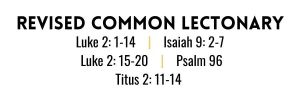
Titus tells us

For the grace of God has appeared, bringing salvation to all, training us to renounce impiety and worldly passions and in the present age to live lives that are self-controlled, upright, and godly,

Titus 2: 11-12

The grace of God appears

It all starts with Divine grace. Not because we deserve it or have worked for it. Simple a Divine gift from above.

We are merely asked to accept it.

Because we have accepted this Divine Love, we can begin to change our habits and way of being.

Training us

Titus then goes on to say that this grace of God, this salvation, trains us. The grace is instantaneous.

But our transformation is something that we work on.

We are trained in this, day by day.

What we renounce or quit

We start by choosing to renounce those habits and ways of living that leave us in the darkness. Titus calls these worldly passions. 

Walking in the light of love is a choice. A choice we make daily.

And the principal part of that choice is to quit those practices, attitudes and ways of living that keep us chained.

This is different for each person. Perhaps it’s gluttony or being lazy. For others, it is a shopping addiction or smoking. And yet, for another, it might be bitterness and hate.

We start by choosing to let go, renounce and quit.

The new habits we adopt

Then, we open our time, energy and focus up to the opportunity to adopt new habits and ways of being.

Titus says that in the present age – at this moment – we choose to live lives of self-control. Creating a new habit requires discipline, attention and focus.

It’s more than just making a New Year’s resolution to do things differently. For many of us, it’s noticing our hidden triggers and what stimulates the old habits.

For example: gluttony is often about avoidance of emotions. But we get stuck on thinking that gluttony is about the food. There is nothing wrong with the food. What we need to look at is our relationship with food. When we use food to cover up and avoid, we end up eating more than we need because we don’t want to feel emotionally uncomfortable. It’s easier to feel physically uncomfortable.

So, when we start to notice our triggers and what stimulates the old, then we can adopt the new.

Coming back to our example of gluttony: if I am avoiding my emotions, when I accept God’s love and grace in my life, then I can start to love myself. At this moment, I interrupt the old habit of over-eating and instead sit with the emotions and feelings that had me uncomfortable.

With this love and grace that shone down from me from above, I practice loving and accepting myself, rather than avoiding my feelings by eating them. 

Let your love shine bright

Once I have mastered this, even in one area of my life, it’s possible to let that love shine bright in many other areas of my life.

Other habits are easier to break and new habits become easier to make.

As I change – emotionally, mentally, physically and spiritually – others can see the change in me.

But it all starts because of a message I received of Divine Love – acceptance of Divine Grace – that allows me to then go out, like the shepherds at Christmas, and share with others about this miracle of transformation.

How will you choose, this Christmas, to let your love shine bright in your neighbourhood and community? 
love and forgiveness, how to stop suffering, how forgiveness can ease the pain, learning to let go, Ho'oponopono, release, allowing, detachment, attachment, emotions, identity, learning to love, loving myself, loving others

Love and forgiveness: how to stop suffering

The only way out of the labyrinth of suffering is to forgive.

John Greene

As a child, growing up in a Christian environment, I was told to forgive and forget, the same way that God forgave and put our sins on the other side of the ocean. I was told to turn the other cheek and to pray for those who might persecute or mock me.

Be a proud martyr.

Unfortunately, the way I was taught forgiveness did not do me very many favours! It built and perpetrated many misconceptions of what forgiveness was, without in any way stopping the suffering! In fact, we were taught suffering was necessary. It was good.

It was proof of our faith – that your joy may be complete.

Yeah, right.

Some joy.

How I wish Christians would do a better job of teaching forgiveness and everything that it means!

What verses were used?

The following are two of the most common verses I heard as a child regarding forgiveness:

For if you forgive other people when they sin against you, your heavenly Father will also forgive you.

Matthew 6:14 (NIV)

If you don’t forgive, you won’t be forgiven. So, now, I made him tell you he’s sorry and you have to say “I forgive you”. Of course, if we didn’t say “I’m sorry” we would have received a paddling. And if we didn’t say “I forgive you” we would equally have received a paddling.

I know they did it with the best of intentions. But this is no way to teach forgiveness! We went through the motions to avoid the physical consequences. I was no more forgiving than the other child was sorry.

Make allowance for each other’s faults, and forgive anyone who offends you. Remember, the Lord forgave you, so you must forgive others.

Colossians 3:13

Misconceptions of forgiveness & love

The way that I was taught forgiveness created several erroneous beliefs around the effect of forgiveness. These were reinforced through social norms and adult behaviours.

I know, they had good intentions. But good intentions pave the road to… well, suffering.

For example, as a kid, we were forced to reconcile with another kid – at least on the outside, going through the motions. I can tell you this strips all your power away. You are instructed to kiss and make up, by adults with authority to make you do so. And then you are forced to have a relationship with this person that hurt you, with disregard for how you might have felt about it.

But this doesn’t teach you how to handle and deal with the emotions that go with forgiveness. As you get older, you try to reason away the pain. I can’t count the times I told myself “I shouldn’t feel this way.” You still feel the anger, sadness and hurt, but now you stuff it down, rather than releasing it because it’s not supposed to be there!

So often I felt worse and hypocritical because forgiveness didn’t work.

Myth: Forgive, and everything goes back to how it was

My experience, even now with having learnt how to forgive, is that things never go back to how they were. When trust is broken, it has to be rebuilt. It doesn’t magically reappear.

Forgiveness does not rebuild trust or magically rebuild relationships. The best apology is changed behaviour.

Myth: Forgiveness means there are no consequences

Another way that we were dis-empowered as children were that when we forgave, we were expected to relinquish any hope of seeing justice. Forgiveness meant that the other got off “scot-free“, excusing whatever actions they had done.

So, for example, in the cases of child abuse, we were expected to forgive an abuser and then not request that any further action be taken. Otherwise, we hadn’t truly forgiven.

Myth: Forgiveness means you can’t have boundaries

One of my hardest life lessons as an adult has been developing healthy boundaries in relationships. I never learnt how to say “this treatment is unacceptable”. If someone mistreated us, we were expected to forgive them.

And then turn the other cheek.

How many battered women are told to forgive their husbands, and go back into a situation of domestic violence, only to have the cycle repeated?

Obviously, we weren’t praying hard enough. (Sorry – not sorry, every once in a while my sarcasm slips in).

Learning forgiveness through Ho’oponopono

As unusual as it might seem, I finally learnt forgiveness through the Huna practice of Ho’oponopono. Many people know this as a simple meditative practice of mantras:

I love you.
I’m sorry.
Please forgive me.
Thank you.

Ho’oponopono prayer mantra

For months, this was all I did: repeating this mantra over and over. With time, however, I changed. I began to understand it differently.

The Huna practice says that whatever comes into your awareness you are responsible for. You are 100% accountable for everything that happens in the world around – as you are part of the problem.

100% responsible

So, you hear on the news that someone was murdered last night – that’s on you. You read in the newspaper that a drunk driver hit a car and killed a family, that’s your responsibility too. Your grandfather beat a man within an inch of his life before you were born: that was you as well.

Everything is connected to everything. That flap of a butterflies wings in Africa that starts the hurricane that hits the Caribbean and then the East Coast of Georgia. It is all connected.

We are all connected.

The anger I feel in my heart and life is merely a connection to the anger that any other person in the world is feeling. The hatred and discrimination that I feel towards any set of people on earth feed hatred in the world. The carelessness that I show when driving feeds the negligence of that young driver that ploughs into the back of another car.

  • If I want less anger in the world: I have to stop contributing to the energy of anger.
  • If I want less bigotry and hatred towards me and “my people”, I must release and relinquish all prejudice and disgust I feel towards any others, so that there is less of it in the world!
  • If I want less carelessness on the streets, I must become present and aware at all times.
  • If I want more understanding in the world and compassion, I must be understanding and compassionate.

In any situation where there is anger, violence or hurt, there is a role that I have played. And I am 100% responsible for my part in perpetuating the violence – whether it is mental, physical, emotional or spiritual abuse!

Learning to break the cycle through forgiveness & compassion

This has not been a comfortable journey, much less one without relapses. I always find myself doing the inner work, recognising what I have overlooked.

Whatever I notice and see in the world around me is simply a call to look within and see how that is reflected in who I am and how I have expressed myself in the world.

An example of forgiveness in action:

Let’s say that a distracted driver caused an accident.

  • How do I forgive them for the hurt and pain that they have caused?
  • How do I recognise my role in participating in this?

I start simply by acknowledging that sometimes I am a distracted driver. I have looked at my phone while driving, eaten in my car, had a sip of my coffee, handed a toy that fell on the floor to my crying toddler, and many other moments of distraction. Maybe my distraction hasn’t lead to an accident, but I also am a distracted driver.

Then, I go through the emotions, thoughts and senses in my body and mind of what is happening within me when I am distracted driving. Am I frustrated? Impatient? Anxious?

Forgiveness is not just about “being distracted while driving” – it’s about allowing yourself to be present with WHY you allowed yourself to become distracted. What was really happening at the time?

This awareness allows me to really do the work of forgiveness and release! Then I forgive myself for the frustration, the impatience, the anxiety. I take the time to release those emotions from my body and bring myself back to love and compassion.

When I turn my attention to the distracted driver, it’s easy to forgive. I can feel empathy and compassion. I can experience the pain and suffering without allowing it to overwhelm me.

Because while I cannot change the world or any other person, I can change how I interact with the world. As I become aware of a situation and how I have participated in this in the world, I can practice forgiveness and release.

Forgiveness starts and ends with forgiving myself

Ho’oponopono practice has taught me that forgiveness is never actually about the other person! When I fail to forgive, my burden is pain and blame.

As I walk around carrying blame towards another, saying that I am the victim, I dis-empower myself. I continue, long after the event is finished, to give that person and the hurt that they caused me, power over my life. You might even say I give them greater importance than I have. They rule my life, my thoughts and my memories.

To forgive is to set a prisoner free and realise that prisoner was you.

Lewis B. Smedes

Forgiveness allows me to reclaim my power – to accept that I gave it away and forgive myself for having done so. Many times, forgiveness means to forgive me for having carried the burden for so long, rather than leaving on the roadside years ago.

Only as I begin to love myself do I begin to see that forgiveness is the only way to end my own suffering.

  • I don’t have to “kiss-and-make-up”.
  • There is no need to accept that others mistreat me or abuse me.
  • Living as a martyr is not standing in the power of love and compassion.
  • I will probably feel pain and anger and rage and those are all valid emotions. Acknowledging them is the first step towards letting them go, rather than stuffing them down within me and trying to “hold it all together”.
  • I can ask that justice be served and that someone receive their just deserts and the consequences of their actions.

Forgiveness is leaving the burden and suffering that I carried with me by the side of the road and continuing my life journey full of compassion. It’s a choice that I have to make each day: who do I want to give the power to?

I hope that each day I can choose to give the power to Divine Love within me.