

Faith,Love Thy Neighbour,Social justice,growth,living with purpose,living in truth,Integrity,spiritual transformation,Love Your Neighbor,fruit of the Spirit,power of prayer,spiritual worship,practicing presence,kindness,time management,self-control,spiritual discipline,emotional intelligence,

Teaching to Fish: Faith, Justice, and Growth today

A few weeks ago, in a message titled “Living with Truth,” we looked at Amos 8 and Psalm 15, seeing how God despises exploitation and steadies those who live with integrity. We saw that an upright heart is not just a moral ideal, but a firm foundation in a shifting world. Today, as we turn our gaze once more to the prophetic words of Amos, and the poetic truths of Psalm 113 and 1 Timothy 2, we are invited to go even deeper. We are called to see God’s heart for justice not merely as a set of ethical rules or a social program to be enacted, but as a profound act of spiritual worship—a natural, unavoidable overflow of a life lived in His divine presence.

From Presence to Practice: Living a Life of Justice

Consider a scene right here in Panama City: A maid earns about $450–$650 a month. Her days are defined by a quiet, relentless rhythm—hands calloused from brooms, mops and detergents, a body weary from endless tasks. Her labor is a testament to her strength, but her circumstances hold her captive.  If she spoke English, her reality could be transformed by a new opportunity: a job with foreigners, offering higher wages and new possibilities. In some cases, the opportunity to work in a business, not just a home.

On the surface, this is a beautiful story of economic mobility. But what if it’s also a story of a deeper, spiritual transformation—a journey from being overlooked to being fully seen, from feeling defeated to embodying the dignity with which God created her? This new role could be the stepping stone she needs, a way to move into an office position and grow professionally.

We are called, above all, to love our neighbor as ourselves. But sometimes, in our well-intentioned outreach, we stop at handing out fish—a meal, a bag of clothes, temporary aid. We address the immediate symptoms of poverty without looking to the root cause. What if God is calling us to a deeper form of love—not just to teach our neighbors to fish with practical skills, but to teach them to live by the Spirit? To live with the Fruit of the Spirit—love, joy, peace, patience, kindness, goodness, faithfulness, gentleness, and self-control? Practicing God’s presence in our work, in our relationships, and in our communities is how we truly empower others, for it is in our spiritual overflow that we find the capacity to reflect His heart and lift the lowly from the dust to dignity.

Let’s explore how the virtues of justice, the power of prayer, and the grace of reconciliation are not just things we do, but things that grow from a place of deep spiritual worship, transforming minimum-wage struggles into futures of hope.

Faith and Finance: Practicing Presence in the Economy

Amos 8 delivers a searing, prophetic warning to those who “trample the needy” with dishonest scales, exploiting the poor for something as trivial as a pair of sandals ($2.50 in those days, according to some commentators).

Faith,Love Thy Neighbour,Social justice,growth,living with purpose,living in truth,Integrity,spiritual transformation,Love Your Neighbor,fruit of the Spirit,power of prayer,spiritual worship,practicing presence,kindness,time management,self-control,spiritual discipline,emotional intelligence,

This wasn’t just a business crime; it was a profound spiritual betrayal. It was a failure to see God’s image in the very people they were exploiting. In their relentless pursuit of profit, they created a moral and spiritual gap—a chasm between themselves and those they were created to love. They lost the ability to practice God’s presence in their transactions, turning human beings into commodities.

Contrast this with the story of Dan Price, the CEO of Gravity Payments, who in 2015 made a startling decision. He slashed his own $1 million salary to ensure every employee, from the lowest-paid clerk to the most experienced developer, earned at least $70,000. This man is not perfect, but his business model has shown us it’s possible to build a business to foster employee well-being.

We see this emphasis not as a clever business strategy; But an act of profound spiritual integrity. It becomes an outward expression of a heart that was practicing generosity and kindness, where a side-effect is a flourishing company which far outweighs the financial cost. We can model our business on what it means to truly love your neighbor as yourself in a corporate setting. This decision isn’t just about money; it’s about dignity and mutual respect.

In a similar fashion, Fundación Microfinanzas BBVA provides training and micro-loans to women who would never be able to access traditional bank loans. Their stories of success are not just about a loan, but about a woman who used that small loan to start a sustainable business—a local market stall, a small bakery, a sewing business—and became a pillar in her community.

These stories show us that when we act with integrity and love, we create opportunities for dignity and self-sufficiency, turning a simple loan into an instrument of God’s grace. It is a powerful example of how a practical business model can be an expression of spiritual conviction.

From Dust to Dignity: Living the Fruit of the Spirit

Psalm 113 paints a glorious, almost unbelievable, picture of God. He is “enthroned on high,” yet He “stoops down to look” at the heavens and the earth (Psalm 113:4-6). This is the great paradox of God: He is infinitely high, yet He condescends to be intimately involved in our lives. The Psalm continues this breathtaking thought: God raises the poor from the dust and seats them “with princes” (Psalm 113:7-8). This isn’t just a metaphor for a better life; it is a spiritual truth. Justice is a form of worship, an act of love that mirrors God’s own heart, transforming our neighbors from being forgotten to being honored.

Faith,Love Thy Neighbour,Social justice,growth,living with purpose,living in truth,Integrity,spiritual transformation,Love Your Neighbor,fruit of the Spirit,power of prayer,spiritual worship,practicing presence,kindness,time management,self-control,spiritual discipline,emotional intelligence,

In Panama City, CAPTA, a program by Fundación Calicanto, empowers marginalized women. Their training focuses on vocational skills, but the true transformation happens on a deeper level. It is a work of building self-esteem and confidence—a rebuilding of the inner person. This is where the spiritual and the practical beautifully intersect.

From a spiritual perspective, we can see that the professional skills they teach are not merely a checklist for a job; they are an invitation to live with the Fruit of the Spirit. They are a spiritual path in themselves.

Think about it:

  • Professional communication becomes an act of kindness and gentleness, a way of building up instead of tearing down. It’s an expression of inner peace that makes our words steady and our intentions clear.
  • Time management becomes a practice of peace and self-control. It is a spiritual discipline that brings order to chaos and frees us to be present in our work.
  • Emotional intelligence becomes a manifestation of love and patience. It is an acknowledgment that our neighbor’s struggles are real and that we can meet them with empathy.
  • Dress code becomes a reflection of self-worth and inner dignity. It is a way of honoring God by honoring the temple of the Holy Spirit.

By teaching these, we are not just preparing someone for a job; we are teaching them to practice God’s presence in every part of their lives, transforming the exploited poor into Psalm 113’s princes.

Prayer in Action: Aligning Our Hearts with God’s

1 Timothy 2 urges us to pray for all people, especially those in authority, so that we may live “peaceful and quiet lives in all godliness” (1 Timothy 2:1-2). This is not a call to be passive; it is a call to be grounded. Prayer is not a passive wish; it is an active alignment of our hearts with God’s will. It is the fuel for our action.

Daniel’s life is a perfect example. He prayed faithfully three times a day in exile, facing the threat of the lion’s den, yet his prayer life was the spiritual foundation that allowed him to maintain his integrity and influence kings. His prayers weren’t just an escape from his circumstances; they were a way of maintaining his relationship with God, allowing him to be a transformative presence in a pagan nation.

In Haiti, SALT Microfinance is a powerful, modern example of prayer leading to action. They blend savings groups, vocational training, and Bible teaching in a holistic approach to empowerment. A testimonial from a woman named Elashe shows how a small loan helped her start a small store, a business that grew so much that she was eventually able to help her children move to the United States to pursue their dreams. This is what happens when prayer shapes our vision, leading to tangible, life-changing results.

Here in Panama, INADEH trains thousands in vocational skills, a tool for breaking the cycle of poverty. Let’s join our Wednesday night online prayer group to lift up the leaders of these organizations and our neighbors in Santa Ana and El Chorrillo.

For our church: Prayer is where empowerment begins, but it should never end there. It should lead us to ask the question: what is God calling us to do? Could we offer a health workshop, teaching nutrition as an act of loving our neighbor with our knowledge? Even if you are unable to teach, you can pray every Wednesday, asking God to guide our leaders and neighbors. This is how we blend faith and action, shaping peace and justice through empowered lives.

Bridging the Divide: The Journey of Reconciliation

1 Timothy 2:5 proclaims Christ as the “one mediator” between God and man. This is the heart of the Christian faith. Justice, then, is His gospel in action, the visible fruit of a reconciled life, bridging the divides of our broken world. The parable of the Good Samaritan is not just a lesson in kindness; it is a story of radical reconciliation. A Samaritan, despised by the Jewish people, crossed ethnic and class barriers to show mercy (Luke 10:25-37), binding the wounds and restoring dignity to a man who had been cast aside. His compassion was an act of grace that mirrored the mediation of Christ.

Faith,Love Thy Neighbour,Social justice,growth,living with purpose,living in truth,Integrity,spiritual transformation,Love Your Neighbor,fruit of the Spirit,power of prayer,spiritual worship,practicing presence,kindness,time management,self-control,spiritual discipline,emotional intelligence,

In Panama, the AES Panamá Foundation trains youth with technical and English language skills. Similarly, WeGrow Panama mentors young women in STEAM fields. These programs are not just about job training; they are about bridging divides and restoring relationships. They create a space where people can see beyond class and background to find a shared sense of dignity and purpose. They are a powerful image of Christ’s work of reconciliation in our city.

No matter how big or small our involvement, this is how our church can build bridges, not walls, across economic and cultural divides. These acts of reconciliation are a physical embodiment of Christ’s mediation, transforming our community with opportunity and hope.

Conclusion: From Being to Doing

Acts 4:32-35 shows the early church sharing so that “no one was in need.” Their community was a testament to justice and accountability. Like SALT’s savings groups or AES’s training, we can empower, not enable.

The true work of justice begins not with a strategy, but with a spiritual posture. It begins by practicing God’s presence in every area of our lives, allowing His love, His kindness, and His peace to flow through us and into the world around us. When we seek Him first, the actions of justice become a natural, beautiful overflow of our hearts.

This is the very essence of what the scriptures we explored today call us to: to be a people who, like the “upright” in Psalm 113, are lifted from the dust of our own spiritual poverty to reflect God’s justice. It is to live with integrity, rejecting the dishonest scales of Amos, and to be grounded in prayer, as 1 Timothy teaches, so that our lives become a visible testimony to God’s love and reconciliation.

My question for you today is not what you will do, but what you will become. How is God inviting you to practice His presence and cultivate His fruit in your life today? How will that inner transformation spill over into an act of love for your neighbor, an act of justice that reflects the very heart of God?

5 Ways to Reflect the Spirit of Jesus’ Birth in your Life

When we look at the life and death of Jesus there are many lessons that stand out. But today, I invite you to reflect on these 5 ways that you can practice the presence of Spirit in your life, based on Jesus’ birth.

Revised common lectonary, luke, hebrews, jesus' birth, Christmas, spirit, divine presence, presence of spirit

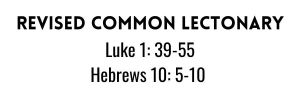
Today’s reading from Luke demonstrates to us the joy and rejoicing of Mary and Elizabeth, as well as John the Baptist’s reaction to first meeting Jesus while in the womb.

We’re told that Elizabeth was filled with the Holy Spirit immediately.

These are the first two ways that we reflect the spirit of Christmas and Jesus’ birth in our lives:

  • Rejoicing
  • Filled with the Spirit

Rejoicing in the Christmas Spirit

If only it were as easy as I make it sound. Rejoice!

Many try to imitate this Christmas spirit with dopamine and serotonin substitutes:

  • Shopping sprees
  • Parties
  • Giving gifts
  • Novelty: Loads of new toys and things to do

All of these mimic that feeling of rejoicing, but once Christmas is over and we enter the New Year, we slump. They were just substitutes for true joy.

True joy, on the other hand, is from the inside out. Mary responds to Elizabeth’s greeting with these words: (1:47)

my spirit rejoices in God my Savior

This is a spiritual joy, not a dopamine rush. It’s not dependent on circumstances or the latest buzz.

Before this, however, we read that Mary proclaims:

My soul magnifies the Lord.

In order to reach this level of spiritual joy, Mary focused on praise and worship. What is your focus and praise?

Where attention goes, energy flows.

Where is your focus? Does this create spiritual joy for you? 

Filled with the Spirit

Secondly, as I mentioned, Elizabeth was filled with the Spirit. She had a moment of enlightenment as she spoke to Mary and blessed her. 

But the fruit of the Spirit is love, joy, peace, patience, kindness, goodness, faithfulness, gentleness, self-control… (Galatians 5: 22-23)

Is your spiritual focus on being filled with the Spirit and growing these fruit as a natural outcome of your spiritual practice?

When you squeeze a lemon, you get lemon juice. If you are squeezed and pressured in life, what naturally flows out of you?  Is it love, joy, peace and patience?

It’s when you are under pressure that you naturally see what fruit you have.

And the spirit of Christmas calls us to be filled with the Spirit.

The purpose of Christ’s coming

The final three ways that we can reflect the spirit of Jesus’ birth in our lives are all related to the purpose of Christ’s coming to this world. 

Hebrews 10 mentions that sacrifices and burnt offerings are not what the Creator desires to see from us. Jesus also said that he had not come to  do away with the law or change it, but to fulfill it.

And yet, our sacrifices and burnt offerings are not what is desired. So, what does the Creator desire from us?

Love the Lord thy God…

Love the Lord your God with all your heart, with all your soul, and with all your mind, and with all your strength.

Mark 12: 30

So, what is your heart set on? What rules your emotions and feelings? Neuroscience tells us that our heart governs our desires. It’s not a rational thought governed from the mind – but rather something that is felt and hoped for. 

But our mind and thoughts are also covered by this rule to Love God. It’s not just with your heart, but also with your mind. Are your thoughts governed by your love for God? What do you spend all your time thinking and worrying about?

As I said above, where attention goes, energy flows. Is your attention placed on your love of God?

Once again, we are called to love God with all our soul – it’s a spiritual love of God, not just thoughts and feelings.

Finally, there’s a physical love of God: what we actually do. Do your actions reflect your love of God?

This takes us naturally into the second part of Jesus’ teaching:

Love your neighbour…

The second is this: ‘You shall love your neighbor as yourself.’ There is no other commandment greater than these.

Mark 12: 31

The first commandment is to love God, and the second ones tells us to love others as much as we love ourselves.

The spirit of Christmas often shows up in churches and communities as giving to those less fortunate than us. Especially in colder climates, where the homeless battle extreme cold, Christmas is a time for sharing basic necessities and life-saving goods. 

But as you reflect on this season, how will you express your love for others and those around you?

As Jesus taught us, your neighbour can be anyone, including marginalised social groups or immigrants.

Thy will be done…

Perhaps the biggest challenge of the season is to accept that the real message in Christ coming to earth is these four words:

Thy will be done…

We read this in the text from Hebrews, where the author tells us

I have come to do your will…

It’s not about offerings and sacrifices, but understanding the Creator’s will in your life. Not looking at how this is expressed for the person sitting beside you, but rather accepting that your life has a plan and a purpose.

Exclusively yours.

How will you fulfill this purpose?

Are you willing to look at what this purpose for your life is and then put all of your heart and soul into living with purpose?

Is your daily prayer: “Thy will be done”?

It’s easy to get caught up in plans and executing good ideas. But are those good idea a reflection of the Creator’s will for your life? Are you in alignment with your purpose?

When you tune into your heart’s desire, what do you heart? Is your heart’s desire to live your best life for yourself? Or are you willing to focus your energy on letting your heart’s desire be what God has for you?

When you take action, who guides and leads those actions?  What is the driving motivation behind you?

Reflecting the purpose of Christmas in your life

So, in these coming days, I invite each and every one of us to delve into:

Rejoicing in a life filled with the Spirit, where your heart, mind, soul and strength are focused on loving God and your neighbour as yourself. In this way, saying “Thy will be done” starts to come naturally for each of us. 

love and forgiveness, how to stop suffering, how forgiveness can ease the pain, learning to let go, Ho'oponopono, release, allowing, detachment, attachment, emotions, identity, learning to love, loving myself, loving others

Love and forgiveness: how to stop suffering

The only way out of the labyrinth of suffering is to forgive.

John Greene

As a child, growing up in a Christian environment, I was told to forgive and forget, the same way that God forgave and put our sins on the other side of the ocean. I was told to turn the other cheek and to pray for those who might persecute or mock me.

Be a proud martyr.

Unfortunately, the way I was taught forgiveness did not do me very many favours! It built and perpetrated many misconceptions of what forgiveness was, without in any way stopping the suffering! In fact, we were taught suffering was necessary. It was good.

It was proof of our faith – that your joy may be complete.

Yeah, right.

Some joy.

How I wish Christians would do a better job of teaching forgiveness and everything that it means!

What verses were used?

The following are two of the most common verses I heard as a child regarding forgiveness:

For if you forgive other people when they sin against you, your heavenly Father will also forgive you.

Matthew 6:14 (NIV)

If you don’t forgive, you won’t be forgiven. So, now, I made him tell you he’s sorry and you have to say “I forgive you”. Of course, if we didn’t say “I’m sorry” we would have received a paddling. And if we didn’t say “I forgive you” we would equally have received a paddling.

I know they did it with the best of intentions. But this is no way to teach forgiveness! We went through the motions to avoid the physical consequences. I was no more forgiving than the other child was sorry.

Make allowance for each other’s faults, and forgive anyone who offends you. Remember, the Lord forgave you, so you must forgive others.

Colossians 3:13

Misconceptions of forgiveness & love

The way that I was taught forgiveness created several erroneous beliefs around the effect of forgiveness. These were reinforced through social norms and adult behaviours.

I know, they had good intentions. But good intentions pave the road to… well, suffering.

For example, as a kid, we were forced to reconcile with another kid – at least on the outside, going through the motions. I can tell you this strips all your power away. You are instructed to kiss and make up, by adults with authority to make you do so. And then you are forced to have a relationship with this person that hurt you, with disregard for how you might have felt about it.

But this doesn’t teach you how to handle and deal with the emotions that go with forgiveness. As you get older, you try to reason away the pain. I can’t count the times I told myself “I shouldn’t feel this way.” You still feel the anger, sadness and hurt, but now you stuff it down, rather than releasing it because it’s not supposed to be there!

So often I felt worse and hypocritical because forgiveness didn’t work.

Myth: Forgive, and everything goes back to how it was

My experience, even now with having learnt how to forgive, is that things never go back to how they were. When trust is broken, it has to be rebuilt. It doesn’t magically reappear.

Forgiveness does not rebuild trust or magically rebuild relationships. The best apology is changed behaviour.

Myth: Forgiveness means there are no consequences

Another way that we were dis-empowered as children were that when we forgave, we were expected to relinquish any hope of seeing justice. Forgiveness meant that the other got off “scot-free“, excusing whatever actions they had done.

So, for example, in the cases of child abuse, we were expected to forgive an abuser and then not request that any further action be taken. Otherwise, we hadn’t truly forgiven.

Myth: Forgiveness means you can’t have boundaries

One of my hardest life lessons as an adult has been developing healthy boundaries in relationships. I never learnt how to say “this treatment is unacceptable”. If someone mistreated us, we were expected to forgive them.

And then turn the other cheek.

How many battered women are told to forgive their husbands, and go back into a situation of domestic violence, only to have the cycle repeated?

Obviously, we weren’t praying hard enough. (Sorry – not sorry, every once in a while my sarcasm slips in).

Learning forgiveness through Ho’oponopono

As unusual as it might seem, I finally learnt forgiveness through the Huna practice of Ho’oponopono. Many people know this as a simple meditative practice of mantras:

I love you.
I’m sorry.
Please forgive me.
Thank you.

Ho’oponopono prayer mantra

For months, this was all I did: repeating this mantra over and over. With time, however, I changed. I began to understand it differently.

The Huna practice says that whatever comes into your awareness you are responsible for. You are 100% accountable for everything that happens in the world around – as you are part of the problem.

100% responsible

So, you hear on the news that someone was murdered last night – that’s on you. You read in the newspaper that a drunk driver hit a car and killed a family, that’s your responsibility too. Your grandfather beat a man within an inch of his life before you were born: that was you as well.

Everything is connected to everything. That flap of a butterflies wings in Africa that starts the hurricane that hits the Caribbean and then the East Coast of Georgia. It is all connected.

We are all connected.

The anger I feel in my heart and life is merely a connection to the anger that any other person in the world is feeling. The hatred and discrimination that I feel towards any set of people on earth feed hatred in the world. The carelessness that I show when driving feeds the negligence of that young driver that ploughs into the back of another car.

  • If I want less anger in the world: I have to stop contributing to the energy of anger.
  • If I want less bigotry and hatred towards me and “my people”, I must release and relinquish all prejudice and disgust I feel towards any others, so that there is less of it in the world!
  • If I want less carelessness on the streets, I must become present and aware at all times.
  • If I want more understanding in the world and compassion, I must be understanding and compassionate.

In any situation where there is anger, violence or hurt, there is a role that I have played. And I am 100% responsible for my part in perpetuating the violence – whether it is mental, physical, emotional or spiritual abuse!

Learning to break the cycle through forgiveness & compassion

This has not been a comfortable journey, much less one without relapses. I always find myself doing the inner work, recognising what I have overlooked.

Whatever I notice and see in the world around me is simply a call to look within and see how that is reflected in who I am and how I have expressed myself in the world.

An example of forgiveness in action:

Let’s say that a distracted driver caused an accident.

  • How do I forgive them for the hurt and pain that they have caused?
  • How do I recognise my role in participating in this?

I start simply by acknowledging that sometimes I am a distracted driver. I have looked at my phone while driving, eaten in my car, had a sip of my coffee, handed a toy that fell on the floor to my crying toddler, and many other moments of distraction. Maybe my distraction hasn’t lead to an accident, but I also am a distracted driver.

Then, I go through the emotions, thoughts and senses in my body and mind of what is happening within me when I am distracted driving. Am I frustrated? Impatient? Anxious?

Forgiveness is not just about “being distracted while driving” – it’s about allowing yourself to be present with WHY you allowed yourself to become distracted. What was really happening at the time?

This awareness allows me to really do the work of forgiveness and release! Then I forgive myself for the frustration, the impatience, the anxiety. I take the time to release those emotions from my body and bring myself back to love and compassion.

When I turn my attention to the distracted driver, it’s easy to forgive. I can feel empathy and compassion. I can experience the pain and suffering without allowing it to overwhelm me.

Because while I cannot change the world or any other person, I can change how I interact with the world. As I become aware of a situation and how I have participated in this in the world, I can practice forgiveness and release.

Forgiveness starts and ends with forgiving myself

Ho’oponopono practice has taught me that forgiveness is never actually about the other person! When I fail to forgive, my burden is pain and blame.

As I walk around carrying blame towards another, saying that I am the victim, I dis-empower myself. I continue, long after the event is finished, to give that person and the hurt that they caused me, power over my life. You might even say I give them greater importance than I have. They rule my life, my thoughts and my memories.

To forgive is to set a prisoner free and realise that prisoner was you.

Lewis B. Smedes

Forgiveness allows me to reclaim my power – to accept that I gave it away and forgive myself for having done so. Many times, forgiveness means to forgive me for having carried the burden for so long, rather than leaving on the roadside years ago.

Only as I begin to love myself do I begin to see that forgiveness is the only way to end my own suffering.

  • I don’t have to “kiss-and-make-up”.
  • There is no need to accept that others mistreat me or abuse me.
  • Living as a martyr is not standing in the power of love and compassion.
  • I will probably feel pain and anger and rage and those are all valid emotions. Acknowledging them is the first step towards letting them go, rather than stuffing them down within me and trying to “hold it all together”.
  • I can ask that justice be served and that someone receive their just deserts and the consequences of their actions.

Forgiveness is leaving the burden and suffering that I carried with me by the side of the road and continuing my life journey full of compassion. It’s a choice that I have to make each day: who do I want to give the power to?

I hope that each day I can choose to give the power to Divine Love within me.


Sermon: Love Thy Neighbour

As you know, when I talked earlier this month, I spoke about Social Justice, in light of Isaiah 58 and the call to prayer and fasting that was pleasing to the Lord.  In the current political climate, in the US as well as in Panama, where there is such a backlash against “immigrants” and “illegals” and so much discrimination, I find it challenging that once again today’s readings focus on aspects of social justice and what it means to be a follower of Jesus and to really and truly love our neighbour.

We all know pretty well the text in Matthew, chapter 22, where one of the Pharisees asked Jesus about the greatest commandment of the law, to which Jesus replied (Matthew 22: 36-40):

Love the Lord your God with all your heart and with all your soul and with all your mind.’ This is the first and greatest commandment. And the second is like it: ‘Love your neighbor as yourself.’ All the Law and the Prophets hang on these two commandments.

The ENTIRE message of the Bible can be summarised in this short paragraph!  You can ignore all of the small print of the Bible, if you just do these 2 things.  Easy, right?

Maybe not so easy, because we find that in another part of the Gospels, (Luke 10: 22 and following) a lawyer who wished to justify himself by asking “who is my neighbour?”, to which Jesus responded with the parable of the good samaritan.  I’m not going to look at, this morning, “who is our neighbour” – but rather focus on what it means, in a very practical sense, to love your neighbour.  What is the visible expression of your love for God and the commandments that were given to the people of Israel through the Law and the Prophets?

In Romans 13, verses 8 to 10, Paul says:

8 Owe no one anything, except to love each other, for the one who loves another has fulfilled the law. For the commandments, “You shall not commit adultery, You shall not murder, You shall not steal, You shall not covet,” and any other commandment, are summed up in this word: “You shall love your neighbor as yourself.”10 Love does no wrong to a neighbor; therefore love is the fulfilling of the law.

Our readings this morning, especially from Leviticus, give a context to the response that Jesus gave the Pharisee and then his conversation with the lawyer and the parable of the Samaritan.  When Jesus spoke of “Love your neighbour as yourself” he was making reference to these particular verses from Leviticus 19, which would have been well known to the Pharisee and also to the lawyer. We might not know them so well; so I’d like us to take a moment to review the verses we read this morning and the examples of what it means to love your neighbour in a very practical sense.

  • Verses 9 and 10 – be kind to the poor and the alien by leaving something for them in your fields and vineyards: do not reap to the very edges, do not gather the gleanings that fell, do not go over your field a second time picking up what you missed and do not pick up what has fallen.  The poor and the alien still have to work for it, but it is made easy for them to find and forage for food.
  • Verses 11 & 13: teach us compassion and absolute honesty and justice in our relationships
    • no lying
    • no fraud or dealing falsely
    • no stealing
    • no defauding
    • and don’t keep for yourself an employees wages until the next day – always pay on time.

It’s interesting this last point, because under the Law it was perfectly legal to pay the labourer the next day for his work – you didn’t have to pay him the same day.  But God’s law says – it’s just and right to pay him that day, so that he can take food home to his family.  It wasn’t about what was legal, it was about what was right.

According to an article I read recently, it says that a persons lies 2 to 3 times every 10 minutes.  Yes, mostly totally white lies:  “How are you doing?”  “I’m great!” – the lie may be the person asking how you are doing – when they really don’t care, or the lie may be the “I’m great” when they really aren’t feeling that way…  And of all the lies we tell, 25% of those lies are for the sake of the other person!  Very thoughtful of us, isn’t it!

Nietzsche said:

What upsets me is not that you lied to me, but that from now on, I can no longer believe you.

  • Verse 12:  Don’t swear in God’s name
  • Verse 14:
    • don’t curse the deaf
    • don’t put a stumbling block before the blind

It’s very easy to make fun of someone that can’t hear what you are saying or see what you are doing, but that doesn’t make it right.  Verse 14 reminds us to treat every person with empathy according to their situation and not take advantage of any weaknesses that they might have.

  • Verse 15:  be just and judge your neighbour with justice
    • do not be partial to the poor
    • do not defer to the great
  • Verse 16:
    • Do not speak badly of others
    • Do not profit at your neighbour’s expense
  • Verse 17:
    • Do not hate in your heart anyone of your family
    • If your neighbour makes a mistake, be the one to tell him so that you aren’t an accomplice to his actions.    When you give feedback to an employee, do you care about them enough to tell them the hard truths, the mistakes or omissions that they are making that are holding them back from doing better?  Do you love someone enough to tell them that they are messing up and that they need to turn their life around?  Or do you just want to be seen as the nice person that loves them just the way they are?   Loving your neighbour is more than just being nice – it’s also practicing tough love, to become all that they can be.

Imagine, if you will for a moment, your child:  when they make a mistake you correct them – because you love them enough that you want them to grow and learn.  You know that this mistake now may cost them dear later on in life and so you make a point of having the hard conversations now, so that later on in life they do better.

Do you do the same with other people in your life?  Or is that simply not your problem?

  • Verse 18:
    • no taking revenge
    • no holding grudges

And it ends with “but you shall love your neighbour as yourself: I am the Lord.”

Because God is God, you should do this!  Because God is love and we are children of God, we do this!

Matthew 5, part of the Sermon on the Mount, illustrates this love for your neighbour in greater depth.  If you haven’t already done so, re-read the entire sermon on the Mount!

In today’s passage, we read the following:

  • turn the other cheek if someone strikes you
  • give your cloak and not just your coat
  • go the 2nd mile
  • give to everyone who begs from you
  • do not refuse anyone who wants to borrow from you
  • love your enemies
  • prayer for those who persecute you
  • be perfect, as your heavenly Father is perfect

Because if you only love those who love you, what reward do you have?  If you greet only your brothers and sisters, what more are you doing than others?  God sends rain to all: the righteous and the unrighteous – and so, as children of God, we should follow this example and not only treat well our family and friends, but treat everyone well.   The Bible tells us to love our neighbours, and also to love our enemies – probably because, generally speaking, they are the same people!

So, make an effort today to love your neighbour:

  • your homeless neighbour
  • your immigrant neighbour
  • your poor neighbour
  • your uneducated neighbour
  • your gay, lesbian, trans neighbour
  • your jewish neighbour
  • your right wing neighbour
  • your fundamentalist Christian neighbour
  • your athiest neighbour
  • your disabled neighbour
  • your drug addict or alcoholic neighbour

And let us all remember, 1st John 4: 20

If anyone says “I love God” but hates his brother, he is a liar; for he who does not love his brother whom he has seen, cannot love God whom he has not seen.  

Let’s pray.