
I was recently reading on compassion, and I came across the following thought:
Pity is when your fear touches another person’s suffering.
Compassion is when love touches their suffering!
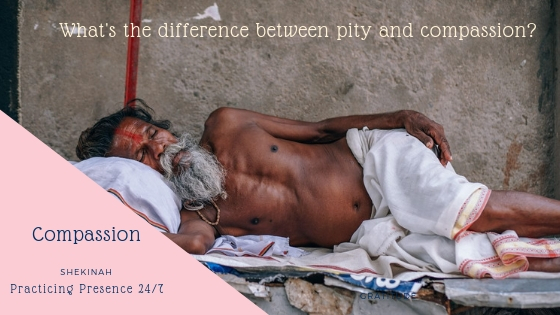
I was recently reading on compassion, and I came across the following thought:
Pity is when your fear touches another person’s suffering.
Compassion is when love touches their suffering!

How many of you today have felt that you have just received a huge new learning, something that has truly transformed your life, and you share it at home — and no one is listening?
Or maybe you have started a new diet and it is really working for you… you are excited about it, and share it with those who know you best… and they just don’t get how important this discovery is for you?Read More »

For God so loved the world… that over two thousand years ago, Jesus came to this earth in human form to show us what this love truly means. Through his life, his teachings and his example, we find a new way, a better way. He gave what we may consider to be the ultimate sacrifice, his earthly body, in a painful and excruciating death, so that we might receive the gift of Oneness of our spiritual bodies with God, no longer separated but as Children of God. Through this, we might fully understand the meaning of eternal life, as spiritual beings living continually in the presence of God. Not waiting for our earthly death for eternity to start, but recognising that we are already living eternity.
Jesus came and taught us humility, as he lived as a refugee in Egypt as a child, much like Syrian refugees live today in Jordan and Lebanon. Do we treat our refugees any better than we have treated Jesus? How do we treat the refugees from Venezuela? The refugees from Haiti, from Africa? If we imagine that each of these refugees was Jesus, how are we doing?
‘Truly I say to you, to the extent that you did it to one of these brothers of Mine, even the least of them, you did it to Me.’ (Matthew 25: 40)
In Matthew 18: 1 we find the disciples discussing “Who really is the greatest in the Kingdom of the heavens?” He calls a child, stands the child in the midst of the disciples and tells them:
“Unless you turn around and become as young children, you will by no means enter into the Kingdom of the heavens. Therefore, whoever will humble himself like this young child is the one who is the greatest in the Kingdom of the heavens; and whoever receives one such young child on the basis of my name receives me also.”—Matthew 18:3-5.
As we consider how we are treating the sojourners and refugees among us, then we known how great we are in the Kingdom! Before the last supper, we find Jesus washing the feet of his disciples.
Because God so loved us… Jesus showed us the importance of reading the Word, as a twelve year old when he read and discussed in the temple the scriptures. Luke 2: 47 says that “all that heard Him were astonished at His understanding and answers.” At twelve years old. He not only was willing to read the Bible allowed in the temple, but to answer questions and explain it. And yet, we seem to struggle each week for participants to read the scriptures aloud in church each Sunday.
Jesus showed us dedication and patience, as he worked as a carpenter, under his father’s tutelage. And yet we reject the authority of our parents, failing to honor our mother and father as we are called to do. We push our way forward for honor and rewards, seeking the limelight, rather than being willing to work in the background.
Because God so loved you… Jesus showed us how to handle the temptations that arise in our day to day lives. Through his temptations of hunger (lust of the body), egoism (misuse of our power) and materialism (kingdoms and wealth) we see what is means to be a child of God, holding fast to that identity, and still standing strong in the knowledge of what that really means. In these temptations, we see the challenge to Jesus: “If you are the Son of God” – are you really a child of God? Prove it.
Through these temptations, we see how the ego wants to use our spiritual power and gifts to satisfy human cravings. This is attempting to turn stones into bread, the attempt to find gratification in using spiritual power to satisfy human, personal desires.And yet, Jesus shows us the better and higher way. Are you fully secure in your identity as a child of God? Can you, like Jesus, respond: “It is written”? Our human nature wants to demonstrate prosperity and success or healing and “prove” that it works. We think some outer achievement will make us happy and successful. But Jesus teaches us a higher way: “Seek ye first the kingdom of God.”
Most importantly, Jesus showed us what it really means to have a relationship with God, to have the indwelling of the Spirit. Jesus showed us, in his every day living and loving, what it means to truly be One with God the Father.
John 14: 4-7 promise us:
4 Remain in me, as I also remain in you. No branch can bear fruit by itself; it must remain in the vine. Neither can you bear fruit unless you remain in me.
…7 If you remain in me and my words remain in you, ask whatever you wish, and it will be done for you.
We are reminded of this again in John 17: 21-23
As you, Father, are in me and I am in you, may they also be in us, so that the world may believe that you have sent me. 22 … so that they may be one, as we are one, 23 I in them and you in me, that they may become completely one, so that the world may know that you have sent me and have loved them even as you have loved me.
For God so loved the World that he sent us Jesus… who taught us what it means to be a child of God (as each one of us has already been called to be). Paul says in Colossians 2:9 “For in Him all the fullness of Deity dwells in bodily form.” The Message says “Everything of God gets expressed in him, so that you can see and hear God clearly”.” Are you living out your life as a son or daughter of God? Is every quality of God fully expressed in your life and living and loving?
Psalm 82: 6 says in a stunning way:
You are gods, And all of you are sons of the Most High.
The same calling to greatness and Oneness with God that Jesus had, each of us has. To be the Son of God is to be of the same nature as God. The Son of God is “of God.” We were created by God, in God’s image, to do God’s will on this earth. And God so loved each one of us, as sons and daughters, that God sent us Jesus to show us the way home.
Jesus reminds us of this in John 10: 33-38:
33 The Jews answered, “It is not for a good work that we are going to stone you, but for blasphemy, because you, though only a human being, are making yourself God.”
34 Jesus answered, “Is it not written in your law, ‘I said, you are gods’? 35 If those to whom the word of God came were called ‘gods’—and the scripture cannot be annulled— 36 can you say that the one whom the Father has sanctified and sent into the world is blaspheming because I said, ‘I am God’s Son’? 37 If I am not doing the works of my Father, then do not believe me. 38 … know and understand that the Father is in me and I am in the Father.”
Like the Prodigal son, we have lived our lives without authority, power, belonging and sharing at the table of the feast: but God loved us. And so today we are reminded of this rich mercy, of the great love with which we are loved. We are made alive in Christ, seated with him, shown the immeasurable riches of his grace in kindness towards us! If we are living in separation from God, then we are throwing away the gift of love that was given to us.
And because of this great love that we have been shown, we are all challenged today to love each other! The test of how well we have overcome that which separates us from God is how well we love our brothers and sisters:
John 13: 35
By this everyone will know that you are my disciples, if you love one another.”
Readings:
This morning in Romans we read:
Why do you pass judgment on your brother or sister? Or you, why do you despise your brother or sister? For we will all stand before the judgment seat of God. … So then, each of us will be accountable to God.
And in Matthew we read:
So my heavenly Father will also do to every one of you, if you do not forgive your brother or sister from your heart.
The reading in Matthew started with:
Then Peter came and said to him, “Lord, if another member of the church sins against me, how often should I forgive? As many as seven times?”
18:22 Jesus said to him, “Not seven times, but, I tell you, seventy-seven times.
Some say that means that we have to forgive 77 times and others say that’s 490 times: seventy times seven. So, imagine with me, for a moment, if God actually kept score of our forgiveness of each other, the same way that we keep score of how others have wronged us. How would that ledger look? Do you ever make it to forgiving someone 77 times for one offence? Ever?

And then imagine if God was as quick to pass judgment on us as we pass judgment on others. Romans asks us today, why do we despise each other? Some versions say “treat them with contempt”, others use the word “belittle” or “look down on”, and still other versions say “set at naught”. To set at naught means to treat as of no account, to disdain, to hold in disregard, to treat with ignominy, to hold as insignificant.
A loving Christian is meant to care, deeply, for others: family, friends, church members & neighbors. But when we go into survival mode, that vulnerability and authenticity get shut down. Poets have long claimed that hearts grow cold and become hardened: we treat others with disdain and insignificance. In our attempt to protect ourselves from distress and dull the pain, we divest ourselves of caring and responsibility.
When broken people live together in a broken world, pain is inevitable for anyone who loves. The only way to avoid the crushing pain of a broken heart is to make your heart unbreakable. So, we become the person that says “I don’t care” or “whatever”, when the luxury of giving ourselves the time and space to feel is threatened. And much of this despising or indifference towards others comes from looking inwards at our hurt and pain, and the defense mechanisms that we naturally have to block this out: just stop feeling. And so our hearts become hardened. If you choose the becoming “unbreakable”, you will also choose to lose your compassion.
What is critical to remember is when a heart becomes hardened, the brain has its own reasons for pressing down upon vulnerable feelings. To feel sets the person up to get hurt and the brain is geared towards survival at all costs. To bring emotional defenses down, the heart must be softened. The question is how can this be done? For me, personally, forgiveness has played an incredible role. I have repeatedly worked with Ho’oponopono meditation, where you sit and repeat: “I love you, I’m sorry, Please forgive me, Thank you.” I’ve used this focusing on loving myself, loving others, loving God.
Forgiving and letting go is so much more than just my relationship with other people: a hardening of heart inevitably means I have hardened my heart towards God. And when you forgive yourself and others, truly forgiving them, you begin once more to experience God’s love and light in your life.
Jesus knew this: which is why he said we need to forgive an offense 77 times (or 490 if you read the KJV). If we want to be compassionate in this world, we need to allow people into our hearts. People will hurt you. People will take advantage of you. People will manipulate you. Not everyone and not all the time, but some will. And you have two choices: you can either choose to forgive or you can choose to become hard. You can’t have it both ways. And forgiving is a hard practice: for most of us, it is not something we just do once and then we’re done. Hence the need to forgive again, and again.
When we remember the offense that the other person has committed against us, we have to repeat: practicing forgiveness. And for a while we will forget and let it go. But the memory of the hurt and offense will come back again, and we will have to repeat once more. And repeat once again. Not because you are going to leave yourself in a situation where that person will continue to hurt or take advantage of you, but because you are choosing a relationship with God over and above all things.
When you are consciously aware that such-and-such a person is “like this”: let’s say that they always ask you to lend them money and they never pay it back. When you make a decision to forgive them and also to keep that person in your life, you know that you will be exposed to more requests for money that will not be paid back. And then you have two choices:
But if you give them that money with resentment, it’s like you are putting a curse upon them, because in your heart: you are cursing them and resenting them. If you are going to give, then give with love and joyously. Make it truly a blessing.
1 John 4: 20 reminds us of this truth:
“Whoever claims to love God yet hates a brother or sister is a liar. For whoever does not love their brother and sister, whom they have seen, cannot love God, whom they have not seen.”
There’s a lot of emotional intelligence involved in being a true Christian! You have to set loving boundaries in your life: where you love yourself enough to be true to yourself, and yet you love God enough to be willing to do the work to be open, vulnerable and authentic. We say we love God, but then we’re not willing to let go of our pain and hurt. That’s mine – my precious. I’m holding onto that pain. I’m not letting it go, I’ve been carrying it around for so long now, it’s part of who I am.
We say we love God, but then we’re not willing to let go of our judgments and prejudices against others. Paul says in Romans 14: don’t judge those who are vegetarians, or those who eat pork, or those who honor the Sabbath differently from us. Are we supposed to respect the Sabbath on Saturday, or on Sunday? We live in a society where dressing in a nun’s habit is okay, but it’s not okay to dress in a hijab. A society where girls should be allowed to dress anyway they like – but it’s their own fault when they get raped for dressing seductively. If we read Romans 4, verses 2 to 4 from the version The Message, we read:
For instance, a person who has been around for a while might well be convinced that he can eat anything on the table, while another, with a different background, might assume he should only be a vegetarian and eat accordingly. But since both are guests at Christ’s table, wouldn’t it be terribly rude if they fell to criticizing what the other ate or didn’t eat? God, after all, invited them both to the table. Do you have any business crossing people off the guest list or interfering with God’s welcome? If there are corrections to be made or manners to be learned, God can handle that without your help.
So who are we to judge another by appearances? Everyone has been invited to God’s table and is to be warmly welcomed. Even those who have hurt us. Even those who have somehow betrayed us. Our accountability before God is individual – I will be judged according to what I have thought, said, done or failed to do in honor of God. You will be judged and held accountable for what you have thought, said, done, or failed to do for God.
I leave us with this parting thought about the way we live our lives, in forgiveness and compassion for all others who are invited to the table:
None of us are permitted to insist on our own way in these matters. It is God we are answerable to—all the way from life to death and everything in between—not each other. (The Message – Romans 14:7-8)

Happy New Years! Welcome to Day 1 of failed New Year’s Resolutions… a little cynicism for you… How many millions resolve to make a change in the new year and then fail in the first week? Most of us see the New Year as a perfect opportunity to start over or to change bad habits. How’s the new diet going? Did you start exercising this morning, or have you already started with “I’ll start on Monday!”? Oh, that’s right – Monday’s a public holiday – I’ll bet you’re starting on Tuesday, right?
I’ve been reading a lot recently about how to make (and keep to) your New Year’s Resolutions:
I’m sure, as you look at all of your New Year’s Resolutions for 2017, there is a common thread throughout – they are your version of YOU as a better person: exercise, less television or internet or social media, more prayer, giving, serving, practicing gratitude…
This New Years, I want to remind you of the disruptions that happen in life, and those who live with and around us whose lives have been disrupted. Remember Joseph and Mary, living in Bethlehem – probably rebuilding their new life in Bethlehem after the birth of Jesus. I wonder… Where was Joseph working? Had they started to build their own home or were they living in a rental?
And suddenly, in the midst of whatever life and plans and dreams Joseph and Mary had now rebuilt, an angel appears in the middle of the night in a dream and tells Joseph to flee to Egypt and remain there until they are told they can leave, because Herod intends to search for the child and destroy him. And we know what the collateral damage of Herod’s fear was: all children under 2 years old in and around Bethlehem. Now, maybe that was only 20-30 children, if Bethlehem only had a population of 1,000 or so people – but that’s 20-30 too many!
A few weeks ago you may have seen the image of a couple and their baby from Aleppo, the father wearing patched pants and mismatched clothes, carrying a baby in a blanket that was much too large for the child, with the baby in one arm and an IV drip in the other. The look of determination, shock, and yet emptiness in the father’s face. A mid-eastern couple and their child, fleeing from violence – just like Mary, Joseph and the baby Jesus whose birth we have just celebrated last week. Displaced by a power struggle that really has nothing to do with them, and yet everything to do with them!
And how many displaced sojourners and aliens do we have in Panama at the moment? People whose plans for their lives were disrupted by the situation in their homeland, who have now traveled to Panama, as Mary & Joseph traveled to Egypt, looking for a safer place to live, away from the imminent threat that their homeland held for them as a family. There are over 90 verses throughout the Bible regarding the “sojourner” or the “alien”, and it’s good to be reminded of them:
“When a stranger sojourns with you in your land, you shall not do him wrong. You shall treat the stranger who sojourns with you as the native among you, and you shall love him as yourself, for you were strangers in the land of Egypt: I am the Lord your God.
“You shall not wrong a sojourner or oppress him, for you were sojourners in the land of Egypt.
“‘Cursed be anyone who perverts the justice due to the sojourner, the fatherless, and the widow.’
“Thus says the Lord of hosts, Render true judgments, show kindness and mercy to one another, do not oppress the widow, the fatherless, the sojourner, or the poor, and let none of you devise evil against another in your heart.”
“If your brother becomes poor and cannot maintain himself with you, you shall support him as though he were a stranger and a sojourner, and he shall live with you.
Isaiah 16: 3-5 ESV
3“Give counsel; grant justice; make your shade like night at the height of noon;
shelter the outcasts; do not reveal the fugitive; 4 let the outcasts of Moab sojourn among you;
be a shelter to them from the destroyer. When the oppressor is no more, and destruction has ceased,
and he who tramples underfoot has vanished from the land, 5then a throne will be established in steadfast love,
and on it will sit in faithfulness in the tent of David one who judges and seeks justice and is swift to do righteousness.”
And yet, our world has become one in which we have all become like Herod, treating the outcasts and the sojourners and the aliens as if they were a threat to us – wanting them dead and out of our towns and countries: they should just go home, they don’t belong here! They have come to take what is ours! They are a threat to our comfort and power! So we should destroy them before they destroy us.
And yet this is not what we are taught if we closely read everything that God ordered Moses and the people of Israel in the Old Testament, and certainly not in the light of today’s reading in Matthew: Jesus was that outcast, whose parents ran with him to Egypt as an alien and sojourner to escape the anger and threat of Herod.
This New Years, I invite you to remember:
“As one person, I cannot change the world; but I can change the world of one person.”
We are called to be Christ-like – to giving living water to the Samaritan woman, to heal the lepers, to feed the hungry, to dine with the tax-collector, to accept the Centurions’ request and command from afar… Decide this day, what will you choose? And each day in 2017, choose again and again! One act a day to being the presence and love of Christ in this world! Actively choosing each day to be this love.
Let us pray:
Creator God, today we remember that you taught us by your very example humility and simplicity in live. As this New Year begins, focus our hearts on paying more attention to others and less on ourselves; listening first and talking later; offering constructive criticism, without complaining; performing acts of kindness each day. We remember this day that you have granted us the gifts of the Holy Spirit so that we might show the fruit of the Spirit in this world, being the light and salt of the earth. In the name of him who taught us by his very example. Amen.

Lectionary:
I’d like to introduce you all this morning to a special artifact from our home that is of vital importance for dressing up as a fairy princess: the magic wand.
A couple of weeks ago, I helped little Miss Two dress up in a pretty dress, and put a little crown on her head, and this little wand in her hand. She was parading round the house rather happily and looking at herself in the mirror, admiring her princess self when she exclaimed “Is broken”.
As any good mother, I asked what was broken, and was informed that her wand was broken “Is not working”, followed by the words any mother wants to hear about a magic wand “fix it mummy”. Since she knows that broken cars are taken to a “car shop” to get fixed, she made mention of a”wand shop” in her request for fixing her broken wand. Now, I don’t know how other mother’s do it, but we’re miles away from Diagon Alley, if I were even able to find platform 9 3/4, and there are no elves from the Little Kingdom that I can call on to fix the fairy wand, and I have no special abilities where expectations of what a magic wand is suppose to do are concerned.
I don’t know about you, but I’m still left wondering what was supposed to have happened when she waved her magic wand and what it failed to do.
Oh! to have the simple faith of a child that can believe anything is possible and doable! Matthew 18:2-4 calls us to become like children,
“I tell you the truth, unless you turn from your sins and become like little children, you will never get into the Kingdom of Heaven. 4 So anyone who becomes as humble as this little child is the greatest in the Kingdom of Heaven.
Mark 10: 14-15
14 But when Jesus saw it, he was indignant and said to them, “Let the children come to me; do not hinder them, for to such belongs the kingdom of God. 15 Truly, I say to you, whoever does not receive the kingdom of God like a child shall not enter it.”
So, today I want to deal with an issue that I struggle with in my Christian faith: are Christians able to raise the dead through faith? In fact, are we supposed to believe in signs and wonders, like healing the sick and making the blind to see? Is there a place for raising the dead in today’s modern world or is it just relegated to fables and myths and Game of Thrones? If it is beyond our ability and powers, how should we live our lives as Christians? What should we learn from today’s readings that we can really take out into this world and be the salt of the earth?
I’ve spent the better part of a week reading various points of view on raising the dead. I’ve discovered groups such as a group of Evangelicals who call themselves the “Dead Raising Team”. I’ve read about Saint Patrick’s 33 cases of raising the dead in Ireland, in order to convince the many pagans of the day to convert. What is amazing about Saint Patrick is that in 30 years he converted an entire island (Ireland) to Christianity, when previous missionaries had been unable to convert towns, and he gave all glory for this to God and the moving of the Holy Spirit.
But when it comes to raising the dead, as Christians, we’re skeptical.
“Levitating saints, sure. Weeping icons and statues, yep. … The dying healed through the intercession of the saints, of course. The world is filled with miracles. …. We’re supernaturalists, but most of us live by the normal (supernatural) means of grace. We go through life in the usual and sometimes God disrupts things with a special benefit.”
While I would love to believe that we could all participate in the supernatural, my rational thinking gets in the way, and I’m left searching for practical and rational ways that I can transform this world.
Most of what I’ve read about Luke 7 speaks to Christ’s compassion for the widow who has lost her only son, in a society where she would have been left completely unprotected and without any rights.
How are we to react as Christ when we see those in need and hurting? As Christians, we are called to have the same compassion for our fellow man. We are called to look beyond just what we can see, and commit to life-changing actions in the lives of others. But do you have the time, energy & commitment for that?
The principle of compassion is the very heart of Christ. The ministry of Jesus flowed from His heart of compassion toward those in need. Compassion is a word of action. It is not observing from the sidelines; it is the heartfelt care for another with both the intent and action. The compassion of Christ carries the notion of tenderness and affection.
The uniqueness of Jesus’ ministry rests in His concern for persons — He truly loves people and considers them worthy of respect and compassion because of what they are — bearers of the divine image of God.
John challenges us to look to the needs of others,
“But if anyone has the world’s goods and sees his brother in need, yet closes his heart against him, how does God’s love abide in him? Little children, let us not love in word or talk but in deed and in truth” (3:17-18).
Loving others is one of the many ways we put our faith into action.
“People do not care how much you know, until they know how much you care.”
So, how can we put this compassion into practice? If we can’t do the supernatural, what can we do that will make life-changing differences?
Let us pray:
Creator God,Give us compassion and humility in our hearts. Let us be kind, gentle, generous, loving, giving and forgiving wherever we may go. Allow pride to never get the best of us as You fulfill our dreams. Help us not to have a boastful tongue against our brothers. Let humility invade our souls.In Jesus’ name. Amen
 Divine Presence: Letting the Infinite flow in my life