Welcome to the Good Shepherd Sunday, the fourth Sunday of Easter (or the third Sunday after Easter if you prefer), where every year we remind ourselves of a special relationship that we have with our Creator. Each year, we read on Good Shepherd Sunday two particular readings:
- Psalm 23: The Lord is my Shepherd
- John 10: 1-10
Throughout our three-year cycle of the Revised Common Lectionary, while we may read different Epistles or different Prophets, the reading of the Psalm and this particular Gospel remain unchanged. So I would like us to consider, this morning, what we can learn from them regarding our day-to-day living, because being of the Christian faith isn’t something you do on Sundays: it’s how your live your day-to-day life. And the Creator’s offer to “shepherd” us is not something that we only need on Sundays: it’s a protection, guidance, purpose, security, blessing, and healing that should happen every day for each of us.
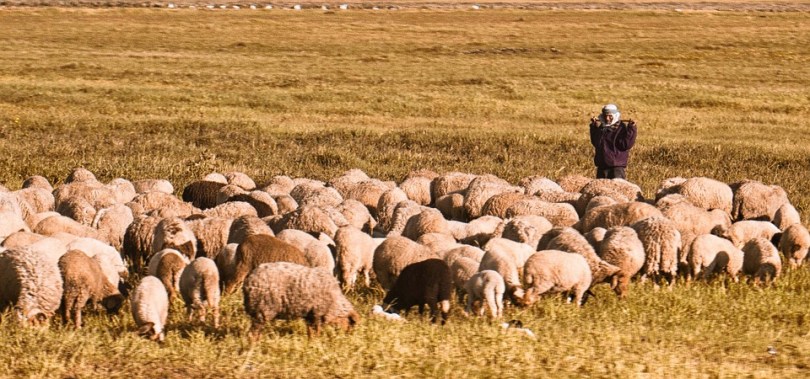
In the Old Testament, like in the book of Exodus, Yahweh is represented as a shepherd. The prophets Isaiah and Ezekiel compare Yahweh’s care and protection of His people to that of a shepherd. “He is like a shepherd feeding his flock, gathering lambs in his arms, holding them against His breast and leading the mother ewes to their rest” (Is. 40:11).
I would like to start with some thoughts, briefly, regarding the Gospel from John, and then focus on Psalm 23.
10:1 Very truly, I tell you, anyone who does not enter the sheepfold by the gate but climbs in by another way is a thief and a bandit.
10:2 The one who enters by the gate is the shepherd of the sheep.
John starts chapter 10, speaking metaphorically of us as sheep and of the Christ as our shepherd, and he begins with entrance into our lives. John reminds us that the legitimate way into our lives is through the gate: anyone who climbs in by any other way is a thief and a bandit. Leaders may enter our lives through false pretenses, lies, manipulation, false promises, deceit, masquerade, pressure, threats, or playing on our fears (think of political leaders, electoral promises, fears that are preyed upon), but I AM enters our lives through the relationship that we voluntarily establish with God’s Presence, drawing our spirit into Oneness with God’s Spirit. It is only in the presence of pure love that we can openly and willingly open the door our hearts, souls and spirits, to become one with the Holy Spirit, voluntarily.
10:3 The gatekeeper opens the gate for him, and the sheep hear his voice. He calls his own sheep by name and leads them out.
Whose voice are you listening to? Maybe you are listening to political commentary, webinars, self-help gurus, podcasts by your favorite fitness guru. But do you take time in your day to listen to the voice of the Shepherd? Is your life so busy and so caught up that there is no time for silence? If you are feeling like you are a hamster on a wheel, maybe it is time to start saying “no” and learning to enjoy the Silence and stillness of “Be Still and Know that I AM that I AM”. The promise we have in John 10 is that I AM will call you by name and lead you out, but in order for this promise to be fulfilled, you need to actually hear I AM’s voice. That means time in silence. Time in prayer. Time in quiet peace and meditation. And once you hear I AM’s voice, then you will hear where he wants to lead you. Not your plans, but I AM’s plans and leadership.
10:4 When he has brought out all his own, he goes ahead of them, and the sheep follow him because they know his voice.
10:5 They will not follow a stranger, but they will run from him because they do not know the voice of strangers.”
Do you know and hear the voice of I AM? Or have you become so deaf to this voice that you are following the voice of strangers? Searching for an earthly shepherd to take care of you, to allay your fears, to give you safety and security? Who is your shepherd? When we start to only follow the voices and advice and direction from our leaders, we start to believe that only they can hear the voice of the Shepherd and we simply do what they are telling us. It’s certainly easier this way, we can abdicate “responsibility” and if anything goes wrong, “it was their fault”: certainly nice to have a scapegoat. And that’s a sermon for another day… Are you running from the strangers and following the voice of the Shepherd? Or have you become so accustomed to the voice of the stranger that you have stopped following the voice of the Shepherd?
As I said at the beginning, I want us to turn now to Psalm 23, and go through this line by line, understanding a little bit more today our relationship with I AM. Some of you may be wondering why I have used I AM so frequently through my sermon this morning: God’s name is almost always translated LORD (all caps) in the English Bible. But the Hebrew would be pronounced something like “Yahweh,” and is built on the word for “I am.” So every time we read or hear the word “Yahweh”, or our poor translation of it as “LORD” in the English Bible, you should think: this is “I am”, reminding me each time that God absolutely is. “YHWH Raah” – I AM, my Shepherd.
And Psalm 23 starts with this:
The Lord is my shepherd,
I AM is my shepherd. I want you to think about this “I AM” for a moment. This I AM is the same I AM that Moses encountered at the burning bush; this is the I AM that the children of Israel followed out of Egypt and through the desert. This is the I AM that is the way, the truth and the life. This is “I am the bread of life”. “Truly, truly, I say to you, before Abraham was born, I am.” (John 8:58). I am the light of the world. I am the door of the sheep. “I AM the good shepherd.The good shepherd gives His life for the sheep.” (John 10:11) I am the resurrection and the life. “You call Me Teacher and Lord; and you are right, for so I am. (John 13:13). I am the true vine. “I am the Alpha and the Omega,” says the Lord God, “who is and who was and who is to come, the Almighty.” (Revelation 1:8). I am the first and the last. That’s our shepherd: all-powerful, all-knowing, all-loving, all-presence.
This verse speaks about our relationship with I AM. And I would like to invite you, for a moment, to consider your idea of who and what God is. If we are to effectively pray, listen and communicate with God we need to become clear on exactly who and what we think God is, and become clear about our feelings toward God. Religions around the world typically classify God as Thou/You, Me (the indwelling Spirit), or He/She/It.
This first view of God: Thou/You – is “Our Father, who art in Heaven”. The second view of God, is problematic for some Christians, as it views God as being within us, and yet we profess that we believe the Holy Spirit to abide inside us, and say “not I, but Christ that lives in me”.
And that third face of God is the Omni-Presence of God in all of life: I AM the way, the truth and the life. It is the breath of life that we breath each moment of every day. As Christians, we are quite fearful of this face of God, seeing religions that are idol worshipers, because they focus on God in things and creation. Yet, we fail to see that this is God: “In the beginning was the Word, and the Word was with God, and the Word was God.” God, as Omni-Presence does not mean God in the air, “around” all things… it is God IN all things. It is God that is IN this pulpit, it is God IN the floor, it is God IN the pew-bench on which you are seated, it is God in your car, in your steering wheel, in the gear shift. It is God in your home, in your sofa, in your bed. It is God in each bird, each butterfly, each mosquito (sorry… terrible example!). We say we believe God to be Onmi-Presence, but then when we talk about God, we seem to limit God to just being in the air “around”, rather than literally EVERYWHERE.
Let me try to explain this a little better: you stand on a beach looking out at the vastness of the Ocean. There are waves breaking on the shore, and in each wave that breaks on the shore, you will find the Ocean. You take a bucket and you fill it with water, and in this water you will also find the Ocean. If you took just one drop of that water, it would still be part of the Ocean. Now, that drop of water is not the whole Ocean, obviously. But how do you separate that drop of water from being Ocean. And that, for me, is the Omni-Present God: God is much more than JUST the bird or the butterfly or the mosquito… but God is there!
And having said all of this, I will admit, I don’t understand God: I don’t even begin to. God remains unfathomable to me! I cannot wrap my tiny human brain around a definition that even comes close!
So, I invite you this morning to answer this question this week: Who or What is God for you?
I apologise that I have spent so much time discussing this first verse of Psalm 23, that it will not leave me much time to go through the rest of the lines of Psalm 23, but I felt that “how we see God” is the very crux of how we interpret Psalm 23.
I AM is my shepherd,
And so, let’s continue with Psalm 23:
I shall not want.
Some translations write this as “I have everything I need” or “I lack nothing”. YHWH Jireh, my provider. I AM, my provider. Are you allowing God to provide for you? Physically? Mentally? Spiritually? Do you allow God to nourish your soul?
As a parent, I reserve the right to say “no” to all the whims and requests of my daughter. She would love ice cream, M&Ms and candy every day: I think about the teeth, the enamel and vitamins and minerals. She will not lack anything, she will have everything she needs.
Do you accept that God may say “no” to your whims and fancies?
He makes me lie down in green pastures,
Are you resting with God?
He leads me beside still waters.
Are you following God beside still waters, so that God can refresh your soul?
He restores my soul;
How do you allow God to heal you? YHWH Rapha: I AM that healeth.
He leads me in paths of righteousness,
We sing “Jesus take the wheel”, but do you let God actually drive? You ask for guidance, but do you follow the guide? “No, not there! That’s not where I want to go… I want you to take the wheel when I’ve already got myself into trouble – just get me out of this and then give me back my steering wheel!”
For His name’s sake.
Are you living a purpose driven life? I AM that I AM… His name’s sake…
Yea, though I walk through the valley of the shadow of death,
Sometimes, on the road to greener pastures there will be trials and hardships and difficult paths. Do you trust I AM?
I will fear no evil;
I will fear no evil. This is a powerful declaration! I will fear no evil. How often do we allow fear to dictate our lives?
For You are with me,
YHWH Shammah – God is faithful, omni-present, everywhere we are.
Your rod and Your staff, they comfort me.
The rod and the staff – they are for fighting off the wolves, the lions and the bears. And for stopping us from going down the wrong path, to pull us back us (sometimes around the neck) when we’ve started to go over the edge. Sometimes pulling us kicking and screaming from the edge, when we don’t realise we are about to step over the edge.
You prepare a table before me in the presence of my enemies,
We have hope and abundance and moments of rejoicing! Do you enjoy those feasts that God provides?
You anoint my head with oil;
We are consecrated to God. Do you live your life as a consecrated child of God?
My cup runs over.
Are you truly thankful?
Surely goodness and mercy shall follow me all the days of my life.
You are blessed – richly blessed! Goodness and mercy follow you – do you show goodness and mercy to everyone in your life? Do your acts reflect this goodness and mercy you have received?
And I will dwell in the house of the Lord
God is everywhere… you dwell in his house at every moment of every day. Not just while you are here in the house of the Lord which is this building. But every moment. Do your actions and thoughts reflect that?
Forever.
Eternity… it’s a long time.
As you leave today, consider this:
- Who, what and where is God for you?
- What is your personal definition of God?
- What does that definition mean for your relationship with God? With others?
- Who are you listening to? Do you recognise the Shepherd’s voice?
- Do you allow the Shepherd to guide you? To provide what you need?
- Do you give thanks for the rich blessings, allowing goodness and mercy to shower those who come into contact with you?
Be blessed in every way!
Originally in the sermon, but then edited out to make it more understandable:
In The Three Faces of God we read:
“Most of us are familiar with three different perspectives from which to approach and describe God. These perspectives determine whether we address God in the first, second, or third person:
God as Ground of Being is the First Face of God. It is the experiential “I”—God within us, or God immanent.
God as an entity to whom we relate and pray to is the Second Face. It is God as “Thou” or “You.”
God present in the manifest world as the Web of Life, as Nature, as All That Is, is the Third Face. It is ‘He/She/It’ and is understood through our senses.”
This book, the Bible, attempts to teach us that God is all three. We know this as the Trinity: God, as Holy Spirit, is the “I” within each one of us, the “not I but Christ that liveth in me” that connects directly with our spirit, bringing us to complete Oneness with God. When we completely still, when we allow ourselves to finally connect, it is the still small voice that speaks to us. God as the Father we know as Thou or You, this is the God that we pray to. In many senses, it is the God we have a relationship with – some see God as a Santa Claus, that we make our requests to, others see God as an angry or justifying abuses. The Three Faces of God reminds us:
“It’s the unhealthy version of the Second Face of God that has created so much trouble throughout history. Since medieval times and within hierarchical religions, the Second Face of a judgmental God who metes out punishments and rewards has been used as a weapon to marginalize, kill, emotionally wound, and control people and circumstances. Abuse of the Second Face of God resulted in a judgmental superbeing before whom we all stood as sinners.”
“Yet by rejecting the Second Face of God relationship entirely, we miss the richness offered by a healthy version. This is an understanding of God with whom we can experience personal and intimate relationship in our daily lives, to whom we can express gratitude and love and surrender. It’s God as unconditionally loving parent, comforter, supportive friend.”




 Divine Presence: Letting the Infinite flow in my life