authentic,authentic living,bold,boldness over fear,choosing faith over fear,Divine Law,divine presence,divine wisdom,embodying faith,fear,freedom,fruit of the Spirit,generative wisdom,heart-centered living,Holy Spirit,humility,inner transformation,Integrity,living authentically,Love Your Neighbor,new covenant,spiritual freedom,

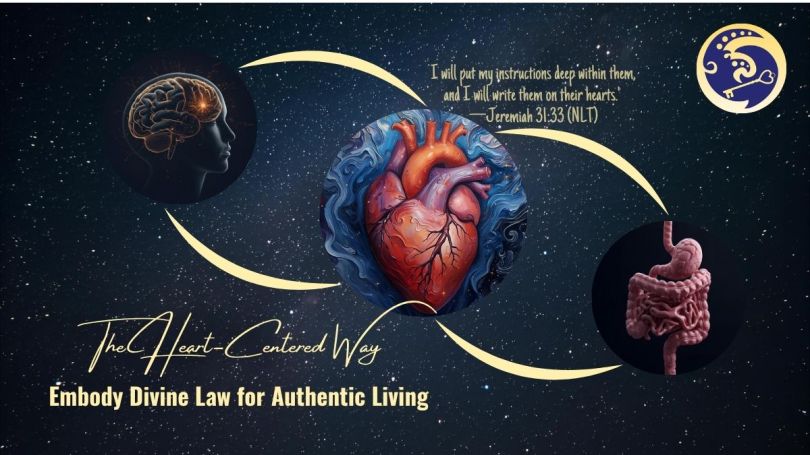
The Heart-Centered Way: Embody Divine Law for Authentic Living

In a fragmented world where decisions pull you in every direction—scheming strategies clashing with visceral drives and fleeting emotions—the heart-centered way invites you into the transformative rhythm of Divine Presence.

As Jeremiah 31:33 declares, God promises to inscribe His Divine Law not on stone tablets, but deep within your heart, unlocking authentic living as a flow of embodying faith that reshapes your core. Crucially, this isn’t rigid rule-keeping; it’s an inner transformation fueled by the Holy Spirit within, granting spiritual freedom to navigate life’s complexities with coherence and joy.

Drawing from the wisdom of Psalm 119’s honey-sweet meditation and 2 Timothy’s equipped endurance, we’ll explore how this New Covenant blueprint harmonizes your God-given centers—mind, spirit, and drive—for decisions that sow abundance and ripple love outward.

The Promise of Divine Presence: Awakening to the New Covenant

The prophet Jeremiah stood at the breaking point of a nation. Israel and Judah were in exile, a consequence of continually breaking the covenant God had established through Moses. That covenant—etched onto stone tablets—was a good and perfect law, yet it remained external. As a result, it was a law you could fail to keep, leading to cycles of obedience, failure, and punishment. The law was out there; the problem was always in here.

However, Jeremiah offers a vision of divine reset, a New Covenant that is unlike the old. God says: “The days are surely coming, says the Lord, when I will make a new covenant… I will put my law within you, and I will write it on your heart; and I will be your God, and you shall be my people” (Jeremiah 31:31-33).

authentic,authentic living,bold,boldness over fear,choosing faith over fear,Divine Law,divine presence,divine wisdom,embodying faith,fear,freedom,fruit of the Spirit,generative wisdom,heart-centered living,Holy Spirit,humility,inner transformation,Integrity,living authentically,Love Your Neighbor,new covenant,spiritual freedom,

This promise is the ultimate invitation into Divine Presence. It’s not about geography or temple rituals; it’s about intimacy. God moves the legal center of the universe—His governing Divine Law—from a scroll locked away in an ark to the deepest core of your being. Consequently, this is the difference between obeying a rulebook out of fear and aligning your very desires with God’s will out of love.

The shift means that knowing God is no longer a privilege of the few—a priest or prophet—but an intuitive reality for you: “for you shall all know me, from the least of you to the greatest” (v. 34).

Moreover, the New Covenant is God’s revolutionary act of grace, promising not only an inscribed heart but also full forgiveness: “I will forgive your iniquity, and remember your sin no more.” This foundational grace is what makes true inner transformation possible.

You are freed from the paralysis of generational blame (“The parents have eaten sour grapes, and the children’s teeth are set on edge,” v. 29) to take ownership of a life now written and defined by God’s love and presence.

From Exile to Inner Transformation: Your Blueprint for Spiritual Freedom

This shift from the external law to the heart-inscription is God’s blueprint for spiritual freedom. While the old law was a schoolmaster, pointing out our failure, the Divine Law written on your heart through the New Covenant is an embodying faith, empowering you to succeed.

Imagine a sophisticated navigation app: the old law gave you a paper map that was always getting lost or ignored. By contrast, the Divine Law is the GPS installed directly in your consciousness. It updates in real-time. Therefore, it doesn’t just tell you when you made a wrong turn; it guides your step before you even take it.

The result is spiritual freedom—not the freedom from all rules, but the freedom to live fully into the loving intent of the Law. Ultimately, it transforms rigid obedience into flowing, authentic living. This inward law, powered by Divine Presence, becomes the core operating system of your life, harmonizing the chaotic signals from your mind, heart, and gut into a single, coherent response. It turns following God from a stressful performance into a peaceful, heart-centered living that is guaranteed by grace.

The Holy Spirit within: The Power to Live an Embodied Faith

The profound promise of the Divine Law being inscribed on the heart immediately raises a critical question: How is this massive inner transformation achieved? The simple, divine answer is the presence of the Holy Spirit within.

The New Testament makes it clear that the Holy Spirit is the active agent who writes the Law of God onto the new heart (Romans 8:4-6; 2 Corinthians 3:3, 6). If the new covenant is the blueprint, the Holy Spirit is the master architect and builder, shifting your core from a self-serving mechanism to one capable of embodying faith—a practical, daily living-out of God’s presence.

Furthermore, this embodiment isn’t just a mental assent; it is fully integrated. Paul reminds us that our bodies are temples of the Holy Spirit within (1 Corinthians 6:19), implying that your very physical design is meant to facilitate a life of Divine Presence.

This truth—that God empowers transformation through your embodied experience—is powerfully illuminated by the modern framework of coherence, drawn from multiple Brain Integration Techniques (mBraining). This model posits that you possess three distinct intelligence centers, often called the “three brains”:

  • Head (Cerebral Cortex): The center for Cognitive intelligence (analysis, foresight, strategy).
  • Heart (Intrinsic Cardiac Nervous System): The center for Emotional/Relational intelligence (values, compassion, connection).
  • Gut (Enteric Nervous System): The center for Instinctual/Mobilizational intelligence (core identity, self-preservation, drive).

Therefore, the constant chaos in your life often stems from these three centers “voting” against each other: a head-led plan ignores the heart’s empathy, or a gut-led reaction overrides the head’s wisdom. Ultimately, the Spirit-led life, the life of authentic living, is one where the inscribed Divine Law leads these three centers into coherence.

authentic,authentic living,bold,boldness over fear,choosing faith over fear,Divine Law,divine presence,divine wisdom,embodying faith,fear,freedom,fruit of the Spirit,generative wisdom,heart-centered living,Holy Spirit,humility,inner transformation,Integrity,living authentically,Love Your Neighbor,new covenant,spiritual freedom,

The Holy Spirit within works within this triune system to align your thought, feeling, and drive. He ensures that your head meditates on truth (Psalm 119:97), your heart is anchored in love, and your gut is propelled by boldness Over fear (2 Timothy 1:7). The rest of our journey will explore this harmony, proving that the Law on the heart is not an abstract spiritual concept but God’s practical toolkit, enabling a robust, heart-centered living for every corner of your world.

Heart-Centered Living in Action: Coherent Decisions Across Your World

Heart-centered living is not a passive, mystical state; it is a coherent state of being that produces effective action. It is the practical outworking of the Divine Law written on your heart, resulting in Generative Wisdom—the kind of wisdom that integrates foresight (Head), compassion (Heart), and conviction (Gut) to actively create positive outcomes.

When your three intelligence centers—the logical head, the relational heart, and the instinctual gut—are aligned by the Holy Spirit within, your decisions cease to be fragmented. This immediate benefit means you move from the paralysis of confusion to the flow of authentic living. This coherence yields Generative Wisdom—a dynamic process where the whole is greater than the sum of its parts, allowing you to sow abundance where scarcity once reigned.

The promise of Jeremiah is that this alignment, this inner transformation, is available to you wherever you are. Therefore, your calling is to allow that inscribed law to inform your daily rounds.

Let’s look at how this coherence manifests across various aspects of your life, transforming mundane activities into acts of embodying faith.

Divine Wisdom at Home: The Heart-Led Anchor with Proverbs 31 Depth

The home is often the most chaotic and exhausting arena of life, where exhaustion battles the pull to connect, and gut reactions frequently outpace reasoned responses. Whether you are the one holding the home front—mapping school runs amid work calls, or stirring pots while prayers simmer for a wayward child—the heart-law speaks straight to you: “I will be your God, and you shall be my people” (Jer. 33:33). Ultimately, this covenant love fuels your ache to nurture without the accompanying resentment.

Here’s how to apply Divine Wisdom as a Heart-Led Anchor in your family life:

  • Heart (Compassion & Values): Your heart is your default setting, prioritizing relationships and connection over efficiency. The heart-led decision is to pause, breathe, and remember the deepest value: Love Your Neighbor (starting with those under your roof).
  • Head (Foresight & Planning): Divine Wisdom incorporates the head, sharpened by meditating on the law (Psalm 119:97). Consequently, this allows you to anticipate the meltdowns or budget squeezes ahead. Your head charts the strategy for a resilient family—setting boundaries and scheduling the essential family huddle that prevents resentment from building.
  • Gut (Mobilization & Conviction): The gut provides the steady, mobilized drive needed for consistent, patient action. This means your gut’s boldness over fear ensures that love lands effectively, backed by persistent action, enforcing necessary boundaries or gently addressing old family fractures.

The Coherent Outcome: Without your head, your love is scattered. Without your gut, fear-frozen inaction stalls progress. Therefore, with the Divine Law cohering the three, your embodying faith turns home management into a quiet, effective ministry where generations are rooted and the covenant is made real.

Generative Wisdom in the Marketplace: Embodying Faith with Integrity

From the cubicle to the construction site, the marketplace demands that your embodying faith translate into practical justice, equity, and ethical conduct. Whether you’re coordinating teams or bidding on jobs, the heart-law redirects your focus from the grind to grace, requiring Generative Wisdom tempered by boldness over fear to maintain Integrity.

  • Heart (Compassion & Values): The heart-led professional views your colleagues and crew as kin, not resources. Fuelled by Jeremiah’s promise of full forgiveness, your heart means feedback becomes fuel for growth, and compassionate curiosity replaces managerial distance. In business, this insists on honoring your crew with fair wages, echoing Love Your Neighbor, not just the bottom line.
  • Head (Foresight & Planning): A wise head is required to be sustainably compassionate. Dipping into Psalm 119’s meditation, your mind plans with equity in view. You audit workloads for fairness, anticipate supply chain snags, or forecast material hikes—refusing to let short-term pressure compromise quality or ethical standards. In short, you design systems that embody justice and long-term viability.
  • Gut (Mobilization & Conviction): This is where boldness over fear is crucial. The gut ensures follow-through: it stalls the snappy, frustrated email and instead propels a quick, honest huddle to resolve a conflict. Similarly, in leadership, it drives you to take a stand—renegotiating subcontracts for sustainable timelines, or refusing a client whose unethical demands compromise your values, carrying out your ministry fully (Timothy 4:5).

The Coherent Outcome: When your mind, heart, and gut align, your business or administration achieves efficacy with dignity. Integrity transforms transactions into relationships. Jobs finish strong, teams become tighter, and your professional conduct becomes a witness to the abundance sown by the Divine Presence.

Generative Wisdom in Learning: Motivated Steps Toward Authentic Living

If you are navigating lectures, late buses, and the tension between group projects and personal setbacks, Generative Wisdom provides a profound advantage. The internal inscription of God’s law turns learning from a solo scramble into a community endeavor, propelling you toward authentic living.

  • Heart (Compassion & Values): Gut motivation may surge for the cram session, but Jeremiah’s promise of belonging tempers it. The heart-law draws you to notice and include the quiet one at the table (“they shall all know me,” v. 34). Therefore, your heart drives you to seek connections that build up, prioritizing mentorship and genuine relationship over transactional networking.
  • Head (Foresight & Planning): The head is essential for blocking pitfalls. Drawing on the Psalm’s wisdom, your mind plots out study bursts around necessary rest, blocking the overreach of burnout (119:101’s evil-avoidance). Crucially, it defines your why—connecting a challenging project to your larger purpose, ensuring your path is directed by truth, not just trends.
  • Gut (Mobilization & Conviction): The gut propels the bold asks and the persistent effort. It provides the energy to face an intimidating course or to try a new field. In turn, it fuels the natural overflow of tutoring a peer or speaking up for a marginalized view (Timothy 4:2’s persistent encouragement).

The Coherent Outcome: Effective learning is whole-person learning. Your authentic living ensures that your grades climb, your bonds build, and your faith slips in sideways, making your educational experience a testament to the integrated life.

fruit of the spirit, love, joy, peace, patience, kindness, heart-centered living

The Fruit of Heart-Centered Living: Outcomes of Divine Law Embodied

The ultimate test of the heart-centered living you’ve explored isn’t how well you can define your three centers, but the fruit that your decisions bear. The Divine Law written on your heart is not an end in itself; it is the seed that produces a life that is both joyful and effective. This is the key difference between a life of rigid, external rule-keeping and a life of overflowing authentic living.

The psalmist’s exuberant declaration, “Oh, how I love your law! It is my meditation all day long. Your commandment makes me wiser than my enemies, for it is always with me” (Psalm 119:97–98), illustrates this outcome. The law ceases to be bitter medicine and becomes sweeter than honey to the mouth (v. 103), stirring a deep aversion to falsehood (“I hate every false way,” v. 104). This inward delight is what generates the courage and endurance that Paul urges upon Timothy.

When your Head, Heart, and Gut are synchronized by the Holy Spirit within, the inner transformation yields the kind of abundant life Jesus promised. This life is marked by the concrete, observable characteristics known as the Fruit of the Spirit: love, joy, peace, patience, kindness, goodness, faithfulness, gentleness, and self-control.

Humility as the Posture: Cultivating the Fruit of the Spirit in Decisions

To cultivate this fruit, you must begin with a posture of humility. Humility is the essential condition for coherence because it acknowledges that none of your three intelligence centers is infallible on its own.

The Pitfall of the Head: When your head operates in isolation, it becomes impetuous—prideful in its logic, refusing to acknowledge emotional data or spiritual direction. Consequently, your decisions are rigid, lacking the gentle texture of patience and kindness. Humility forces your head to consult the Divine Presence in your heart before analyzing the spreadsheet.

The Pitfall of the Heart: Your heart operating alone becomes overly idealistic or impetuous, sacrificing long-term peace for immediate emotional gratification. Without a doubt, without the stabilizing force of your head’s foresight and your gut’s anchor in core self-control, it produces fleeting joy, not enduring Spiritual Freedom.

The Pitfall of the Gut: The raw, unaligned gut is often ruthless—focused only on survival or selfish gain. It mobilizes action without love or justice. However, Humility allows your gut’s power to be guided by the love and gentleness of the Spirit, ensuring that your boldness over fear is always tempered by self-control.

Humility thus acts as the connective tissue that aligns your centers, allowing the full Fruit of the Spirit to ripen. It turns the powerful energy of your gut into faithfulness, the analysis of your head into Generative Wisdom, and the emotion of your heart into love, ensuring that every decision is a harmonious reflection of the law inscribed within.

Integrity in Motion: Boldness Over Fear for Enduring Witness

The coherent, heart-led life doesn’t stop at inner harmony; it translates into integrity in motion, creating an enduring witness in a world plagued by cynicism. This integrity requires boldness over fear—the spiritual courage to act fully and truthfully, as urged by Paul to Timothy: “Proclaim the message; be persistent whether the time is favourable or unfavourable… do the work of an evangelist, carry out your ministry fully” (2 Timothy 4:2, 5).

In 2025, this witness is desperately needed in public life. When you embody the Divine Law, you are honest about your supply chain, you advocate for fair policies, and you ask hard questions about Ethical AI and data justice. In essence, this is the courage of the integrated soul, where your Gut’s conviction is softened by your Heart’s compassion and informed by your Head’s Generative Wisdom.

This Integrity rebuilds community. It enables you to resist the temptation to succumb to “itching ears”—the distractions and myths Paul warned about—and instead, stand firm on the truth inscribed within. The result is an effective faith that makes the New Covenant visible: not through sermons alone, but through relationships and transactions marked by trustworthiness and boldness over fear.

Love Your Neighbor: The Outward Ripple of Spiritual Freedom

The ultimate outward ripple of heart-centered living is the realization of the greatest commandment: Love Your Neighbor. When the law is written on your heart, you experience spiritual freedom from the bondage of selfishness, enabling you to pour into the lives of others.
The grace received through the New Covenant is contagious. Jeremiah promised not just personal restoration, but the sowing of new life in the community (Jeremiah 31:27). Consequently, your coherent decisions become the seeds of this abundance, challenging the scarcity mindset of the world.

  • When you plan with equity, you sow kindness.
  • When you choose compassion over profit, you sow peace.
  • When you invite the lonely one in, you sow joy.

This Spiritual Freedom is your call to action: The path to authentic living is paved with small, coherent decisions made under the Divine Presence.

Your Invitation: Choose just one area this week—a crew conversation, a family crisis, a tough deadline—and apply the principles of the heart-centered way. Let the inscribed law be your guide, turning an old struggle into a new demonstration of Divine Presence.

Stepping into Authentic Living: Your Invitation to the Heart-Centered Way

The Heart-Centered Way is more than a spiritual concept; it is an active invitation to live the life God has already inscribed within you. The power of Jeremiah’s prophecy, the joy of the Psalmist’s meditation, and the urgency of Timothy’s charge all converge on one point: your authentic living is God’s desired outcome.

You are no longer bound by external rules or fragmented decisions. Instead, you are empowered by the Divine Law written on your heart, equipped with spiritual freedom, and ready to step fully into your calling. The journey begins with the simple, humble choice to let the Holy Spirit within align your mind, heart, and gut.

This week, answer the invitation. Choose one area of chaos or conflict in your life—at home, at work, or in your studies—and commit to making a coherent decision. Let the inscribed law be your guide, turning an old struggle into a new demonstration of Divine Presence.

A Prayer for Inner Transformation: Aligning with Divine Presence

The heart-centered life is one of constant renewal. Use this simple prayer to anchor your intention and invite the inner transformation promised by the New Covenant:

Covenant God, my mind is noisy, my heart is restless, and my drive is often selfish. I receive the Divine Law You have written on my heart. I ask the Holy Spirit within to align my head, heart, and gut, establishing Your Divine Presence as my anchor.

Let my thoughts be sharpened by Your truth, my feelings be fueled by Your love, and my actions be propelled by Your Boldness Over Fear.

I claim the Psalmist’s resolve: “I hate every false way.” Equip me to live with Integrity and Humility, so that my every decision may bear the Fruit of the Spirit and be an act of Love Your Neighbor.

Align me now, O Lord, to live the Heart-Centered Way for Authentic Living. Amen.
Cultivate a life with the Spirit of Freedom

I’ve recently been dwelling on what does it mean to be free? And there are so many aspects to this idea of freedom:

  • Emotional freedom: what emotional baggage am I carrying with me that I need to let go of? Do I feel free to express my emotions and acknowledge what I’m feeling, or do I bottle everything up and avoid my emotions?
  • Relationships: Does freedom mean that I have no responsibility in relationships? Or does it give me freedom of choice in who I cultivate relationships with and how much effort I put into my relationships? Am I free to end a relationship or have boundaries so that others know that I can’t be walked over?
  • Financial freedom: What would it mean to you to be financially free? Would financial freedom mean being rich? Or are rich people equally slaves of money?
  • Freedom of thought and Mental freedom: Is my mind clear and able to focus on what I want to focus on? Am I plagued by my own thoughts and mental demons?
    • Viewed from another perspective: Am I free to have my own thoughts and opinions? Or does someone else control my way of thinking?
  • Physical freedom: Is my body and health in top shape so that I can enjoy the freedom of movement and enjoy life?
    • Physical freedom might also be related to slavery – whether this refers to being an actual slave and controlled by another person or whether this is simply addiction.
  • Spiritual freedom: what does this look like and feel like for you?
  • Freedom to act: What or who governs my actions? Am I free to choose how I behave in life?
  • Freedom of speech: Can I say what I want and what I’m thinking?
  • Time freedom: Who controls my time and how I spend it?

So, today, I want to have a quick look at how the Bible talks about freedom. 

The first verse I want to consider comes from the Revised Common Lectionary for Transfiguration Sunday.

2 Corinthians 3: 17

Now the Lord is the Spirit, and where the Spirit of the Lord is, there is freedom.

Freedom in the Old Testament:

Isaiah 61: 1

The Spirit of the Lord GOD is upon me, Because the LORD has anointed and commissioned me To bring good news to the humble and afflicted; He has sent me to bind up [the wounds of] the brokenhearted, To proclaim release [from confinement and condemnation] to the [physical and spiritual] captives And freedom to prisoners. (Amplified Bible)

And we read in Psalms 119: 45

I have gained perfect freedom by following your teachings (Contemporary English Version)

Most of the Old Testament, when it speaks to freedom and liberty is about literal slaves and setting free the captives. Of course, some of the references can be read metaphorically to spiritual captivity.

Freedom in the New Testament:

Most of the verses about freedom we find in the New Testament, specifically in the Epistles. 

John 8: 32

And you will know the truth, and the truth will set you free.

What is the truth that you need to accept and know in your heart and mind today in order to gain freedom?

Let’s start by looking at those of 2 Corinthians 3, as there are a few that I want to highlight. 

2 Corinthians 3:6

He makes us worthy to be the servants of his new agreement that comes from the Holy Spirit and not from a written Law. After all, the Law brings death, but the Spirit brings life.

1 Corinthians 6: 12, 19-20

You say, “I am allowed to do anything”—but not everything is good for you. And even though “I am allowed to do anything,” I must not become a slave to anything. (NLT)

Or do you not know that your body is a temple of the Holy Spirit within you, whom you have from God? You are not your own, for you were bought with a price. So glorify God in your body. (ESV)

And then again, in 1 Corinthians 10: 23

All things are lawful [that is, morally legitimate, permissible], but not all things are beneficial or advantageous. All things are lawful, but not all things are constructive [to character] and edifying [to spiritual life]. (Amplified Bible)

Galatians 5:1, 13-14

So Christ has truly set us free. Now make sure that you stay free, and don’t get tied up again in slavery to the law.

For you have been called to live in freedom, my brothers and sisters. But don’t use your freedom to satisfy your sinful nature. Instead, use your freedom to serve one another in love. For the whole law can be summed up in this one command: “Love your neighbor as yourself.”

Romans 8: 2

For the law of the Spirit of life has set you free in Christ Jesus from the law of sin and death. (ESV)

Romans 13: 8

Owe no one anything, except to love each other, for the one who loves another has fulfilled the law.

James 1: 25

But the one who looks into the perfect law, the law of liberty, and perseveres, being no hearer who forgets but a doer who acts, he will be blessed in his doing.

Romans 12:2

And do not be conformed to this world [any longer with its superficial values and customs], but be transformed and progressively changed [as you mature spiritually] by the renewing of your mind [focusing on godly values and ethical attitudes], so that you may prove [for yourselves] what the will of God is, that which is good and acceptable and perfect [in His plan and purpose for you]. (Amplified Bible)

And going back to where we started:

2 Corinthians 3:17

For the Lord is the Spirit, and wherever the Spirit of the Lord is, there is freedom. (NLT)

5 Ways to Reflect the Spirit of Jesus’ Birth in your Life

When we look at the life and death of Jesus there are many lessons that stand out. But today, I invite you to reflect on these 5 ways that you can practice the presence of Spirit in your life, based on Jesus’ birth.

Revised common lectonary, luke, hebrews, jesus' birth, Christmas, spirit, divine presence, presence of spirit

Today’s reading from Luke demonstrates to us the joy and rejoicing of Mary and Elizabeth, as well as John the Baptist’s reaction to first meeting Jesus while in the womb.

We’re told that Elizabeth was filled with the Holy Spirit immediately.

These are the first two ways that we reflect the spirit of Christmas and Jesus’ birth in our lives:

  • Rejoicing
  • Filled with the Spirit

Rejoicing in the Christmas Spirit

If only it were as easy as I make it sound. Rejoice!

Many try to imitate this Christmas spirit with dopamine and serotonin substitutes:

  • Shopping sprees
  • Parties
  • Giving gifts
  • Novelty: Loads of new toys and things to do

All of these mimic that feeling of rejoicing, but once Christmas is over and we enter the New Year, we slump. They were just substitutes for true joy.

True joy, on the other hand, is from the inside out. Mary responds to Elizabeth’s greeting with these words: (1:47)

my spirit rejoices in God my Savior

This is a spiritual joy, not a dopamine rush. It’s not dependent on circumstances or the latest buzz.

Before this, however, we read that Mary proclaims:

My soul magnifies the Lord.

In order to reach this level of spiritual joy, Mary focused on praise and worship. What is your focus and praise?

Where attention goes, energy flows.

Where is your focus? Does this create spiritual joy for you? 

Filled with the Spirit

Secondly, as I mentioned, Elizabeth was filled with the Spirit. She had a moment of enlightenment as she spoke to Mary and blessed her. 

But the fruit of the Spirit is love, joy, peace, patience, kindness, goodness, faithfulness, gentleness, self-control… (Galatians 5: 22-23)

Is your spiritual focus on being filled with the Spirit and growing these fruit as a natural outcome of your spiritual practice?

When you squeeze a lemon, you get lemon juice. If you are squeezed and pressured in life, what naturally flows out of you?  Is it love, joy, peace and patience?

It’s when you are under pressure that you naturally see what fruit you have.

And the spirit of Christmas calls us to be filled with the Spirit.

The purpose of Christ’s coming

The final three ways that we can reflect the spirit of Jesus’ birth in our lives are all related to the purpose of Christ’s coming to this world. 

Hebrews 10 mentions that sacrifices and burnt offerings are not what the Creator desires to see from us. Jesus also said that he had not come to  do away with the law or change it, but to fulfill it.

And yet, our sacrifices and burnt offerings are not what is desired. So, what does the Creator desire from us?

Love the Lord thy God…

Love the Lord your God with all your heart, with all your soul, and with all your mind, and with all your strength.

Mark 12: 30

So, what is your heart set on? What rules your emotions and feelings? Neuroscience tells us that our heart governs our desires. It’s not a rational thought governed from the mind – but rather something that is felt and hoped for. 

But our mind and thoughts are also covered by this rule to Love God. It’s not just with your heart, but also with your mind. Are your thoughts governed by your love for God? What do you spend all your time thinking and worrying about?

As I said above, where attention goes, energy flows. Is your attention placed on your love of God?

Once again, we are called to love God with all our soul – it’s a spiritual love of God, not just thoughts and feelings.

Finally, there’s a physical love of God: what we actually do. Do your actions reflect your love of God?

This takes us naturally into the second part of Jesus’ teaching:

Love your neighbour…

The second is this: ‘You shall love your neighbor as yourself.’ There is no other commandment greater than these.

Mark 12: 31

The first commandment is to love God, and the second ones tells us to love others as much as we love ourselves.

The spirit of Christmas often shows up in churches and communities as giving to those less fortunate than us. Especially in colder climates, where the homeless battle extreme cold, Christmas is a time for sharing basic necessities and life-saving goods. 

But as you reflect on this season, how will you express your love for others and those around you?

As Jesus taught us, your neighbour can be anyone, including marginalised social groups or immigrants.

Thy will be done…

Perhaps the biggest challenge of the season is to accept that the real message in Christ coming to earth is these four words:

Thy will be done…

We read this in the text from Hebrews, where the author tells us

I have come to do your will…

It’s not about offerings and sacrifices, but understanding the Creator’s will in your life. Not looking at how this is expressed for the person sitting beside you, but rather accepting that your life has a plan and a purpose.

Exclusively yours.

How will you fulfill this purpose?

Are you willing to look at what this purpose for your life is and then put all of your heart and soul into living with purpose?

Is your daily prayer: “Thy will be done”?

It’s easy to get caught up in plans and executing good ideas. But are those good idea a reflection of the Creator’s will for your life? Are you in alignment with your purpose?

When you tune into your heart’s desire, what do you heart? Is your heart’s desire to live your best life for yourself? Or are you willing to focus your energy on letting your heart’s desire be what God has for you?

When you take action, who guides and leads those actions?  What is the driving motivation behind you?

Reflecting the purpose of Christmas in your life

So, in these coming days, I invite each and every one of us to delve into:

Rejoicing in a life filled with the Spirit, where your heart, mind, soul and strength are focused on loving God and your neighbour as yourself. In this way, saying “Thy will be done” starts to come naturally for each of us. 

practicing presence, light, God, Presence, present, light house, beacon, Spirit, baptism, baptized, baptizer, Holy Spirit

Let there be Light!

Readings:

  • Genesis 1: 2-3

…And the Spirit of God was hovering over the face of the waters. And God said, “Let there be light,” and there was light.

  • Mark 1:4-11

4 John the baptizer appeared in the wilderness, proclaiming a baptism of repentance for the forgiveness of sins.  … 8 I have baptized you with water; but he will baptize you with the Holy Spirit.”
9  In those days Jesus came from Nazareth of Galilee and was baptized by John in the Jordan. 10 And when he came up out of the water, immediately he saw the heavens being torn open and the Spirit descending on him like a dove.

Another version that I read of Mark 1, verse 4 says:

“So, John the Baptizer appeared in the wilderness, calling for baptism and a change of heart that lead to forgiveness of sins.”

  • Acts 19:1-7

And when Paul had laid his hands on them, the Holy Spirit came on them

Without the power of the Spirit, there is no light! And without repentance – in other words, “a change of heart”, there is no filling by the Spirit!

I want us to consider two definitions for repentance: first the definition provided by Marcus Borg:  repentance is not how we understand the word now (repentance from sins), but rather a “return from exile”.  To repent is to enter the kingdom of God: we die to the old way of being and we are “born again” into a new way of being.  Matthew uses this same opening: “Repent, for the kingdom of heaven is at hand.” So once again, we have this message that our relationship with God is changing: God is near to us (not far away) and that we simply have to turn around and return from exile (separation). But this goes hand in hand with the idea of repentance from sins, if we look at it in the following sense.

Repentance is more than simply asking for forgiveness or confessing that we have done something wrong and saying sorry. I read this morning

Saying “I’m sorry” is something anyone can do. Sorry doesn’t require change, only an acknowledgement that you messed up. Sorry is a way out of a problem, not the beginning of a new path.  …Simply saying “I’m sorry” allows that a problem exists, but does nothing to bring about a genuine change of heart.

The idea of metanoia, which has been translated as repentance, is one of admission to God of our deep sorrow for the pain and hurt caused by our actions and sins, and a resolve to change our way of being and life to act correctly in the future.  It is adopting a new way of life, a new way of being.

A little bit like trying to lose weight and get fit, as many of us do at the beginning of every year: but the reality is that it isn’t enough to go on a diet. We need to change our lifestyle and adopt a new lifestyle that allows us to be healthy and fit. It is a complete changing of our ways: adopting new eating habits, adopting a new morning routine, perhaps starting each morning with warm lemon water.  And the first weeks and months of this new way of life are a struggle: you feel like you are on a diet, rather than adopting a new lifestyle.  But you also are aware that if you go back to your “normal habits” you will go back to that weight and that body that you were trying to improve.

David admits: He  struggles with addiction. He is determined to beat his habit but gives in, feels bad, intends to make a change, but ends up slipping time and again. When he does, it deeply hurts his wife and children. He sees the pain in their faces and feels bad that he has hurt them. David is remorseful but not repentant.

Regret and remorse have consequences, but do not necessarily address the wrong-doing of those consequences. People get caught and can feel remorse because there are consequences to their actions. For example, you can speed down the highway, get caught and feel remorse. But you may not feel repentant over the speeding. You have remorse because you received a ticket. The ticket temporarily slows you down, but eventually you creep back up to that speeding level.

Repentance would be sticking to the speed limit, rather than speeding. Repentance for alcoholism is getting into rehab, and then once out changing the lifestyle he has so that he has more human connection and less need to give into the addiction. Repentance would be living a new way of life, in spite of his weakness and addiction.

The same is true spiritually for us. It is not enough for us to be sorry or feel guilty for our sins. This feeling of guilt or remorse achieves nothing for us! Being sorry or feeling remorse is not enough either. To repent is not simply an emotional act, but rather requires a change of moral purpose, and requires regret of the past and pursuit of a new direction.

2 Corinthians 7:10 explains this as follows:

For godly sorrow produces a repentance that leads to salvation without regret, whereas worldly sorrow produces death.

The Message explains this a little better:

Distress that drives us to God does that. It turns us around. It gets us back in the way of salvation. We never regret that kind of pain. But those who let distress drive them away from God are full of regrets, end up on a deathbed of regrets.

It’s not enough to regret what you did. Repentance is about turning things around and living life a completely new way! Repentance is adopting a new way of thinking, it is a change of mind, transformation of your mind and thoughts, deciding to live your life with a new purpose.  It is interesting that baptism is an immersion to complete saturation: it can just as well be immersion in a transformed mind and way of thinking, and not simply immersion in water.  Water is simply symbolic of this immersion to change.  The purpose of baptism by John was repentance: to bring about a change of mind, a change of way of being.  The water baptism symbolizes a cleansing process, the letting go of the old way of being.

The fundamental idea with this repentance is not sorrow or remorse: it is change. But profound and deep change: not just a change superficially of our actions to follow the rules, but rather as Jesus taught us, a profound change of being.  There’s a reason that Jesus spoke of forgiveness being not 7 times, but rather 7 times 70 (7X70) times (490) – because you need to be sorry and forgive yourself this many times in order to truly change your way of thinking and being regarding a certain situation or action.  This repentance is the first step in the realization of Truth and knowing God. The Word (Jesus) dissolves, breaks up and washes away all thoughts of the material world.  And it leaves us as spiritual beings that need and hunger to be connected with Spirit.

We all want light in our lives, we all know that Christ is the Way, the Truth and the Light. We all know that after the baptism of repentance, we make room for the baptism of Spirit. But are you willing to pay the cost for this power and light – filling of the Spirit?

What am I talking about? Why am I talking about paying the cost? Isn’t this a free gift? Yes, the indwelling Spirit of God is a gift: but throughout the Gospels, Jesus would say to the sick or the blind or the lepers that he healed: “Go and sin no more.” The healing that took place was a physical and spiritual healing: and this required a new way of life and being! And you: have you had this transformation? Are you working out your salvation with fear and trembling?

… for it is God who works in you, both to will and to work for his good pleasure. (Philippians 2:13)

And so, we are told as children of God to do everything without grumbling, murmuring, complaining, arguing, hesitation or disputing. (Philippians 2:14) Everything. What does this “everything” refer to? God’s will and God’s work for God’s good pleasure: because it is God who works in you to will and to work.  THEN you will shine like stars, a bright light in this world, full of Spirit, and showing to all the fruits of the Spirit: love, joy, peace, patience, kindness, goodness, faithfulness, humility and self-control.

Every Christian is indwelt by the Spirit, but every Christian does not heed the direction and instruction of the Spirit in their lives. Some Christians are still caught up listening to their material needs, their fears, their ego, their selfish ways. But those guided by the Spirit can rest in the assurance that God’s good will be done. Those who are spiritual “live by the Spirit” (Gal. 5:16), that is, they walk, or live their life, in the power of the Holy Spirit.

God says in Genesis 1 –  “Let there be light” – and Jesus says to us in Matthew 5: 14

You are the light of the world.

Not Jesus – YOU! A city on a hill cannot be hidden. And if the Spirit fills you, that light cannot be hidden!  So – let your light, of a changed way of being, of thinking, of speaking, of acting be the beacon of light that draws others to God.

Sermon: Laboured in Vain

I have laboured in vain, I have spent my strength for nothing…

Over one hundred years ago, Teddy Roosevelt gave what would become one of the most widely quoted speeches of his career.  In addition to touching on his own family history, war, human and property rights, Roosevelt railed against cynics who looked down at men who were trying to make the world a better place.  People like Isaiah, trying to turn the people of Israel back to God, and yet failing miserably at it.

Teddy Roosevelt in this speech said:

“A cynical habit of thought and speech, a readiness to criticize work which the critic himself never tries to perform, an intellectual aloofness which will not accept contact with life’s realities—all these are marks, not … of superiority but of weakness.”

Life is made up of challenges – for each one of us they are different!  And there is always going to be someone on the sidelines criticising your performance, as you struggle to be “wonder woman” or “super man”.  And that intimation of failure often causes us panic, even despair.

Failure is considered an unpardonable sin in a world where we sanctify the successful and worship winners.  Everybody wants to succeed – no one wants to be considered a failure!  How many people do you know whose life goal is to fail?  But this emphasis on success can put an enormous stress on us.  No one wants to be called a failure.  If I fail, what will happen to me? What will others think?  Will they reject me?  Are they going to think I’m worthless?   And yet, our responsibility is to rise from mediocrity to competence, from failure to achievement.

Simply put:  your task on earth is to become your best version of you.  You are unique.  God made you specially just like you – there is no one else exactly like you – and you have a special purpose on this earth, otherwise God would not have made you and put you here! And if you haven’t done it already, you need to take a day or two and sit and medidate (in silence – and for pity’s sake, stop talking and turn off the mobile devices!), and listen to hear what that purpose is.  The Bible of full of examples of ordinary people who did extraordinary things. We’ll talk more about that next week!

The world has a few examples of failures that went on to do some remarkable things:

  • I’m sure you’ve all heard of that guy Henry Ford, bankrupted 2 automobile industries and ruined all his chances of good investors.
  • Or maybe that guy Fred Astaire.  His first screen test didn’t go so well: “Can’t sing. Can’t act. Slightly balding.  Can dance a little.”
  • Then there’s that guy that had trouble adjusting to the culture and classes at Yale, so he dropped out.  He went back again later, and it still wasn’t for him, so he dropped out again.  His name’s Dick Cheney.  Never going to amount to anything!
  • Or there’s that single mother on welfare who was trying to write.  I think her name was J.K. Rowling or something.
  • Or that kid whose teacher told his mother he was “too stupid to learn anything”.  He was unfortunate enough to be called Thomas Edison.
  • And there’s that guy who was so frustrated trying to write his first novel, that he threw away the entire first draft!  His wife found this manuscript for a book “Carrie”, and rescued it from the trash.  You might have heard of him – Stephen King.

There’s a reason you are in church this morning – maybe you are stuck in a place of despair, ready to give up, not sure how to keep up the good fight. But men and women can change: once again we have a Bible full of examples of people who stopped in their tracks and had a heart change, which became a totally new person.  To mention a few of the better know examples from the New Testament:  Saul who became Paul; Simon who became Peter; Jonah (in spite of his best efforts to the contrary); Levi the tax collector who became Matthew the disciple.

But on the road to that transformation, there are holes.  And if we’re not careful, that hole becomes a rut.  And before you know it, you’re stuck in that rut, and your following that rut instead of the path that you’re supposed to be on, because it’s much more comfortable to stay in the rut than to try to get out of it.  And let’s be honest, sometimes getting out of that rut looks impossible!  You tell yourself, it just can’t be done! This is is – the best I can do, the most I can be.

Isaiah is in a rut (and feeling sorry for himself), in verse 4 of our reading this morning:

“But my work seems so useless! I have spent my strength for nothing and to no purpose.”

This is the same servant that said:

“Before I was born, the LORD called me:  from my birth he has made mention of my name.”

He knew what his calling was! He was predestined to do God’s work!  There’s an amazing amount of expectations upon him! And God gave him all the gifts and tools he needed for the task.  Remember verse 2:

“He made my mouth like a sharpened sword, in the shadow of his hand he hid me:  he made me into a polished arrow and concealed me in His quiver.”

I was MADE for this.

But his progress report in verse 4 is not very encouraging:

“My work  is so useless! I have spent my strength for nothing and to no purpose.”

Probably a good time just to go back to bed! The task is too great!  I’m inadequate.  I can’t do it!

Now the whole book of Isaiah can be divided into 2 principle sections:

  1. Part one is chapters 1 to 39, which address Israel’s continuing sin and rebellion, where their hearts are so hardened that no matter the strength of Isaiah’s tone and words, nothing will turn them. They became self-centered and inward-looking; they forgot their covenant.  They forgot they were a people belonging to God. Finally, Isaiah brings a message of judgement and exile – the Old Jerusalem is condemned and will be no more.
  2. Part two, chapters 40 to 66, opens with words of consolation “Comfort, comfort my people, says your God”.  It finishes with the emergence of the NEW Jerusalem.

So we see in Isaiah a transformation – from the old to the new:  the old Jerusalem is torn to the ground and then rebuilt as a new Jerusalem.  You see, when everything is stripped away, our spirit starts to show through, and then our relationship with God and the eternal comes clearly into focus.  Maybe right now you’re sweating and you can’t see the results of all your hard work: and instead of giving up, maybe it’s time to take a small rest and remember WHO you are and WHY you were put on this earth!

1 Peter (2:9-10) reminds us:

You are a chosen people… a people belonging to God… Once you were not a people, but now you are a people of God…”


And I have another little gem for you, God expects you to fail!  Yes, you heard that right: God doesn’t expect you to get it right the first time. In fact, he has an expectation that you are going to fall!

How many of you have children and have taught that child to ride a bicycle?

The first time you put them on the bike – did they get it right?  How many chances did they need to learn?  How many got it on the 2nd time? the 3rd? What do you mean it took 54 times before they learnt?

Well, why are you so hard on yourself?  Why do you expect to learn in just one go?  Let’s go back to the kid on the bike:  you have a little hill (without a main road down the bottom!), it’s a safe place to learn to ride.  So you have this kid who has finally mastered balance and steering (for the most part), and they riding down the hill now pretty well!  So you finally reach the moment when you think they are ready, and instead of pushing the bike back up to the top of the hill again for the kid, you tell, well, why don’t you ride UP the hill now?  And what’s the first thing that happens?  They fall off!  Because it’s easy to ride the bike down the hill and keep your balance when you have a little momentum!  But when you meet resistance and you have to keep your balance AND pedal hard, and you’re new at this, you fall over the moment you push too hard on the left side without adjusting your balance on the right side to counterbalance the force you’re using to get yourself up the hill!  Right?

And God knows this!  God’s been watching us since the Garden of Eden.  How many people has he seen fall off the proverbial bicycle since the world was created?

Matthew 26 reminds us that on the night of the betrayal, when Judas betrays Jesus and gets him arrested, that Jesus said to ALL the disciples (not just one of them, not just Judas):

Tonight, all of you will desert me.

We all remember Peter’s response to that, right? Oh no, not me!  I’m good.  Even if everyone else does.  I won’t.  I’ll be the man.  And in the garden, when Jesus is taken, Peter tries to live up to his word, taking out his sword and cutting off the ear of one of the soldiers.  I’m sure he’s flabbergasted when Jesus heals the ear!

But there was one lesson that Jesus hadn’t taught his disciples yet, and they needed to learn it the hard way – enough with parables and teaching. They needed to experience this first hand.

How do you handle failure?  What do you do in the face of fear?  

And that, ladies and gentlemen, is what we are going to talk about next Sunday.


I want to leave you with one parting thought today from Teddy Roosevelt’s speech in 1910:

“It is not the critic who counts; not the man who points out how the strong man stumbles, or where the doer of deeds could have done them better. The credit belongs to the man who is actually in the arena, whose face is marred by dust and sweat and blood; who strives valiantly; who errs, who comes short again and again, because there is no effort without error and shortcoming; but who does actually strive to do the deeds; who knows great enthusiasms, the great devotions; who spends himself in a worthy cause; who at the best knows in the end the triumph of high achievement, and who at the worst, if he fails, at least fails while daring greatly, so that his place shall never be with those cold and timid souls who neither know victory nor defeat.”

Let’s pray!

Sermon: 2017 plans

Happy New Years! Welcome to Day 1 of failed New Year’s Resolutions… a little cynicism for you… How many millions resolve to make a change in the new year and then fail in the first week?  Most of us see the New Year as a perfect opportunity to start over or to change bad habits. How’s the new diet going?  Did you start exercising this morning, or have you already started with “I’ll start on Monday!”? Oh, that’s right – Monday’s a public holiday – I’ll bet you’re starting on Tuesday, right?

I’ve been reading a lot recently about how to make (and keep to) your New Year’s Resolutions:

  • 29 New Year’s Resolution Ideas – Make This Your Best Year Ever!
  • Make Your New Year’s Resolutions Like a Boss 2017 – The Decision-Driven Secret
  • 6 Ways to Create (and keep) New Year’s Resolutions in 2017

I’m sure, as you look at all of your New Year’s Resolutions for 2017, there is a common thread throughout – they are your version of YOU as a better person: exercise, less television or internet or social media, more prayer, giving, serving, practicing gratitude…

This New Years, I want to remind you of the disruptions that happen in life, and those who live with and around us whose lives have been disrupted.  Remember Joseph and Mary, living in Bethlehem – probably rebuilding their new life in Bethlehem after the birth of Jesus.  I wonder…   Where was Joseph working? Had they started to build their own home or were they living in a rental?

And suddenly, in the midst of whatever life and plans and dreams Joseph and Mary had now rebuilt, an angel appears in the middle of the night in a dream and tells Joseph to flee to Egypt and remain there until they are told they can leave, because Herod intends to search for the child and destroy him.   And we know what the collateral damage of Herod’s fear was:  all children under 2 years old in and around Bethlehem.  Now, maybe that was only 20-30 children, if Bethlehem only had a population of 1,000 or so people – but that’s 20-30 too many!

A few weeks ago you may have seen the image of a couple and their baby from Aleppo, the father wearing patched pants and mismatched clothes, carrying a baby in a blanket that was much too large for the child, with the baby in one arm and an IV drip in the other.  The look of determination, shock, and yet emptiness in the father’s face.  A mid-eastern couple and their child, fleeing from violence – just like Mary, Joseph and the baby Jesus whose birth we have just celebrated last week. Displaced by a power struggle that really has nothing to do with them, and yet everything to do with them!

And how many displaced sojourners and aliens do we have in Panama at the moment?  People whose plans for their lives were disrupted by the situation in their homeland, who have now traveled to Panama, as Mary & Joseph traveled to Egypt, looking for a safer place to live, away from the imminent threat that their homeland held for them as a family.  There are over 90 verses throughout the Bible regarding the “sojourner” or the “alien”, and it’s good to be reminded of them:

LEVITICUS 19:33-34 ESV 

“When a stranger sojourns with you in your land, you shall not do him wrong. You shall treat the stranger who sojourns with you as the native among you, and you shall love him as yourself, for you were strangers in the land of Egypt: I am the Lord your God.

EXODUS 22:21 ESV

“You shall not wrong a sojourner or oppress him, for you were sojourners in the land of Egypt.

DEUTERONOMY 27:19 ESV 

“‘Cursed be anyone who perverts the justice due to the sojourner, the fatherless, and the widow.’

ZECHARIAH 7:9-10 ESV 

“Thus says the Lord of hosts, Render true judgments, show kindness and mercy to one another, do not oppress the widow, the fatherless, the sojourner, or the poor, and let none of you devise evil against another in your heart.”

LEVITICUS 25:35 ESV 

“If your brother becomes poor and cannot maintain himself with you, you shall support him as though he were a stranger and a sojourner, and he shall live with you.

Isaiah 16: 3-5 ESV

3“Give counsel;  grant justice; make your shade like night at the height of noon;
shelter the outcasts; do not reveal the fugitive;  4 let the outcasts of Moab sojourn among you;
be a shelter to them from the destroyer.  When the oppressor is no more, and destruction has ceased,
and he who tramples underfoot has vanished from the land,  5then a throne will be established in steadfast love,
and on it will sit in faithfulness in the tent of David one who judges and seeks justice and is swift to do righteousness.”

And yet, our world has become one in which we have all become like Herod, treating the outcasts and the sojourners and the aliens as if they were a threat to us – wanting them dead and out of our towns and countries: they should just go home, they don’t belong here!  They have come to take what is ours!  They are a threat to our comfort and power!  So we should destroy them before they destroy us.

And yet this is not what we are taught if we closely read everything that God ordered Moses and the people of Israel in the Old Testament, and certainly not in the light of today’s reading in Matthew: Jesus was that outcast, whose parents ran with him to Egypt as an alien and sojourner to escape the anger and threat of Herod.

This New Years, I invite you to remember:

“As one person, I cannot change the world; but I can change the world of one person.”


We are called to be Christ-like – to giving living water to the Samaritan woman, to heal the lepers, to feed the hungry, to dine with the tax-collector, to accept the Centurions’ request and command from afar…  Decide this day, what will you choose?  And each day in 2017, choose again and again!  One act a day to being the presence and love of Christ in this world!  Actively choosing each day to be this love.

Let us pray:

Creator God, today we remember that you taught us by your very example humility and simplicity in live.  As this New Year begins, focus our hearts on paying more attention to others and less on ourselves; listening first and talking later; offering constructive criticism, without complaining; performing acts of kindness each day.  We remember this day that you have granted us the gifts of the Holy Spirit so that we might show the fruit of the Spirit in this world, being the light and salt of the earth.  In the name of him who taught us by his very example. Amen.  

Sermon: He shall not judge…

HE SHALL NOT JUDGE

ISAIAH 11:2-4

2 And the Spirit of the LORD shall rest upon him,
the Spirit of wisdom and understanding,
the Spirit of counsel and might,
the Spirit of knowledge and the fear of the LORD.
3 And his delight shall be in the fear of the LORD.
He shall not judge by what his eyes see,
or decide disputes by what his ears hear,
4 but with righteousness he shall judge the poor,
and decide with equity for the meek of the earth…

December is upon us in Panama – with its terrible traffic, frustrations as you try to get more done than you have hours in the day, and little patience for all the barriers you may find along the way.

  • There are school functions, plays, ballet performances, and all kinds of events that require your time and attention.
  • Mothers’ Day presents to buy and dinners to plan.
  • Christmas parties for the office, with friends, PTA and end of year celebrations.
  • It’s that time of year when you may well find yourself seated next to that difficult person: the complainer or the proverbial GRINCH of Christmas!
  • If you have children, they may be adding to the stress of the season with their demands for presents and the heightened anxiety of “I want”.

Everything clamouring for your attention and adding extra stress to an already busy schedule. And we are, as Christians, expected to put our right foot forward – with the Christmas Spirit-being the bearers of Hope, Peace, Joy and Love, as expressed through our Advent Candles.

Our Gospel reading this morning in Matthew 3 indicates that Jesus’ coming promised a baptism with the Holy Spirit and fire – that will sift through the wheat (or good) in our lives and a fire that will burn through the chaff (or that which is not productive or of any value).

And how will God know what is good and valuable in our lives, versus that which is not productive? Well, as we see in the verses of Isaiah 11:2

…the Spirit of the Lord shall rest upon him,
the Spirit of wisdom and understanding,
the Spirit of counsel and might,
the Spirit of knowledge and the fear of the Lord.
Isaiah goes on to say in verse 3:
He shall not judge by what his eyes see,
or decide disputes by what his ears hear

And as Christ’s followers, we are all called to follow this example!

Not judge by what our eyes see or decide according to what our ears hear, but rather with the Spirit of wisdom and understanding, that Spirit of counsel and might, and that Spirit of knowledge and fear of the Lord.

WHAT DOES THAT MEAN THIS CHRISTMAS SEASON?

If I could sum it up in one word, that one word would be simply this: “empathy”!

Be kind, for everyone is fighting a battle you know nothing about!

Kindness is a wonderful way to let another struggling soul know that there is still love in this world.

We are not to judge others simply by the impressions of what our eyes see (or our perceptions or misconceptions) or what our ears hear (whether that be gossip about a person or even what we think we heard them say)… But rather, we are to allow the Spirit, through wisdom, understanding, counsel, might, knowledge and fear of the Lord guide us to what is right.

Our opinion is really the lowest form of human knowledge: It requires no accountability, no understanding. The highest form of knowledge is empathy – it requires that we suspend our egos and for a moment to live in another’s world. It requires profound purpose larger than the self kind of understanding. (Bill Bullard).

Empathy is:

  1. Seeing with the eyes of another;
  2. Listening with the ears of another; and
  3. Feeling with the heart of another.

So, what would be wisdom, understanding, counsel, might, knowledge and fear of the Lord look like at Christmas time?

The Spirit of Wisdom at Christmas time might be as simple as:

  1. looking after yourself, making sure you’ve given yourself enough time to get where you need to be, without being overly stressed about running late;
  2. having snack food in the car with you or in your purse, so you’re not in a bad mood from low sugar levels;
  3. taking a moment before you get to the mall or a shop to speak with your youngsters about what you will or won’t buy for them, so that they have clear expectations and are prepared for the “no” when you have to give it to them; and
  4. thinking through the obstacles (traffic, queues at the cashier, etc.) before you get started, so that you are already prepared to face them and take them in your stride as they appear.

The Spirit of Understanding at Christmas time manifests itself as simply:

  1. as giving your child 10 extra minutes of cuddle time when they are upset, realising that they need to feel heard, even though they are being completely irrational or unreasonable, because you care (even if the answer is still no);
  2. planning “alone time” or “down time” for the introverts in your household that need to recharge their batteries after being overwhelmed with too many sights, sounds, people and stimulations of the Christmas season;
  3. identifying that person that’s sitting off in a corner by themselves, and sitting down with them to have a one-on-one conversation for 10 minutes, because you realise that they are overwhelmed by crowds, but love to have one-on-ones, without trying to “draw them in” to the crowd, but rather meeting them where they are at; and
  4. giving the extroverts in your family the party and group time that they need to enjoy the festive season, even if you are feeling up to it.

The Spirit of Counsel at Christmas time requires that we take time to listen to God:

  1. It’s sitting in the car for 2 minutes, outside your home, and, before you get out, breathing deeply and allowing yourself to relax and be present:
    a. Identifying how you are feeling and why you are feeling this way;
    b. Breathing your way through leaving the day you have just had and any frustrations you were bringing with you, so that you don’t take those negative feelings home to your loved ones;
    c. Identifying who and what will be waiting for you inside, so that you are present with them when you walk in the door; and
    d. Praying for your loved ones before you walk in.
  2. The Spirit of Counsel is putting before God your concerns and worries, and then listening to God’s response – this means clearing your mind so that God can speak with you.

The Spirit of strength at Christmas time recognises that you are strong enough: Whatever today’s challenge is – you are strong enough – God promised to give you strength for today. If you will focus on today and today’s struggle and stop trying to deal with tomorrow’s struggle and adding tomorrow’s stress into the mix, you are strong enough! They say:

Depression comes from living in the past.
Worry and Anxiety come from living in the future.
The only place of peace is living in the present.

The only place you have any strength and power is in today – you cannot change the past and you cannot act in the future. Your spirit of Strength, this Christmas season, is when you are present in each day. When you focus your daily energy on what you need to get done today: therein lies your strength. If you need to have a conversation with someone today: have that conversation. If you need to have a conversation with someone tomorrow, program it today, and then leave it in tomorrow.

Give us this day our daily bread

It doesn’t say: give us this week or this month… just one day. Remember that this Christmas season – you are only given this much. The person standing or sitting in front of you is only given that much. All either of you have is today.

The Spirit of Knowledge at Christmas time –

  1. It’s using Waze to find out how long you are going to spend in traffic to be able to get to Atlapa for the Ballet presentation by 4.00 p.m., and leaving 2 hours beforehand, and having downloaded onto your iPod or phone on December 1st 12 hours of new Audiobooks, podcasts, meditations and other uplifting material so that you don’t feel like being stuck in traffic is a complete and total waste of time;
  2. It’s knowing the quirks of each one of your kids, nephews & nieces or other kids that you will be spending Christmas day with, and preparing yourself how to deal and interact with them to be a blessing to them; and
  3. It’s reading an article or book on a subject very close to the heart of a person that you will be spending time over the Christmas season with, so that you have a topic to talk to them about.

And finally the fear of the Lord is remaining humble… realising that you are no better than anyone else, that you are the product of all your experiences, decisions, and the people that God has put in your path each day of your life, that have made you into who you are today.

The fear of the Lord is what reminds us “there, but for the grace of God, go I”.

  • You are that child that is having a temper tantrum in the shopping mall;
  • you are that mother that doesn’t know what to do with her child who is hungry and tired and over-stimulated by all the sights and sounds;
  • you are that old man who’s in a bad mood and grumpy because he’d rather be somewhere else;
  • you are that young man behind the wheel beeping the horn because he’s in a hurry and frustrated that the traffic is not moving.

Whatever you are faced with over the coming weeks, remember that you are filled with the Spirit of the Lord: and this Spirit does not judge by what your eyes see or decide by what your ears hear.

You are called to be the light of the world – be LOVE this Christmas season.

Sermon: the Helper

Lectionary Genesis 2:18-24

A HELPER WHO IS “JUST RIGHT”

You’ve all heard the 10 reasons why God created, Eve, right?

  1. God worried that Adam would always be lost in the garden because He knew men would never ask for directions.
  2. God knew that Adam would one day need someone to hand him the TV remote because men don’t want to see what is on TV; they want to see WHAT ELSE is on TV.
  3. God knew that Adam would never2. buy a new fig leaf when the seat wore out and therefore would need Eve to get one for him.
  4. God knew that Adam would never make a doctor’s appointment for himself.
  5. God knew that Adam would never remember which night was garbage night.
  6. God knew that if the world was to be populated there would have to someone to bear children because men would never be able to handle the pain of childbirth.
  7. As Keeper of the Garden Adam would never remember where he put his tools.
  8. The Scripture account of creation indicates that Adam needed someone to blame his troubles on when God caught him hiding in the garden.
  9. As the Bible says, “It is not good for man to be alone”, he only ends up getting himself in trouble.
    And the NUMBER ONE reason…
  10. When God finished the creation of Adam he stepped back, scratched his head and said, “I can do better than that.”

Seriously, there is so much debate now about the correct interpretation that we should give of the Creation story, and especially of the role and relationship between man and woman.  The Church is supposed to be shaped and guided by the Word of God, and yet it is clearly evident that our cultural norms and expectations have guided our interpretation of the Bible, and even come into play with respect to the translation of the Bible.

There is no question that gender issues have been shaped by our culture. In a patriarchal culture, the Church accepted and used passages of the Bible to justify male superiority and female servitude.As cultural views shifted, we have looked back at the translations and words used, and searched for a new understanding of the Bible – but we should ask ourselves, are we simply looking to once again “be right”, as opposed to being guided by the Word of God?  Are we simply now looking to justify a feminist or egalitarian perspective of the creation story that is acceptable in today’s society?  Or are we looking for the Bible to present to us an actual Biblical response to the question of “what is a Godly relationship between a man and woman?”

This morning, I would like to explore the verses of Genesis 2: 18 to 24, and  provide some insight regarding translation and meaning.  But this is merely one of many possible understandings and meanings that can be found, and I would venture to say only scratches the surface of a possibility of interpretations.  But there are lessons here for us!  While God created man & woman equally in His image, there is  no doubt that we are different – the same way that the males and females of all species are equal but different.

In Genesis 1 we find a chronological view of Creation – from day 1 in which God creates time, through to day 7 in which God rests.  On day 6, God is particularly busy, creating all creatures that habitat on land.  Great and small, he creates them, and when God is done, he declares that “it is good”. After this God – Elohim – the multiple nature of God, decides to create man in his image. God says:

“Let us make man in our image, in our likeness.”

And so, man is created, both male and female. In order to avoid confusion, I’m going to use the term “mankind” to refer to humans, and man to refer to the male gender.  To emphasize the godlike nature of mankind, God gives mankind dominion over the earth, and asks Adam to name all of the animals.

The creation story in Genesis 1 is repeated in Genesis 2, but told from a different perspective, demonstrating different facets of God’s character.  And so, in Genesis 2, we rewind a little, and are given more details regarding the creation of mankind, and in particular the differentiation of men and women.

Most versions of the Bible have simply translated verse 18 “It is no good for the human to be alone. I will make a helper suitable for him” or “a helper that is just right for him”. And because it was culturally acceptable and appropriate to define “helper” as an assistant or as subordinate to the man, the woman was interpreted as having a role of serving: somehow intended to be responsible for catering to the needs and demands of her husband.  Because if woman is the helper, man is the boss, right?   Even Paul says that the man is the head…

But much has been written about the translation of this section, especially regarding the original term “ezer” having been user rather than “azar”.  “Ezer”, with an e does not mean the same as “azar”. Azar does mean helper or servant, but ezer has a different meaning completely.

The word EZER is used in the Old Testament some 21 times, 2 in the context of Eve (women made in creation), 3 times in relation to man’s help and 16 in relation to God.  And the 3 times it’s used in relation to man’s help, it is referencing that help did not arrive such as that help which only God can provide.

So let’s see what other words and terms ARE used throughout the Old Testament that might have been used to describe women as servants or assistants, that would have clearly established woman’s role as being subservient to that of man:

  • The best word for helper or assistant in Hebrew is Azar – and it is used 82 times in the Old Testament, in contexts of helping, assisting or giving aid.  So, if God had wanted to say helper, he could simply have used this word, azar, instead of ezer, right?
  • And if we wanted to specify that woman was a servant-helper, a better word would have been ebed.  In fact, the word ebed is used over a thousand times in the Old Testament.  But that’s not what it says in Genesis 2.
  • Or then there’s the word sharath, which means high-ranking assistant, like Elisha was to Elijah, or like Joshua was to Moses.  But Genesis 2 doesn’t use sharath.

So, what does ezer mean, then?  Ezer is help from God: not only from a superior, but a miraculous help.  Divine intervention.

Before you go off thinking that women are witches and we really fly on broom sticks, let’s get into the translation issues a bit more closely.  Ezer means that God is the help.  Ezer conveys that it is never a servant, helper or assistant.

So, how does this help us?  Well, possibly because if we realise that this was Divine assistance, we will realise that maybe we’ve always been misunderstanding this verse.  It never was intended to say that the woman was the helper! In fact, it should not be ascribed to any human at all.  So, if she isn’t the helper, what did God make?  What does Genesis 2:18 refer to?

Let’s look quickly at the other word that rises in this verse – “suitable” or “right” or “companion”.  The word in Hebrew is kenegdo. Kenegdo arises from 2 words:  Neged refers to a mirror image or reflection, and ke refers to “himself” or “likeness”.  So, God has said he will make a likeness of his mirror image or reflection.  So, woman was supposed to be a mirror-image of man.

Going back in the verses in chapter 2 of Genesis we see what the story of the creation of Eve starts out with the only time God says about creation – “this ins’t good”.  And what isn’t good?  It’t not good that man is alone.  Man is incomplete – because unlike all of the creatures that he has just named, male and female, Adam is alone.

And so God says, I will help man by making his mirror likeness, a reflection of himself.  The solution for man’s loneliness is woman, made to reflect him. God did not create woman to be man’s servant, or assistant or subservient to him. He didn’t make Adam “the boss”.  But rather, God makes them one – flesh of my flesh and bone of my bone.  Equal and together. In harmony and communion.

But, as with the fall in Eden, the moment we allow our self-interest to get in the way, we start to run into  relationship and control issues.  The moment we start to allow our egos to rule, we look at our differences, and then separation and domination begin to take hold, rather than unity and oneness.  Separation and domination was never part of God’s divine plan for men and women.

Lessons we can take away from Genesis 2 today:

  1. Companionship – It is not good that the man should be alone.  Human’s are social creatures – we need to connect with other people.  One of the most shattering emotions of which human beings are capable is that of loneliness – it consumes people: whether they be teenagers, struggling with acceptance, stay at home mothers or fathers who are thirsting for interactions, or the elderly who are feeling forgotten.  We need each other.  What are you actively doing to be part of the lives of those around you?  If you are a spouse, are you making sure that your other half doesn’t feel alone?
  2. Are you sharing the load and the burden?  Whether it be with your spouse, or a team member at work, or another volunteer in an organisation you have joined: is someone feeling that they have to do everything themselves and that they are not getting the support that they need?  What can you do to support that person?  What needs to change so that you become a team player?
  3. Are you taking care of your responsibilities?  In every team, each person has different functions and tasks: and your first priority should always be to have fulfilled your responsibilities first.  It’s  no good to be worried about what others aren’t getting done to the detriment of your own responsibilities.  You will always hear – finish  your own responsibilities before helping another – just like in an airplane you put on your own oxygen mask before helping someone else with theirs. AND FINALLY
  4. Acknowledge and rejoice in our individuality and differences.  They are not meant to separate us from each other – they are intended to complement each other.  Yes – women and men are different – women may be more emotional, or protective of our little ones – but that doesn’t mean the weaker sex! And some of us are black, white, yellow, pink or any other colour under the sun.  We come from different cultures and customs.  But these differences are to be enjoyed and celebrated, creating a diversity in our team work and fulfilling all of the needs.

Today I would invite all of you to explore how you were created to be “just right”, a Divine gift to help and connect with those around you.

Sermon: Boasting in my Weakness

“Boasting in my Weakness” – Really?

LECTIONARY:

  • 2 Corinthians 12: 2-10

A teacher said to her students in class one day,

“Boys and girls, there is a wonderful example in the life of the ant. Every day the ant goes to work and works all day, a busy life. And in the end, what happens?

Little Johnny replies, “SOMEONE STEPS ON HIM.”

We live in an era in which life is a constant struggle. Everyone  wants to be healthy and strong; nobody likes to be sick, weak, depressed or worried. And yet, we face problems and tragedies; we struggle to live up to expectations – whether our own or those imposed by others.  We’re not quite who we think we should be. Just like Paul in his letter to the Corinthians.

Take a moment and put this in context: this letter to Corinthians was not written in a vacuum. When Paul wrote this letter (which by the way is his 4th letter, not the second), he didn’t pen in the chapter and verse designations. Those were added much later in history. So chapter 11 and chapter 12 are one continuous thought.  In chapter 11, Paul writes about the suffering he has endured because of the name of Jesus. He tells the Corinthians that he has been imprisoned for preaching the gospel; he has been whipped on several occasions; he had been beaten with rods. He tells them that on one occasion the Jews stoned him; and left him for dead. But he survived (probably with deep lacerations and broken bones.) Paul was shipwrecked three times, spending one night in the open seas. He experienced intense times of suffering and yet found strength.

It is apparent as you read this part of 2nd Corinthians, that some in the church in Corinth were questioning Paul’s authority as an apostle. “Not good enough.”  So in Chapter 11, Paul tells about all the things he could boast about, both good and bad, that make him an apostle. But in Chapter 12 the tone changes, because he is not living in the past.  Our past history and our past glories are all fine and well, but the real question is “who are you today?”.  Paul is writing this letter to the Corinthians when he is no longer in sparkling health and strength.  Who keeps singing “Glory Days” by Bruce Springsteen?

The church in Corinth has these “super apostles” or “big shots” that were criticising Paul. Paul responds, admitting that he was not a trained speaker, (2 Cor. 10:10), implying that the so-called super-apostles were trained speakers. One of their favorite criticisms of Paul seems to have been that he was not very impressive in presence or speech.  Paul warned the Corinthians against the pretense that knowledge can create. Toe to toe with these orators, Paul would fail. In many respects, his writing also lacked sophistication and talent.

And yet Paul says, he will boast about his weaknesses.  We feel unhappy and worried about our weaknesses, but somehow he has accepted his weakness in a positive way and so he is able to boast about it.  And he even accepts that he needs it long-term. In order to remain focused on God, rather than himself and his exploits, Paul has this “thorn in his side”. He prayed repeatedly and yet the thorn remained in his life. I don’t think that ‘three times’ means Paul said three prayers but that he spend three seasons in prayer pleading with God to remove this from his life.  And yet he has an unanswered prayer.

  • How many times could we cite that we are thankful for our unanswered prayers?
  • How often do our prayers tend to focus on making life easier and softer and rarely are for the kind of difficulties that would challenge us and make us grow spiritually.

None of us wants to really be moved outside of our comfort zone, and so we react to life’s situation by rejecting the difficulty.  Paul, for all his abilities and mighty use by God, could not escape the fact that he was human, and thus inevitably susceptible to weakness.

Paul doesn’t like it.
He can’t change it.
And God won’t remove it.

Had Paul focused on the injustice of this torment in his life, he could have become a very bitter man, consumed by how unfair this harsh and excessive situation had become for him.  But Paul not only accepted his negative circumstances but he also expresses his joy and happiness over them.

  • What is your hurt story?
  • What behavior keeps you from where you need to be?

I hate looking weak or insufficient. I particularly loathe being wrong, especially when the mistake I’ve made has public ramifications. What will people think?  God forbid that someone realise how far behind I am at work, or that I get upset and short-tempered with my daughter when I’m tired, or that I can’t seem to get things right in my marriage, or that I don’t think quickly on my feet and always come up with the perfect rebuttal three days later!  I get frustrated by these deficiencies and perceived weaknesses – I’m inadequate and useless.  And so, since I don’t like to feel this way, I adopt a fake persona that I hope others will see (or that they will at least pretend to see, because I pretend to see the fake persona they put forward).

We live in a world where all the photos of models in magazines are Photo-shopped to perfection, where there’s a special model for hands, and another for backs and another for legs.  Where there are body doubles for actresses in Hollywood for those close-up shots or for the action or dance scenes – each one showing a perfection that perhaps the actress doesn’t actually have.

Boasting in weakness goes so against the way the world operates today. We don’t boast to our peers about our weaknesses or in a job interview. Typically, when we’re asked to focus on our weaknesses in an interview, we are trained to say – “Well, I would say that I’m stubborn, and I just don’t give up until I’ve finished the project that I’m working on to successful completion.”  or “I care too much about my work, and don’t have a good work-life balance.” – or whatever we think the perfect answer to the question is.

In our conversations with our friends, we don’t say, “Hey! Turns out I’m really bad at empathy and I’m totally self-centered. Isn’t that great?”

So, let’s each take a moment to reflect – what is your greatest weakness? What are you truly ashamed of?

  • I’m self-centered, frigid, insensitive and withdrawn;
  • I speak too loudly and sometimes have inappropriate social awareness;
  • I hate confrontation and so don’t deal with issues in a timely manner;
  • I don’t take criticism well;
  • I shut down and reject others;
  • I ride rough-shod over other people’s feelings in order to get what I want;
  • I can’t handle change and am stuck in a rut;
  • I take things personally;
  • I can’t say no and am always overloaded;
  • I’m condescending and treat others badly;
  • I have poor leadership skills;
  • I manipulate others;
  • I hold on to hurt feelings and dwell on them;
  • I overreact  …

Each one of us has something that we try to hide and pretend isn’t there. And if it’s a habit that we’re trying to break or a type of reaction that we know is wrong, whatever you do, don’t label it as “SIN”, so passé!  No one “sins” anymore… No one is a “sinner”.

Let me put it this way – the Bible says if you know what is right and you don’t do it, it’s sin – so, when you’re on that diet for your diabetes and you know you shouldn’t eat that chocolate bar and ice cream, that’s sin – not necessarily for someone else, but for you.  Because you know that it’s bad for you!  And yet you insist…

For how many of you, has ignoring and trying to hide this weakness, bad habit or character flaw actually worked?  As much as we may hate it, ignoring our weakness doesn’t make them go away. How many of you notice a character flaw in another person and say nothing, because you’re polite?  You see someone faking it and you go along with the charade, because you want them to go along with your charade?  They say there’s “nothing wrong” and you say “okay”, because it’s the easy way out.

If I took the time to actually ask, and they answered me honestly, I might have to do something about it!  I might then have to care for this person later, and ask how they are doing again… and then hear the truthful answer!  And it’s so much easier to just accept the “nothing wrong” and “okay” and carry on as if nothing had happened.

But that’s not who we are supposed to be!  We’re not supposed to be shallow and callous people, living on a surface, pretending that the weaknesses don’t exist.

When I don’t have enough love in my life, God reminds me that God is LOVE – it’s unlimited! I may be frigid and uncaring, but when I’m filled with God’s love there’s more than enough to go around!  I can be filled to overflowing – because God created me to be His vessel.  It doesn’t matter how much love I have, the question is “how much love does God have?”And so, it is when I can truly say “this is my weakness” that I allow God to shine through!  When I finally accept – “this is how I am”, I’m wonderfully and perfectly made, and God just wants to shine through all the cracks in my character, then I can truly boast in my weakness.

When I don’t have enough patience, God reminds me that He is PATIENCE – unlimited…

When I am filled with anger, God reminds me that He is goodness and kindness… unlimited…

I would invite all of you, during our coffee time after the service, to take a moment and share with someone your weakness, (yes, that one that you are SO ashamed of) and how God can shine through you, in spite of yourself!