Faith,Love Thy Neighbour,Social justice,growth,living with purpose,living in truth,Integrity,spiritual transformation,Love Your Neighbor,fruit of the Spirit,power of prayer,spiritual worship,practicing presence,kindness,time management,self-control,spiritual discipline,emotional intelligence,

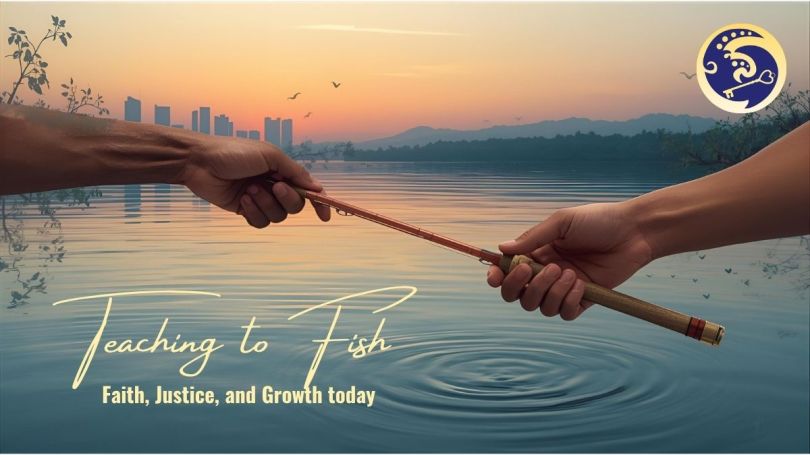
Teaching to Fish: Faith, Justice, and Growth today

A few weeks ago, in a message titled “Living with Truth,” we looked at Amos 8 and Psalm 15, seeing how God despises exploitation and steadies those who live with integrity. We saw that an upright heart is not just a moral ideal, but a firm foundation in a shifting world. Today, as we turn our gaze once more to the prophetic words of Amos, and the poetic truths of Psalm 113 and 1 Timothy 2, we are invited to go even deeper. We are called to see God’s heart for justice not merely as a set of ethical rules or a social program to be enacted, but as a profound act of spiritual worship—a natural, unavoidable overflow of a life lived in His divine presence.

From Presence to Practice: Living a Life of Justice

Consider a scene right here in Panama City: A maid earns about $450–$650 a month. Her days are defined by a quiet, relentless rhythm—hands calloused from brooms, mops and detergents, a body weary from endless tasks. Her labor is a testament to her strength, but her circumstances hold her captive.  If she spoke English, her reality could be transformed by a new opportunity: a job with foreigners, offering higher wages and new possibilities. In some cases, the opportunity to work in a business, not just a home.

On the surface, this is a beautiful story of economic mobility. But what if it’s also a story of a deeper, spiritual transformation—a journey from being overlooked to being fully seen, from feeling defeated to embodying the dignity with which God created her? This new role could be the stepping stone she needs, a way to move into an office position and grow professionally.

We are called, above all, to love our neighbor as ourselves. But sometimes, in our well-intentioned outreach, we stop at handing out fish—a meal, a bag of clothes, temporary aid. We address the immediate symptoms of poverty without looking to the root cause. What if God is calling us to a deeper form of love—not just to teach our neighbors to fish with practical skills, but to teach them to live by the Spirit? To live with the Fruit of the Spirit—love, joy, peace, patience, kindness, goodness, faithfulness, gentleness, and self-control? Practicing God’s presence in our work, in our relationships, and in our communities is how we truly empower others, for it is in our spiritual overflow that we find the capacity to reflect His heart and lift the lowly from the dust to dignity.

Let’s explore how the virtues of justice, the power of prayer, and the grace of reconciliation are not just things we do, but things that grow from a place of deep spiritual worship, transforming minimum-wage struggles into futures of hope.

Faith and Finance: Practicing Presence in the Economy

Amos 8 delivers a searing, prophetic warning to those who “trample the needy” with dishonest scales, exploiting the poor for something as trivial as a pair of sandals ($2.50 in those days, according to some commentators).

Faith,Love Thy Neighbour,Social justice,growth,living with purpose,living in truth,Integrity,spiritual transformation,Love Your Neighbor,fruit of the Spirit,power of prayer,spiritual worship,practicing presence,kindness,time management,self-control,spiritual discipline,emotional intelligence,

This wasn’t just a business crime; it was a profound spiritual betrayal. It was a failure to see God’s image in the very people they were exploiting. In their relentless pursuit of profit, they created a moral and spiritual gap—a chasm between themselves and those they were created to love. They lost the ability to practice God’s presence in their transactions, turning human beings into commodities.

Contrast this with the story of Dan Price, the CEO of Gravity Payments, who in 2015 made a startling decision. He slashed his own $1 million salary to ensure every employee, from the lowest-paid clerk to the most experienced developer, earned at least $70,000. This man is not perfect, but his business model has shown us it’s possible to build a business to foster employee well-being.

We see this emphasis not as a clever business strategy; But an act of profound spiritual integrity. It becomes an outward expression of a heart that was practicing generosity and kindness, where a side-effect is a flourishing company which far outweighs the financial cost. We can model our business on what it means to truly love your neighbor as yourself in a corporate setting. This decision isn’t just about money; it’s about dignity and mutual respect.

In a similar fashion, Fundación Microfinanzas BBVA provides training and micro-loans to women who would never be able to access traditional bank loans. Their stories of success are not just about a loan, but about a woman who used that small loan to start a sustainable business—a local market stall, a small bakery, a sewing business—and became a pillar in her community.

These stories show us that when we act with integrity and love, we create opportunities for dignity and self-sufficiency, turning a simple loan into an instrument of God’s grace. It is a powerful example of how a practical business model can be an expression of spiritual conviction.

From Dust to Dignity: Living the Fruit of the Spirit

Psalm 113 paints a glorious, almost unbelievable, picture of God. He is “enthroned on high,” yet He “stoops down to look” at the heavens and the earth (Psalm 113:4-6). This is the great paradox of God: He is infinitely high, yet He condescends to be intimately involved in our lives. The Psalm continues this breathtaking thought: God raises the poor from the dust and seats them “with princes” (Psalm 113:7-8). This isn’t just a metaphor for a better life; it is a spiritual truth. Justice is a form of worship, an act of love that mirrors God’s own heart, transforming our neighbors from being forgotten to being honored.

Faith,Love Thy Neighbour,Social justice,growth,living with purpose,living in truth,Integrity,spiritual transformation,Love Your Neighbor,fruit of the Spirit,power of prayer,spiritual worship,practicing presence,kindness,time management,self-control,spiritual discipline,emotional intelligence,

In Panama City, CAPTA, a program by Fundación Calicanto, empowers marginalized women. Their training focuses on vocational skills, but the true transformation happens on a deeper level. It is a work of building self-esteem and confidence—a rebuilding of the inner person. This is where the spiritual and the practical beautifully intersect.

From a spiritual perspective, we can see that the professional skills they teach are not merely a checklist for a job; they are an invitation to live with the Fruit of the Spirit. They are a spiritual path in themselves.

Think about it:

  • Professional communication becomes an act of kindness and gentleness, a way of building up instead of tearing down. It’s an expression of inner peace that makes our words steady and our intentions clear.
  • Time management becomes a practice of peace and self-control. It is a spiritual discipline that brings order to chaos and frees us to be present in our work.
  • Emotional intelligence becomes a manifestation of love and patience. It is an acknowledgment that our neighbor’s struggles are real and that we can meet them with empathy.
  • Dress code becomes a reflection of self-worth and inner dignity. It is a way of honoring God by honoring the temple of the Holy Spirit.

By teaching these, we are not just preparing someone for a job; we are teaching them to practice God’s presence in every part of their lives, transforming the exploited poor into Psalm 113’s princes.

Prayer in Action: Aligning Our Hearts with God’s

1 Timothy 2 urges us to pray for all people, especially those in authority, so that we may live “peaceful and quiet lives in all godliness” (1 Timothy 2:1-2). This is not a call to be passive; it is a call to be grounded. Prayer is not a passive wish; it is an active alignment of our hearts with God’s will. It is the fuel for our action.

Daniel’s life is a perfect example. He prayed faithfully three times a day in exile, facing the threat of the lion’s den, yet his prayer life was the spiritual foundation that allowed him to maintain his integrity and influence kings. His prayers weren’t just an escape from his circumstances; they were a way of maintaining his relationship with God, allowing him to be a transformative presence in a pagan nation.

In Haiti, SALT Microfinance is a powerful, modern example of prayer leading to action. They blend savings groups, vocational training, and Bible teaching in a holistic approach to empowerment. A testimonial from a woman named Elashe shows how a small loan helped her start a small store, a business that grew so much that she was eventually able to help her children move to the United States to pursue their dreams. This is what happens when prayer shapes our vision, leading to tangible, life-changing results.

Here in Panama, INADEH trains thousands in vocational skills, a tool for breaking the cycle of poverty. Let’s join our Wednesday night online prayer group to lift up the leaders of these organizations and our neighbors in Santa Ana and El Chorrillo.

For our church: Prayer is where empowerment begins, but it should never end there. It should lead us to ask the question: what is God calling us to do? Could we offer a health workshop, teaching nutrition as an act of loving our neighbor with our knowledge? Even if you are unable to teach, you can pray every Wednesday, asking God to guide our leaders and neighbors. This is how we blend faith and action, shaping peace and justice through empowered lives.

Bridging the Divide: The Journey of Reconciliation

1 Timothy 2:5 proclaims Christ as the “one mediator” between God and man. This is the heart of the Christian faith. Justice, then, is His gospel in action, the visible fruit of a reconciled life, bridging the divides of our broken world. The parable of the Good Samaritan is not just a lesson in kindness; it is a story of radical reconciliation. A Samaritan, despised by the Jewish people, crossed ethnic and class barriers to show mercy (Luke 10:25-37), binding the wounds and restoring dignity to a man who had been cast aside. His compassion was an act of grace that mirrored the mediation of Christ.

Faith,Love Thy Neighbour,Social justice,growth,living with purpose,living in truth,Integrity,spiritual transformation,Love Your Neighbor,fruit of the Spirit,power of prayer,spiritual worship,practicing presence,kindness,time management,self-control,spiritual discipline,emotional intelligence,

In Panama, the AES Panamá Foundation trains youth with technical and English language skills. Similarly, WeGrow Panama mentors young women in STEAM fields. These programs are not just about job training; they are about bridging divides and restoring relationships. They create a space where people can see beyond class and background to find a shared sense of dignity and purpose. They are a powerful image of Christ’s work of reconciliation in our city.

No matter how big or small our involvement, this is how our church can build bridges, not walls, across economic and cultural divides. These acts of reconciliation are a physical embodiment of Christ’s mediation, transforming our community with opportunity and hope.

Conclusion: From Being to Doing

Acts 4:32-35 shows the early church sharing so that “no one was in need.” Their community was a testament to justice and accountability. Like SALT’s savings groups or AES’s training, we can empower, not enable.

The true work of justice begins not with a strategy, but with a spiritual posture. It begins by practicing God’s presence in every area of our lives, allowing His love, His kindness, and His peace to flow through us and into the world around us. When we seek Him first, the actions of justice become a natural, beautiful overflow of our hearts.

This is the very essence of what the scriptures we explored today call us to: to be a people who, like the “upright” in Psalm 113, are lifted from the dust of our own spiritual poverty to reflect God’s justice. It is to live with integrity, rejecting the dishonest scales of Amos, and to be grounded in prayer, as 1 Timothy teaches, so that our lives become a visible testimony to God’s love and reconciliation.

My question for you today is not what you will do, but what you will become. How is God inviting you to practice His presence and cultivate His fruit in your life today? How will that inner transformation spill over into an act of love for your neighbor, an act of justice that reflects the very heart of God?

Perfect control: how to encourage and drive growth

Today, I’m back to one of my favourite passages in James 3: “the untamable tongue”.  Having control of the words of our mouth reflects fully in our relationships. We use words to build others up and encourage them, or we can tear each other down. 

We are warned in the first verse of James not to presume to be teachers (those purporting spiritual authority above others), because these teachers will be judged more harshly.

We all make mistakes, especially in what we say. 

A slip of the tongue for just a moment can destroy a relationship in just a few words.

No amount of saying “I’m sorry, I was angry and I didnt mean it” can rebuild the trust that was destroyed by our words.

Having perfect control of the tongue – to encourage others and drive their growth – is the measure of the perfect man, able to use his self-control in every way. 

From Galatians, we know that one of the fruits of the Spirit is self-control:

Perfect control of your tongue is the hallmark of being filled with the Spirit.

Consider the effect of the words of a school teacher on a child and the impact this may have on them throughout their lives:

  • You’re useless and can’t learn anything.
  • Obviously, you’ll never go to University.
  • I believe in you! Youˋre so hard-working and putting in so much effort, youˋll definitely do great things in the future.
  • I know you can do this! Even though it’s been hard for you to learn these things, youˋve done a great job with this homework. 

And this is even more powerful within the Church.

Imagine what happens when someone in leadership says to our youth:

  • You’re so rebellious, it’s impossible to teach you. There’s simply no hope for you. 
  • With all this rebellious spirit you’ve shown, I’m sure that you will always stand tall and be strong when going against the crowd. You have the strength to be a future leader. 

As we are reminded in James, a large ship is guided by a small rudder. And the tongue of those in leadership can shape the future of our Church and members. 

We don’t have to be in a leadership position to use the power of the tongue. 

  • gossip is mentioned about 133 times in the Bible
  • cursing shows up more than 65 times; and
  • complaining is mentioned more than 100 times.

Proverbs 20:19 reminds us:

A gossip betrays a confidence; so avoid anyone who talks too much.

Worse yet, those who eagerly listen to gossip are considered to be of low character. (Prov. 17:4)

A curse is calling for harm or injury to come to someone, and 1 Peter 3:10 suggest that if we love life and want to see good days, then we should guard our tongue against speaking evil and our lips from lying.

Swearing is not necessarily using curse words – in fact, consider swearing to be verbal abuse.

  • You’re stupid and I hope you die.
  • You will never amount to anything. 
  • You’re so fat and ugly, no one will ever love you.

These are all curses, even though they don’t include any swear words. Instead, we are asked to speak positive and encouraging words to each other. 

Complaining is not the same as letting people know when something is wrong. It comes from the soul and focuses on the problem, rather than on seeking solution.

This is why in verse 7 of James 3 we read:

The tongue also is a fire… It corrupts the whole person, sets the whole course of his life on fire, and is itself set on fire by hell. 

We see examples of this in every day life.

  • Gossip spreads like a wild fire, especially through social media and chat groups.
  • You’re in a meeting discussing a problem and looking for solutions:  One person complains and soon ten people are complaining and the vibe gets dragged down. Soon, everyone has forgotten that the meeting was to look for solutions.
  • One kid in the play ground starts to bully and verbally another, and soon you have a group of kids picking on the victim. 

So, what are we supposed to do?

These verses of James 3, verses 1-12 don’t really offer us the solution. They simply outline for us the power of the challenge and what happens if we fail to control the tongue. 

It’s only when we get to verses 13 and following that we discover the solution:

Wisdom and understanding is shown by a good life, by deeds done in humility and the humility that comes from wisdom.  

So, if we want to drive growth in our community or family, is starts individually: each one of us has to learn to control our tongue.

It’s living from the inside out – what we have on the inside will be shown to others by what we say and do.

Isaiah 50, verse 4 from this week’s lectionary reading offers the following:

To encourage those who are tired and weary.

The Lord GOD has given me a trained tongue, that I may know how to sustain the weary with a word. Morning by morning he wakens, wakens my ear to listen as those who are taught.

This is what we are asked to do.

When we use our words for encouragement and building others up, then we are living a life filled with the presence of the Divine.

God is enriching every aspect of your lives, grace of God, will of God, called to be saints, thanksgiving, enriched in speech, knowing what to say, knowledge, lacking, having all the gifts, waiting, revealed, sustain you till the end, God is faithful, set apart for service, called into community, grace and peace, the right words to say, everything you need to know, necessary gifts, faithfulness

God is enriching every aspect of your lives

Lectionary reading: 1 Corinthians 1: 1-9

In this first letter from Paul to the Corinthians, he reminds them that not only is he designated by the will of God, but rather that all of them are also called.

Leaving aside my personal bones to pick with Paul, I cannot ignore the deep learnings that are available to us from reading this passage. Each of us, even today, has a calling. These verses remind us that we are up to this task – the task of fulfilling our purpose – because the Divine enriches every aspect of our lives.

I want to explore:

  • What we are invited into?
  • Consider the tools and gifts we are each given to fulfil our life mission.

Your Divine purpose

Every tree, every blade of grass, each bird fulfils a purpose on this planet. When we take the time to simply sit and notice, we see how each living being on earth, whether plant, animal or human, fits into the bigger scheme of life.

Nonetheless, we also see a lot of confusion – internally and in society – about our purpose and callings. Many of us are merely “staying alive” and struggling to survive.

Growing up in a very evangelical church, I was brought up to believe that my purpose would be “a cross to carry”. I was terrified of discovering my purpose, hoping it would not be a calling to go to Africa as a missionary. In churches, we talk about “knowing the will of God in your life”, but most of the time it’s put on us as “you’re called into missions” or “you’re called to preach the word of God”.

But if we take a look at most of the “heroes” of the Bible, we find that they were ordinary people with ordinary jobs. They simply happened to be in the right place at the right time. And when they were asked to step into doing something “big”, their lives had already prepared them for this.

Consider Deborah, for example. While she was considered a prophet, she was busy doing her day-to-day responsibilities of being the local “judge”. I’m pretty sure that she didn’t see her job, most days, as anything out of the ordinary. Especially if you watch any episodes of traffic courts or have ever spent a couple of hours in your local magistrate’s court, you will see the everyday complaints that people bring. There was nothing remarkable about her calling — until there was.

Knowing your Divine purpose starts with recognising that we were already given the necessary gifts to fulfil our mission. Paul reminds the Corinthians of this:

“you are not ill-equipped or slighted on any necessary gifts”.

If you are unsure what your purpose and mission are, a great place to start is looking at your talents and natural gifts and abilities. You have everything you need to fulfil your purpose in life. Because a bird has wings, it flies (or if it’s a chicken, it tries to).

I doubt cherry trees complain to each other that they wish they were able to produce oranges, and yet we waste so much of our time lamenting the gifts and talents that we don’t have.

cherry trees, enriched, loved, divine love, loved by the divine, purpose in life

Today I want to invite you to do an inventory of your natural gifts and talents, and consider your calling and purpose in this light.

Set apart for service

Think for a moment of when you are arranging a table for dinner: you go to the cupboard, and you pick up the plates. If there are four of you for dinner, you don’t choose six plates, but only four. You set them aside for service: the ones that you need when you need them.  The rest of the dishes sit in the cupboard, waiting to be shown when they will be required.

Know this: you have been set aside for service. Perhaps you feel like you are sitting in the cupboard – always on the shelf rather than in the game. I wonder if Deborah thought that she was on the shelf as she worked through listening to all the petty complaints that were brought before her.

But Paul reminds us that our purpose will be revealed.

General callings

There are two other callings, apart from our life purpose. We are called to be saints, and we are called into community.

Called to be saints

While Deborah might have been “a saint”, the first description of Deborah was that she was the wife of Lapidoth. I wonder if Lapidoth considered her to be “a saint”; probably not in the way that you and I imagine the word to mean.

So, today I invite you to rewrite your definition of what it means to be a saint!

The calling to be saints is about how we live our day-to-day lives. If I had to sum it up in one word, I would say it’s compassion: 

  • Love for the Divine, with a constant connection that we are overflowing with love and compassion
  • Love for our neighbour as ourself

Compassion allows us to be kind and patient. It will enable us to live with love in our lives, as mentioned in 1 Corinthians 13:

  • not envious, proud or boastful
  • not self-seeking or dishonouring others
  • it keeps no record of wrongs and is not easily angered
  • protects
  • trusts
  • hopes
  • perseveres

We are all called to live in this place of being fulling aligned with Divine Love. What is your personal definition of what it means to live as a saint? Make it realistic for you, rather than something so out of reach that you could not aspire to live each day in sainthood!

Called into community

You are also called into community: that we cannot live in isolation. Take a moment and consider what your community looks like:

  • family
  • friends
  • work colleagues
  • hobbies and activities that you participate in
  • volunteering & community activities
  • your neighbourhood where you live
  • your spiritual community

What does your community look like?

spiritual community, volunteering, charity, neighbourhood, family relationships, social life, professional relationships

God is enriching every aspect of your life

You are promised that nothing is lacking because you have all the gifts that you need. Paul describes this as

God is enriching every aspect of your lives.

He then goes on to explain what he means by this.

You are enriched in speech

This means, when you are in touch with the Divine and that deep inner knowing, you will have the right words to say. Enriched in speech is knowing what to say and when to say nothing.

Most of us want to think about what to say. We make up scenarios and speeches in our head, failing to listen to the still small voice of Spirit.

Consider silence and just going within to listen, confident that you are enriched in speech.

You are enriched in knowledge

Everything you need to know, you will know. Can you trust this?

My first “real job” at sixteen was working as a cashier at McDonald’s: “Would you like fries with that?”. Later in life, I have come to cherish what I learned from “would you like fries with that?” – because it is a lesson in upselling. McDonald’s sells millions of fries every year because of this simple phrase. The client is already there, and they have their wallet in their hand, ready to buy something. The cashier doesn’t know what the client wants, and often the result of the question is “no, but I will have…”. While they didn’t sell the fries, they got an additional sale from the client.

This mundane, everyday job taught me a skill that has served me well over the past thirty years. Am I always open to adding more value to someone else’s life?

You, too, are enriched with knowledge. You have life experiences, abilities and life lessons that you possibly haven’t tapped into. You might not be aware of everything you know.

But trust that you know everything that you need to know when you need it.  You are enriched with knowledge.

Enriched with God’s grace, peace & faithfulness

Today I want to remind you that you are enriched with grace, peace and faithfulness. I don’t mean that you show others mercy, but instead that you accept grace, be open to a peace that transcends your understanding, and that you experience Divine faithfulness towards you.

“Grace is love that cares and stoops and rescues.”(John Stott)

It is said that the grace of God is the opposite of karma – it’s receiving the good that you do not deserve because you are a child of God. You are loved and cherished. In my life, I can see where I have blocked grace, continuing to believe that I deserve punishment and the consequences of my decisions and actions. Nonetheless, we are enriched with grace. Are you willing to accept more grace?

enriched with grace, peace that passes understanding, peace that transforms, faithfulness

We are also enriched with peace: that peace that while we are waiting, we will be sustained emotionally, mentally, physically and spiritually. It’s the peace that we hold within us, even in the middle of the storm. This inner peace does not depend on what is happening in our environment. While we are aware of the situation and in touch with it – we are present – but we also connect with the Divine. It is that Divine that allows us to say

I am not overcome by the storm, because I am one with the storm.

Sometimes storms clear our path. Can you recognise this inner peace which sustains you while you wait?

Finally, the Divine is faithful, constant and true. When I say we are enriched with faithfulness, I am not referring to your faith in God, but rather how the Divine relates to you! It doesn’t matter how small your faith is, but rather that we know that Divine Love is faithful. We can trust that all things are working for our good and that we are enriched with all good things.

Thanksgiving

Our response to this is one of gratitude and thanksgiving.

If you are struggling to discover your purpose, consider a daily practice of gratitude, where you each day you focus your attention and thanksgiving on your talents, gifts, strengths and abilities. Start to notice the patterns and what you genuinely enjoy. Be grateful for the desires of your heart and the wisdom and insight that you gain from being present.

Take note of the times when you receive grace: when in spite of the natural consequences of your choices and decisions, you get a second chance! Practice thanksgiving for all those opportunities.

Start to notice when you are filled with peace, in spite of the situations and challenges you are facing. Be grateful for those moments.

Notice the presence of the Divine in your life in each moment of the day. Sit in silence and be thankful.

sign up, weekly newsletter, Divine Presence
Sign up to receive Beth’s weekly newsletter with the latest blog posts, journal prompts and affirmations.

field of mustard, mustard seed, humble, humility, noble cedar, cedar trees, evergreen, faith, growth, branch, uprooted, chopped down, defeated

“A noble cedar or a humble mustard seed?”

A few months ago I threw some avocado seeds into my compost bin, and now I’ve discovered I have a beautiful avocado seedling growing in my compost.  I’ve very happy about that – but all I did was throw it away! I was expecting to make compost, but now I am very pleased that I need to ask Alexis to locate a great place to plant an avocado tree.  And we all know how big an avocado tree can get.  So, I’m not sure where that avocado tree will get planted, but I am pretty sure that it will produce some great avocados!Read More »

Sermon: Abundance of Grace

How many of you are awake this morning?  I’m looking for a show of hands here…

How many of you were awake while Betsy read the 7 verses from Romans 5: 12-17?  English Standard Version.  It seems amazing that the entire message of the Bible, from Genesis to the end,  is found here, all summed up neatly in seven verses.

If you all understood it, I don’t need to give you this sermon, and we can go straight to the offertory (we’ll skip the prayers) and then head downstairs to the coffee break.  How does that sound?

How many of you think you don’t need to hear this sermon?

How many of you think you can stay awake until I finish the sermon?

We’ll see how you all go with that, shall we?  …

This morning I’m going to take you on an intellectual (read: scientific journal mumbo jumbo), winding maze through one of the toughest texts that I’ve ever had to prepare for.

I am going to try to give you an explanation that you can hopefully understand…  although I am going to rely a bit on my high-school science as it relates to DNA sequencing in the human body and a very basic knowledge of NLP (NeuroLinguistic Programming).

I want to start with the idea of the “Original Sin” and the effect of that “Original Sin” on mankind and how that is passed down from generation to generation.  Verse 12 of Romans 5 starts with

“just as sin came into the world through one man, and death through sin, and so death spread to all men”

We’ve all been taught that Adam had everything he needed to live eternally, but that because of his sin in the garden of Eden, life becomes finite instead of infinite – death enters the world.

And I want to add to that mix the verse from Exodus 34:7 (ESV) that says:

Keeping steadfast love for thousands, forgiving iniquity and transgression and sin, but who will by no means clear the guilty, visiting the iniquity of the fathers on the children and the children’s children, to the third and the fourth generation.”

And I’ve wondered to myself how that might be possible on a molecular and physical level – can science explain what the Bible says happened to Adam because of sin and to all mankind, through the passing of the sin from generation to generation?  How does Adam’s bad nature get down to me all these millennia later? Well, some say, it’s like pollution or poison poured into a river. If a company dumps hundreds of liters of mercury into a river, then no matter how far downstream you go, you still get mercury poisoning.

Now – today I’m not going to give you a definition of sin – or even discuss what Adam’s sin was – trying to become like God, transgressing the Commandment God gave him, or whether sin is simply missing the mark of the most perfect version of yourself that God created you to be (like the archer that fails to hit the target).

What I want to look at is the effect that sin has upon us, as a human race, and then briefly touch about the gift of Abundance of Grace that we are promised in Romans 5: 17.

Our bodies have 3 billion genetic building blocks, or base pairs, that make us who we are. And we are somewhere between 99.5 to 99.9% similar to the person next to us.  A printed version of your entire genetic code would occupy some 262,000 pages! Of those pages, only some 500 would be unique to you. So how much of that do you think you inherited from 20 generations back?  How similar does that make you to the person sitting behind you?

And it seems that in 2017, scientists are getting closer to having the answers as they study the effects of stress and life-styles on our DNA codes and sequencing.  And now it seems that there is a reason for this, on 2 levels: epigenetics and the shortening of our telomeres (the protective casing at the end of a strand of DNA).   The field of epigenetics refers to the science that studies how the development, functioning and evolution of biological systems are influenced by forces operating outside the DNA sequence, including intracellular, environmental and energetic influences (and by energetic, I also mean the emotional forces that affect our bodies organs, such as when we get angry, are upset, or stressed and tired, especially for long periods of time).

Since the 1970s, researchers had known that the tightly wound spools of DNA inside each cell’s nucleus require something extra to tell them exactly which genes to transcribe, whether for a heart cell, a liver cell or a brain cell.

One such extra element is the methyl group, a common structural component of organic molecules. The methyl group works like a placeholder in a cookbook, attaching to the DNA within each cell to select only those recipes —  genes — necessary for that particular cell’s proteins. Because methyl groups are attached to the genes, residing beside but separate from the double-helix DNA code.  Originally these changes were believed to occur only during fetal development. But it has already been shown that DNA can be added to in adulthood, setting off a cascade of cellular changes resulting in cancer, diabetes or other illnesses.  Not only that, but epigenetic change could be passed down from parent to child, one generation after the next (hence you find the reference in the Bible that the sins of the fathers are passed down to the son to the third and fourth generations). A study from Randy Jirtle of Duke University showed that when female mice are fed a diet rich in methyl groups, the fur pigment of subsequent offspring is permanently altered. Just by playing with the diet, they could alter the colour of the fur of the mice.  Now, what if emotions, such as guilt, could play a similar role?

The medical field has already shown that stress has this particular effect.  Telomeres are a protective casing at the end of a strand of DNA. Each time a cell divides, it loses a bit of its telomeres. An enzyme called telomerase can replenish it, but chronic stress and cortisol exposure decrease your supply. When the telomere is too diminished, the cell often dies or becomes pro-inflammatory. This sets the aging process in motion, along with associated health risks.

Now we all know that old wives tale that tells a young pregnant woman not to cry during the pregnancy because her child will bear the effects of it through their entire life – but now science is beginning to understand that the negative effects of stress begin before conception.  A baby’s intrauterine environment is shaped by a mom’s pre-existing physical health. There have also been several studies looking at maternal health and telomeres in offspring: the higher a mom’s prenatal anxiety, the shorter the baby’s telomere length (i.e. the shorter the life span).

According to the new insights of behavioral epigenetics, traumatic experiences in our past, or in our recent ancestors’ past, leave molecular scars adhering to our DNA. Jews whose great-grandparents were chased from their Russian shtetls; a child whose grandparents lived through the ravages of a Revolution; young immigrants whose parents survived massacres; anyone who grew up with alcoholic or abusive parents — all carry with them more than just memories.

So what on earth does any of all this scientific mumbo jumbo have to do with the “Original Sin”, and Paul’s discussion of the original Adam and the posterior Adam (Jesus)?

Well, for starters – it explains how our genetic make up is affected by our habits, our environment, our diet, our stress, and even the stress and anxiety of being ashamed, berating ourselves, or failing to accept God’s forgiveness of our sins.  It explains how any resentment, bitterness or anger that we carry towards another person, when we fail to forgive, affects us to the most innermost of our being as David describes in the Psalms.

1. Your beliefs influence your behavior.  

One of the most basic ways that beliefs can shape reality is through their influence on behavior—no quantum physics or molecular genetics knowledge required.  Beliefs about your basic character—who you are as a person on a fundamental level—can be especially powerful. Research suggests that while guilt (feeling that you did a bad thing) can motivate self-improvement, shame (such as that felt by Adam & Eve in the garden), tends to create a self-fulfilling prophecy, reducing hope and undermining efforts to change, leaving you stuck in the rut of the very behavior you are ashamed of.

And your behavior will directly impact you with respect to your habits, whether they are good habits, or bad habits.

2. Your feelings directly affect your DNA:   

“When we have negative emotions such as anger, anxiety and dislike or hate, or think negative thoughts such as ‘I hate my job,’ ‘I don’t like so and so’ or ‘Who does he think he is?’, we experience stress and our energy reserves are redirected,” and I’m not talking about a positive redirecting. Part of our energy reserves, which otherwise would be put to work maintaining, repairing and regenerating our complex biological systems, which you probably know as your “body”, are used to confront the stresses these negative thoughts and feelings create, leaving your body unattended.

On another level, science is now beginning to understand that humans have multiple brains: the one you know in your head, your heart brain (which generates much of your energy field), and your gut brain.  So, when you are feeling heavy-hearted, what effect is this physically having on your DNA and body – how is it affecting the helix structure of your DNA strands?  When you are in a gut-wrenching panic or suffering constant anxiety, what effect is this having on the nutrients that are getting to your cells and DNA on a molecular level?

3. You may choose, or not, to accept the abundance of God’s grace:   

The entire Bible is about the transformation of man… having been made perfect, having become imperfect, and having reached perfection once more in the person of Jesus Christ.  Having loved perfectly: God and others – fulfilling the 2 greatest laws of the Bible:  To Love the Lord your God with all your heart, soul, mind & strength, and to love your neighbour as yourself.  And how Jesus came to make the way for us to become perfect also in Him, breaking the curses so that they are no longer passed down to future generations, allowing us to re-write the code and become truly transformed, by the renewing of our mind (which will, of course, affect our bodies and even down to our DNA).

There is only one question:  are you willing to allow God’s grace to truly sweep through your life and transform you: To practice abiding in His presence on a daily basis until you reach a level of peace that transcends all human understanding, guarding your heart and mind in His love? 

Let’s pray.


Sources and further reading:

Sermon: Handling Failure

Last week’s sermon focused on Isaiah 49, verses 1 to 7 and in particular verse 4.

But my work seems so useless! I have spent my strength for nothing and to no purpose!

As part of that sermon, we looked at the warning that Jesus gave the disciples on the night of the betrayal, that on this night ALL of them would desert him.  Which they did after the was arrested, in spite of Peter’s assertion that while everyone else might desert Jesus, he would be faithful.  And we watched Peter fail.

I reminded  you that Jesus expected them to fail and wasn’t judging them for their weakness.  In fact, he knew it was a lesson that they needed to learn.  I ended that sermon asking the following 2 questions, that I would like to address this morning:

How do you handle failure? What do you do in the face of fear?

The first thing I would like to remind all of us is that we don’t grow through our successes:  we learn from our mistakes and failures.  Think of Peter, and his many mistakes and opportunities to learn:

  • This is the disciple that gets out of the boat and starts sinking when he takes his eyes off Jesus and looks at the storm
  • The one that rebuked Jesus for talking about his crucifixion and death
  • Was told “Get behind me Satan” by Jesus
  • Promised that he would never desert Jesus and yet denied him 3 times
  • Even doubted when he saw the empty tomb!

Failure… and yet this was the rock on which Christ chose to build the church!  Because he got back up and learnt from those mistakes.

John Maxwell wrote a book a good few years ago now titled “Failing Forward: how to make the most of your mistakes”.  If you haven’t read it, I would encourage you to scrounge a copy and take time to learn how to make better mistakes!  Sorry – how to make the most of the mistakes you’ve made.

I would start with looking at 2 aspects of the mistakes and failures in our lives:

  1. How do you view your failure?
  2. How do you respond to your failure?

HOW DO YOU VIEW YOUR FAILURE?

There are 2 ways we can look at our mistakes and our failures.

We can react like Adam and Eve:  It was the serpent’s fault, it was the woman you gave me who caused this, and play the blame game.  Maybe it was your staff’s fault, the secretary, the economy, the supplier that failed to deliver on time. Many times, we try to hide or conceal our failures, living our lives covering up or becoming prisoners of pretense.  It’s hard to learn from something that you are hiding from!

Or we can look at it like David: “I have sinned”, with true repentance in his heart.

The second part of looking at and viewing your failure, is whether you can look at it as actions and decisions and not circumstances or part of who you are.  When David says “I have sinned”, he talking about his actions and his decisions – he doesn’t say “I am a failure, my life is a disaster”.  He takes responsibility for his his actions, but doesn’t automatically assume that this is his entire life.  He doesn’t take this on as a complete way of being:  believing that therefore he can succeed at nothing!

How do you talk about your failure and yourself?

  • I just can’t keep going
  • I’m ready to quit, walk away and not look back
  • Why are people always doing this to me?
  • Why does God allow this to happen to me?
  • I’m just such a failure, idiot, etc.
  • I’m so stressed, I just can’t handle this.
  • There’s just not enough time, there’s no way I could get this done.
  • How could I be so stupid?  Look at the mess I made!

If you heard someone else talk about you the way you talk about yourself, you would probably stand up for yourself!  But we often talk toxicly without even realizing what we’re doing.  When you beat yourself up, a blunder or a moment becomes a hurricane of failure!

How you handle setbacks in life will shape you: will you focus on the failure or on the change that you need to make?  Will you allow it to define who you are, or choose to become someone that will overcome? Like I mentioned last week, most of the so-called heroes in the Bible were ordinary people who accomplished extra-ordinary things!  They were humans who overcame their weaknesses and mistakes and went on to learn to do greater things.

It’s one thing to identify the behavior, actions, attitudes that are wrong and another thing entirely to self-deprecate ourselves.  It’s not the same to say “I’m an idiot that just ruined my career”, as saying “That was a really poor choice of words and I could have done better”.  Life is much more than just an event or a series of events:  no one is a total failure and no one falls all the time.

This season, this moment does not have to be final: if you throw in the towel, it’s final.  But a ball game isn’t over until the last man is out!

I’d like us all to try a little experiment this morning, to show you the power of your words.


HOW DO YOU RESPOND TO FAILURE OR MISTAKES?

If you have viewed your failure as “it was inevitable”, or “there was nothing I could do” or “it was someone else’s fault”, there’s a strong possibility that you could allow anger, bitterness or resentment to grow inside, and be destined to repeat the same mistake again.  If we live on the defensive, like King Saul in 1st Samuel, justifying ourselves and our actions, it’s hard to learn the lessons.

In particular, when we look at King Saul, we find someone who never takes responsibility for his mistakes – I didn’t keep the animals alive, the people did.  I only did it because the people pressured me to do it.  And more so, his “repentance”, if you can call it that, seems to have no interest in the cause (or why he really did it) and therefore no cure for it!  One of the beauties of poor decision making is that if you can identify the cause of your weakness, you can make better decisions in the future.

Remember this:

“A mistake repeated more than once is a decision.”

“Those who fail to learn from history are doomed to repeat it.”

Or you can choose to learn from this, growing wiser and making better decisions in the future.  We can look at why we failed and when we failed.  We may have to follow back a chain of events to get to that first decision that set us up on the wrong path.  The decision we put off when we should have made a choice.

But when we admit our failures, we conquer pride.  There’s possibilities of change.

We read in Isaiah 9, verse 2 earlier:

“ºThe people who walked in darkness have seen a a great light; those who lived in a land of deep darkness on them light has shined.”

Now, it’s true that the process of learning, picking yourself up, dusting yourself off and getting back into the game may be painful.  I never promised that it wouldn’t hurt a little!  But I’m saying it will be worth it!  The kid on the bike may have grazed his knees, those of you who are still working out and getting fit as part of your 2017 resolutions are still feeling the pain in your muscles as you train!

Hebrews 12, verses 11 to 13 remind us:

“All discipline for the moment seems not to be joyful, but sorrowful;  yet to those who have been trained by it, afterwards it yields the peaceful fruit of righteousness.  Therefore, strengthen the hands that are weak and the knees that are feeble, and make straight the paths for your feet…”

Become more like Christ will stretch you – and stretching will take you outside of your comfort zone.  It’s going to be uncomfortable and sometimes even painful.  God uses everything in our lives to transform us into the people He means for us to be – mistakes and failures should be responded to as learning experiences, rather than being considered character traits.  It’s not who you are – it’s what you did or what happened to you.

THERE IS ALWAYS A THIRD WAY – AVOIDANCE

Some people will do anything not to fail, even doing nothing.  The person who does nothing will certainly not fail… they risk nothing.  But there is no gain, no lesson, no wisdom to be gained in sitting on the sidelines!  They become just like the servant in Matthew 25 that hid his talents in the ground, well at least I’ll still have them!

They say that the only thing worse than a quitter is the man that is afraid to begin!  Achieving low aims, low goals, can be a greater failure than aiming for a higher target, and missing!   You will always miss 100% of the shots what you fail to take!

Have you ever heard anyone say:  “I achieved everything I have because I am a perfectionist.”?  Probably not!  That’s because it’s not until you are free to fail that you are free to succeed and do greater things!


I want to close this morning with the analogy of an acorn.  When an acorn looks at itself and the possibilities that life offers, it may see itself just as an acorn, or it may dream of one day becoming an oak tree.  So you take that acorn, and you throw it in the ground, maybe you put a little dirt over it.  It’s not very nice to have dirt thrown on you!

That acorn may choose that it’s not willing to change, and it’s not willing to let go of being an acorn.  But in order to become an oak tree, that acorn needs to die!  It has to die to its littleness and smallness and embrace the idea that God gave it the divine possibility of becoming a great oak.  But becoming a great oak means letting go of what it is right now.  Being willing to let God transform it into something completely new and different.

You can either choose to hold onto and embrace who you are today and your ideas of what you are, or you can embrace the vision that God has of who he would have you be, letting go of what you are today, risking failure in order to learn, moving outside of your comfort zone, and taking a chance of becoming that strong oak that God envisions you being.

Lets pray!

Sermon: Laboured in Vain

I have laboured in vain, I have spent my strength for nothing…

Over one hundred years ago, Teddy Roosevelt gave what would become one of the most widely quoted speeches of his career.  In addition to touching on his own family history, war, human and property rights, Roosevelt railed against cynics who looked down at men who were trying to make the world a better place.  People like Isaiah, trying to turn the people of Israel back to God, and yet failing miserably at it.

Teddy Roosevelt in this speech said:

“A cynical habit of thought and speech, a readiness to criticize work which the critic himself never tries to perform, an intellectual aloofness which will not accept contact with life’s realities—all these are marks, not … of superiority but of weakness.”

Life is made up of challenges – for each one of us they are different!  And there is always going to be someone on the sidelines criticising your performance, as you struggle to be “wonder woman” or “super man”.  And that intimation of failure often causes us panic, even despair.

Failure is considered an unpardonable sin in a world where we sanctify the successful and worship winners.  Everybody wants to succeed – no one wants to be considered a failure!  How many people do you know whose life goal is to fail?  But this emphasis on success can put an enormous stress on us.  No one wants to be called a failure.  If I fail, what will happen to me? What will others think?  Will they reject me?  Are they going to think I’m worthless?   And yet, our responsibility is to rise from mediocrity to competence, from failure to achievement.

Simply put:  your task on earth is to become your best version of you.  You are unique.  God made you specially just like you – there is no one else exactly like you – and you have a special purpose on this earth, otherwise God would not have made you and put you here! And if you haven’t done it already, you need to take a day or two and sit and medidate (in silence – and for pity’s sake, stop talking and turn off the mobile devices!), and listen to hear what that purpose is.  The Bible of full of examples of ordinary people who did extraordinary things. We’ll talk more about that next week!

The world has a few examples of failures that went on to do some remarkable things:

  • I’m sure you’ve all heard of that guy Henry Ford, bankrupted 2 automobile industries and ruined all his chances of good investors.
  • Or maybe that guy Fred Astaire.  His first screen test didn’t go so well: “Can’t sing. Can’t act. Slightly balding.  Can dance a little.”
  • Then there’s that guy that had trouble adjusting to the culture and classes at Yale, so he dropped out.  He went back again later, and it still wasn’t for him, so he dropped out again.  His name’s Dick Cheney.  Never going to amount to anything!
  • Or there’s that single mother on welfare who was trying to write.  I think her name was J.K. Rowling or something.
  • Or that kid whose teacher told his mother he was “too stupid to learn anything”.  He was unfortunate enough to be called Thomas Edison.
  • And there’s that guy who was so frustrated trying to write his first novel, that he threw away the entire first draft!  His wife found this manuscript for a book “Carrie”, and rescued it from the trash.  You might have heard of him – Stephen King.

There’s a reason you are in church this morning – maybe you are stuck in a place of despair, ready to give up, not sure how to keep up the good fight. But men and women can change: once again we have a Bible full of examples of people who stopped in their tracks and had a heart change, which became a totally new person.  To mention a few of the better know examples from the New Testament:  Saul who became Paul; Simon who became Peter; Jonah (in spite of his best efforts to the contrary); Levi the tax collector who became Matthew the disciple.

But on the road to that transformation, there are holes.  And if we’re not careful, that hole becomes a rut.  And before you know it, you’re stuck in that rut, and your following that rut instead of the path that you’re supposed to be on, because it’s much more comfortable to stay in the rut than to try to get out of it.  And let’s be honest, sometimes getting out of that rut looks impossible!  You tell yourself, it just can’t be done! This is is – the best I can do, the most I can be.

Isaiah is in a rut (and feeling sorry for himself), in verse 4 of our reading this morning:

“But my work seems so useless! I have spent my strength for nothing and to no purpose.”

This is the same servant that said:

“Before I was born, the LORD called me:  from my birth he has made mention of my name.”

He knew what his calling was! He was predestined to do God’s work!  There’s an amazing amount of expectations upon him! And God gave him all the gifts and tools he needed for the task.  Remember verse 2:

“He made my mouth like a sharpened sword, in the shadow of his hand he hid me:  he made me into a polished arrow and concealed me in His quiver.”

I was MADE for this.

But his progress report in verse 4 is not very encouraging:

“My work  is so useless! I have spent my strength for nothing and to no purpose.”

Probably a good time just to go back to bed! The task is too great!  I’m inadequate.  I can’t do it!

Now the whole book of Isaiah can be divided into 2 principle sections:

  1. Part one is chapters 1 to 39, which address Israel’s continuing sin and rebellion, where their hearts are so hardened that no matter the strength of Isaiah’s tone and words, nothing will turn them. They became self-centered and inward-looking; they forgot their covenant.  They forgot they were a people belonging to God. Finally, Isaiah brings a message of judgement and exile – the Old Jerusalem is condemned and will be no more.
  2. Part two, chapters 40 to 66, opens with words of consolation “Comfort, comfort my people, says your God”.  It finishes with the emergence of the NEW Jerusalem.

So we see in Isaiah a transformation – from the old to the new:  the old Jerusalem is torn to the ground and then rebuilt as a new Jerusalem.  You see, when everything is stripped away, our spirit starts to show through, and then our relationship with God and the eternal comes clearly into focus.  Maybe right now you’re sweating and you can’t see the results of all your hard work: and instead of giving up, maybe it’s time to take a small rest and remember WHO you are and WHY you were put on this earth!

1 Peter (2:9-10) reminds us:

You are a chosen people… a people belonging to God… Once you were not a people, but now you are a people of God…”


And I have another little gem for you, God expects you to fail!  Yes, you heard that right: God doesn’t expect you to get it right the first time. In fact, he has an expectation that you are going to fall!

How many of you have children and have taught that child to ride a bicycle?

The first time you put them on the bike – did they get it right?  How many chances did they need to learn?  How many got it on the 2nd time? the 3rd? What do you mean it took 54 times before they learnt?

Well, why are you so hard on yourself?  Why do you expect to learn in just one go?  Let’s go back to the kid on the bike:  you have a little hill (without a main road down the bottom!), it’s a safe place to learn to ride.  So you have this kid who has finally mastered balance and steering (for the most part), and they riding down the hill now pretty well!  So you finally reach the moment when you think they are ready, and instead of pushing the bike back up to the top of the hill again for the kid, you tell, well, why don’t you ride UP the hill now?  And what’s the first thing that happens?  They fall off!  Because it’s easy to ride the bike down the hill and keep your balance when you have a little momentum!  But when you meet resistance and you have to keep your balance AND pedal hard, and you’re new at this, you fall over the moment you push too hard on the left side without adjusting your balance on the right side to counterbalance the force you’re using to get yourself up the hill!  Right?

And God knows this!  God’s been watching us since the Garden of Eden.  How many people has he seen fall off the proverbial bicycle since the world was created?

Matthew 26 reminds us that on the night of the betrayal, when Judas betrays Jesus and gets him arrested, that Jesus said to ALL the disciples (not just one of them, not just Judas):

Tonight, all of you will desert me.

We all remember Peter’s response to that, right? Oh no, not me!  I’m good.  Even if everyone else does.  I won’t.  I’ll be the man.  And in the garden, when Jesus is taken, Peter tries to live up to his word, taking out his sword and cutting off the ear of one of the soldiers.  I’m sure he’s flabbergasted when Jesus heals the ear!

But there was one lesson that Jesus hadn’t taught his disciples yet, and they needed to learn it the hard way – enough with parables and teaching. They needed to experience this first hand.

How do you handle failure?  What do you do in the face of fear?  

And that, ladies and gentlemen, is what we are going to talk about next Sunday.


I want to leave you with one parting thought today from Teddy Roosevelt’s speech in 1910:

“It is not the critic who counts; not the man who points out how the strong man stumbles, or where the doer of deeds could have done them better. The credit belongs to the man who is actually in the arena, whose face is marred by dust and sweat and blood; who strives valiantly; who errs, who comes short again and again, because there is no effort without error and shortcoming; but who does actually strive to do the deeds; who knows great enthusiasms, the great devotions; who spends himself in a worthy cause; who at the best knows in the end the triumph of high achievement, and who at the worst, if he fails, at least fails while daring greatly, so that his place shall never be with those cold and timid souls who neither know victory nor defeat.”

Let’s pray!

sunlight, streetlamps, more light, firelight, candlelight, torchlight, incandescent light, illuminate, floodlights, light is metaphore, knowledge, truth, the age of enlightenment, growth, light is energy, force, light is light, make straight, in the beginning was the Word, life, the light of men, the light shines in the darkeness, let there be light, breath of life, light of the Spirit, joy, giving, radiant

Sunlight is said to be the best bleach and streetlamps the most effective police officers…

Lectionary Readings:
  1. Isaiah 61:1-4, 8-11
  2. Luke 1:46b-55
  3. 1 Thessalonians 5: 16-24
  4. John 1:6-8; 19-28

Growing up here in Panama, I went to Boarding School in Chame. As a child, after playing games or skating on the basketball court, we’d head back to our dorms, taking the shortest way back straight across the soccer field.  Pitch dark – although probably only 7.30 or 8.00 p.m.  Not something I wanted to do alone!

I remember (probably on more than one occasion), walking back across that field, and my friend Marion would let out a screech or scream and take off running, and I would scream and bolt for the buildings and the lights.  In overtaking her I would notice she was doubled over with laughter, but that wouldn’t really sink in until I was safely standing, out of breath, on the porch under the lights.  She’d eventually show up, still laughing.  I was so predictable: waiting for those unseen snakes or ghouls or scary monsters to grab me out of the dark.

I’m not afraid of the dark, I’m just scared of what might be hiding in it.

Today I want to speak about the LIGHT.

Ever since mankind crawled out of the primordial slime, we’ve cried: “More light.”

Sunlight. Firelight. Candlelight. Torchlight. Neon, incandescent light that banishes the darkness from our caves, homes; lights that illuminate our roads, dangerous intersections and treacherous corners; and even lights that turn on when you open the door scaring the bogey man out from inside our refrigerators. Floodlights for our sports arenas. Tiny flashlights for those books we read under the covers when we’re supposed to be asleep.

Light is so much  more than watts and foot-candles. Light is metaphor: knowledge and truth (the age of enlightenment); light is life and growth (photosynthesis, vitamin D); light is energy and force; and light is light.

There was a man sent from God, whose name was John.  He came as a witness to testify to the light, so that all might believe through him.   He himself was not the light, but he came to testify to the light.

The Pharisees said to him: “Who are you? Let us have an answer for those who sent us.  What do you say about yourself?”

He said “I am the voice of one crying out in the wilderness: ‘Make straight the way of the Lord.’”

This is our third week of Advent, our celebration of the birth of Jesus: the way, the truth and the life.  The gospel of John starts with these words of Truth:

In the beginning was the Word, and the Word was with God, and the Word was God… Through Him all things were made… In Him was life, and that life was the light of men.  The light shines in the darkness…

Notice the connection with Genesis 1?

Now the earth was formless and empty, darkness was over the surface of the deep… And God said, “Let there be light” and there was light. God saw that the light was good…

And to Genesis 3?

The Lord God formed the man from the dust of the ground and breathed into his nostrils the breath of life, and the man became a living being.

I want to start today by quickly reviewing the dichotomy of light versus darkness, in all its metaphors. Take a moment to reflect on these contrasts. What images come to mind as I read these words of Light and Darkness?

Doubt Anxiety Nightmares Despair London winter Dimness Depression Fear Tiredness Lethargy Captivity Blindness Haunted  Sickness Grief Sadness Deception  Heavy-hearted Addicted Imprisoned Contaminated Hatred Ignorance Consumed Hungry Famine

Faith Peace Courage Energy Dreams Freedom Hope Health Sunshine Sight Brightness Pleasant Contentedness Truth Joy Happiness Light-heartedness  Free spirit  Pure Love Knowledge Rejuvenated  Plenty Satisfied

Light is a force and energy, whereas darkness is merely the absence of this force and energy.  So, when the Bible says that God is LIGHT, what are the author’s trying to communicate to us?  It doesn’t say that God is LIKE light, or God is “surrounded by” light, or “God has a great big electric generator so He can sit in the spotlight”, it says “God IS light”.

Light is the essence of God – the same way that man is flesh and blood.  This light is self-existent, God possesses this power in and of Himself.  It has no external source. God is pure light, not diluted or mixed in any way with evil, hatred, untruth, ignorance or hostility. God is light is not a theoretical assertion about the nature of God, but a statement that drives us to the heart of what God is like: God is pure light.

God is the source of all living things.  God is truth and enlightenment.

If we briefly look at some of man’s encounters with God in the Bible, we can see a little better this Light and its many meanings.

Think of Moses’ first encounter with God: the burning bush. The bush was on fire, but was not consumed by the flames.  God has his full attention – but didn’t have to destroy anything in order to do so.

The children of Israel got a glimpse of the glory of God at Mount Sinai:

under his feet was something like a pavement made of sapphire, clear as the sky itself… but the cloud covered the mountain, and the glory of God looked like a consuming fire on the top of the mountain.

This was all a little much for the children of Israel, especially when Moses came down from Mount Sinai with a radiant face, and they were afraid to come near him.  A little like Jesus’ transfiguration  on the mountain with Moses and Elijah.  A bright cloud enveloped them… and when Peter, James & John heard the voice, they fell facedown to the ground, terrified.

On the other hand, think now of David, and his beautiful psalms. Here we find at least three metaphors:

  1. Picture God “clothed in garments of light”, symbolising the One who is pure, righteous and holy (there is no dirtiness, nothing to taint or contaminate God).
  2. God’s revelation through spoken and written word gives light: “Thy Word is a lamp to my feet and a light to my path.”; offering moral guidance and direction for how to live.
  3. Light symbolises also salvation: “God is my light and my salvation, whom shall I fear? The LORD is the strength of my life; of whom shall I be afraid?”

Or how about Isaiah:

The sun shall be no more thy light by day; neither for brightness shall the moon give light unto thee: but the LORD shall be unto thee an everlasting light, and thy God thy glory.

Did you ever notice that most of the prophets start with “The word of the Lord came to…”, except for Ezekiel. Have you noticed Ezekiel’s spaceship?

I looked and I saw a windstorm coming out of the north – an immense cloud with flashing lightening and surrounded by brilliant light.  The centre of the fire looked like glowing metal, and in the fire was what looked like four living creatures (with faces and wings – each of the four had the face of a man, the face of a lion, the face of an ox and the face of an eagle) – so it didn’t matter which way they were facing, they were always facing forward.  The appearance of the living creatures was like burning coals of fire or like torches.  Fire moved back and forth among the creatures; it was bright and lightening flashed out of it.  The creatures sped back and forth like flashes of lightening.

Spread out above the heads of the living creatures was what looked like an expanse, sparkling like ice, and awesome… Then there came a voice… Above the expanse over their heads was what looked like a throne of sapphire, and high above on the throne was a figure like that of a man.  I saw that from what appeared to be his waist up he looked like glowing metal, as if full of fire, and that from there down he looked like fire; and brilliant light surrounded him.  Like the appearance of a rainbow in the clouds on a rainy day, so was the radiance around him.

This was the appearance of the likeness of the glory of the Lord.  When I saw it, I fell facedown…

I’m somewhat relieved I haven’t had THAT encounter with God!  And then sent out to preach against the injustice and evil of man…

And what about Paul? While breathing out murderous threats against the disciples, on the road to Damascus suddenly a light from heaven flashed around him, sending him to the ground.  When he got up and opened his eyes, he couldn’t see.  And for three days he was blind.  Three days to sit in quiet and solitude, and meditate on the meaning of his life.  Three days to sit and think about what he’d been shown when he saw the light.  Three days to wonder if the light was going to be the last thing he ever saw.

And yet, without light, none of us can see.  Our eyes are useless in the pitch dark.  Our sense of hearing and smell and taste and touch are unaffected by the darkness – but take away the light, and we are all blind.  We need the reflection of light off objects to be able to see them.  Light = sight.

You know, and I know, we each need that encounter with the LIGHT.

Some of us will find that light burning within us, but like the burning bush, this light doesn’t consume us. It is the Light that sends us out to rescue those who are prisoners or slaves, whether they are addicts, those imprisoned by poverty, those bound by depression or those just in need of love.  This light from within feeds itself and gives us energy and light, but it doesn’t destroy us. It is the light of life!  The light of the Spirit! The light of joy and giving! This is the Light that we are called to share with our fellow man. Don’t hide this light under a bushel.  We are not to be mirrors of this light – this light is meant to burn inside each of us!

Some of us will fall on our faces, before the purity and power of the LIGHT, and simply worship.  And when we walk away, after being in God’s presence you will be radiant, transfigured.  Perhaps scary for others to see, but we will be RADIANT.

Some of us need to walk in the light, as David did: the light that guides each footstep and guides our path. We all need the words of truth.

Others will find in the Light that place of safety and security, the salvation that they so desperately need.  The light that lifts them out of depression or addiction.  The light that sets them free.

Some of us may be in that place where it seems that there is no light from the sun, and then we will hear, as Isaiah did “the LORD will be an everlasting light”.

Others of us will need to see the supernatural, like Ezekiel. That light that takes our breath away – and when it’s done, empowers and emblazons us to stand up and speak out against the injustices in the world.   That takes us to fight for the 13 million people in the Horn of Africa that are starving because of the drought; the drive and motivation to face the starving refugees of Somalia; the motivation to stand up in “occupy” and say I disagree with the financial powers that be, “this is wrong”; or whatever message is laid on our hearts regarding the injustices and inequality in this world.

We need that Light that moves us to pray for the family in England of the man who after losing his job went home and shot his wife and daughter and 2 other children and then turned the gun on himself, leaving 2 orphaned children in the hospital to deal with the horror of the future without a father or mother or sister.  And yet others will be called to minister directly to the grieving.

Some of us need that jolt of lightening like Paul, that stops us in our tracks, and makes us take time out from our endeavours and goals and plans, and the rat-race we call life, to make us rethink the direction that our life is heading in.

But more than anything, ALL of us need to be plugged into the LIGHT, the energy, the life-force.  We are all like stand-alone computers, that until we are plugged in to the electricity, we can’t do anything, and unless we’re connected to the network, there’s a limit to how much information or data we can access.  We all need to be plugged in and connected.

We read in first John 1: 5-7

This is the message we have heard from Him and declare to you: God is Light; in Him there is no darkness at all.  If we claim to have fellowship with Him, yet walk in the darkness, we lie and do not live by the truth.  But if we walk in the light, as He is in the light, we have fellowship with one another, and the blood of Jesus… purifies us from all sin.

I ask each of you to take a moment right now, before we go on with this service, to meditate on what God’s Spirit reveals to you.  How are you called to respond this Christmas season?

Some of us will be called, like Isaiah to proclaim:

The Spirit of the Lord God is upon me, because I have been anointed by the LIGHT; the LIGHT has sent me to bring good news to the oppressed, to bind up the broken-hearted, to proclaim liberty to the captives, and release to the prisoners; To proclaim the year of the LIGHT’s favour… to comfort all who mourn; … to give them a garland instead of ashes, the oil of gladness instead of mourning, the mantle of praise instead of a faint spirit. For the LIGHT loves justice, and hates robbery and wrongdoing; the LIGHT will faithfully give them their recompense. … I will greatly rejoice in the LIGHT, my whole being shall exult in my God; for the LIGHT has clothed me with the garments of salvation, and covered me with the robe of righteousness…   For as the earth brings forth its shoots, and as a garden causes what is sown in it to spring up, so the LIGHT will cause righteousness and praise to spring up before all the nations.

Others, will, like Mary proclaim:

My soul magnifies the Lord, my LIGHT, and my spirit rejoices in God my Savior, for the LIGHT has looked with favor on the lowliness of this servant. Surely, from now on all generations will call me blessed; for the Mighty One has done great things for me…  His mercy is for those who fear him from generation to generation. He has shown strength with his arm; the LIGHT and TRUTH has scattered the proud in the thoughts of their hearts. The Mighty One has brought down the powerful from their thrones, and lifted up the lowly; the LIGHT has filled the hungry with good things, and sent the rich away empty. The Mighty One has helped his servant … in remembrance of His mercy.

And finally, from Paul we are reminded:

Rejoice always; Pray without ceasing; Give thanks in ALL circumstances, knowing that this is the LIGHT’s will for you. Don’t quench or put out the Spirit of Light by allowing darkness to take hold in your life; Do not despise the words of the prophets, but test everything that you are told and hold fast to what is good and true; abstaining from every form of evil.  And know that the God of peace Himself will sanctify you entirely; that your spirit and soul will be kept sound and blameless, no matter what happens or how crazy this world gets.  Because the one who is call THE LIGHT has called you, and the LIGHT is faithful and true, and will do this.

spiritual growth, reading, studying, prayer, holy spirit, the fear of the Lord, the power of prayer, women, the role of women, point of power, divine presence, presence of the divine, practising the presence of the Divine, the power of the tongue, the words of your mouth

Spiritual growth for a decade

There’s nothing like having high expectations of yourself and raising the bar.  And one of the areas in my life that I have started to refocus on is spiritual growth.

Admittedly, it all started in 2008 when Dr. Taylor challenged me to become a “Virtuous Woman”, according to Proverbs 31.  Now THAT is a woman I am very happy to imitate.  Following on from that, she challenged me to become “wise”, so I started reading a chapter of Proverbs each day, to increase in wisdom.  I was reading a lot of John Maxwell, on leadership, and each of the other books I read seemed to take me back to the Bible.  (Why is it that the good authors on leadership are all from churches?).

Eventually, that lead me to reading other books of the Bible and then to start reading Bible study books.  I got hooked, somewhere along the line, on Elizabeth George and her book “A Woman after God’s own heart”, referring to David being a man after God’s own heart.

In her book, which I finished some time last year, she challenges each woman to choose 5 topics and over the next decade become “an expert” in those 5 areas.

So, I’ve chosen 5 topics that caught my attention, principally because of Proverbs and also in part because they are areas that I simply feel I don’t understand.

  1. The fear of the Lord (which is the beginning of wisdom, according to Proverbs).  Who is God?  What does it mean (in this day & age) to fear him?  What is “fear”?
  2. An intimate relationship with God: which is really 2 topics – Prayer and speaking to God; and being filled with the Holy Spirit.
  3. The tongue – blessings and curses, the control of the tongue, the power of the tongue for good and for bad.  What we build up and what we tear down.
  4. Women – how do I reconcile the Virtuous Woman in Proverbs 31 with what Paul says about women in 1 Timothy 1: 11-12.  Throughout most of what is written by Paul, he makes mention over and over to the fact that women “caused” the fall of man and were lead astray, and lead man astray.  (Unfortunately, Eve wasn’t the only woman to do this – Sara did so with Abraham, giving him Hagar to have a child, as well as other examples in the Bible).  But, how do I reconcile this model to follow in Proverbs with other parts of the Bible.  What about Deborah?

Anyway, by 2020 I want to be an expert in these 5 areas of the Bible. So, when reading my Chronological Bible I am paying special attention to everything about these topics, and I am accumulating a library of books that study these topics.  And trying to get a little further ahead each week in reading and studying about them and how they fit into daily life.

One of the other things I’ve learned about is tithing, and since for me “time is money”, I am tithing not only my money, but also my time to study.  So, setting aside about 2 1/2 hours each day for prayer (practicing prayer) and study.  And all sorts of different study aids and guides to keep me motivated and moving.

Believe in your infinite potential. Your only limitations are those you set upon yourself.