authentic,authentic living,bold,boldness over fear,choosing faith over fear,Divine Law,divine presence,divine wisdom,embodying faith,fear,freedom,fruit of the Spirit,generative wisdom,heart-centered living,Holy Spirit,humility,inner transformation,Integrity,living authentically,Love Your Neighbor,new covenant,spiritual freedom,

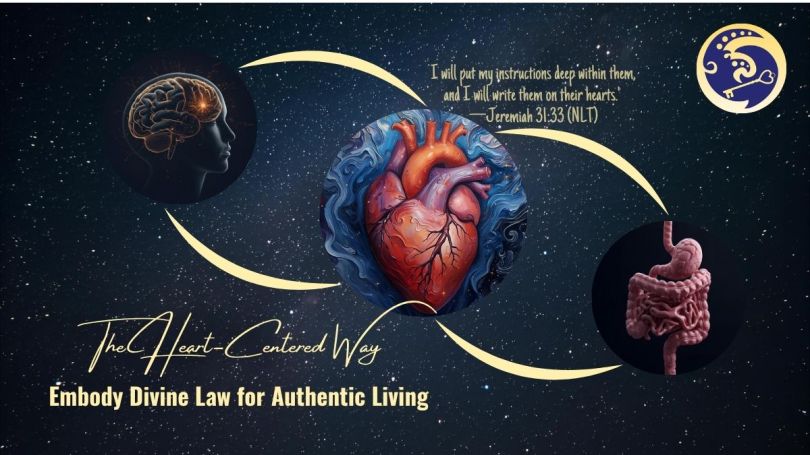
The Heart-Centered Way: Embody Divine Law for Authentic Living

In a fragmented world where decisions pull you in every direction—scheming strategies clashing with visceral drives and fleeting emotions—the heart-centered way invites you into the transformative rhythm of Divine Presence.

As Jeremiah 31:33 declares, God promises to inscribe His Divine Law not on stone tablets, but deep within your heart, unlocking authentic living as a flow of embodying faith that reshapes your core. Crucially, this isn’t rigid rule-keeping; it’s an inner transformation fueled by the Holy Spirit within, granting spiritual freedom to navigate life’s complexities with coherence and joy.

Drawing from the wisdom of Psalm 119’s honey-sweet meditation and 2 Timothy’s equipped endurance, we’ll explore how this New Covenant blueprint harmonizes your God-given centers—mind, spirit, and drive—for decisions that sow abundance and ripple love outward.

The Promise of Divine Presence: Awakening to the New Covenant

The prophet Jeremiah stood at the breaking point of a nation. Israel and Judah were in exile, a consequence of continually breaking the covenant God had established through Moses. That covenant—etched onto stone tablets—was a good and perfect law, yet it remained external. As a result, it was a law you could fail to keep, leading to cycles of obedience, failure, and punishment. The law was out there; the problem was always in here.

However, Jeremiah offers a vision of divine reset, a New Covenant that is unlike the old. God says: “The days are surely coming, says the Lord, when I will make a new covenant… I will put my law within you, and I will write it on your heart; and I will be your God, and you shall be my people” (Jeremiah 31:31-33).

authentic,authentic living,bold,boldness over fear,choosing faith over fear,Divine Law,divine presence,divine wisdom,embodying faith,fear,freedom,fruit of the Spirit,generative wisdom,heart-centered living,Holy Spirit,humility,inner transformation,Integrity,living authentically,Love Your Neighbor,new covenant,spiritual freedom,

This promise is the ultimate invitation into Divine Presence. It’s not about geography or temple rituals; it’s about intimacy. God moves the legal center of the universe—His governing Divine Law—from a scroll locked away in an ark to the deepest core of your being. Consequently, this is the difference between obeying a rulebook out of fear and aligning your very desires with God’s will out of love.

The shift means that knowing God is no longer a privilege of the few—a priest or prophet—but an intuitive reality for you: “for you shall all know me, from the least of you to the greatest” (v. 34).

Moreover, the New Covenant is God’s revolutionary act of grace, promising not only an inscribed heart but also full forgiveness: “I will forgive your iniquity, and remember your sin no more.” This foundational grace is what makes true inner transformation possible.

You are freed from the paralysis of generational blame (“The parents have eaten sour grapes, and the children’s teeth are set on edge,” v. 29) to take ownership of a life now written and defined by God’s love and presence.

From Exile to Inner Transformation: Your Blueprint for Spiritual Freedom

This shift from the external law to the heart-inscription is God’s blueprint for spiritual freedom. While the old law was a schoolmaster, pointing out our failure, the Divine Law written on your heart through the New Covenant is an embodying faith, empowering you to succeed.

Imagine a sophisticated navigation app: the old law gave you a paper map that was always getting lost or ignored. By contrast, the Divine Law is the GPS installed directly in your consciousness. It updates in real-time. Therefore, it doesn’t just tell you when you made a wrong turn; it guides your step before you even take it.

The result is spiritual freedom—not the freedom from all rules, but the freedom to live fully into the loving intent of the Law. Ultimately, it transforms rigid obedience into flowing, authentic living. This inward law, powered by Divine Presence, becomes the core operating system of your life, harmonizing the chaotic signals from your mind, heart, and gut into a single, coherent response. It turns following God from a stressful performance into a peaceful, heart-centered living that is guaranteed by grace.

The Holy Spirit within: The Power to Live an Embodied Faith

The profound promise of the Divine Law being inscribed on the heart immediately raises a critical question: How is this massive inner transformation achieved? The simple, divine answer is the presence of the Holy Spirit within.

The New Testament makes it clear that the Holy Spirit is the active agent who writes the Law of God onto the new heart (Romans 8:4-6; 2 Corinthians 3:3, 6). If the new covenant is the blueprint, the Holy Spirit is the master architect and builder, shifting your core from a self-serving mechanism to one capable of embodying faith—a practical, daily living-out of God’s presence.

Furthermore, this embodiment isn’t just a mental assent; it is fully integrated. Paul reminds us that our bodies are temples of the Holy Spirit within (1 Corinthians 6:19), implying that your very physical design is meant to facilitate a life of Divine Presence.

This truth—that God empowers transformation through your embodied experience—is powerfully illuminated by the modern framework of coherence, drawn from multiple Brain Integration Techniques (mBraining). This model posits that you possess three distinct intelligence centers, often called the “three brains”:

  • Head (Cerebral Cortex): The center for Cognitive intelligence (analysis, foresight, strategy).
  • Heart (Intrinsic Cardiac Nervous System): The center for Emotional/Relational intelligence (values, compassion, connection).
  • Gut (Enteric Nervous System): The center for Instinctual/Mobilizational intelligence (core identity, self-preservation, drive).

Therefore, the constant chaos in your life often stems from these three centers “voting” against each other: a head-led plan ignores the heart’s empathy, or a gut-led reaction overrides the head’s wisdom. Ultimately, the Spirit-led life, the life of authentic living, is one where the inscribed Divine Law leads these three centers into coherence.

authentic,authentic living,bold,boldness over fear,choosing faith over fear,Divine Law,divine presence,divine wisdom,embodying faith,fear,freedom,fruit of the Spirit,generative wisdom,heart-centered living,Holy Spirit,humility,inner transformation,Integrity,living authentically,Love Your Neighbor,new covenant,spiritual freedom,

The Holy Spirit within works within this triune system to align your thought, feeling, and drive. He ensures that your head meditates on truth (Psalm 119:97), your heart is anchored in love, and your gut is propelled by boldness Over fear (2 Timothy 1:7). The rest of our journey will explore this harmony, proving that the Law on the heart is not an abstract spiritual concept but God’s practical toolkit, enabling a robust, heart-centered living for every corner of your world.

Heart-Centered Living in Action: Coherent Decisions Across Your World

Heart-centered living is not a passive, mystical state; it is a coherent state of being that produces effective action. It is the practical outworking of the Divine Law written on your heart, resulting in Generative Wisdom—the kind of wisdom that integrates foresight (Head), compassion (Heart), and conviction (Gut) to actively create positive outcomes.

When your three intelligence centers—the logical head, the relational heart, and the instinctual gut—are aligned by the Holy Spirit within, your decisions cease to be fragmented. This immediate benefit means you move from the paralysis of confusion to the flow of authentic living. This coherence yields Generative Wisdom—a dynamic process where the whole is greater than the sum of its parts, allowing you to sow abundance where scarcity once reigned.

The promise of Jeremiah is that this alignment, this inner transformation, is available to you wherever you are. Therefore, your calling is to allow that inscribed law to inform your daily rounds.

Let’s look at how this coherence manifests across various aspects of your life, transforming mundane activities into acts of embodying faith.

Divine Wisdom at Home: The Heart-Led Anchor with Proverbs 31 Depth

The home is often the most chaotic and exhausting arena of life, where exhaustion battles the pull to connect, and gut reactions frequently outpace reasoned responses. Whether you are the one holding the home front—mapping school runs amid work calls, or stirring pots while prayers simmer for a wayward child—the heart-law speaks straight to you: “I will be your God, and you shall be my people” (Jer. 33:33). Ultimately, this covenant love fuels your ache to nurture without the accompanying resentment.

Here’s how to apply Divine Wisdom as a Heart-Led Anchor in your family life:

  • Heart (Compassion & Values): Your heart is your default setting, prioritizing relationships and connection over efficiency. The heart-led decision is to pause, breathe, and remember the deepest value: Love Your Neighbor (starting with those under your roof).
  • Head (Foresight & Planning): Divine Wisdom incorporates the head, sharpened by meditating on the law (Psalm 119:97). Consequently, this allows you to anticipate the meltdowns or budget squeezes ahead. Your head charts the strategy for a resilient family—setting boundaries and scheduling the essential family huddle that prevents resentment from building.
  • Gut (Mobilization & Conviction): The gut provides the steady, mobilized drive needed for consistent, patient action. This means your gut’s boldness over fear ensures that love lands effectively, backed by persistent action, enforcing necessary boundaries or gently addressing old family fractures.

The Coherent Outcome: Without your head, your love is scattered. Without your gut, fear-frozen inaction stalls progress. Therefore, with the Divine Law cohering the three, your embodying faith turns home management into a quiet, effective ministry where generations are rooted and the covenant is made real.

Generative Wisdom in the Marketplace: Embodying Faith with Integrity

From the cubicle to the construction site, the marketplace demands that your embodying faith translate into practical justice, equity, and ethical conduct. Whether you’re coordinating teams or bidding on jobs, the heart-law redirects your focus from the grind to grace, requiring Generative Wisdom tempered by boldness over fear to maintain Integrity.

  • Heart (Compassion & Values): The heart-led professional views your colleagues and crew as kin, not resources. Fuelled by Jeremiah’s promise of full forgiveness, your heart means feedback becomes fuel for growth, and compassionate curiosity replaces managerial distance. In business, this insists on honoring your crew with fair wages, echoing Love Your Neighbor, not just the bottom line.
  • Head (Foresight & Planning): A wise head is required to be sustainably compassionate. Dipping into Psalm 119’s meditation, your mind plans with equity in view. You audit workloads for fairness, anticipate supply chain snags, or forecast material hikes—refusing to let short-term pressure compromise quality or ethical standards. In short, you design systems that embody justice and long-term viability.
  • Gut (Mobilization & Conviction): This is where boldness over fear is crucial. The gut ensures follow-through: it stalls the snappy, frustrated email and instead propels a quick, honest huddle to resolve a conflict. Similarly, in leadership, it drives you to take a stand—renegotiating subcontracts for sustainable timelines, or refusing a client whose unethical demands compromise your values, carrying out your ministry fully (Timothy 4:5).

The Coherent Outcome: When your mind, heart, and gut align, your business or administration achieves efficacy with dignity. Integrity transforms transactions into relationships. Jobs finish strong, teams become tighter, and your professional conduct becomes a witness to the abundance sown by the Divine Presence.

Generative Wisdom in Learning: Motivated Steps Toward Authentic Living

If you are navigating lectures, late buses, and the tension between group projects and personal setbacks, Generative Wisdom provides a profound advantage. The internal inscription of God’s law turns learning from a solo scramble into a community endeavor, propelling you toward authentic living.

  • Heart (Compassion & Values): Gut motivation may surge for the cram session, but Jeremiah’s promise of belonging tempers it. The heart-law draws you to notice and include the quiet one at the table (“they shall all know me,” v. 34). Therefore, your heart drives you to seek connections that build up, prioritizing mentorship and genuine relationship over transactional networking.
  • Head (Foresight & Planning): The head is essential for blocking pitfalls. Drawing on the Psalm’s wisdom, your mind plots out study bursts around necessary rest, blocking the overreach of burnout (119:101’s evil-avoidance). Crucially, it defines your why—connecting a challenging project to your larger purpose, ensuring your path is directed by truth, not just trends.
  • Gut (Mobilization & Conviction): The gut propels the bold asks and the persistent effort. It provides the energy to face an intimidating course or to try a new field. In turn, it fuels the natural overflow of tutoring a peer or speaking up for a marginalized view (Timothy 4:2’s persistent encouragement).

The Coherent Outcome: Effective learning is whole-person learning. Your authentic living ensures that your grades climb, your bonds build, and your faith slips in sideways, making your educational experience a testament to the integrated life.

fruit of the spirit, love, joy, peace, patience, kindness, heart-centered living

The Fruit of Heart-Centered Living: Outcomes of Divine Law Embodied

The ultimate test of the heart-centered living you’ve explored isn’t how well you can define your three centers, but the fruit that your decisions bear. The Divine Law written on your heart is not an end in itself; it is the seed that produces a life that is both joyful and effective. This is the key difference between a life of rigid, external rule-keeping and a life of overflowing authentic living.

The psalmist’s exuberant declaration, “Oh, how I love your law! It is my meditation all day long. Your commandment makes me wiser than my enemies, for it is always with me” (Psalm 119:97–98), illustrates this outcome. The law ceases to be bitter medicine and becomes sweeter than honey to the mouth (v. 103), stirring a deep aversion to falsehood (“I hate every false way,” v. 104). This inward delight is what generates the courage and endurance that Paul urges upon Timothy.

When your Head, Heart, and Gut are synchronized by the Holy Spirit within, the inner transformation yields the kind of abundant life Jesus promised. This life is marked by the concrete, observable characteristics known as the Fruit of the Spirit: love, joy, peace, patience, kindness, goodness, faithfulness, gentleness, and self-control.

Humility as the Posture: Cultivating the Fruit of the Spirit in Decisions

To cultivate this fruit, you must begin with a posture of humility. Humility is the essential condition for coherence because it acknowledges that none of your three intelligence centers is infallible on its own.

The Pitfall of the Head: When your head operates in isolation, it becomes impetuous—prideful in its logic, refusing to acknowledge emotional data or spiritual direction. Consequently, your decisions are rigid, lacking the gentle texture of patience and kindness. Humility forces your head to consult the Divine Presence in your heart before analyzing the spreadsheet.

The Pitfall of the Heart: Your heart operating alone becomes overly idealistic or impetuous, sacrificing long-term peace for immediate emotional gratification. Without a doubt, without the stabilizing force of your head’s foresight and your gut’s anchor in core self-control, it produces fleeting joy, not enduring Spiritual Freedom.

The Pitfall of the Gut: The raw, unaligned gut is often ruthless—focused only on survival or selfish gain. It mobilizes action without love or justice. However, Humility allows your gut’s power to be guided by the love and gentleness of the Spirit, ensuring that your boldness over fear is always tempered by self-control.

Humility thus acts as the connective tissue that aligns your centers, allowing the full Fruit of the Spirit to ripen. It turns the powerful energy of your gut into faithfulness, the analysis of your head into Generative Wisdom, and the emotion of your heart into love, ensuring that every decision is a harmonious reflection of the law inscribed within.

Integrity in Motion: Boldness Over Fear for Enduring Witness

The coherent, heart-led life doesn’t stop at inner harmony; it translates into integrity in motion, creating an enduring witness in a world plagued by cynicism. This integrity requires boldness over fear—the spiritual courage to act fully and truthfully, as urged by Paul to Timothy: “Proclaim the message; be persistent whether the time is favourable or unfavourable… do the work of an evangelist, carry out your ministry fully” (2 Timothy 4:2, 5).

In 2025, this witness is desperately needed in public life. When you embody the Divine Law, you are honest about your supply chain, you advocate for fair policies, and you ask hard questions about Ethical AI and data justice. In essence, this is the courage of the integrated soul, where your Gut’s conviction is softened by your Heart’s compassion and informed by your Head’s Generative Wisdom.

This Integrity rebuilds community. It enables you to resist the temptation to succumb to “itching ears”—the distractions and myths Paul warned about—and instead, stand firm on the truth inscribed within. The result is an effective faith that makes the New Covenant visible: not through sermons alone, but through relationships and transactions marked by trustworthiness and boldness over fear.

Love Your Neighbor: The Outward Ripple of Spiritual Freedom

The ultimate outward ripple of heart-centered living is the realization of the greatest commandment: Love Your Neighbor. When the law is written on your heart, you experience spiritual freedom from the bondage of selfishness, enabling you to pour into the lives of others.
The grace received through the New Covenant is contagious. Jeremiah promised not just personal restoration, but the sowing of new life in the community (Jeremiah 31:27). Consequently, your coherent decisions become the seeds of this abundance, challenging the scarcity mindset of the world.

  • When you plan with equity, you sow kindness.
  • When you choose compassion over profit, you sow peace.
  • When you invite the lonely one in, you sow joy.

This Spiritual Freedom is your call to action: The path to authentic living is paved with small, coherent decisions made under the Divine Presence.

Your Invitation: Choose just one area this week—a crew conversation, a family crisis, a tough deadline—and apply the principles of the heart-centered way. Let the inscribed law be your guide, turning an old struggle into a new demonstration of Divine Presence.

Stepping into Authentic Living: Your Invitation to the Heart-Centered Way

The Heart-Centered Way is more than a spiritual concept; it is an active invitation to live the life God has already inscribed within you. The power of Jeremiah’s prophecy, the joy of the Psalmist’s meditation, and the urgency of Timothy’s charge all converge on one point: your authentic living is God’s desired outcome.

You are no longer bound by external rules or fragmented decisions. Instead, you are empowered by the Divine Law written on your heart, equipped with spiritual freedom, and ready to step fully into your calling. The journey begins with the simple, humble choice to let the Holy Spirit within align your mind, heart, and gut.

This week, answer the invitation. Choose one area of chaos or conflict in your life—at home, at work, or in your studies—and commit to making a coherent decision. Let the inscribed law be your guide, turning an old struggle into a new demonstration of Divine Presence.

A Prayer for Inner Transformation: Aligning with Divine Presence

The heart-centered life is one of constant renewal. Use this simple prayer to anchor your intention and invite the inner transformation promised by the New Covenant:

Covenant God, my mind is noisy, my heart is restless, and my drive is often selfish. I receive the Divine Law You have written on my heart. I ask the Holy Spirit within to align my head, heart, and gut, establishing Your Divine Presence as my anchor.

Let my thoughts be sharpened by Your truth, my feelings be fueled by Your love, and my actions be propelled by Your Boldness Over Fear.

I claim the Psalmist’s resolve: “I hate every false way.” Equip me to live with Integrity and Humility, so that my every decision may bear the Fruit of the Spirit and be an act of Love Your Neighbor.

Align me now, O Lord, to live the Heart-Centered Way for Authentic Living. Amen.

Faith,Love Thy Neighbour,Social justice,growth,living with purpose,living in truth,Integrity,spiritual transformation,Love Your Neighbor,fruit of the Spirit,power of prayer,spiritual worship,practicing presence,kindness,time management,self-control,spiritual discipline,emotional intelligence,

Teaching to Fish: Faith, Justice, and Growth today

A few weeks ago, in a message titled “Living with Truth,” we looked at Amos 8 and Psalm 15, seeing how God despises exploitation and steadies those who live with integrity. We saw that an upright heart is not just a moral ideal, but a firm foundation in a shifting world. Today, as we turn our gaze once more to the prophetic words of Amos, and the poetic truths of Psalm 113 and 1 Timothy 2, we are invited to go even deeper. We are called to see God’s heart for justice not merely as a set of ethical rules or a social program to be enacted, but as a profound act of spiritual worship—a natural, unavoidable overflow of a life lived in His divine presence.

From Presence to Practice: Living a Life of Justice

Consider a scene right here in Panama City: A maid earns about $450–$650 a month. Her days are defined by a quiet, relentless rhythm—hands calloused from brooms, mops and detergents, a body weary from endless tasks. Her labor is a testament to her strength, but her circumstances hold her captive.  If she spoke English, her reality could be transformed by a new opportunity: a job with foreigners, offering higher wages and new possibilities. In some cases, the opportunity to work in a business, not just a home.

On the surface, this is a beautiful story of economic mobility. But what if it’s also a story of a deeper, spiritual transformation—a journey from being overlooked to being fully seen, from feeling defeated to embodying the dignity with which God created her? This new role could be the stepping stone she needs, a way to move into an office position and grow professionally.

We are called, above all, to love our neighbor as ourselves. But sometimes, in our well-intentioned outreach, we stop at handing out fish—a meal, a bag of clothes, temporary aid. We address the immediate symptoms of poverty without looking to the root cause. What if God is calling us to a deeper form of love—not just to teach our neighbors to fish with practical skills, but to teach them to live by the Spirit? To live with the Fruit of the Spirit—love, joy, peace, patience, kindness, goodness, faithfulness, gentleness, and self-control? Practicing God’s presence in our work, in our relationships, and in our communities is how we truly empower others, for it is in our spiritual overflow that we find the capacity to reflect His heart and lift the lowly from the dust to dignity.

Let’s explore how the virtues of justice, the power of prayer, and the grace of reconciliation are not just things we do, but things that grow from a place of deep spiritual worship, transforming minimum-wage struggles into futures of hope.

Faith and Finance: Practicing Presence in the Economy

Amos 8 delivers a searing, prophetic warning to those who “trample the needy” with dishonest scales, exploiting the poor for something as trivial as a pair of sandals ($2.50 in those days, according to some commentators).

Faith,Love Thy Neighbour,Social justice,growth,living with purpose,living in truth,Integrity,spiritual transformation,Love Your Neighbor,fruit of the Spirit,power of prayer,spiritual worship,practicing presence,kindness,time management,self-control,spiritual discipline,emotional intelligence,

This wasn’t just a business crime; it was a profound spiritual betrayal. It was a failure to see God’s image in the very people they were exploiting. In their relentless pursuit of profit, they created a moral and spiritual gap—a chasm between themselves and those they were created to love. They lost the ability to practice God’s presence in their transactions, turning human beings into commodities.

Contrast this with the story of Dan Price, the CEO of Gravity Payments, who in 2015 made a startling decision. He slashed his own $1 million salary to ensure every employee, from the lowest-paid clerk to the most experienced developer, earned at least $70,000. This man is not perfect, but his business model has shown us it’s possible to build a business to foster employee well-being.

We see this emphasis not as a clever business strategy; But an act of profound spiritual integrity. It becomes an outward expression of a heart that was practicing generosity and kindness, where a side-effect is a flourishing company which far outweighs the financial cost. We can model our business on what it means to truly love your neighbor as yourself in a corporate setting. This decision isn’t just about money; it’s about dignity and mutual respect.

In a similar fashion, Fundación Microfinanzas BBVA provides training and micro-loans to women who would never be able to access traditional bank loans. Their stories of success are not just about a loan, but about a woman who used that small loan to start a sustainable business—a local market stall, a small bakery, a sewing business—and became a pillar in her community.

These stories show us that when we act with integrity and love, we create opportunities for dignity and self-sufficiency, turning a simple loan into an instrument of God’s grace. It is a powerful example of how a practical business model can be an expression of spiritual conviction.

From Dust to Dignity: Living the Fruit of the Spirit

Psalm 113 paints a glorious, almost unbelievable, picture of God. He is “enthroned on high,” yet He “stoops down to look” at the heavens and the earth (Psalm 113:4-6). This is the great paradox of God: He is infinitely high, yet He condescends to be intimately involved in our lives. The Psalm continues this breathtaking thought: God raises the poor from the dust and seats them “with princes” (Psalm 113:7-8). This isn’t just a metaphor for a better life; it is a spiritual truth. Justice is a form of worship, an act of love that mirrors God’s own heart, transforming our neighbors from being forgotten to being honored.

Faith,Love Thy Neighbour,Social justice,growth,living with purpose,living in truth,Integrity,spiritual transformation,Love Your Neighbor,fruit of the Spirit,power of prayer,spiritual worship,practicing presence,kindness,time management,self-control,spiritual discipline,emotional intelligence,

In Panama City, CAPTA, a program by Fundación Calicanto, empowers marginalized women. Their training focuses on vocational skills, but the true transformation happens on a deeper level. It is a work of building self-esteem and confidence—a rebuilding of the inner person. This is where the spiritual and the practical beautifully intersect.

From a spiritual perspective, we can see that the professional skills they teach are not merely a checklist for a job; they are an invitation to live with the Fruit of the Spirit. They are a spiritual path in themselves.

Think about it:

  • Professional communication becomes an act of kindness and gentleness, a way of building up instead of tearing down. It’s an expression of inner peace that makes our words steady and our intentions clear.
  • Time management becomes a practice of peace and self-control. It is a spiritual discipline that brings order to chaos and frees us to be present in our work.
  • Emotional intelligence becomes a manifestation of love and patience. It is an acknowledgment that our neighbor’s struggles are real and that we can meet them with empathy.
  • Dress code becomes a reflection of self-worth and inner dignity. It is a way of honoring God by honoring the temple of the Holy Spirit.

By teaching these, we are not just preparing someone for a job; we are teaching them to practice God’s presence in every part of their lives, transforming the exploited poor into Psalm 113’s princes.

Prayer in Action: Aligning Our Hearts with God’s

1 Timothy 2 urges us to pray for all people, especially those in authority, so that we may live “peaceful and quiet lives in all godliness” (1 Timothy 2:1-2). This is not a call to be passive; it is a call to be grounded. Prayer is not a passive wish; it is an active alignment of our hearts with God’s will. It is the fuel for our action.

Daniel’s life is a perfect example. He prayed faithfully three times a day in exile, facing the threat of the lion’s den, yet his prayer life was the spiritual foundation that allowed him to maintain his integrity and influence kings. His prayers weren’t just an escape from his circumstances; they were a way of maintaining his relationship with God, allowing him to be a transformative presence in a pagan nation.

In Haiti, SALT Microfinance is a powerful, modern example of prayer leading to action. They blend savings groups, vocational training, and Bible teaching in a holistic approach to empowerment. A testimonial from a woman named Elashe shows how a small loan helped her start a small store, a business that grew so much that she was eventually able to help her children move to the United States to pursue their dreams. This is what happens when prayer shapes our vision, leading to tangible, life-changing results.

Here in Panama, INADEH trains thousands in vocational skills, a tool for breaking the cycle of poverty. Let’s join our Wednesday night online prayer group to lift up the leaders of these organizations and our neighbors in Santa Ana and El Chorrillo.

For our church: Prayer is where empowerment begins, but it should never end there. It should lead us to ask the question: what is God calling us to do? Could we offer a health workshop, teaching nutrition as an act of loving our neighbor with our knowledge? Even if you are unable to teach, you can pray every Wednesday, asking God to guide our leaders and neighbors. This is how we blend faith and action, shaping peace and justice through empowered lives.

Bridging the Divide: The Journey of Reconciliation

1 Timothy 2:5 proclaims Christ as the “one mediator” between God and man. This is the heart of the Christian faith. Justice, then, is His gospel in action, the visible fruit of a reconciled life, bridging the divides of our broken world. The parable of the Good Samaritan is not just a lesson in kindness; it is a story of radical reconciliation. A Samaritan, despised by the Jewish people, crossed ethnic and class barriers to show mercy (Luke 10:25-37), binding the wounds and restoring dignity to a man who had been cast aside. His compassion was an act of grace that mirrored the mediation of Christ.

Faith,Love Thy Neighbour,Social justice,growth,living with purpose,living in truth,Integrity,spiritual transformation,Love Your Neighbor,fruit of the Spirit,power of prayer,spiritual worship,practicing presence,kindness,time management,self-control,spiritual discipline,emotional intelligence,

In Panama, the AES Panamá Foundation trains youth with technical and English language skills. Similarly, WeGrow Panama mentors young women in STEAM fields. These programs are not just about job training; they are about bridging divides and restoring relationships. They create a space where people can see beyond class and background to find a shared sense of dignity and purpose. They are a powerful image of Christ’s work of reconciliation in our city.

No matter how big or small our involvement, this is how our church can build bridges, not walls, across economic and cultural divides. These acts of reconciliation are a physical embodiment of Christ’s mediation, transforming our community with opportunity and hope.

Conclusion: From Being to Doing

Acts 4:32-35 shows the early church sharing so that “no one was in need.” Their community was a testament to justice and accountability. Like SALT’s savings groups or AES’s training, we can empower, not enable.

The true work of justice begins not with a strategy, but with a spiritual posture. It begins by practicing God’s presence in every area of our lives, allowing His love, His kindness, and His peace to flow through us and into the world around us. When we seek Him first, the actions of justice become a natural, beautiful overflow of our hearts.

This is the very essence of what the scriptures we explored today call us to: to be a people who, like the “upright” in Psalm 113, are lifted from the dust of our own spiritual poverty to reflect God’s justice. It is to live with integrity, rejecting the dishonest scales of Amos, and to be grounded in prayer, as 1 Timothy teaches, so that our lives become a visible testimony to God’s love and reconciliation.

My question for you today is not what you will do, but what you will become. How is God inviting you to practice His presence and cultivate His fruit in your life today? How will that inner transformation spill over into an act of love for your neighbor, an act of justice that reflects the very heart of God?

5 Ways to Reflect the Spirit of Jesus’ Birth in your Life

When we look at the life and death of Jesus there are many lessons that stand out. But today, I invite you to reflect on these 5 ways that you can practice the presence of Spirit in your life, based on Jesus’ birth.

Revised common lectonary, luke, hebrews, jesus' birth, Christmas, spirit, divine presence, presence of spirit

Today’s reading from Luke demonstrates to us the joy and rejoicing of Mary and Elizabeth, as well as John the Baptist’s reaction to first meeting Jesus while in the womb.

We’re told that Elizabeth was filled with the Holy Spirit immediately.

These are the first two ways that we reflect the spirit of Christmas and Jesus’ birth in our lives:

  • Rejoicing
  • Filled with the Spirit

Rejoicing in the Christmas Spirit

If only it were as easy as I make it sound. Rejoice!

Many try to imitate this Christmas spirit with dopamine and serotonin substitutes:

  • Shopping sprees
  • Parties
  • Giving gifts
  • Novelty: Loads of new toys and things to do

All of these mimic that feeling of rejoicing, but once Christmas is over and we enter the New Year, we slump. They were just substitutes for true joy.

True joy, on the other hand, is from the inside out. Mary responds to Elizabeth’s greeting with these words: (1:47)

my spirit rejoices in God my Savior

This is a spiritual joy, not a dopamine rush. It’s not dependent on circumstances or the latest buzz.

Before this, however, we read that Mary proclaims:

My soul magnifies the Lord.

In order to reach this level of spiritual joy, Mary focused on praise and worship. What is your focus and praise?

Where attention goes, energy flows.

Where is your focus? Does this create spiritual joy for you? 

Filled with the Spirit

Secondly, as I mentioned, Elizabeth was filled with the Spirit. She had a moment of enlightenment as she spoke to Mary and blessed her. 

But the fruit of the Spirit is love, joy, peace, patience, kindness, goodness, faithfulness, gentleness, self-control… (Galatians 5: 22-23)

Is your spiritual focus on being filled with the Spirit and growing these fruit as a natural outcome of your spiritual practice?

When you squeeze a lemon, you get lemon juice. If you are squeezed and pressured in life, what naturally flows out of you?  Is it love, joy, peace and patience?

It’s when you are under pressure that you naturally see what fruit you have.

And the spirit of Christmas calls us to be filled with the Spirit.

The purpose of Christ’s coming

The final three ways that we can reflect the spirit of Jesus’ birth in our lives are all related to the purpose of Christ’s coming to this world. 

Hebrews 10 mentions that sacrifices and burnt offerings are not what the Creator desires to see from us. Jesus also said that he had not come to  do away with the law or change it, but to fulfill it.

And yet, our sacrifices and burnt offerings are not what is desired. So, what does the Creator desire from us?

Love the Lord thy God…

Love the Lord your God with all your heart, with all your soul, and with all your mind, and with all your strength.

Mark 12: 30

So, what is your heart set on? What rules your emotions and feelings? Neuroscience tells us that our heart governs our desires. It’s not a rational thought governed from the mind – but rather something that is felt and hoped for. 

But our mind and thoughts are also covered by this rule to Love God. It’s not just with your heart, but also with your mind. Are your thoughts governed by your love for God? What do you spend all your time thinking and worrying about?

As I said above, where attention goes, energy flows. Is your attention placed on your love of God?

Once again, we are called to love God with all our soul – it’s a spiritual love of God, not just thoughts and feelings.

Finally, there’s a physical love of God: what we actually do. Do your actions reflect your love of God?

This takes us naturally into the second part of Jesus’ teaching:

Love your neighbour…

The second is this: ‘You shall love your neighbor as yourself.’ There is no other commandment greater than these.

Mark 12: 31

The first commandment is to love God, and the second ones tells us to love others as much as we love ourselves.

The spirit of Christmas often shows up in churches and communities as giving to those less fortunate than us. Especially in colder climates, where the homeless battle extreme cold, Christmas is a time for sharing basic necessities and life-saving goods. 

But as you reflect on this season, how will you express your love for others and those around you?

As Jesus taught us, your neighbour can be anyone, including marginalised social groups or immigrants.

Thy will be done…

Perhaps the biggest challenge of the season is to accept that the real message in Christ coming to earth is these four words:

Thy will be done…

We read this in the text from Hebrews, where the author tells us

I have come to do your will…

It’s not about offerings and sacrifices, but understanding the Creator’s will in your life. Not looking at how this is expressed for the person sitting beside you, but rather accepting that your life has a plan and a purpose.

Exclusively yours.

How will you fulfill this purpose?

Are you willing to look at what this purpose for your life is and then put all of your heart and soul into living with purpose?

Is your daily prayer: “Thy will be done”?

It’s easy to get caught up in plans and executing good ideas. But are those good idea a reflection of the Creator’s will for your life? Are you in alignment with your purpose?

When you tune into your heart’s desire, what do you heart? Is your heart’s desire to live your best life for yourself? Or are you willing to focus your energy on letting your heart’s desire be what God has for you?

When you take action, who guides and leads those actions?  What is the driving motivation behind you?

Reflecting the purpose of Christmas in your life

So, in these coming days, I invite each and every one of us to delve into:

Rejoicing in a life filled with the Spirit, where your heart, mind, soul and strength are focused on loving God and your neighbour as yourself. In this way, saying “Thy will be done” starts to come naturally for each of us. 

Perfect control: how to encourage and drive growth

Today, I’m back to one of my favourite passages in James 3: “the untamable tongue”.  Having control of the words of our mouth reflects fully in our relationships. We use words to build others up and encourage them, or we can tear each other down. 

We are warned in the first verse of James not to presume to be teachers (those purporting spiritual authority above others), because these teachers will be judged more harshly.

We all make mistakes, especially in what we say. 

A slip of the tongue for just a moment can destroy a relationship in just a few words.

No amount of saying “I’m sorry, I was angry and I didnt mean it” can rebuild the trust that was destroyed by our words.

Having perfect control of the tongue – to encourage others and drive their growth – is the measure of the perfect man, able to use his self-control in every way. 

From Galatians, we know that one of the fruits of the Spirit is self-control:

Perfect control of your tongue is the hallmark of being filled with the Spirit.

Consider the effect of the words of a school teacher on a child and the impact this may have on them throughout their lives:

  • You’re useless and can’t learn anything.
  • Obviously, you’ll never go to University.
  • I believe in you! Youˋre so hard-working and putting in so much effort, youˋll definitely do great things in the future.
  • I know you can do this! Even though it’s been hard for you to learn these things, youˋve done a great job with this homework. 

And this is even more powerful within the Church.

Imagine what happens when someone in leadership says to our youth:

  • You’re so rebellious, it’s impossible to teach you. There’s simply no hope for you. 
  • With all this rebellious spirit you’ve shown, I’m sure that you will always stand tall and be strong when going against the crowd. You have the strength to be a future leader. 

As we are reminded in James, a large ship is guided by a small rudder. And the tongue of those in leadership can shape the future of our Church and members. 

We don’t have to be in a leadership position to use the power of the tongue. 

  • gossip is mentioned about 133 times in the Bible
  • cursing shows up more than 65 times; and
  • complaining is mentioned more than 100 times.

Proverbs 20:19 reminds us:

A gossip betrays a confidence; so avoid anyone who talks too much.

Worse yet, those who eagerly listen to gossip are considered to be of low character. (Prov. 17:4)

A curse is calling for harm or injury to come to someone, and 1 Peter 3:10 suggest that if we love life and want to see good days, then we should guard our tongue against speaking evil and our lips from lying.

Swearing is not necessarily using curse words – in fact, consider swearing to be verbal abuse.

  • You’re stupid and I hope you die.
  • You will never amount to anything. 
  • You’re so fat and ugly, no one will ever love you.

These are all curses, even though they don’t include any swear words. Instead, we are asked to speak positive and encouraging words to each other. 

Complaining is not the same as letting people know when something is wrong. It comes from the soul and focuses on the problem, rather than on seeking solution.

This is why in verse 7 of James 3 we read:

The tongue also is a fire… It corrupts the whole person, sets the whole course of his life on fire, and is itself set on fire by hell. 

We see examples of this in every day life.

  • Gossip spreads like a wild fire, especially through social media and chat groups.
  • You’re in a meeting discussing a problem and looking for solutions:  One person complains and soon ten people are complaining and the vibe gets dragged down. Soon, everyone has forgotten that the meeting was to look for solutions.
  • One kid in the play ground starts to bully and verbally another, and soon you have a group of kids picking on the victim. 

So, what are we supposed to do?

These verses of James 3, verses 1-12 don’t really offer us the solution. They simply outline for us the power of the challenge and what happens if we fail to control the tongue. 

It’s only when we get to verses 13 and following that we discover the solution:

Wisdom and understanding is shown by a good life, by deeds done in humility and the humility that comes from wisdom.  

So, if we want to drive growth in our community or family, is starts individually: each one of us has to learn to control our tongue.

It’s living from the inside out – what we have on the inside will be shown to others by what we say and do.

Isaiah 50, verse 4 from this week’s lectionary reading offers the following:

To encourage those who are tired and weary.

The Lord GOD has given me a trained tongue, that I may know how to sustain the weary with a word. Morning by morning he wakens, wakens my ear to listen as those who are taught.

This is what we are asked to do.

When we use our words for encouragement and building others up, then we are living a life filled with the presence of the Divine.

living authentically, authentic Christians, fruit of the Spirit, speaking the truth in love, let love be genuine, true to self, true to God, authenticity, faith, works, show me your faith apart from your works, love, joy, peace, patience, kindness, goodness, faithfulness, self-control, humility, the truth will set you free

Living authentically – the authentic Christian

One of the reasons that I think Christians get such a bad rap, is that we only ever talk about our struggles behind closed doors – if we admit them at all! Perhaps if we admitted our struggles to those outside of Churches – especially the struggles with ego and learning to truly love, we would find that others were more accepting when we tried to share our journey with them!

But, if your upbringing in the church was anything like mine – God forbid that we admit to others that we have doubts about faith, God and “salvation”. You parrot off that you are sharing God’s love with the world, as you Bible-bash them into salvation.

Read More »
field of mustard, mustard seed, humble, humility, noble cedar, cedar trees, evergreen, faith, growth, branch, uprooted, chopped down, defeated

“A noble cedar or a humble mustard seed?”

A few months ago I threw some avocado seeds into my compost bin, and now I’ve discovered I have a beautiful avocado seedling growing in my compost.  I’ve very happy about that – but all I did was throw it away! I was expecting to make compost, but now I am very pleased that I need to ask Alexis to locate a great place to plant an avocado tree.  And we all know how big an avocado tree can get.  So, I’m not sure where that avocado tree will get planted, but I am pretty sure that it will produce some great avocados!Read More »