How Jesus got cancelled: faith, expectations, and betrayal

On Sunday Jesus is welcomed into Jerusalem with crowds, praise and celebration, waving palms and welcoming him with joy. Celebrating with the disciples after his arrival, we learn of the Last Supper.

Nevertheless, on Spy Wednesday he’s betrayed and arrested in the Garden of Gethsemane, and by Friday he’s crucified.

How quickly public opinion changes and you fall from hero to zero. From being welcomed as the saviour to asking to release Barabbas, a Jewish bandit and rebel.

We have many examples of cancel culture in the past five years, for political motives as well as personal indiscretions. Whether it’s sexual indiscretion, badly handled brand messaging or simply holding an unpopular opinion.

So, what changed? Why did public opinion pivot so rapidly?

Personally, I think it all comes down to expectations, which play a huge role in our relationships.

There’s nothing like having hope and expecting a certain outcome, only to face disappointment.

If we don’t guard our hearts, bitterness and resentment grow within.

On Palm Sunday, Jesus rides into Jerusalem as a king, sitting on a colt, as prophesied in the Old Testament.

The crowds that welcomed him (all by word of mouth), have witnessed his miracles and healing hands. But now they are expecting more.

While they might be grateful for everything that he’s done so far, they still expect him to give more. 

What they are looking for is that hero that will save them from the tyranny of the Roman Empire. The new king. The Messiah. 

And Jesus is bound to disappoint them.

And as we’ve learned time and time again in our relationships, disappointment often leads to a cruel backlash. 

Jesus wasn’t offering a physical salvation, but spiritual. While he had healed many physical ailments, many of those miracles went hand-in-hand with spiritual healing and a change of behaviour and habits. 

Largely overlooked by the crowds.

Their faith and belief in his teachings, which overturned the status quo and Pharisees, seemingly overlooked the underlying message.

When they heard “the Kingdom of God is at hand”, they believed in a physical kingdom, returning to the glories of David and Solomon. 

This crowd had real problems and real needs.

And they expected Jesus to be the Saviour and hero that would fix everything. 

They were disappointed to find out that he offered spiritual salvation and a spiritual Kingdom of Heaven. 

But don’t we still do the same now?

We elect politicians and then criticize them when they don’t fix all the problems in our community. But what about the community getting together and facing the problems and working together for healing and improvement?

We watch blockbuster movies, celebrating heroes like Ironman, Superman, Captain America and Daredevil. All heroes, some with a small band of misfits, that do the impossible and save the world.

Imagine how boring a movie would be to show a community that came together and worked tirelessly to improve their city, but with no heroes or individuals that stood out to take the lead.

Since time immemorial, like Bonnie Tyler, we’ve been singing “I need a hero”:

He’s gotta be strong and he’s gotta be fast
And he’s gotta be fresh from the fight

And it’s these very same expectations that lead to disappointment, and ultimately lead to betrayal. 

How faith turns into disappointment

Take a moment to consider your prayers this week.

What did you pray and ask for?

Were you asking God for a specific outcome or solution? Or have you learned, like Jesus in Gethsemane to pray for God’s will to be done.

Jesus alerts the disciples that night:

My soul is very sorrowful, even to death. (Matt. 26: 38)

Nonetheless, he prays (v. 39):

“My Father, if it be possible, let this cup pass from me; nevertheless, not as I will, but as you will.”

As such, he’s not disappointed in the outcome, no matter how much it pains him.

But many  times, we’re tied to a particular outcome. We pray for healing for a person, and the expected outcome is that the illness or physical healing take place and be immediate.

And in doing so, we overlook that sometimes that most profound healing takes place over time. It’s like building up strength and stamina from walking and doing exercise every day. It can only be built by repetition.

Many times, our healing only happens by repetition – like forgiveness that takes place 70 time 7 times. Regularly letting go of the hurt and pain and replacing it with forgiveness.

But we want the instant gratification. Give me the pill that can stop the pain and get me back up and running immediately. Who care what the long term side-effects might be.

We want miracles and instant healing, not gradual improvement. 

As such, we’re disappointed and disillusioned when the outcome is long term. 

What expectations are you putting on miracles?

Disappointment in our relationships

Think also about your relationships with friends and family. Or perhaps going a bit further to those that you know.

Do you know someone who received a lot of help and support from someone, and then when that person stopped helping and supporting them they almost became enemies?

What’s really happening? Often, the person receiving the help is initially angry and frustrated with themselves. They might even hate themselves for being helpless and needing to rely on someone else’s benevolence.

But over time, they begin to hate the other, because this persons generosity highlights their own shortcomings and feelings of inadequacy. Most of this lies deep within as latent bitterness. Covered up with an band-aid of gratitude and praise. 

Nonetheless, the moment that benefactor fails to step up and meet a need, they become the subject of criticism. The hidden bitterness and resentment bubbles to the surface, and accusations fly of selfishness and pride. 

Now imagine the crowds that Jesus faced in Jerusalem.

So many expectations placed upon him with different people expecting from him different things.

And he fails to give them what they wanted.

It all ends with the cries to release Barabbas, the bandit and rabble-rouser.  He’s been known to revolt in small ways against the Romans. While he doesn’t promise to rebuild a kingdom, he openly opposes the Roman Empire.

And being disappointed that Jesus never had plans to revolt, they turn to the popular insurrectionist and rebel leader. 

And just like that, Jesus gets cancelled by popular opinion. 

Betrayal after disappointment

I wonder which hurt Jesus more: the betrayal of Judas or of Peter? Remember, Jesus predicts both of them.

At the last supper, he highlights that Judas will hand him over. In the garden of Gethsemane, Jesus warns Peter that before morning he will have denied him and turned his back on him. 

Which one of us would have dared to respond differently to the crowd than Peter?

We’ll never know whether Judas betrayed Jesus to cover up slipping his hand in the till and expecting to replace the missing coin by using the funds he received from the Pharisees, or whether he was simply disappointed, like the crowds, that Jesus wasn’t the Messiah that would save Israel from the Roman Empire.

No matter what lay beneath his betrayal, Peter’s actions were much more about fear and peer pressure. 

Was Peter afraid of being put in the same cell as Jesus if he was identified as being his follower? Or was he simply ashamed to be different? Had he lost complete faith in Jesus being the Messiah?

Your expections, your faith

So now, it’s your turn.

What expectations do you have when you pray and in your daily spiritual habits?

When you sit quietly in your heart, are you holding onto any bitterness or resentment towards God for unanswered prayers or situations in life that didn’t go how you expected God’s hand to move?

Each of us needs to be honest within about the state of our faith.

the gift of authentic detachment, spiritual bypassing, spiritual ideas, spiritual practices, emotional issues, psychological wounds, unfinished developmental tasks, fake positivity, positive affirmations, prayer, meditation, practising the presence, presence of the Divine, divine presence, spiritually distracted, healthy spiritual path, checking out, avoidance, avoid our feelings, grasping, clinging, letting go, release control, give up control, surrender, attachment is the source of all suffering, defence mechanism, self-care, self-awareness

The value of true detachment, not spiritual bypassing

As spiritual beings having a human experience, we get attached and tied to things, relationships and stuff. In fact, we begin to measure our own value by that attachment. And then, when a relationship breaks, or we fail at something, we somehow believe that we are a failure. We are no longer worthy.

Attachment is the source of all suffering.

Buddha

People, places and things can ruin us unless we can learn to live in a state of detachment. Not detachment as “I don’t care”, in a disconnected way. But detached in the sense of no longer needing to have control over the outcome. That place where you can honestly say, I trust that all is well.

Let go and let God.

Can you enter that place where you release your perceptions, beliefs, expectations of how things should turn out? Can you experience life as it is, even when that’s not how you hoped it would be? In some cases, this means feeling your emotions, then letting them go. It might include establishing emotional boundaries, rather than giving away your power to others.

Can you detach from the material world and simply trust that all is well?

The love of money is the root of all evil.

1Tim. 6:10

Take a moment and consider your spiritual practices – whether it’s prayer, meditation, singing, chanting, study or silence. What is the purpose of your practice, and how has it helped you heal?

Contemplate how you can practise healthy detachment from relationships, situations or even thought patterns and habits because of these spiritual practices.

Are they really working for you?

Or are you merely going through the motions of being busy in spiritual practice to avoid doing the deep work of facing your shadows, pain, guilt and shame?

What is spiritual bypassing?

A spiritual bypass is a defence mechanism we use, which effectively distracts us from experiencing the present moment. It’s what we do when we get busy so that we can ignore our feelings.

Do you find yourself using spiritual bypassing to shield you from the ugly truth of what you really feel? Perhaps you keep telling yourself, I obviously need to pray more, because I shouldn’t feel this way. You stuff it or swallow it down so that it doesn’t show.

Are you “checking out” by studying more, reading more, and learning more, instead of checking in with your feelings? How long do you think you can go on saying “I’m fine”, rather than acknowledging that you really aren’t okay?

Perhaps you tell yourself it’s self-care, even, when it’s really just avoidance. You become a Pharisee, busy following all the rules, without ever really experiencing the cleansing flood of tears and true healing.

The reality is that spiritual healing doesn’t typically happen when you are reading, studying, in prayer, singing or in meditation. Healing occurs in the middle of an argument – when you remember to pause before you say something hateful.  Rebuilding yourself comes after a breakdown or loss, walking down the beach, crying silent tears. In the middle of life, you find grace and mercy to cleanse your soul, heal your emotions, and refocus your thoughts.

Bypassing your unresolved trauma, wounds & issues

While you might try to outrun the pain and forgetting it, spirituality is not about “feeling good” or “being positive”. Pain in life is inevitable, and your spiritual practice is not intended to numb the pain but to truly heal it.

Have you noticed that 40% of the Psalms are about pain suffering and lament? When was the last time you read Job or even the book of Jonah?

And yet we tell ourselves:

Don’t be a Debbie Downer.

When we live in a culture that says “just use your positive affirmations”. Claim your power.  All the while, you fail to acknowledge that you are angry, fearful and irritable. Because we hide it, we side-step the healing process for emotional, mental and psychological wounds.

Perhaps you are telling yourself “I forgave them”, but still feel the resentment, hurt and anger. And in your confusion of “I shouldn’t feel this way”, you bottle it up and swallow it down, rather than acknowledging the truth that you haven’t done enough work to forgive and release. Sometimes there is much deeper healing work that needs to take place, but it makes us too uncomfortable, so we settle for the spiritual bypass that lets us off the hook.

shadow work, healing the pain, release the pain, trauma, emotional hurt

The potential harm of false positivity

I believe in positive affirmations. They are intense and influential; they have a fantastic role to play. But you can’t fake healing! It’s like painting over a structural crack in the wall: the paint job just won’t hold the building up!

If you want to grow and flourish, you can’t avoid the painful experiences of life. More often than not, it’s not in deep meditation that you find your growth, but when you’re angry, frustrated and upset – and you breathe for a moment. You recognise that you have space to choose your response. That’s where your growth happens.

Of course, you can only achieve this is you have the awareness to acknowledge that you are feeling angry, frustrated and upset. Have you created a safe space in which you can feel pain, sadness or even depression? Is it okay, in your world, to not be okay? Can you admit and ask for help when you need it, whether it be therapy, coaching or spiritual counselling?

We don’t need to hear any more “you shouldn’t feel like that” – but rather the helping hands that say “I see that you feel this way”, now let’s help you move through this.

I love one of the acronyms I learnt through mBraining (most likely from Vikki Coombes, who probably learnt it from Grant Soosalu):

PAIN =
Please
Acknowledge
Information
Now

When you are feeling pain – what is the information that it is inviting you to acknowledge?

Shadow work and healing

Are you scared of the dark? Are you afraid to face your guilt and shame, hiding from the pain and ugly aspects of your life? Do you tell yourself to move on, without really doing the work? There is a moment when we stop digging and move on. But not by studiously ignoring it when it needs to be addressed. Not through spiritual bypassing.

explore your inner darkness, shadow work, healthy detachment, true detachment, spiritual bypassing

Can you explore your inner darkness, sit with it and then release it?

To start on the healing process, we have to acknowledge it exists. Stop denying a part of yourself and turning a blind eye to those parts of yourself that you don’t want to see.

You cannot heal what does not exist. So, your first step in the healing process is to allow it into your awareness, acknowledge it, feel it. Carl Jung referred to this dark part we deny as the shadow self. It might be anger, lust, envy, pain, sadness, anxiety or depression. Generally, these are emotions we feel and thoughts we have, that we have labelled as “wrong”. We tell ourselves “I shouldn’t feel this way any more”, and so we begin to hide them, even from ourselves.

Detachment is what happens when we acknowledge it, but don’t get caught up in it. Be willing to see it, and see yourself experience it, and then allow it to go, rather than engulfing you.

Allow yourself to ask these questions:

  • What do I feel?
  • When did this start?
  • What were the events that triggered this? Which events in my present life are continuing to trigger this?
  • Why am I ashamed of feeling this way?
  • What part of my identity – who I think I am – requires me to hold onto this? Who would I be if I released this?

Let go and let God

Yes, it’s cliché. But it’s also healthy detachment.

You are not your pain. Or your anger. That is not your identity. It is an emotion you have felt or are continuing to experience. Can you feel it and then let it go?

Can you see yourself disconnecting from that emotion that controls your life? Could you take it one step further and see yourself disconnecting from the people that trigger this response in you and allowing them to control your life?

It’s easy to mistake connection and attachment. Connecting with others is essential. Attachment, however, brings in elements of control and expectations. We get tangled in a web and lose our identity.

Detaching allows you to step back, and see how you can connect with others compassionately, without attachment. With no control or expectations of what should be. It allows you to say “I don’t need you, but I can love you, compassionately“.

In this very same way, can you look in the mirror and see yourself without expectations? Could you acknowledge the shadow self and love yourself just as you are? This is where the healing starts.

Just let go and be with I AM.

guilt and shame, faith or fear, loved by God, controlled by fear, use fear to rule, saved from hell, fear and social control, fear versus power, fear vs power, using fear to control the masses, work out your salvation with fear and trembling, why do you believe in Jesus, Jesus as a saviour, saved from sin, the way, the truth, the life, no one comes to the Father but by me, I am, overcoming fear with faith, church scares me, dread going to church, religion based on fear, controlling through fear,

Guilt & Shame – motivating you towards God?

This is Part 2, following on from Faith or Fear: Love of God or saving you from hell?

As we continue to move up Maslow’s Heirarchy of Needs, the motivating factors become weaker. So, while fear may be the strongest, with guilt and social acceptance being another strong external motivator, when you reach shame (internal), the power it holds over you lessens.

Nonetheless, shame as a learned behaviour is something that carries with you all your life! The effects of the manipulation and emotional abuse are scars carried until healing takes place on a deep level.

Read More »
faith or fear, loved by God, controlled by fear, use fear to rule, saved from hell, fear and social control, fear versus power, fear vs power, using fear to control the masses, work out your salvation with fear and trembling, why do you believe in Jesus, Jesus as a saviour, saved from sin, the way, the truth, the life, no one comes to the Father but by me, I am, overcoming fear with faith, church scares me, dread going to church, religion based on fear, controlling through fear,

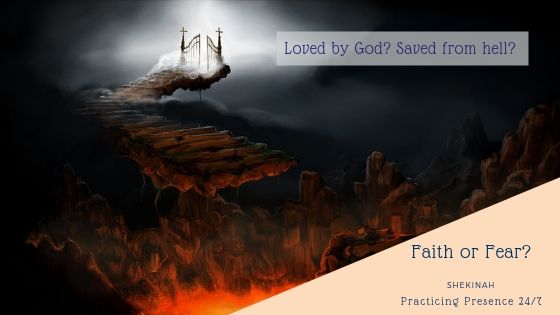
Faith or Fear: Love of God or saving you from hell?

I’ve written a lot lately about how mission boarding school and growing up on the mission field has influenced my faith and my journey to practicing Presence. Today – I want to dive into the darkness of the journey from a culture of fear, into learning to lead from faith and love.

A topic I have been ruminating on recently: How many of my choices and decisions in life are made based on faith? What decisions were fear-based?

Where does the fear come from? Unfortunately – indoctrination.

Read More »