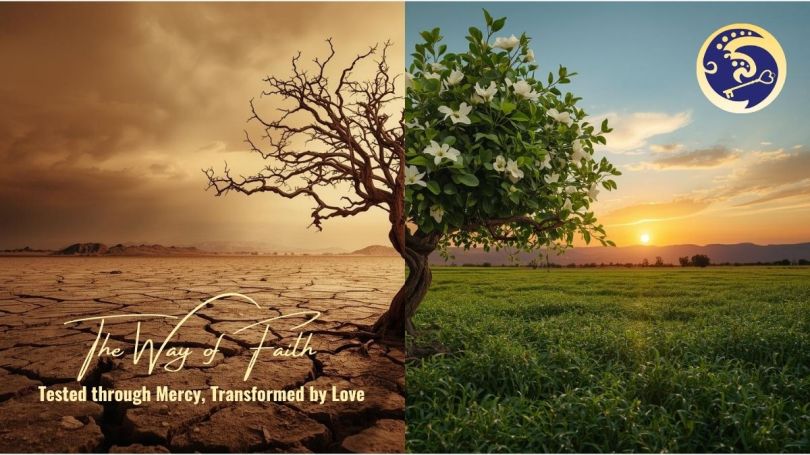
The Way of Faith: Tested Through Mercy, Transformed by Love

We all carry burdens we refuse to name, yet we often mistake our spiritual journey for a performance. The prophet Isaiah forces us to confront this: What if our most fervent prayers are, to God, simply a heavy burden (1:14)? Our way of faith is not found in the rituals we repeat, but in the inner transformation that begins with honest reckoning. These readings reveal how works without faith are a scarlet-stained futility, but they also unveil the path of renewal through confession. When we embrace mercy, we receive the power of love and forgiveness, preparing us to make the decisive leap of following Jesus.

​The Foundation: Lectionary Texts for Reflection

  • Isaiah 1:10–18: The Reckoning and the promise of purification.
  • Psalm 32:1–7: The joy of confession and forgiveness, unsealing mercy’s flood.
  • 2 Thessalonians 1:1–12: The endurance of growing faith amid affliction.
  • Mark 10:46–52: Bartimaeus’s cry and the leap of response.

I. The Weariness: Laying Down the Mask

From burden to authenticity.

Inner Posture: Awareness of hypocrisy.

Movement Phrase: The soul grows weary of pretending holiness.

​If the exhaustion we feel is not from the difficulty of our life, but from the spiritual lie we maintain, then the path to renewal begins here. We are invited not as performers, but as the weary ones, to lay down the mask of false piety. The soul grows weary of pretending holiness.

​The prophet Isaiah points to the divine sigh: “I am weary of bearing them” (1:14). God is not weary of our sin, but of our inauthenticity. We have become so adept at the motions of our way of faith that we’ve forgotten its meaning. This is the quiet, daily form of Christian hypocrisy.

The Apostle Paul, writing to the Thessalonians, offers a vision of what genuine, unwearying faith looks like. He commends them not for their rituals, but for a tested faithgrowing abundantly” amid affliction (2 Thess. 1:3). Their love is increasing, not as effort, but as overflow. He prays that God will “fulfill by his power every good resolve and work of faith” (2 Thess. 1:11). This is the promise: Not our frantic striving, but divine presence fueling what endures.

confession,Faith,faith and works,following Jesus,Forgiveness,hypocrisy,inner transformation,justice,love,mercy,renewal,spiritual journey,tested faith,way of faith,works without faith,

Invitation: What resolve stirs in you, unspoken, waiting for such power?

Refrain: Faith births love. Love births justice.

​But unmasking is only the beginning. Awareness without repentance still withers; the soul must face what its silence has hidden.

​II. The Reckoning: Facing the Abomination (Isaiah 1:10–18)

From hypocrisy to confession.

Inner Posture: Honest confession.

Movement Phrase: When I kept silent, I dried within.

​We move from the fatigue of pretense to the necessary shock of the reckoning. We must face the spiritual cost of hiding our true state, accepting that our works without faith are what God finds burdensome. When I kept silent, I dried within. This phrase captures the internal cost of the hypocrisy Isaiah is about to name.

​A. The Prophetic Renaming (The Fire of Recognition)

​Isaiah begins with a devastating act of renaming: “Hear the word of the Lord, you rulers of Sodom; listen to the law of our God, you people of Gomorrah!” (1:10). This is the prophet’s gut-punch. We, the covenant people, are labeled for cities consumed by their own moral decay. The sin of Sodom and Gomorrah wasn’t hidden vice alone; it was a profound spiritual blindness—a prosperity that felt no obligation to the poor.

Invitation: In this renaming, what hidden Sodom lingers in your governance of self—of time, of words, of withheld mercy?

​B. The Vain Offering (The Futility of Unrooted Works)

​This hypocrisy leads to the central crisis: “What to me is the multitude of your sacrifices?Your hands are full of blood” (1:11, 15). God rejects all the outward rituals because iniquity poisons the air. The vast accumulation of our works of faith is rendered futile if our inner transformation hasn’t aligned our heart with justice. Deeds detached from the heart’s truth are echoes in an empty chamber—resounding, yet rootless.

The Refrain: Faith births love. Love births justice.

​Yet divine judgment is never the final word. Even as Isaiah names our desolation, mercy waits in the next breath. The Psalmist teaches us how grace begins — not in defense, but in confession.

​III. The Release: Confessing the Heart’s Truth (Psalm 32:1–7)

From silence to song.

Inner Posture: Receiving mercy.

Movement Phrase: Truth demands its voice.

The spiritual journey pivots here, at the hinge of confession. We move from condemnation to the forge where guilt yields to grace. Confession unseals the flood of grace.

Truth demands its voice, confession,Faith,faith and works,following Jesus,Forgiveness,hypocrisy,inner transformation,justice,love,mercy,renewal,spiritual journey,tested faith,way of faith,works without faith,

​A. The Cost of Concealment (The Wasting Silence)

​The Psalmist articulates the precise internal cost of living under the burden exposed by the prophet. When I kept silent, I dried within. This phrase perfectly captures the barren weight of unacknowledged sin: “my bones wasted away… my strength was dried up as by the heat of summer” (Psalm 32:3-4). Inauthentic faith is this exhaustion. It is why the first step toward renewal is simply speaking the truth.

Invitation: Where in your silence does the heat rise, drying what once flowed freely?

​B. The Cleansing Fire (The Forgiveness Freely Given)

​The moment of release is simple and instantaneous: “Then I acknowledged my sin to you, and I did not hide my iniquity; I said, ‘I will confess my transgressions to the Lord,’ and you forgave the guilt of my sin” (Psalm 32:5).

The Theological Hinge: The fire that razed Sodom becomes, in mercy, the forge that purifies the heart—ashes transfigured to gold, pretense to truth. We are covered by divine embrace: “Happy are those whose transgression is forgiven” (Psalm 32:1). We are no longer defined by the scarlet of our past, for God declares: “if your sins are like scarlet, they shall become like snow” (Isaiah 1:18). This is the power of love and forgiveness.

The Refrain: Faith births love. Love births justice.

​The silence that once drained the Psalmist now gives way to the shout of faith. What was inwardly confessed now becomes outwardly embodied.

​IV. The Response: Leaping into the Way (Mark 10:46–52)

From sight to following.

Inner Posture: Faith embodied.

Movement Phrase: He threw off his cloak and followed the Way.

​A forgiven heart does not sit still; it shouts, it springs, it follows. Bartimaeus, the blind beggar, embodies this final stage of our way of faith.

​A. The Bold Cry (The Heart’s Unsilenced Plea)

​Bartimaeus began to shout: “Jesus, Son of David, have mercy on me!” (Mark 10:47). He prioritized his need over the crowd’s rules.

The Theological Hinge: Isaiah’s Sodom burned because blindness reigned in the powerful; Bartimaeus’s physical blindness is healed because he had spiritual sight. He recognizes mercy in Christ and voices the plea that the self-righteous refused to speak for the poor.

Invitation: What mercy do you cry for, louder than the world’s silencing?

​B. The Surrender and Healing (The Way Made Visible)

​When called, Bartimaeus made a definitive choice: “So throwing off his cloak, he sprang up and came to Jesus” (Mark 10:50). The cloak was his beggar’s chain. To cast it off was faith’s decisive surrender: no more hiding in the old sin.

Jesus honored the source: “Go; your faith has made you well” (Mark 10:52). The outward act was merely the visible evidence of the inner transformation. The story is incomplete without the following: “Immediately he regained his sight and followed Jesus on the way.” This is the key to all works of faith. Justice becomes not a duty, but love in motion on this spiritual journey.

faith embodied, confession,Faith,faith and works,following Jesus,Forgiveness,hypocrisy,inner transformation,justice,love,mercy,renewal,spiritual journey,tested faith,way of faith,works without faith,

The Refrain: Faith births love. Love births justice.

​The one who follows on the Way becomes the sign of what faith fulfilled looks like. Bartimaeus’s leap becomes our lifelong walk — love made visible.

​V. The Fulfillment: Living Love in Motion

From action to enduring love.

Inner Posture: Love enduring.

​The cycle is complete: Isaiah wrenched open the abomination; the Psalm forged the release; Bartimaeus leapt into the Way. We are no longer Sodom’s heirs, burdened by scarlet-stained futility, but snow’s—made clean by surrender and empowered by love enduring, tested through mercy as Paul envisions. The goal is not just to feel forgiven, but to let that forgiveness drive us. As Paul prayed, God can fulfill in you “every good work of faith” (2 Thess. 1:11).

​Final Challenge

​Pause here: Confess the silence in your heart, not to earn, but to receive the boundless love and forgiveness. Then rise: Seek justice not as frantic striving, but as the forgiven one’s quiet command. Let your heart become the clean altar where mercy kindles every act of love.

​Contemplative Sending

​Go now—washed, forgiven, and aflame with faith that does not tire. Amen.

The Final Echo (Closing the Cycle):

Faith births love. Love births justice. And justice, lived in mercy, returns us again to faith.
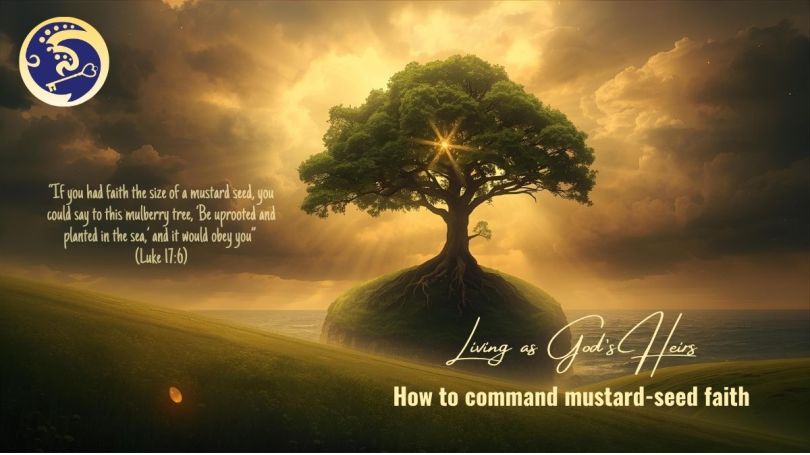
How to Command Mustard-Seed Faith: Living as God’s Heirs


There’s a powerful thread weaving through Habakkuk, Psalm 37, 2 Timothy, and this Gospel: faith isn’t a timid plea—it’s a bold command from God’s heirs.

Let’s pray:

Creator of all, open our eyes to our identity as Your children. Ignite our mustard-seed faith to uproot the impossible. Amen.

Mustard-Seed Authority: Faith That Commands

Imagine the apostles, exhausted from Jesus’ teachings, blurting out, “Increase our faith!” (Luke 17:5). They’ve seen miracles, but the world’s weight—oppression, division—feels too heavy.

Jesus doesn’t hand them a faith-booster shot.

He says, “If you had faith the size of a mustard seed, you could say to this mulberry tree, ‘Be uprooted and planted in the sea,’ and it would obey you” (Luke 17:6).

That’s wild.

Not “ask God to move the tree.”

Command it.

Expect obedience.

Then He pivots to a parable:

“Who among you would say to your slave who has just come in from plowing or tending sheep in the field, ‘Come here at once and take your place at the table’?
Would you not rather say to him, ‘Prepare supper for me; put on your apron and serve me while I eat and drink; later you may eat and drink’?
Do you thank the slave for doing what was commanded? So you also, when you have done all that you were ordered to do, say, ‘We are unworthy slaves; we have done only what we ought to have done!'”

Luke 17:7-10

At first glance, this feels like a humility slap: Don’t pat yourself on the back for basics.

But dig deeper.  This isn’t our posture toward God—it’s a caution against entitlement.

And yet, we are not groveling servants begging favors.

John 1:12 declares: “But to all who received him, who believed in his name, he gave power to become children of God.”

Power.

Authority.

As sons and daughters, we command with expectation, rooted in the Father’s will.

Think of Nigeria, where over 7,000 Christians have been slaughtered this year by jihadists like Boko Haram—villages razed, churches in flames, largely ignored by global headlines. Chaos screams, “Where’s God?”

Yet Jesus invites us: As His kids, command protection over those believers.

Uproot the violence.

Expect it done—not as beggars, but heirs.

This commanding faith pulses through our readings. Let’s stand on the ramparts with Habakkuk.

Standing on the Ramparts: Visionary Faith Amid Violence

Habakkuk stares at a broken world:

“O LORD, how long shall I cry for help, and you will not listen? Or cry to you ‘Violence!’ and you will not save? Why do you make me see wrongdoing and look at trouble? Destruction and violence are before me; strife and contention arise”

Habakkuk 1:2-3

Sound familiar?

In Panama City, violence scars Curundú and El Chorrillo—200-250 murders this year, gangs trapping the poor at the bottom of Cerro Ancón and in 4 de Julio, while Albrook, Clayton, and the top of Cerro Ancón sit safe, gated, untouched. It’s injustice, raw and next door—the rich insulated, the poor bleeding.

How long, O Lord?

Habakkuk doesn’t crumble. “I will stand at my watchpost and station myself on the rampart; I will keep watch to see what he will say to me” (Habakkuk 2:1).

He demands God’s answer.

And it comes:

“Write the vision; make it plain on tablets, so that a runner may read it. For there is still a vision for the appointed time; it speaks of the end and does not lie. If it seems to tarry, wait for it; it will surely come; it will not delay.”

Habakkuk 2:2-3

This isn’t passive waiting—it’s defiant faith.
Galatians 4:7 reminds us: “So you are no longer a slave but a child, and if a child then also an heir, through God.”

Slaves fear; heirs inherit visions.

Habakkuk’s rampart is our prayer closet, our street corners in Curundú.

Write God’s vision for Panama City: Peace in El Chorrillo, equity from Cerro Ancón’s base to summit.

Command it as heirs—expect the delay to shatter.

Church, what’s your rampart? A neighborhood vigil? Advocating for the poor?

Stand there, not in fear, but visionary authority. Because this faith doesn’t fret—it fruits.

From Fret to Fruit: Stillness in the Storm

Psalm 37 meets us in the envy trap: “Do not fret because of the wicked; do not be envious of wrongdoers” (Psalm 37:1).

Fretting is spiritual quicksand—sinking us into anxiety over evil’s apparent wins.

In Nigeria’s silent slaughter—7,000 Christians gone, militants prospering—it’s tempting: Why them, Lord? Why not us?

The psalm flips it: “Trust in the LORD and do good; live in the land, and enjoy security. Take delight in the LORD, and he will give you the desires of your heart. Commit your way to the LORD; trust in him, and he will act” (Psalm 37:3-5). Then: “Be still before the LORD, and wait patiently for him; do not fret over those who prosper in their way” (Psalm 37:7). And the gut-punch: “Refrain from anger and forsake wrath. Do not fret—it leads only to evil” (Psalm 37:8).

Fretting breeds anger, wrath, evil. What’s the opposite? Galatians 5’s fruit of the Spirit:

  • Instead of fret’s anxiety, choose peace and patience.
  • Swap anger’s heat for kindness and gentleness.
  • Ditch wrath’s rage for love, joy, and self-control.

Galatians 4:7 frees us: “So you are no longer a slave but a child, and if a child then also an heir.”

Slaves fret; heirs bear fruit.

For Nigeria’s persecuted, don’t rage—pray kindness over killers, peace over pain.

In Panama City, when Albrook’s luxury mocks Curundú’s cries, be still.

Commit your way.

As God’s kids, command fruitfulness: Delight in Him, expect heart-desires fulfilled. Watch justice shine like noonday (Psalm 37:6).

This fruitful heirship ignites Timothy’s fire.

A Spirit of Power: Boldness Over Fear

Paul writes to Timothy, a young leader facing trials: “For this reason I remind you to rekindle the gift of God that is within you through the laying on of my hands” (2 Timothy 1:6). Then the powerhouse: “For God did not give us a spirit of cowardice, but rather a spirit of power and of love and of self-discipline” (2 Timothy 1:7).

Fear shrinks us—cowardice in chaos. But Romans 8:15-16 declares: “For you did not receive a spirit of slavery to fall back into fear, but you have received a spirit of adoption. When we cry, ‘Abba! Father!’ it is that very Spirit bearing witness with our spirit that we are children of God.”

Adopted!

Not slaves trembling, but kids crying “Abba!” with power.

In Panama City, where Curundú and El Chorrillo bleed from gang violence while Albrook, Clayton, and Cerro Ancón’s top rest easy, this spirit empowers us.

Don’t pray timidly—command justice.

Rekindle your gift: Love for the lost, discipline against division.  Suffer boldly for the gospel, expecting God’s guard (2 Timothy 1:12).

Church, rekindle today.

For Nigeria’s churches in flames, pray power. For our city’s streets, command healing. As heirs, expect it.

Commanding as Heirs: Uprooting the Trees

Let’s pull the thread: Luke’s mustard seed commands creation.

Habakkuk stands visionary on ramparts, heirs writing justice over Panama City’s divides—from Curundú and 4 de Julio’s pain to Cerro Ancón’s safe summit. Psalm 37 trades fretting over Nigeria’s persecuted for fruitful stillness. Timothy’s power-spirit, rooted in adoption, banishes fear.

We’re not unworthy slaves begging. John 1:12 grants power as God’s children. Romans 8 seals our heirship. Galatians 4:7 frees us from slavery. This is commanding faith: Tiny as mustard, potent to uproot mulberry trees of violence, injustice, fear.

What tree blocks you? A divided marriage? Addictive chains? Our city’s inequities? Command it: “Be uprooted!” Expect obedience, because Abba backs you.

This week, act:

  • Pray boldly for Nigeria’s protection—7,000 lives lost, but faith endures.
  • For Curundú and El Chorrillo, intercede for peace, equity. Write your vision. Bear fruit. Rekindle power.

Church, may we live as heirs, not slaves—commanding with mustard-seed faith.

Faith,Love Thy Neighbour,Social justice,growth,living with purpose,living in truth,Integrity,spiritual transformation,Love Your Neighbor,fruit of the Spirit,power of prayer,spiritual worship,practicing presence,kindness,time management,self-control,spiritual discipline,emotional intelligence,

Teaching to Fish: Faith, Justice, and Growth today

A few weeks ago, in a message titled “Living with Truth,” we looked at Amos 8 and Psalm 15, seeing how God despises exploitation and steadies those who live with integrity. We saw that an upright heart is not just a moral ideal, but a firm foundation in a shifting world. Today, as we turn our gaze once more to the prophetic words of Amos, and the poetic truths of Psalm 113 and 1 Timothy 2, we are invited to go even deeper. We are called to see God’s heart for justice not merely as a set of ethical rules or a social program to be enacted, but as a profound act of spiritual worship—a natural, unavoidable overflow of a life lived in His divine presence.

From Presence to Practice: Living a Life of Justice

Consider a scene right here in Panama City: A maid earns about $450–$650 a month. Her days are defined by a quiet, relentless rhythm—hands calloused from brooms, mops and detergents, a body weary from endless tasks. Her labor is a testament to her strength, but her circumstances hold her captive.  If she spoke English, her reality could be transformed by a new opportunity: a job with foreigners, offering higher wages and new possibilities. In some cases, the opportunity to work in a business, not just a home.

On the surface, this is a beautiful story of economic mobility. But what if it’s also a story of a deeper, spiritual transformation—a journey from being overlooked to being fully seen, from feeling defeated to embodying the dignity with which God created her? This new role could be the stepping stone she needs, a way to move into an office position and grow professionally.

We are called, above all, to love our neighbor as ourselves. But sometimes, in our well-intentioned outreach, we stop at handing out fish—a meal, a bag of clothes, temporary aid. We address the immediate symptoms of poverty without looking to the root cause. What if God is calling us to a deeper form of love—not just to teach our neighbors to fish with practical skills, but to teach them to live by the Spirit? To live with the Fruit of the Spirit—love, joy, peace, patience, kindness, goodness, faithfulness, gentleness, and self-control? Practicing God’s presence in our work, in our relationships, and in our communities is how we truly empower others, for it is in our spiritual overflow that we find the capacity to reflect His heart and lift the lowly from the dust to dignity.

Let’s explore how the virtues of justice, the power of prayer, and the grace of reconciliation are not just things we do, but things that grow from a place of deep spiritual worship, transforming minimum-wage struggles into futures of hope.

Faith and Finance: Practicing Presence in the Economy

Amos 8 delivers a searing, prophetic warning to those who “trample the needy” with dishonest scales, exploiting the poor for something as trivial as a pair of sandals ($2.50 in those days, according to some commentators).

Faith,Love Thy Neighbour,Social justice,growth,living with purpose,living in truth,Integrity,spiritual transformation,Love Your Neighbor,fruit of the Spirit,power of prayer,spiritual worship,practicing presence,kindness,time management,self-control,spiritual discipline,emotional intelligence,

This wasn’t just a business crime; it was a profound spiritual betrayal. It was a failure to see God’s image in the very people they were exploiting. In their relentless pursuit of profit, they created a moral and spiritual gap—a chasm between themselves and those they were created to love. They lost the ability to practice God’s presence in their transactions, turning human beings into commodities.

Contrast this with the story of Dan Price, the CEO of Gravity Payments, who in 2015 made a startling decision. He slashed his own $1 million salary to ensure every employee, from the lowest-paid clerk to the most experienced developer, earned at least $70,000. This man is not perfect, but his business model has shown us it’s possible to build a business to foster employee well-being.

We see this emphasis not as a clever business strategy; But an act of profound spiritual integrity. It becomes an outward expression of a heart that was practicing generosity and kindness, where a side-effect is a flourishing company which far outweighs the financial cost. We can model our business on what it means to truly love your neighbor as yourself in a corporate setting. This decision isn’t just about money; it’s about dignity and mutual respect.

In a similar fashion, Fundación Microfinanzas BBVA provides training and micro-loans to women who would never be able to access traditional bank loans. Their stories of success are not just about a loan, but about a woman who used that small loan to start a sustainable business—a local market stall, a small bakery, a sewing business—and became a pillar in her community.

These stories show us that when we act with integrity and love, we create opportunities for dignity and self-sufficiency, turning a simple loan into an instrument of God’s grace. It is a powerful example of how a practical business model can be an expression of spiritual conviction.

From Dust to Dignity: Living the Fruit of the Spirit

Psalm 113 paints a glorious, almost unbelievable, picture of God. He is “enthroned on high,” yet He “stoops down to look” at the heavens and the earth (Psalm 113:4-6). This is the great paradox of God: He is infinitely high, yet He condescends to be intimately involved in our lives. The Psalm continues this breathtaking thought: God raises the poor from the dust and seats them “with princes” (Psalm 113:7-8). This isn’t just a metaphor for a better life; it is a spiritual truth. Justice is a form of worship, an act of love that mirrors God’s own heart, transforming our neighbors from being forgotten to being honored.

Faith,Love Thy Neighbour,Social justice,growth,living with purpose,living in truth,Integrity,spiritual transformation,Love Your Neighbor,fruit of the Spirit,power of prayer,spiritual worship,practicing presence,kindness,time management,self-control,spiritual discipline,emotional intelligence,

In Panama City, CAPTA, a program by Fundación Calicanto, empowers marginalized women. Their training focuses on vocational skills, but the true transformation happens on a deeper level. It is a work of building self-esteem and confidence—a rebuilding of the inner person. This is where the spiritual and the practical beautifully intersect.

From a spiritual perspective, we can see that the professional skills they teach are not merely a checklist for a job; they are an invitation to live with the Fruit of the Spirit. They are a spiritual path in themselves.

Think about it:

  • Professional communication becomes an act of kindness and gentleness, a way of building up instead of tearing down. It’s an expression of inner peace that makes our words steady and our intentions clear.
  • Time management becomes a practice of peace and self-control. It is a spiritual discipline that brings order to chaos and frees us to be present in our work.
  • Emotional intelligence becomes a manifestation of love and patience. It is an acknowledgment that our neighbor’s struggles are real and that we can meet them with empathy.
  • Dress code becomes a reflection of self-worth and inner dignity. It is a way of honoring God by honoring the temple of the Holy Spirit.

By teaching these, we are not just preparing someone for a job; we are teaching them to practice God’s presence in every part of their lives, transforming the exploited poor into Psalm 113’s princes.

Prayer in Action: Aligning Our Hearts with God’s

1 Timothy 2 urges us to pray for all people, especially those in authority, so that we may live “peaceful and quiet lives in all godliness” (1 Timothy 2:1-2). This is not a call to be passive; it is a call to be grounded. Prayer is not a passive wish; it is an active alignment of our hearts with God’s will. It is the fuel for our action.

Daniel’s life is a perfect example. He prayed faithfully three times a day in exile, facing the threat of the lion’s den, yet his prayer life was the spiritual foundation that allowed him to maintain his integrity and influence kings. His prayers weren’t just an escape from his circumstances; they were a way of maintaining his relationship with God, allowing him to be a transformative presence in a pagan nation.

In Haiti, SALT Microfinance is a powerful, modern example of prayer leading to action. They blend savings groups, vocational training, and Bible teaching in a holistic approach to empowerment. A testimonial from a woman named Elashe shows how a small loan helped her start a small store, a business that grew so much that she was eventually able to help her children move to the United States to pursue their dreams. This is what happens when prayer shapes our vision, leading to tangible, life-changing results.

Here in Panama, INADEH trains thousands in vocational skills, a tool for breaking the cycle of poverty. Let’s join our Wednesday night online prayer group to lift up the leaders of these organizations and our neighbors in Santa Ana and El Chorrillo.

For our church: Prayer is where empowerment begins, but it should never end there. It should lead us to ask the question: what is God calling us to do? Could we offer a health workshop, teaching nutrition as an act of loving our neighbor with our knowledge? Even if you are unable to teach, you can pray every Wednesday, asking God to guide our leaders and neighbors. This is how we blend faith and action, shaping peace and justice through empowered lives.

Bridging the Divide: The Journey of Reconciliation

1 Timothy 2:5 proclaims Christ as the “one mediator” between God and man. This is the heart of the Christian faith. Justice, then, is His gospel in action, the visible fruit of a reconciled life, bridging the divides of our broken world. The parable of the Good Samaritan is not just a lesson in kindness; it is a story of radical reconciliation. A Samaritan, despised by the Jewish people, crossed ethnic and class barriers to show mercy (Luke 10:25-37), binding the wounds and restoring dignity to a man who had been cast aside. His compassion was an act of grace that mirrored the mediation of Christ.

Faith,Love Thy Neighbour,Social justice,growth,living with purpose,living in truth,Integrity,spiritual transformation,Love Your Neighbor,fruit of the Spirit,power of prayer,spiritual worship,practicing presence,kindness,time management,self-control,spiritual discipline,emotional intelligence,

In Panama, the AES Panamá Foundation trains youth with technical and English language skills. Similarly, WeGrow Panama mentors young women in STEAM fields. These programs are not just about job training; they are about bridging divides and restoring relationships. They create a space where people can see beyond class and background to find a shared sense of dignity and purpose. They are a powerful image of Christ’s work of reconciliation in our city.

No matter how big or small our involvement, this is how our church can build bridges, not walls, across economic and cultural divides. These acts of reconciliation are a physical embodiment of Christ’s mediation, transforming our community with opportunity and hope.

Conclusion: From Being to Doing

Acts 4:32-35 shows the early church sharing so that “no one was in need.” Their community was a testament to justice and accountability. Like SALT’s savings groups or AES’s training, we can empower, not enable.

The true work of justice begins not with a strategy, but with a spiritual posture. It begins by practicing God’s presence in every area of our lives, allowing His love, His kindness, and His peace to flow through us and into the world around us. When we seek Him first, the actions of justice become a natural, beautiful overflow of our hearts.

This is the very essence of what the scriptures we explored today call us to: to be a people who, like the “upright” in Psalm 113, are lifted from the dust of our own spiritual poverty to reflect God’s justice. It is to live with integrity, rejecting the dishonest scales of Amos, and to be grounded in prayer, as 1 Timothy teaches, so that our lives become a visible testimony to God’s love and reconciliation.

My question for you today is not what you will do, but what you will become. How is God inviting you to practice His presence and cultivate His fruit in your life today? How will that inner transformation spill over into an act of love for your neighbor, an act of justice that reflects the very heart of God?

Seeing is believing: how Thomas’ challenge shaped his faith

Today’s lectionary reading brings us the story of Thomas after Jesus’ crucifiction and burial (John 20: 19-31). For most of us, it’s a well-known story. 

Jesus comes to the disciples who are meeting and praying together in hiding, but Thomas is absent this day. When he returns, they tell him that Jesus has risen and visited, but he doubts. 

“Unless I see the mark of the nails in his hands and put my finger in the mark of the nails and my hand in his side, I will not believe.” (John 20:25)

And yet, when Jesus returns to visit a week later, Thomas is there and witnesses for himself that Jesus has indeed risen. 

“Put your finger here and see my hands. Reach out your hand and put it in my side. Do not doubt but believe.” (John 20: 27)

So, what would it take for your faith to be challenged and strengthened? 

What personal experience could you have that would confirm to you that God’s power in your life is real? 

Peter stumbled and fell into faith

Perhaps an easier example for us to relate to is Peter, the rock on which Jesus said the church would be built. We see many instances where Peter shows a great understanding of Christ, only to overshadow it with his doubting, hesitance, and failure of faith.
Peter was possibly the only one to see Jesus walking on water, yet this same Peter was hot-tempered and rebuked the children that wanted to come to Jesus. 

He’s passionate and impetuous: Peter was the first to say that he would accompany Jesus in prison and death, but at the moment of truth, denied that he even knew him.

This very same Peter was told off three times for falling asleep while accompanying Jesus in the garden for prayer. 

From euphoria to failure

Peter gets swept up in the euphoria of Jesus’s power and miracles.

I want that!

But he crumbles under persecution. 

He got it – Jesus was the messiah.

And he lost it – I’m too scared to follow this road of faith

Many of us, like Peter, have denied that we knew Jesus: with our words, or with our actions, or our priorities.

Perhaps you’ve lost faith, because of fear – just like Peter.

Nonetheless, Peter still becomes the pillar of the early church, an example for others to follow. 

Peter is the first to run to the empty tomb. He is also the first to jump out of the boat and swim to the shore to see Jesus after the resurrection.

In order to counter Peter’s denial of Christ three times before the crucifixion, we see Jesus ask Peter three times “Do you love me?”. Having failed three times, it’s important for Peter to confirm three times that he has overcome this failure in faith and believes. 

But his journey was plagued by missteps and mistakes.

Do your actions speak of faith or doubt? 

Thomas doubts strengthen his faith

It’s easy to see how Peter’s mistakes turn into strength. 

But Thomas has a different road of challenges before him. They are more subtle, but equally strong.

And these are the mental doubts and stumbling blocks we face.

When we lose a loved one, or don’t get that dream job, it’s easy to fall into the mental loop of doubt and asking “Why?”

People around us are quick to give us empty platitudes:

  • “Everything happens for a reason…”
  • “God won’t give you more than you can handle…”
  • “God has a wonderful plan for your life…”

And for Thomas, that challenge was seeing the man and friend that he believed in killed to satisfy the bloodthirst of the mobs and political powerplays.

The monkey mind: making you second-guess yourself

I’m sure he had millions of thoughts running through his head:

  • We did so much for the sick, the needy and the masses, but they turned their backs on Jesus.
  • Everyone listened to Jesus’ teachings, but is this the end of our journey?
  • Jesus promised us the kingdom of heaven, but now all we have is death and despair. 

And when the disciples tell him that they’ve seen a resurrected Jesus, Thomas doesn’t jump with joy and faith. 

He’s cynical. He’s rational and thoughtful, not easily swayed by a cheerful friend.

He no doubt has a million thoughts running through his head as he tries to make sense of his experiences of the past three years. 

Show me the money

Most of us have heard someone say “Show me the money.”

I don’t want any of your stories: I want to see the evidence. Don’t talk about the value you bring to the table, show me the value and benefits. 

And for Thomas, it wasn’t enough that others had experienced seeing Jesus. He needed to experience this for himself. 

When Jesus shows up, he doesn’t lecture Thomas. We might judge Thomas and read judgment into Jesus’ words to him, but does Jesus actually judge him?

Instead, Jesus says:

“Put your finger here; see my hands. Reach out your hand and put it into my side. Do not doubt but believe.” (v. 27)

Thomas said: “Show me the money!” and Jesus’ response is “Here’s the cold, hard cash.” Stop doubting. Here you go. 

His evidence is the wounds and scars, yet he overcame this. 

The challenge to overcome

For most of us, we find it easier to trust someone that has the battle scars than someone finely dressed, that hasn’t experienced life’s hard knocks. 

Want to know why Dr. Joe Dispenza is so popular? It’s not just what he’s teaching, but rather that he first had to get himself out of his semi-paralysed state and back on his feet again! Six of his vertebrae has compound fractures. He risked being a quadriplegic. But he overcame this challenge. 

We trust his scars and his journey. He walked the talk. Those scars tell a story of faith and healing. 

Similarly, people are willing to follow the teachings of Louise Hay who healed herself from cervical cancer through forgiveness and letting go.

Because, for many of us, seeing is believing.

We need to see the scars and wounds of others to believe that it’s possible for us to heal and get back on our feet. M

Much like Thomas, we say when I see the nail marks in his hands and the wound in his side, then I’ll believe that healing is possible.

We need these live examples to open our eyes to the possibilities of what could be. 

What challenge are you facing?

So today, I ask:

What challenge are you facing and what example do you need to strengthen your faith? 

Perhaps you’ve lost your business and are struggling with financial difficulties: 

  • Job had everything – the richest man, a wonderful family with children and grandchildren, and a fantastic reputation – only to have it all disappear in a moment. Can you find inspiration in Job for seeing is believing?
  • David is another great example – reduced to living in caves, running and hiding despite having been anointed to be the new king.

If you’re looking for modern examples, there are many like J.K. Rowling who went from a broke mother to becoming a billionaire through her creative efforts in writing.  Even Richard Branson, the owner of Virgin, had a rought start to life.

For others, it’s getting through betrayal.

Wasn’t Jesus betrayed? And David, by his son Absalom? Or Joseph who was sold into slavery by his brothers. 

Perhaps the challenge to your faith is sickness.

And we have many examples of healing:

  • Natural healing – you break a bone, the doctor sets it back in place and immobilises it, and your body takes care of the rest! The doctor only has to make sure it’s aligned, so that when healing takes place, it’s all in the right place. 
  • Sometimes, the miracle we need comes in the form of a doctor and medicine! But isn’t that still healing. The knowledge and how to help the body to overcome sickness and injury pave the road to recovery.
  • Most of us, of course, just want the miracle healing. The instant, no rational explanation, kind of healing. Of course there are examples of this – in life and in the Bible. But this isn’t the most common type.
  • We also have examples of miraculous healing over time – like Dr. Joe Dispenza and Louise Hay that weren’t healed in a day, but rather healed little by little. How many of us are willing to hold our faith, day by day, for this healing?
  • And sometimes, the healing that happens is in the heart – with acceptance for what is, forgiveness and letting go of resentment. Perhaps there is no physical manifestation, but what gets healed is relationships and we let go of bitterness.  Isn’t this also a miracle? 

What scars and wounds do you need to see, like Thomas, in order to restore your faith?

Do not doubt, but believe.

John 20: 27

How Jesus got cancelled: faith, expectations, and betrayal

On Sunday Jesus is welcomed into Jerusalem with crowds, praise and celebration, waving palms and welcoming him with joy. Celebrating with the disciples after his arrival, we learn of the Last Supper.

Nevertheless, on Spy Wednesday he’s betrayed and arrested in the Garden of Gethsemane, and by Friday he’s crucified.

How quickly public opinion changes and you fall from hero to zero. From being welcomed as the saviour to asking to release Barabbas, a Jewish bandit and rebel.

We have many examples of cancel culture in the past five years, for political motives as well as personal indiscretions. Whether it’s sexual indiscretion, badly handled brand messaging or simply holding an unpopular opinion.

So, what changed? Why did public opinion pivot so rapidly?

Personally, I think it all comes down to expectations, which play a huge role in our relationships.

There’s nothing like having hope and expecting a certain outcome, only to face disappointment.

If we don’t guard our hearts, bitterness and resentment grow within.

On Palm Sunday, Jesus rides into Jerusalem as a king, sitting on a colt, as prophesied in the Old Testament.

The crowds that welcomed him (all by word of mouth), have witnessed his miracles and healing hands. But now they are expecting more.

While they might be grateful for everything that he’s done so far, they still expect him to give more. 

What they are looking for is that hero that will save them from the tyranny of the Roman Empire. The new king. The Messiah. 

And Jesus is bound to disappoint them.

And as we’ve learned time and time again in our relationships, disappointment often leads to a cruel backlash. 

Jesus wasn’t offering a physical salvation, but spiritual. While he had healed many physical ailments, many of those miracles went hand-in-hand with spiritual healing and a change of behaviour and habits. 

Largely overlooked by the crowds.

Their faith and belief in his teachings, which overturned the status quo and Pharisees, seemingly overlooked the underlying message.

When they heard “the Kingdom of God is at hand”, they believed in a physical kingdom, returning to the glories of David and Solomon. 

This crowd had real problems and real needs.

And they expected Jesus to be the Saviour and hero that would fix everything. 

They were disappointed to find out that he offered spiritual salvation and a spiritual Kingdom of Heaven. 

But don’t we still do the same now?

We elect politicians and then criticize them when they don’t fix all the problems in our community. But what about the community getting together and facing the problems and working together for healing and improvement?

We watch blockbuster movies, celebrating heroes like Ironman, Superman, Captain America and Daredevil. All heroes, some with a small band of misfits, that do the impossible and save the world.

Imagine how boring a movie would be to show a community that came together and worked tirelessly to improve their city, but with no heroes or individuals that stood out to take the lead.

Since time immemorial, like Bonnie Tyler, we’ve been singing “I need a hero”:

He’s gotta be strong and he’s gotta be fast
And he’s gotta be fresh from the fight

And it’s these very same expectations that lead to disappointment, and ultimately lead to betrayal. 

How faith turns into disappointment

Take a moment to consider your prayers this week.

What did you pray and ask for?

Were you asking God for a specific outcome or solution? Or have you learned, like Jesus in Gethsemane to pray for God’s will to be done.

Jesus alerts the disciples that night:

My soul is very sorrowful, even to death. (Matt. 26: 38)

Nonetheless, he prays (v. 39):

“My Father, if it be possible, let this cup pass from me; nevertheless, not as I will, but as you will.”

As such, he’s not disappointed in the outcome, no matter how much it pains him.

But many  times, we’re tied to a particular outcome. We pray for healing for a person, and the expected outcome is that the illness or physical healing take place and be immediate.

And in doing so, we overlook that sometimes that most profound healing takes place over time. It’s like building up strength and stamina from walking and doing exercise every day. It can only be built by repetition.

Many times, our healing only happens by repetition – like forgiveness that takes place 70 time 7 times. Regularly letting go of the hurt and pain and replacing it with forgiveness.

But we want the instant gratification. Give me the pill that can stop the pain and get me back up and running immediately. Who care what the long term side-effects might be.

We want miracles and instant healing, not gradual improvement. 

As such, we’re disappointed and disillusioned when the outcome is long term. 

What expectations are you putting on miracles?

Disappointment in our relationships

Think also about your relationships with friends and family. Or perhaps going a bit further to those that you know.

Do you know someone who received a lot of help and support from someone, and then when that person stopped helping and supporting them they almost became enemies?

What’s really happening? Often, the person receiving the help is initially angry and frustrated with themselves. They might even hate themselves for being helpless and needing to rely on someone else’s benevolence.

But over time, they begin to hate the other, because this persons generosity highlights their own shortcomings and feelings of inadequacy. Most of this lies deep within as latent bitterness. Covered up with an band-aid of gratitude and praise. 

Nonetheless, the moment that benefactor fails to step up and meet a need, they become the subject of criticism. The hidden bitterness and resentment bubbles to the surface, and accusations fly of selfishness and pride. 

Now imagine the crowds that Jesus faced in Jerusalem.

So many expectations placed upon him with different people expecting from him different things.

And he fails to give them what they wanted.

It all ends with the cries to release Barabbas, the bandit and rabble-rouser.  He’s been known to revolt in small ways against the Romans. While he doesn’t promise to rebuild a kingdom, he openly opposes the Roman Empire.

And being disappointed that Jesus never had plans to revolt, they turn to the popular insurrectionist and rebel leader. 

And just like that, Jesus gets cancelled by popular opinion. 

Betrayal after disappointment

I wonder which hurt Jesus more: the betrayal of Judas or of Peter? Remember, Jesus predicts both of them.

At the last supper, he highlights that Judas will hand him over. In the garden of Gethsemane, Jesus warns Peter that before morning he will have denied him and turned his back on him. 

Which one of us would have dared to respond differently to the crowd than Peter?

We’ll never know whether Judas betrayed Jesus to cover up slipping his hand in the till and expecting to replace the missing coin by using the funds he received from the Pharisees, or whether he was simply disappointed, like the crowds, that Jesus wasn’t the Messiah that would save Israel from the Roman Empire.

No matter what lay beneath his betrayal, Peter’s actions were much more about fear and peer pressure. 

Was Peter afraid of being put in the same cell as Jesus if he was identified as being his follower? Or was he simply ashamed to be different? Had he lost complete faith in Jesus being the Messiah?

Your expections, your faith

So now, it’s your turn.

What expectations do you have when you pray and in your daily spiritual habits?

When you sit quietly in your heart, are you holding onto any bitterness or resentment towards God for unanswered prayers or situations in life that didn’t go how you expected God’s hand to move?

Each of us needs to be honest within about the state of our faith.

Radiance of faith: how to let your love shine bright

Today we remember and celebrate the birth of Jesus, and how his lessons of love shine bright through the ages. All over the world, different peoples and cultures join together to remember the birth of this bright light in the midst of darkness. 

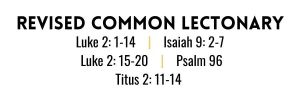
revised common lectionary, luke, isaiah, psalm, titus, bright light, radiance of faith, love, christmas message, birth of jesus

Our story starts out with homeless travellers, forced by colonisers and imperialists to return to a town that was no longer home. For them, this meant a winter’s nights spent in a stable.

No central heating (possibly no heating at all). No electricity or running water. Instead, they put up with straw beds, the smell of dung and moisture, and possibly leaks in the roof and a cold wind chill.

It was only slightly better than staying outdoors. 

We’re told that Mary gave birth in these conditions. Forget

  • the midwife, doctor or antibiotics
  • warm water and clean towels
  • another pair of hands to help Joseph clean up the baby after it was born
  • close family and friends to help out and bring a caserole. 

Instead, it is a very humble birth, as you might find in an indigenous village of the third world, yet devoid the community support. 

This is the birth that we celebrate at Christmas. 

A birth of humility, yet full of a mother’s love and the faith of strangers. 

A birth that changed the world, how we see God, and even how we interact with God. 

From these humble beginnings, we find ourselves two thousand years later here in this Church remembering the meaning of Christmas.

The Radiance of Faith

In Luke we read that following the birth of Jesus, an angel appeared to shepherds, watching their sheep in the fields around Bethlehem.

Perhaps you would be more acquainted with cowboys than shepherds, unless you live in the outback of Australia, the highlands of Scotland or various parts of the Middle East.

But most of us know that these shepherds were likely in worse conditions than Mary and Joseph who were in the stable. They were likely under the stars, without a roof or tent over their heads. Exposed to the elements in the middle of winter.

And it’s to these people that the angel appears with the good news of the birth of the Messiah.

The angel didn’t appear to the priests and pharisees.  He didn’t go to the palace and announce the birth to the king or to Pontius Pilate as the representative of Rome in Judea.

Instead, the good news was shared with lowly shepherds.

In what was undoubtedly a terrifying way. Great light and fanfare on a quiet night in the mountains.

Scared much? 

And yet, what was the response of the shepherds after overcoming their fear?

Rejoicing!

More importantly: they responded with action.

They left their flocks and went straight to visit Mary, Joseph and Jesus. Without waiting. 

This is their example to us of the radiance of faith.

Hearing. Believing. Taking action based on that faith and belief.

So, for each of us today, let’s take a moment to reflect on our faith in action.

How do we live a life of faith?

Titus tells us

For the grace of God has appeared, bringing salvation to all, training us to renounce impiety and worldly passions and in the present age to live lives that are self-controlled, upright, and godly,

Titus 2: 11-12

The grace of God appears

It all starts with Divine grace. Not because we deserve it or have worked for it. Simple a Divine gift from above.

We are merely asked to accept it.

Because we have accepted this Divine Love, we can begin to change our habits and way of being.

Training us

Titus then goes on to say that this grace of God, this salvation, trains us. The grace is instantaneous.

But our transformation is something that we work on.

We are trained in this, day by day.

What we renounce or quit

We start by choosing to renounce those habits and ways of living that leave us in the darkness. Titus calls these worldly passions. 

Walking in the light of love is a choice. A choice we make daily.

And the principal part of that choice is to quit those practices, attitudes and ways of living that keep us chained.

This is different for each person. Perhaps it’s gluttony or being lazy. For others, it is a shopping addiction or smoking. And yet, for another, it might be bitterness and hate.

We start by choosing to let go, renounce and quit.

The new habits we adopt

Then, we open our time, energy and focus up to the opportunity to adopt new habits and ways of being.

Titus says that in the present age – at this moment – we choose to live lives of self-control. Creating a new habit requires discipline, attention and focus.

It’s more than just making a New Year’s resolution to do things differently. For many of us, it’s noticing our hidden triggers and what stimulates the old habits.

For example: gluttony is often about avoidance of emotions. But we get stuck on thinking that gluttony is about the food. There is nothing wrong with the food. What we need to look at is our relationship with food. When we use food to cover up and avoid, we end up eating more than we need because we don’t want to feel emotionally uncomfortable. It’s easier to feel physically uncomfortable.

So, when we start to notice our triggers and what stimulates the old, then we can adopt the new.

Coming back to our example of gluttony: if I am avoiding my emotions, when I accept God’s love and grace in my life, then I can start to love myself. At this moment, I interrupt the old habit of over-eating and instead sit with the emotions and feelings that had me uncomfortable.

With this love and grace that shone down from me from above, I practice loving and accepting myself, rather than avoiding my feelings by eating them. 

Let your love shine bright

Once I have mastered this, even in one area of my life, it’s possible to let that love shine bright in many other areas of my life.

Other habits are easier to break and new habits become easier to make.

As I change – emotionally, mentally, physically and spiritually – others can see the change in me.

But it all starts because of a message I received of Divine Love – acceptance of Divine Grace – that allows me to then go out, like the shepherds at Christmas, and share with others about this miracle of transformation.

How will you choose, this Christmas, to let your love shine bright in your neighbourhood and community? 

Proverbs, how to get wisdom, instruction, good judgement, wise action, live well, wellbeing, embodied wisdom, learning, personal development, generative wisdom

Proverbs: How to get Wisdom, Instruction, and Good Judgement

For the past couple of years, I’ve chosen a Word of the Year – one value which I wish to embody in my life. It’s always been one of my values, but there’s always one that stands out more than others. For 2022, that word is Mastery:

  • the mastery of self (self-awareness and the resulting self-control) as well as
  • knowing more (knowledge and understanding) and
  • putting that new learning into practice.

Because to know anything is to do things differently from before.

Life management is about being well adjusted. … being able to stand against the wind of disappointment.
Time is not really the important element. It is what time represents that matters.
Time management is not about a list of things in order of priority that must be completed… Time management is about life management.

Given that life is mostly about intangible things, does it not make sense to learn to control them – things such as thoughts, desires, anger, curiosity, ambition, motivation, sadness, hurt and sorrow?
Althought we live in a tangible world, life itself occurs within our mind, spirit and soul.

Jonar C. Nader, How to Lose Friends & Infuriate People, a controversial book for thinkers.

For me, this is the essence of what I am reminded of when I read Proverbs – self-awareness and then the option for self-control.

The wisdom of Proverbs

One of the many things that I’ve had on my “I wish I had time to do” list is to deep dive back into Proverbs. Of all the books of the Bible, this is one of the two that most resonates with me. The other one is the book of James.

Proverbs has a special place in my heart because I remember my dad reading it to me every night before bed. Occasionally, we would talk about what a verse meant. But more often than not, it was just a reading of a chapter or a portion of a chapter.

I was left with many more questions than answers.

proverb, definition, dictionary.com, commonplace truth, adage, a wise saying, precept, a profound saying, maxim, oracular utterance, meaning of proverb
from dictionary.com

Of course, many times, we try to read Proverbs literally, and not all of it can be understood with a literal meaning.

My experience with Proverbs is that different ones “jump out at me” at different moments in life. Moreover, I’ve interpreted them differently, depending on what I’ve been learning at the time.

As with any proverbs, many of them take time to digest and understand.

The usefulness of Proverbs

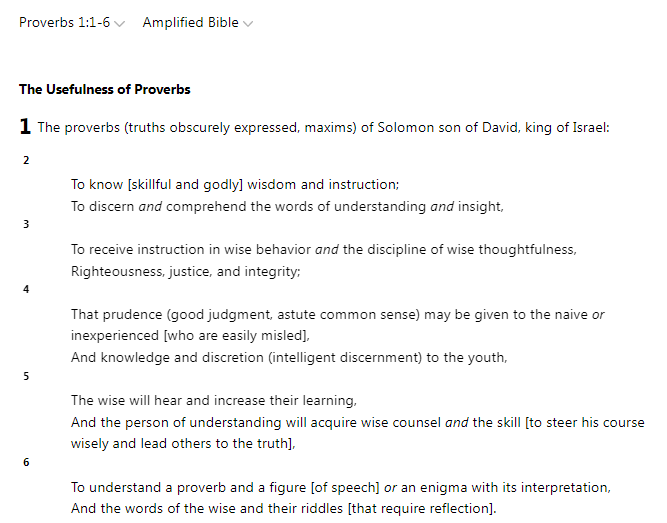
In the very first chapter of Proverbs, there is a small introduction, although there is debate as to how much of the book of Proverbs this introduction applies to.

usefulness of proverbs, proverbs 1, amplified Bible, Solomon, wisdom, instruction, words of understanding, insight, wise behaviour, discipline, wise thoughtfulness, righteousness, justice, integrity, prudence, good judgement, asuste common sense, knowledge, discretion, intelligence discernment, learning, wise counsel, truth, understand a proverb, interpretation, the words of the wise,
Proverbs 1: 1-6, Amplified Bible

I find it irrelevant who the author of Proverbs was: I don’t read the book of Proverbs because of who wrote it.

Throughout my life, I’ve turned to Proverbs when I’m in turmoil. And these last three years have had their fair share of inner (and outer) turmoil.

Consider how other translations present the introduction to Proverbs:

proverbs 1, the message, wise sayings, Solomon, live well, understand, learning, right, just, fair, wise men
Proverbs 1: 1-6, The Message
proverbs 1, wisdom, instructions, words of understanding, justice, judgment, equity, knowledge, discretion, a wise man, learning, a man of understanding, wise counsel, understand a proverb, words of the wise, kjv
Proverbs 1: 1-6, King James Version

These are the wise sayings of Solomon,
    David’s son, Israel’s king—
Written down so we’ll know how to live well and right,
    to understand what life means and where it’s going;
A manual for living,
    for learning what’s right and just and fair;
To teach the inexperienced the ropes
    and give our young people a grasp on reality.
There’s something here also for seasoned men and women,
    still a thing or two for the experienced to learn—
Fresh wisdom to probe and penetrate,
    the rhymes and reasons of wise men and women.

The proverbs of Solomon the son of David, king of Israel;

To know wisdom and instruction; to perceive the words of understanding;
To receive the instruction of wisdom, justice, and judgment, and equity;
To give subtilty to the simple, to the young man knowledge and discretion.
A wise man will hear, and will increase learning; and a man of understanding shall attain unto wise counsels:
To understand a proverb, and the interpretation; the words of the wise, and their dark sayings.

The place of Proverbs

Proverbs is one of the five books of Wisdom of the Bible, together with Job, Psalms, Ecclesiastes and Song of Solomon.

I find it interesting that two of these books are poetry and psalms, rather than writings of wisdom, per se. And yet, all five of the books offer unique perspectives on life and the experiences of life.

But, as you will have noticed from the introduction to Proverbs, it has lofty goals:

  • wisdom
    • wise behaviour
    • the discipline of wise thoughtfulness
    • good judgement
    • astute common sense
    • intelligent discernment
  • instruction
    • a manual for living
  • knowledge
  • understanding
    • to understand what life means
  • insight
  • righteousness
  • justice
  • integrity
  • lead others to the truth

The road to wisdom

So, over the coming weeks and months, I intend to take a new journey through Proverbs and re-examine how it impacts my life. What new wisdom can I glean from these pages?

Where do you go for wisdom?

creativity as an act of worship, a powerful intention, Artist's Prayer, Great Creator, Divine Love,

Creativity as an act of worship: a powerful intention

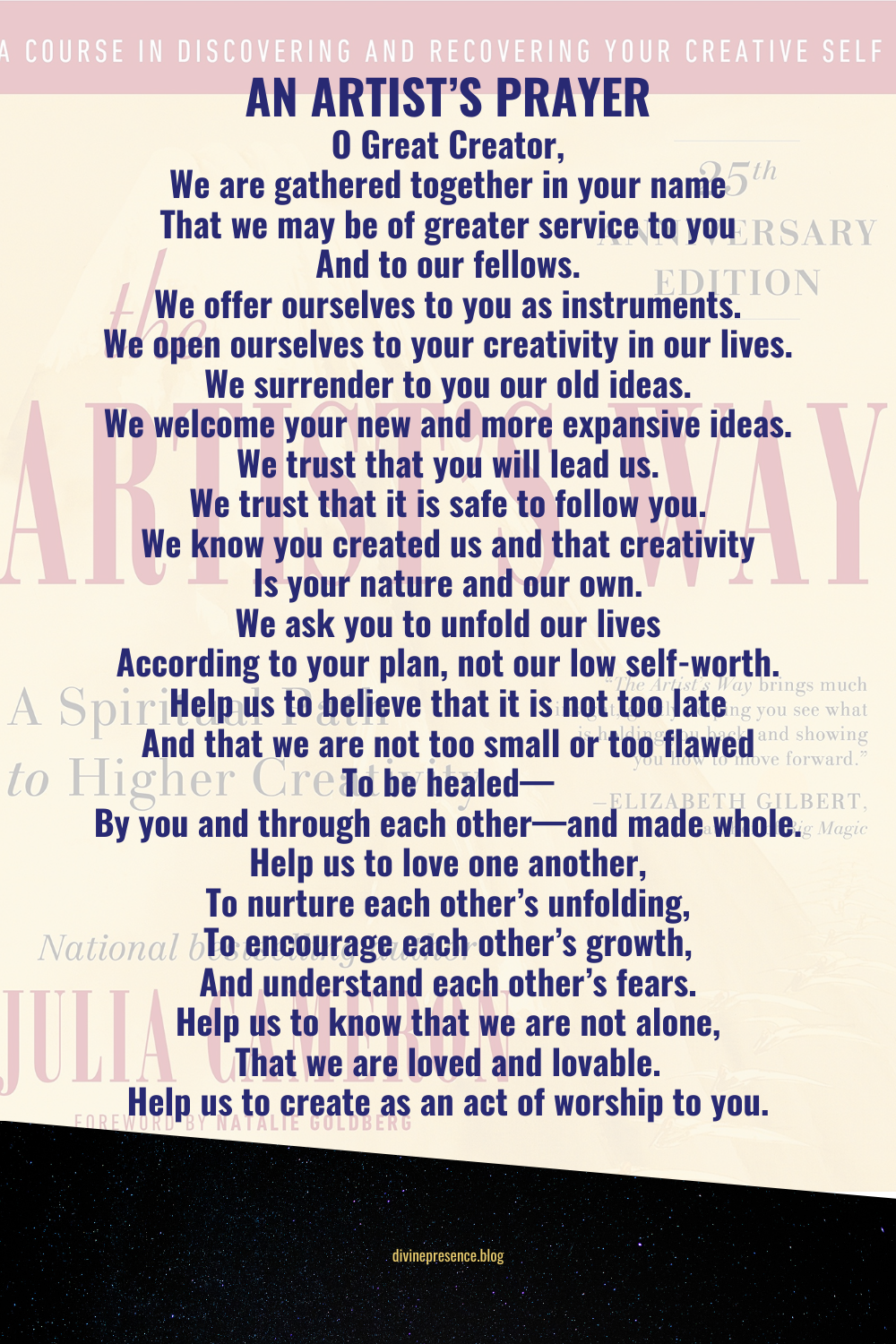
In the exercises for week 4 of the Artist’s Way (by Julia Cameron) one of the tasks is to write your own Artist’s Prayer.

AN ARTIST’S PRAYER O Great Creator, We are gathered together in your name That we may be of greater service to you And to our fellows. We offer ourselves to you as instruments. We open ourselves to your creativity in our lives. We surrender to you our old ideas. We welcome your new and more expansive ideas. We trust that you will lead us. We trust that it is safe to follow you. We know you created us and that creativity Is your nature and our own. We ask you to unfold our lives According to your plan, not our low self-worth. Help us to believe that it is not too late And that we are not too small or too flawed To be healed— By you and through each other—and made whole. Help us to love one another, To nurture each other’s unfolding, To encourage each other’s growth, And understand each other’s fears. Help us to know that we are not alone, That we are loved and lovable. Help us to create as an act of worship to you. Julia Cameron, The Artist's Way: A Spiritual Path to Higher Creativity

AN ARTIST’S PRAYER

O Great Creator,
We are gathered together in your name
That we may be of greater service to you
And to our fellows.
We offer ourselves to you as instruments.
We open ourselves to your creativity in our lives.
We surrender to you our old ideas.
We welcome your new and more expansive ideas.
We trust that you will lead us.
We trust that it is safe to follow you.
We know you created us and that creativity
Is your nature and our own.
We ask you to unfold our lives
According to your plan, not our low self-worth.
Help us to believe that it is not too late
And that we are not too small or too flawed
To be healed—
By you and through each other—and made whole.
Help us to love one another,
To nurture each other’s unfolding,
To encourage each other’s growth,
And understand each other’s fears.
Help us to know that we are not alone,
That we are loved and lovable.
Help us to create as an act of worship to you.

Of course, we’re now in Week 8, and I haven’t done it yet.

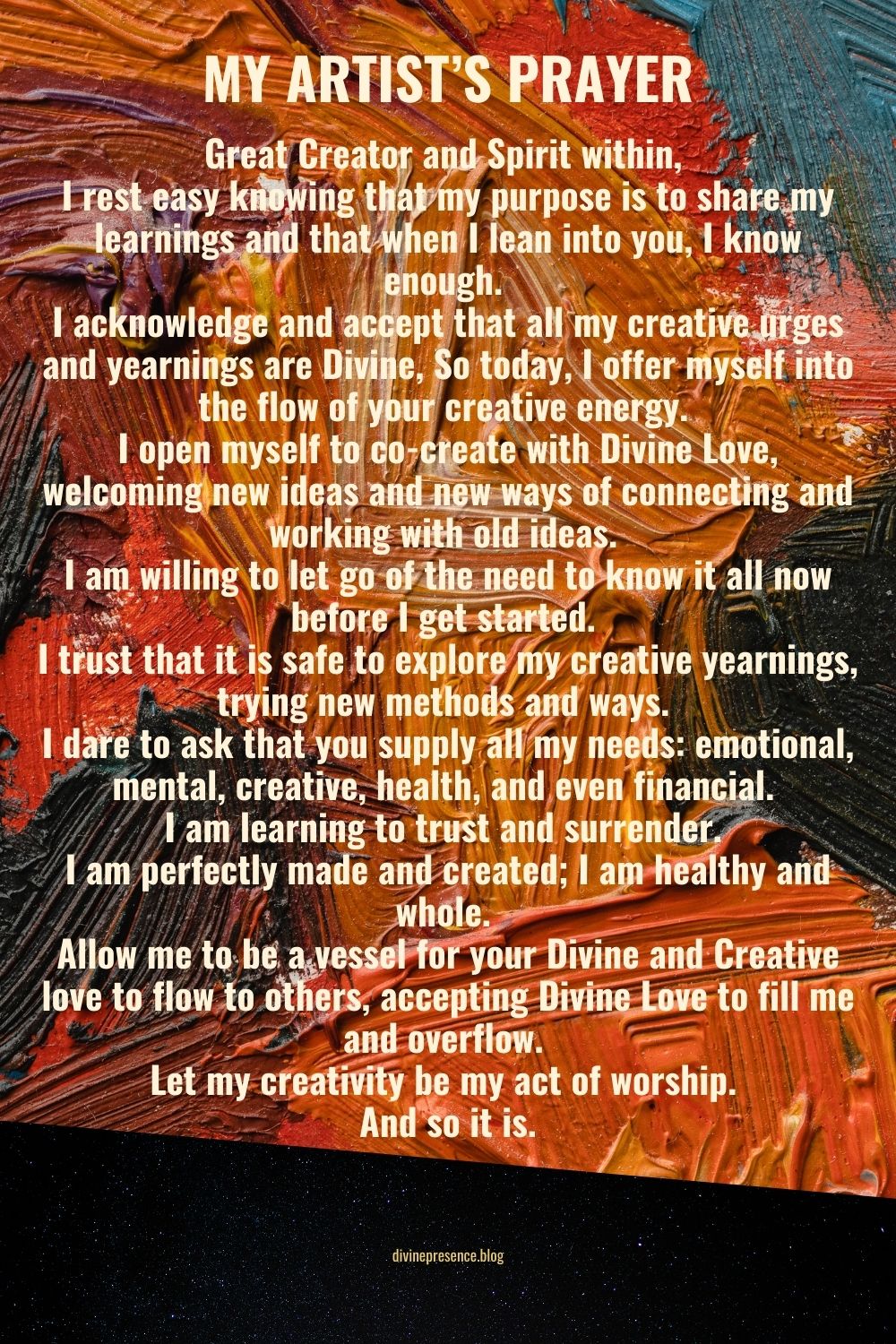
So, perhaps it’s time to really look at how I wish to co-create with the Creator.

Great Creator and Spirit within,
I rest easy knowing that my purpose is to share my learnings and that when I lean into you, I know enough.
I acknowledge and accept that all my creative urges and yearnings are Divine,
So today, I offer myself into the flow of your creative energy.
I open myself to co-create with Divine Love, welcoming new ideas and new ways of connecting and working with old ideas.
I am willing to let go of the need to know it all now before I get started.
I trust that it is safe to explore my creative yearnings, trying new methods and ways.
I dare to ask that you supply all my needs: emotional, mental, creative, health, and even financial.
I am learning to trust and surrender.
I am perfectly made and created; I am healthy and whole.
Allow me to be a vessel for your Divine and Creative love to flow to others, accepting Divine Love to fill me and overflow.
Let my creativity be my act of worship.
And so it is.

MY ARTIST’S PRAYER Great Creator and Spirit within, I rest easy knowing that my purpose is to share my learnings and that when I lean into you, I know enough. I acknowledge and accept that all my creative urges and yearnings are Divine, So today, I offer myself into the flow of your creative energy. I open myself to co-create with Divine Love, welcoming new ideas and new ways of connecting and working with old ideas. I am willing to let go of the need to know it all now before I get started. I trust that it is safe to explore my creative yearnings, trying new methods and ways. I dare to ask that you supply all my needs: emotional, mental, creative, health, and even financial. I am learning to trust and surrender. I am perfectly made and created; I am healthy and whole. Allow me to be a vessel for your Divine and Creative love to flow to others, accepting Divine Love to fill me and overflow. Let my creativity be my act of worship. And so it is.
Divine wisdom shepherds me, peace, abundance, love, a time of turmoil, the valley of the shadow of death, comfort, psalm 23, psalms 23, the Lord is my shepherd, I shall not want, green pastures, still waters,

Peace, abundance and love in a time of turmoil

I took a moment today to reread one of my posts from ten years ago: The Lord is my shepherd. It was a collection of thoughts about Psalm 23 and what it means to feel safe in the presence of God.

For these last ten years, I’ve come to understand that our English Bible translation uses “the Lord” as the standard translation wherever the original used YHWH. I’ve distanced myself from the idea of God being a man sitting Santa-like on his sky-throne.

Somehow distant and looking down on us all – rather than Spirit and in each and every one of us. Over these past 22 months, I realise that what has kept me going strong is the Divine presence of inner peace, abundance, and compassion, despite living in a time of turmoil.

So, today I want to share my thoughts on what it means to allow the Infinite to flow through us as Divine Wisdom, peace and love, taking thoughts and ideas from Psalm 23.

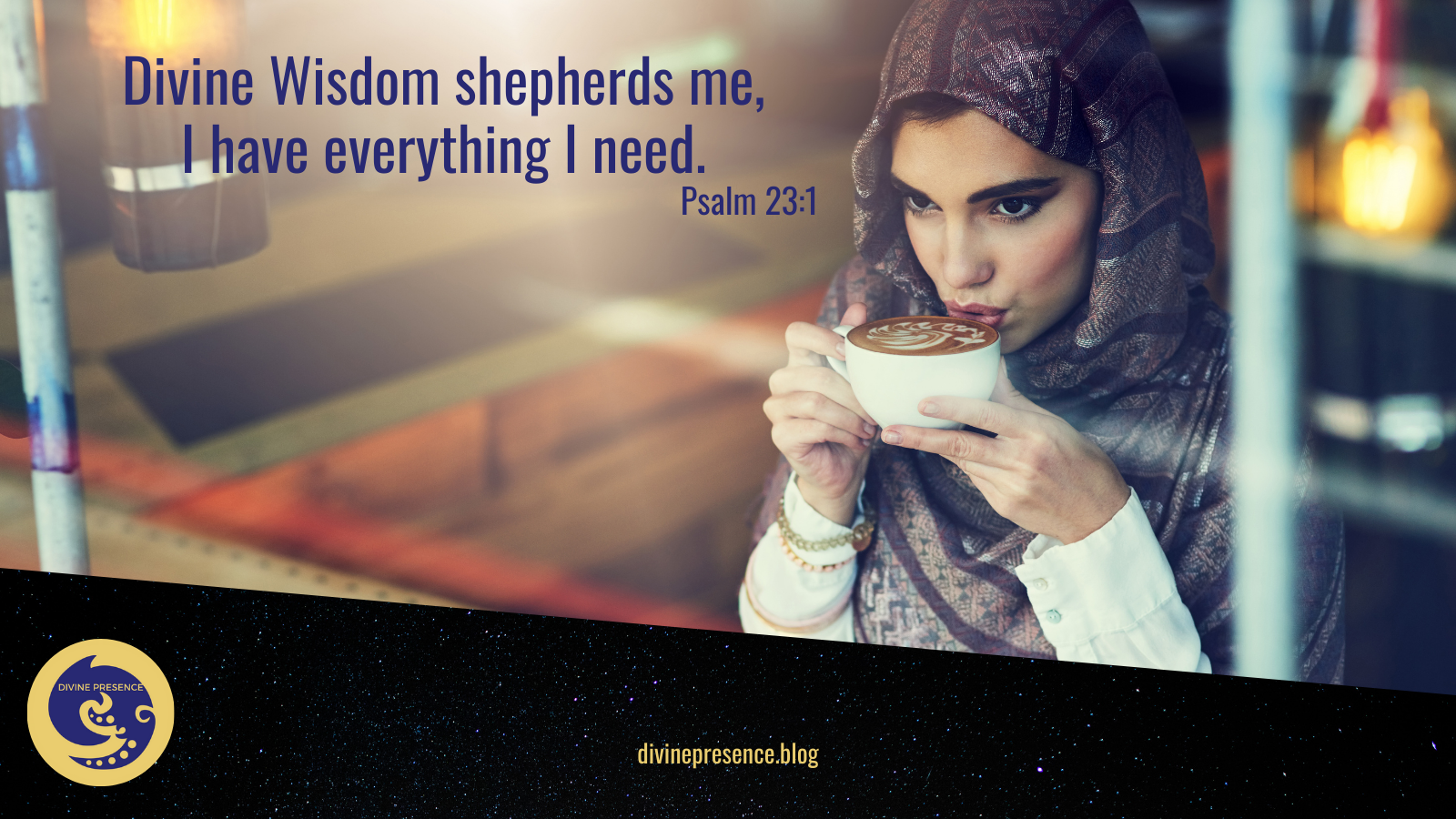
Divine Wisdom shepherds me

One of the things about sheep and shepherds is that the sheep get used to the shepherd because the shepherd lives with them twenty-four hours a day. They recognise the shepherd by the sound of their voice and the scent.

And so, as I learn to live in the presence of the Divine, I learn to listen to that still, small voice of Divine Wisdom. It’s often hushed, although occasionally, I get a brutal shake or prod!

Shepherding is about being led, surrendering to the path of Divine Will, rather than what my ego would have me do. And when I listen and surrender, I recognise that I have everything I need.

Divine Wisdom shepherds me, I have everything I need, abundance, peace, love, compassion, Psalm 23, The Lord is my Shepherd, I shall not want

Everything I need: all the time I could possibly need to get things done, all the love and affection that my heart desires, and all the resources that I need at this moment.

In fact, when I sit with my God Box, which I made at the beginning of this year, I am in awe! All the worries and concerns that I put in my God Box were taken care of. All of them. Not a single one of those worries came to pass this year! I took all those things that were beyond my control and simply said, “you handle this for now, and when I’m ready, gently place it on my plate to take care of”.

Resting in the presence of the Divine

Most of us remember that the shepherd makes us lie down in green pastures; there’s a lushness to this imagery. In addition to having our fill – an all you can eat banquet – do you experience the softness and gentleness of lying down and resting?

How have you rested in 2021?

Are you resting gently and deeply, or do you stay up at night with worries?

To quote my previous post on Psalm 23:

“We have found both  provender and peace, rest and refreshment, serenity and satisfaction.”

In addition to surrendering to rest and relaxation, we are offered our fill of living water – to be cleansed, refreshed and revitalised.

Can you allow the Infinite to flow through you?

I rest gently and deeply, drinking my fill of living water in safety, relaxation and rest, security, feeling safe, a safe place to be, He makes me lie down in green pastures, He leads me beside still waters

My soul is restored and renewed

I wear myself out trying to do it all from my own strength and under my own steam. I forget – regularly – to allow Divine Presence to flow through me and empower me. But, as I let it, my soul and spirit are restored and renewed.

All I have to do is step away from staying business – holding and grasping desperately to doing it all myself.

When I’m doing it all alone, it’s empty and incomplete. My ego’s happy – for a while until it falls and fails. Then it throws a tantrum when I realise that I am not perfect and complete unless I am open to the presence of the Divine.

I am complete when I am One with Spirit. But when I allow myself to be guided by Divine Wisdom, I find myself facing anything and everything. The path takes me back to wholeness.

But it is a soft allowing and opening up. It is surrender and trusting, which I still find challenging.

How are you allowing the Divine Creator to complete you?

My soul is restored, as I am guided by Divine Wisdom along paths of wholeness, I am made complete., He restoreth my soul, He renews my soul, He guides me along paths of righteousness, for His name's sake, I am whole and complete, nothing is lacking in me, Psalm 23

A time of turmoil in the world

Walking through the valley of the shadow of death

These two years have felt like a walk through the valley of the shadow of death. The foreboding of “it’s out there” could be terrifying, and yet I have discovered this fantastic, deep well within me of inner peace. One that genuinely has surpassed all my understanding.

I know, without a doubt, that we are walking through this valley. That means that there is a light at the end: there will be a moment when we are no longer under the shadow of death.

But I feel an intense peace and calm within me. I haven’t feared for myself or those I love in these two years of uncertainty. I have felt deeply protected and shielded despite all the turmoil.

Some of the changes have been harrowing – as an introvert with a slightly extroverted child, I cannot begin to explain the challenges of two years of home-schooling while working from home. And yet, this too shall pass.

And every time she says that these have been the best two years of her life, I am blown away. In my mind, I have focused on my shortcomings rather than how resilient we have both been!

Even when the path I am on is hard, and it seems that there is a shadow of death hanging over me, I walk calmly, with courage, fearing no harm, I live in the presence of the Divine even here, I feel protected and shielded, I am pulled to safety, though I walk through the valley of the shadow of death, I fear no ill, I fear no evil, for Thou art with me, thy rod and thy staff they comfort me, Psalm 23

We have been abundantly protected and shielded. We’ve grown and changed with the changing times.

And in so many ways, I have been miraculously comforted and found safety.

Making time for self-care

Despite the challenges of these times – the enemies that surround us – Divine Wisdom reminds me to take time out. To sit quietly and eat calmly. To enjoy the food before me.

These past two years have been about re-encountering a relationship with gratitude and pausing, especially around food. I’ve made more time cooking and sitting down to eat, with grace before meals, rather than eating on the run.

And what I’ve realised is that this has a very practical application in our digestive system: as we switch over from “fight & flight mode” to “rest and digest”. It’s a crucial physiological distinction. Divine Wisdom reminds me regularly: stop what you’re doing and just eat. It’s okay to take time for nourishing your body without multi-tasking.

I am also reminded that I have a purpose and calling – and that does not require multi-tasking either! It’s becoming more single-minded about “the one thing” and focusing my energy and attention on what I am called to be and do.

The more I follow this, I count my many blessings! My cup indeed does run over!

Divine Wisdom reminds me to make time for self-care, even in the face of life's challenges, I am blessed, protected & empowered, I have a special calling and purpose, I count my blessings and am content, Psalm 23, Thou preparest a table before me in the presence of my enemies, Thou anointest my head with oil, My cup runneth over

Guided by Divine Wisdom, with goodness & mercy watching my back

Who has your back?

We’re promised that both goodness and mercy will follow us wherever we go. Mercy sweeps along behind me, forgiving my mistakes and weaknesses, allowing me to forgive myself.

Can I let go of the guilt and shame that I’ve carried and allow it to be swept away by goodness and mercy?

The final part of Psalm 23 reminds us that we dwell forever with Divine Presence, finally reaching that place of complete Oneness with Spirit.

Goodness and mercy follow me wherever I go, my faithful companions on this journey of life, I will allow the Infinite to flow through me until I am one with Spirit, Psalm 23, Surely goodness and mercy shall follow me all the days of my life, And I will dwell in the house of the Lord for ever,

I belong. I am loved and cherished, with an everlasting love.

This is what it means for Divine Wisdom to be omnipotent, omniscient and omnipresent.

Will you allow the Infinite to flow through you until you are One with Spirit?

blind trust, communication, Compassion, competency, consistency, consistent, dependability, distrust, emotional and spiritual healing, Faith, family, Forgiveness, God, hope, learning and personal development, life, living in the Spirit, love, reliability, self-awareness for personal growth, spiritual abuse, Spiritual Growth, spiritual healing, spiritually mature, trust, truth

Trust, distrust and blind trust: rebuilding faith and hope

Over recent weeks, in my healing journey, I have been examining my relationship with trust. It first came to my attention when I looked at my business decisions, especially mistakes that I have made over the past 20 years. But, in recent days, I noticed a pattern emerge.

The beauty of recognising patterns of behaviour is that it opens the door for change and transformation. What I’ve noticed is a swinging pendulum in my life between distrust and blind trust. This pattern has cost me thousands of dollars, as well as relationships and creating heartbreak.

It is in seeing my actions and omissions accurately that the doors open.

The truth sets us free.

You will know the truth, and the truth will set you free, John 8:32

Let me provide you with some concrete examples: 

  1. In my early business days, I hired a friend to run one of my companies. Because I was overwhelmed and swamped with the growth in business and hiring new staff, I failed to supervise her properly. She was struggling in getting everything done, and I wasn’t available to support her. I didn’t ask how things were going, instead choosing to focus exclusively on my own overwhelm. Unfortunately, while she was getting the client work done, she wasn’t invoicing the client for it! By the time I realised the mess in accounts receivable and payable, the client had accrued some $40,000.00 in services they hadn’t paid for. Thankfully, the client eventually paid all outstanding invoices. But it took years to get fully up to date, and I bore the financial brunt of being caught between suppliers and financing a client. When I’m overwhelmed, I shut down, dissociate from the present, and turn to blind trust. 
  2. In March 2009, I left on holiday for three weeks to New Zealand. I chose the dates based on the weather (end of summer) and flight costs (cheaper because summer holidays were over and it wasn’t yet Easter). I was overwhelmed and exhausted after restructuring staff following the 2008 markets crash. Unfortunately, March 31st is the end of tax season – which meant that my company tax returns were prepared and presented in my absence. The company accountant and external accountants included a refundable expense in “income”, an extra $54,000 in ghost income! As a result, my income tax bill that year was $27,000.00 when it should have been less than $9,000.00. But, you prepay taxes for the next year, based on the estimates of what you paid the previous year! So, not only was I hit with the current tax bill, but my estimated taxes for the next year were identical, giving me a tax credit for years to come. My blind trust created a substantial financial pinch. 

I could provide you with many more examples in my professional life where I have distrusted, micro-managed and controlled every aspect of an employee’s performance, to those moments where I am overwhelmed and shut down, leading to no involvement or supervision at all.

Definitions

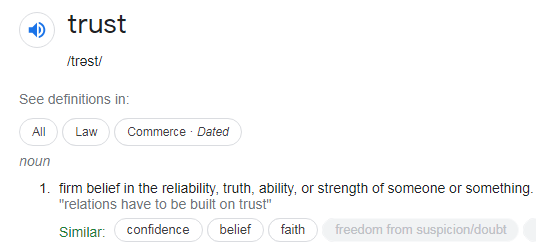
definition of trust, Oxford Languages, firm belief in the reliability, truth, ability, or strength of someone or something
definition of Trust

Trust = firm belief in the reliability, truth, ability, or strength of someone or something

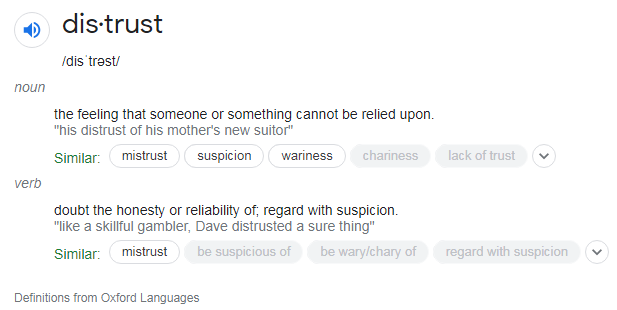
distrust, feeling that someone or something cannot be relied upon, doubt the honest or reliability of, regard with suspicion, definitions from Oxford Languages
definition of Distrust

Distrust = the feeling that someone or something cannot be relied upon.

Blind faith or blind trust: “unquestioning belief in something, even when it’s unreasonable or wrong”. I take it to mean “trust in spite of evidence to the contrary” or blindly ignoring evidence that perhaps they are undeserving of your complete trust.

trauma, state of mind, overwhelmed, shut down, freeze, dissociation, present moment, avoidance, blind faith, trust, firm belief, distrust

How trauma informs our state of mind

Unfortunately, this pattern is not something I learned as an adult, and I’ve been using this pattern since early childhood. When I get overwhelmed, the easiest solution is to shut down and freeze, and this takes me into dissociation from the present moment and avoidance. In these cases, blind faith and trust in others become the only option, and I can’t trust myself. 

Hypervigilance at the other end of the pendulum presents itself as distrust, micro-managing every situation as I attempt to control the outcome. Of course, this is exhausting, making me angry (an emotion that I was taught not to acknowledge as a child) and frustrated. To avoid anger, I would rebound into dissociation and shut down.  

I never learned how to stay in the middle: in balance, calm and being alert. I struggle on so many levels with trust, and this shows up in my life on every level: 

  • personal 
  • interpersonal 
  • professional 
  • spiritual 

I could choose to sit in victimhood: “this is how I am, because of my childhood“. But I choose not to. I started to look at my patterns as generative learning – an opportunity to grow and change. And I share these learnings with you, because I want you to recognise that you have options and choices available to you.

As I have begun to experience inner peace, the wisdom of trust has become available.  

The human experiences that break trust, building distrust

Years ago, I denied being traumatised at boarding school because I wasn’t regularly beaten and abused. Anger and speaking up would earn you a beating, being labelled a Jezebel, or having a rebellious spirit.

I avoided beatings by being “a good girl”, knowing when to shut my mouth and swallowing any anger I felt. The survival skills I learned were to shut down, dissociate, and walk away. Unfortunately, those skills are not very resourceful and helpful in my life anymore.

There are many moments that I wish I were rebellious, angry & unruly. How I wish I had been the wild child that baulked the system and stood up against injustices, daring to question unfair authority. Instead, I chose the safety and security of apathy, withdrawal and indifference.
Unfortunately, as an adult, I still struggle with dealing with my anger, boundaries and injustice. As a lawyer, it’s easy to stand up for others. But I shrink instead of standing up for myself. I avoid confrontations of a personal nature, even when they would clear the air.

Through it all, I am entrenched in my independence. Of course, as I know now – hyper-independence is merely a symptom of trauma: unable to ask for help because I can’t trust others. Can I even trust myself?

Taught to obey Church leaders without question:

We had verses drummed into us, which in themselves were not wrong. But was the interpretation of these verses rightly applied?

Obey your leaders and submit to them, Hebrews, Romans, Let every person be subject to the governing authorities. For there is no authority except from God, and those that exist have been instituted by God

Under no circumstances were we, children, to question those in authority because they were “appointed by God”. And if God wanted to remove them for wrongdoing, then it was merely our duty to “pray about it” rather than to do anything.

Remind them to be subject to rulers, to authorities, to be obedient, to be ready for every good deed, Therefore whoever resists the authorities resists what God has appointed, and those who resist will incur judgment, Romans, Titus,

Even the hymns we sang reminded us that we were to “Trust and Obey” rather than stand up for ourselves or others. Helplessness was ingrained, and anything that was not as it “should be” was “God’s will”, and we were to endure it.

Biblical teachings: the human heart

But that wasn’t the only weapon in the arsenal of submission. In reading the below verses, repeatedly we heard: “The heart is deceitful above all things”. Divine Justice prevailing, to each according to their ways, patterns and actions received little mention. Instead, beatings were justified because our hearts were deceitful.

Those in power were above all of that.

The heart is deceitful above all things, devious & incurably sick.  But I - the Eternal One - probe the innermost heart & the innermost thoughts. I compensate & repay justly - how they really are, not how they pretend to be - to each according to their ways, patterns & actions, Jeremiah 17: 9-10

How can I trust myself if I believe that my heart is deceitful? What relationship or trust can I build with others if they are devious and incurably sick in their hearts?

If you question what I am telling you, you lack faith. Instead, you should “pray about it” and “trust God” to solve this for you.

If the prevalent attitude about human nature is one of sin and depravity, then there is no trust.

Maureen Murdock, “The Heroine’s Journey”

Divide and conquer has worked for centuries, both within the church and politics, and it’s as quickly at work today as it always has been. Even today, we hear who to distrust and then expected to place blind trust in authority.

But blind faith means that you have no ownership of your spiritual path or will. It relieves you of responsibility, creating victimhood. And victims are powerless, easy to manipulate.

I am so grateful for learning a new way: what it means to have a healthy trust.

trust, blind trust, distrust, integrity, benevolence, ability, competence, character, caring, credibility, reliability, intimacy, self-orientation, communication, compassion, caring, consistency, competency,
Trust

Trusting Divine Presence, trusting myself & trusting others

As much as I would like to say that my journey back to trust began with trusting Divine Presence in my life, that’s not the truth of my journey. My transformation started with an exploration of self-awareness for personal growth, and spiritual healing occurred after learning and personal development.

The first step back to trust was:

Know thyself.

In noticing my patterns of distrust and blind trust, I could explore what healthy trust means. Emotional and spiritual healing have come together as I worked with forgiveness of myself and others.

My trust in the Divine grows as I let go of my need to micro-manage and control every tiny detail. And in living in the Spirit, I trust my insight and intuition to build relationships with others.

What does it mean to trust me, others and Divine Presence?

Divine Presence, the elements of trust, apathy, withdrawal, dissociation, distrust, blind faith, blind trust, healthy trust

The elements of trust

Trust is not something we do from a place of apathy, withdrawal or dissociation. It is active and engaged: trust requires relaxed courage, curiosity, and calm presence. 

According to Grant Soosalu & Marvin Oka, in their book mBraining, they identify the four elements of trust (learning to trust yourself):  

  • Communication
  • Compassion
  • Consistency
  • Competency

Other authors and writers similarly identify the basic requirements of trust as: 

  • Competence
  • Character
  • Caring
  • Credibility
  • Reliability
  • Intimacy
  • Self-Orientation
  • Integrity
  • Benevolence
  • Ability

These authors point towards the same essential characteristics and requirements of trust. As difficult as it is, I have tried to group these together in a simple explanation:

Communication:

  • Is all about listening as well as sharing
  • As Covey says: “Seek first to understand, and then to be understood”
  • To build trust, it’s necessary to voice your wants, needs, desires and motives. It’s okay to have self-interest, but be open about what those interests are

“intimacy refers to your willingness to share appropriate information about the things that truly matter.”

Diana Gabriel, The 4 Components of Trust

Heart – Intimacy, Benevolence, Compassion & Caring:

  • Trust begins when we are open & transparent – even with ourselves
  • It is recognising my value and the value of others, leading to genuine empathy & understanding
  • Clear & heartfelt commitment to my personal wellbeing and the wellbeing of others
  • Only then can we build trusted relationships

Actions – Consistency & Character:

  • In order to build trust, there has to be congruence and alignment between what I say and do! This applies as much to promises I make to myself as what I promise others.
  • Predictable, reliable, & full of integrity
  • Loyalty, honour & duty
  • Respect and selfless service
  • Oriented to values and the vision – not just selfish interest
  • Clear set of principles, so you can be on the same wavelength
  • Can be counted upon

Ability – Competency & Credibility:

  • Mastery – skilled & knowledgeable
  • Has a domain of expertise and performs their functions well
  • Will speak up and give their point of view on the matter at hand from a point of knowledge
  • Stays current & up to date
  • Self-assured in their competence
  • Demonstrating progress towards goals


Emotional and spiritual healing: rebuilding trust 

When I look back at boarding school and these four qualities of trust, I find those in authority sorely lacking. If they had known better, they would have done better. But they lacked communication skills; they were authoritarian rather than compassionate. When I look at their actions, looking for consistency and character, I find them predictable, but I couldn’t count on them. They were not always congruent in what they said and did, as the rules did not apply equally to all. Perhaps worst of all, they were not skilled and knowledgeable, although they believed themselves to be.

We were left with an expectation of blind faith and trust in authority because the essential elements of a healthy trust were missing.

self-awareness, self awareness, building relationships, trust, authority, blind faith, qualities of trust, communication skills, compassion, consistency, character

Self-awareness

I now recognise that I have a proactive role in building relationships: I listen to the desires of my heart and trust my gut. I stay engaged and curious, rather than withdrawing. Instead of seeing myself as helpless and needing to be rescued, I recognise that I must play a part in building my future.

True faith is an inner alignment with yourself and with God. It’s a balance of trusting the universe to provide and doing your part to co-create with the Creator.

Jim Tolles “The problems with blind faith

Letting the Infinite flow in my life: rebuilding trust

The road back to faith, trust and hope is uneven and rocky. Sometimes, it’s the procession of three steps forward and two steps back as I fall into habitual patterns of blind trust or distrust.

I am learning to communicate and listen. As I consistently practise the presence of the Divine in my life, I hear the small, still voice of Spirit. It requires that I quiet my mind – that I sit in Silence and allow my heart to be still. It’s a daily practice in which my mastery builds up each day.

I have to choose to be open and transparent; it doesn’t happen naturally. There are times I want to shut down, and I have to make a conscious choice to be vulnerable and compassionate. When I commit to building relationships with myself, others, and the Divine, trusting relationships open up for me.

I sit in the Silence each morning to reconnect and refill my heart with the faithful love of Divine Presence, for I trust in Divine Love.
Each morning I listen to how I should walk and allow my Spirit to submit fully to Spirit

Ps. 143: 8

My understanding of what it means to rely on the Divine entirely has changed: it is no longer helplessness. I am not frozen in fear, unable to think logically or approach life with curiosity. I’m not keeping myself safe by being emotionally disengaged or apathetic. Instead, I am choosing to be fully present and connected.

From this place, I still choose trust, faith and hope.

Place your trust in the Eternal; rely on the Divine completely;
never depend upon your own ideas and inventions.
Give the Great Creator the credit for everything you accomplish,
trusting that Divine Love will smooth out and straighten the road that lies ahead.

Prov. 3: 5-6

Other posts your might find interesting on Blind Faith:

Divine Presence, trust, distrust, blind faith, blind trust, rebuilding faith, hope