I’ve recently been dwelling on what does it mean to be free? And there are so many aspects to this idea of freedom:
Emotional freedom: what emotional baggage am I carrying with me that I need to let go of? Do I feel free to express my emotions and acknowledge what I’m feeling, or do I bottle everything up and avoid my emotions?
Relationships: Does freedom mean that I have no responsibility in relationships? Or does it give me freedom of choice in who I cultivate relationships with and how much effort I put into my relationships? Am I free to end a relationship or have boundaries so that others know that I can’t be walked over?
Financial freedom: What would it mean to you to be financially free? Would financial freedom mean being rich? Or are rich people equally slaves of money?
Freedom of thought and Mental freedom: Is my mind clear and able to focus on what I want to focus on? Am I plagued by my own thoughts and mental demons?
Viewed from another perspective: Am I free to have my own thoughts and opinions? Or does someone else control my way of thinking?
Physical freedom: Is my body and health in top shape so that I can enjoy the freedom of movement and enjoy life?
Physical freedom might also be related to slavery – whether this refers to being an actual slave and controlled by another person or whether this is simply addiction.
Spiritual freedom: what does this look like and feel like for you?
Freedom to act: What or who governs my actions? Am I free to choose how I behave in life?
Freedom of speech: Can I say what I want and what I’m thinking?
Time freedom: Who controls my time and how I spend it?
So, today, I want to have a quick look at how the Bible talks about freedom.
Now the Lord is the Spirit, and where the Spirit of the Lord is, there is freedom.
Freedom in the Old Testament:
Isaiah 61: 1
The Spirit of the Lord GOD is upon me, Because the LORD has anointed and commissioned me To bring good news to the humble and afflicted; He has sent me to bind up [the wounds of] the brokenhearted, To proclaim release [from confinement and condemnation] to the [physical and spiritual] captives And freedom to prisoners. (Amplified Bible)
And we read in Psalms 119: 45
I have gained perfect freedom by following your teachings (Contemporary English Version)
Most of the Old Testament, when it speaks to freedom and liberty is about literal slaves and setting free the captives. Of course, some of the references can be read metaphorically to spiritual captivity.
Freedom in the New Testament:
Most of the verses about freedom we find in the New Testament, specifically in the Epistles.
John 8: 32
And you will know the truth, and the truth will set you free.
What is the truth that you need to accept and know in your heart and mind today in order to gain freedom?
Let’s start by looking at those of 2 Corinthians 3, as there are a few that I want to highlight.
2 Corinthians 3:6
He makes us worthy to be the servants of his new agreement that comes from the Holy Spirit and not from a written Law. After all, the Law brings death, but the Spirit brings life.
1 Corinthians 6: 12, 19-20
You say, “I am allowed to do anything”—but not everything is good for you. And even though “I am allowed to do anything,” I must not become a slave to anything. (NLT)
Or do you not know that your body is a temple of the Holy Spirit within you, whom you have from God? You are not your own, for you were bought with a price. So glorify God in your body. (ESV)
And then again, in 1 Corinthians 10: 23
All things are lawful [that is, morally legitimate, permissible], but not all things are beneficial or advantageous. All things are lawful, but not all things are constructive [to character] and edifying [to spiritual life]. (Amplified Bible)
Galatians 5:1, 13-14
So Christ has truly set us free. Now make sure that you stay free, and don’t get tied up again in slavery to the law.
For you have been called to live in freedom, my brothers and sisters. But don’t use your freedom to satisfy your sinful nature. Instead, use your freedom to serve one another in love. For the whole law can be summed up in this one command: “Love your neighbor as yourself.”
Romans 8: 2
For the law of the Spirit of life has set you free in Christ Jesus from the law of sin and death. (ESV)
Romans 13: 8
Owe no one anything, except to love each other, for the one who loves another has fulfilled the law.
James 1: 25
But the one who looks into the perfect law, the law of liberty, and perseveres, being no hearer who forgets but a doer who acts, he will be blessed in his doing.
Romans 12:2
And do not be conformed to this world [any longer with its superficial values and customs], but be transformed and progressively changed [as you mature spiritually] by the renewing of your mind [focusing on godly values and ethical attitudes], so that you may prove [for yourselves] what the will of God is, that which is good and acceptable and perfect [in His plan and purpose for you]. (Amplified Bible)
And going back to where we started:
2 Corinthians 3:17
For the Lord is the Spirit, and wherever the Spirit of the Lord is, there is freedom. (NLT)
I’ve been somewhat unsettled in recent weeks hearing masses around the world chanting “I can’t breathe”. I believe in the power of the tongue in creating wellness and illness in our bodies.
I pin my hopes on George receiving justice: what was done to him was an abomination. I firmly believe that the systems that stand in place to perpetuate injustice and prejudice should be exposed and torn away—all the wrongs of those who are silenced and told that their opinions don’t matter.
I wasn’t going to write this post. This has been sitting in my drafts for two weeks. Not my place to comment. I didn’t want to be one to criticise.
But does holding back my voice not make me part of the problem, rather than contributing to a solution? So, let me say this clearly:
I am horrified by the continued use of the slogan”I can’t breathe“.
On the one hand, it’s great for the media. On the other hand, do those chanting it consider the double-edged sword it can be for their health?
Words spoken by masses with strong emotions: powerful stuff.
Calling into existence that which is spoken.
The question is: what does it create?
What spells are we casting?
We laugh at “abracadabra” – but many believe that the word actually has meaning and power.
Scholars who support the Hebrew etymology say that abracadabra is a corruption of the Hebrew, ebrah k’dabri, meaning “I will create as I speak,” ie that the act of speech will magically create new realities. … the words and letters of the Hebrew alphabet have the power to create.
Similarly, you may scoff at those that use affirmations and recite promises to themselves or God, claiming a blessing or healing.
But what if words and thoughts and emotions do have power?
This is particularly true of words spoken full of emotion.
What if I can’t breathe has power?
The first reference I can find to this slogan arises in late 2014, shortly after the asphyxiation of Eric Gardner by a police officer. His last words “I can’t breathe”, were raised like a mantra in the protests that followed in New York City.
“There was this quote staring me in the face, and that’s something that should be the quote of the year,” Shapiro recalled.
So the Yale Law Library’s associate director and lecturer revised his 2014 list, placing “I can’t breathe” in the top slot. His widely cited annual list, which is intended to capture the political and cultural mood of the country each year, serves as a supplement to “The Yale Book of Quotations,” originally published in 2006.
Unfortunately, when I took a quick look at the 2014-15 flu deaths for that same period, there was a small spike – from the usual 36,000 a year up to 51,000. Mere coincidence? Quite likely. There are probably a million factors that played a part in the increase. Again in 2017, when the book “I can’t breathe” by Matt Kaibbi comes out, and Queen Ifrica publishes her song “I can’t breathe”: we get another spike up to 61,000 flu deaths. Probably irrelevant.
However, at this moment in history, following on the heels of mass sickness caused by a little-studied virus, we have angry crowds chanting “I can’t breathe”. We have media pushing fear and uncertainty. We have politicians using fear for personal safety and security for their platforms and personal gain.
So, if our words do have power and every cell of our body is eavesdropping on our thoughts, emotions and words – recreating what we declare into existence – how important then are the words that we choose to chant in protest?
Justice for George becomes much more powerful than I can’t breathe if we believe that we have a hand in creating an outcome!
Every cell in your body is eavesdropping.
In the same way that our mind is aware of everything that goes on in our body, our body and cells are listening and experiencing our thoughts, emotions and words. Unfortunately, our body takes those thoughts, emotions and words literally.
Our cells don’t differentiate when we are protesting from when we are having a phone call or merely meditating alone. Your body experiences your thoughts, emotions and words as they are. You can’t tell your body “I was just joking”.
Like a child that doesn’t understand sarcasm, our body responds to what was said and doesn’t take a joke. It takes everything we feel, say and think quite seriously.
In many different teachings, we find the effects of emotions on our organs:
anger: affects the liver
fear: affects the kidneys
grief: weakens the lungs
worry: affects the stomach
stress: wreaks havoc on your heart and mind
Examine, for a moment, how your words spoken with emotion are affecting different parts of your body.
Consider your inner child and the children around you:
We all have the voice of an inner critic stuck in our heads – and quite often it’s the voice of a parent, teacher or someone we respected or feared as a child. The voice that our child hears now is the voice that will become their inner critic in the future.
Do we want our children to have an inner voice that says “I can’t breathe”?
What are our children hearing and experiencing in the chants and protests? How are we explaining the situation to them? What conversations do we have that allow understanding, compassion and wisdom to guide the experience?
Consider a child: how do you build them up after you’ve stripped them down with words said in anger? Think for a moment about any relationship where words have been spoken in anger: if you don’t move past the hatred into love, understanding and acceptance, what footing is your relationship on?
The protests in Panama are not about Black Lives Matter: they are about the lock-down and people going hungry. I have it so much easier in what I have to explain! But I still have to explain to my daughter the images, emotions and even violence that she is witnessing if she catches the news.
At the same time, I explain how incredible our bodies and immune systems are! I talk about how we eat, and even how our emotions and thoughts can help us stay healthy and strong. I check myself any time I notice that I am feeling fearful or anxious: careful not to stuff it down but to release it. I don’t need my daughter to latch onto my fear or anxiety!
In the same way, I have to relate and quieten that inner child of my own: that part of me that feels insecure in any way.
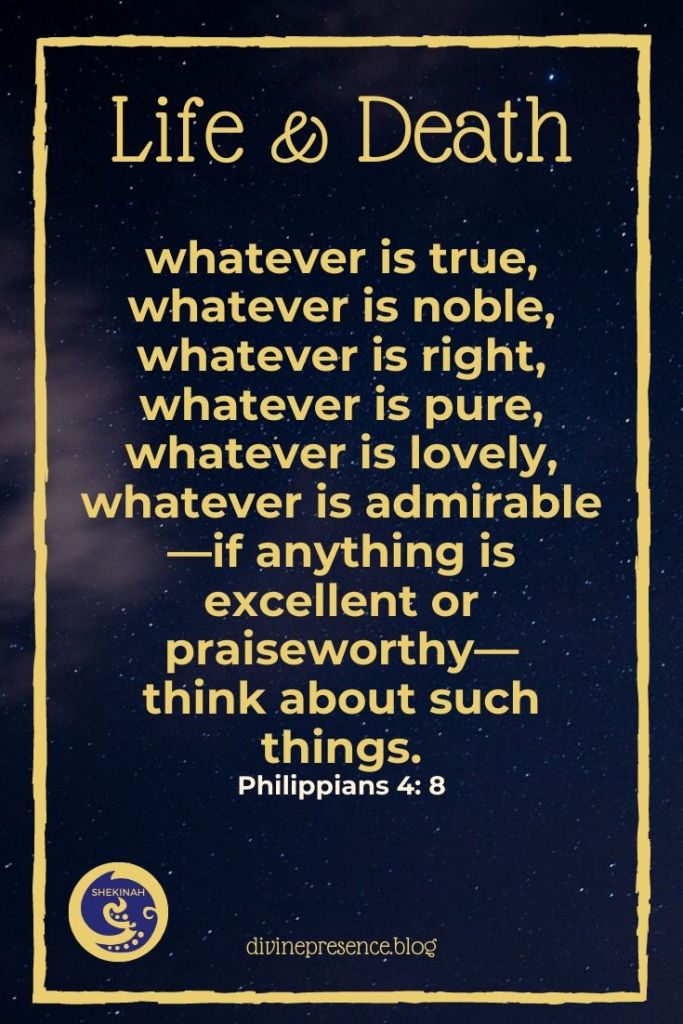
Whatever is true, whatever is noble, whatever is right, whatever is pure, whatever is lovely, whatever is admirable—if anything is excellent or praiseworthy—think about such things.
The power of your thoughts
Your thoughts influence your words and your actions. Long before you choose to do something, you have probably considered it multiple times.
Think, for a moment, about words that you spoke to someone in anger. How many times had you thought that before you actually said it? Then, in a moment of rage and slightly out of control (or perhaps in control but no caring about the consequences) you actually said what you’ve been thinking for a while. You voiced how you truly felt. Maybe it wasn’t the whole picture. But it started with thoughts that you have mulled over.
Consider the effect of thinking “I can’t breathe”, with all the nuances that it carries. Perhaps one of those nuances is that the system is unjust and doesn’t allow you to speak your mind.
If you regularly think “the system is unjust”, are you motivated to change it? Or do you get caught in a feeling of hopelessness? Notice the difference between thinking “I can participate in changing this unjust system” versus thinking “the system is unjust”.
Have you noticed how all your thoughts influence your emotions and your words? If your thoughts control your actions, then they have a role to play in creating your future! The action you take has a direct impact on your results.
The power of our emotions when mixed with words.
Our words are so much more powerful when they are spoken with emotion. It doesn’t matter if you are creating and destroying.
Anger at injustice can provide us with the strength and courage to embark on a journey that we might otherwise never take. Unfortunately, anger can also eat us up on the inside if we bottle it up, rather than channelling and releasing it.
Before becoming a bitter person: this was probably an angry person. Over time, the fire of the anger dies down, but the embers continue to burn within. The dissatisfaction and discontent are still there, unresolved. After the explosion of rage burnt out, bitter ashes and disillusion are left.
When we start a journey to transform our community, we may embark on it out of anger and frustration at the current situation. It is terrific to shout out to the world:
This is wrong! Wrongs must be righted!
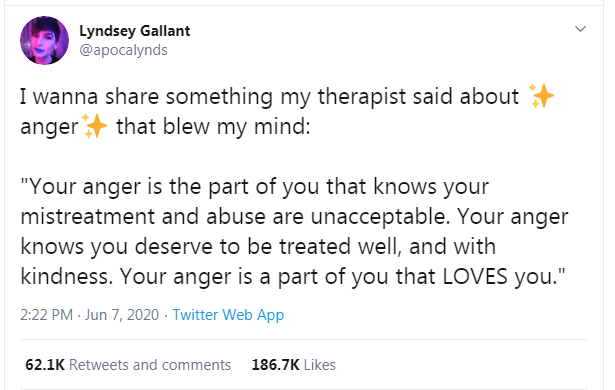
“Your anger is the part of you that knows your mistreatment and abuse are unacceptable. Your anger knows you deserve to be treated well, and with kindness. Your anger is a part of you that LOVES you.” https://twitter.com/apocalynds/status/1269711325749563399
But at some moment, love and compassion for our community need to replace that anger against the aggressors as the driving force of change. When we fail to recognise that our passion is driven by love and stay only in the rage, we miss an opportunity to grown in greater love and compassion.
Revolutions begin in angry protest and perhaps even rioting but have to end in love and compassion to build!
Man must evolve for all human conflict a method which rejects revenge, aggression and retaliation. The foundation of such a method is love.
Martin Luther King, Jr.
Make sure your thoughts, emotions & words serve your goals.
I love that injustice has awoken people to stand up and make a difference in their worlds. But if I could ask just one thing, it would be this:
Choose your words carefully, especially those spoken with emotion.
I want to hear the masses chanting:
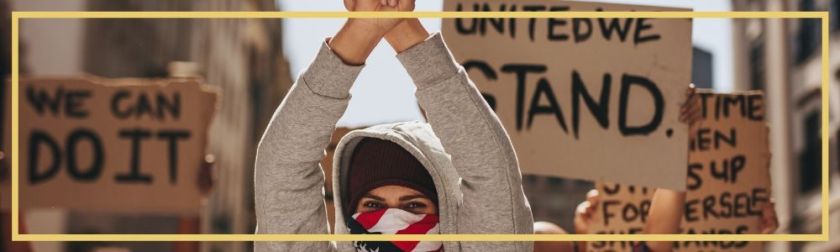
Justice for George! We can do it!
United we stand.
Black lives matter!
Fighting for justice!
We stand for justice.
We demand justice!
Respect me.
My voice matters!
I’m sure you could make a better list of powerful statements that could create change, without cursing your body or those supporting you.
And when we are done tearing down what no longer serves us, let’s build communities of compassion, love and kindness. Communities that are safe for our children, and that allow us to learn what it means to love our neighbour as ourselves.
If I look to Proverbs for Wisdom, these are but a few of the reminders about the power of our thoughts, emotions and words:
Proverbs 12:18
The tongue of the wise brings healing.
Proverbs 23:7
As a man thinks, so is he.
Proverbs 4:23
Above all else, guard your heart, for everything you do flows from it.
Proverbs 4:20-22
My son, pay attention to what I say; turn your ear to my words. Do not let them out of your sight, keep them within your heart; for they are life to those who find them and health to one’s whole body.
Proverbs 17:22
A cheerful heart is good medicine, but a crushed spirit dries up the bones.
I’ve spent a lot of time, these last three weeks, in silence – being still with my thoughts. I also spent a lot of time binging on Netflix in between. I was trying to work through a particular pattern in my life that I was sick of repeating!
But, I also had to recognise that I couldn’t spend 8 hours a day just in inner work. I would reach a point where I was tired of thinking and contemplating, and wanted to be mindless and entertained. It felt like too much to try to work it all out.
Last week, on Divine Shenanigans, we pulled our topic “from the Sorting Hat” – random name generator – and it picked the topic for us to discuss of “at-one-ment”. Very similar to atonement – but really about Oneness. At-One.
Easter has just passed, and while everyone was focused on Jesus’ resurrection I was busy thinking about my personal “death” and “resurrection”. I don’t know about you, but it seems that every 6-7 years, life presents us with a “breakdown”: grow through this experience or be doomed to repeat it in 6-7 years time! They say that after every breakdown, comes a break through, and I think that this is very true for all of us, especially spiritually. Without the break down, we would never be forced to break through!
Over the past months, I have been convinced that I need to focus on my spiritual well-being, putting God, as Source and Substance first in my life. I find this to be particularly challenging. Source: as in source of my
income and substance,
energy and health,
emotions and feelings, and
source of my thoughts.
If I focus on one aspect of my life, I typically exclude the Divine from other aspects, unconsciously. So, I constantly find myself “going it alone”, and then try to come back to center. When I remember that the Infinite is the source of my abundance and finances, I forget about my health and well-being. When I focus on Divine as source of my emotions, I get caught up in my thoughts.
Death: releasing and renewing
So, over Easter, I was busy contemplating: what do I need to release and let go of? What beliefs and thoughts and feelings no longer serve me? What would I be better of without?
And even more importantly, perhaps, what do I need to forgive and release? What baggage am I carrying around, emotionally and in my thoughts, that needs to “die” in me and be released?
“Holding on to anger is like grasping a hot coal with the intent of throwing it at someone else; you are the one who gets burned.” — Buddha
The same goes for suffering, hurt and pain that we hold onto because it has become part of who we identify with. Who will I be if I let go of this? We talk about “renewal of our minds” and yet strangely consider it okay to hold on to those beliefs and habits which do not allow us to grow, renew and resurrect.
I started March on the right foot: a morning spent on World Day of Prayer in prayer and forgiveness. And yet, when we arrived at Easter, I was very aware that there was still work to be done in forgiveness and release. I needed to renew my mind even further. I needed to focus on forgiveness of self, and release and let go, so that I could move past mistakes of the past and grow.
Rising from the ashes like a phoenix:
We have developed, as a human race, many concepts of death and resurrection. We speak of rising like a phoenix from the ashes, and this symbolism exists across many cultures. For the Greeks, it is the phoenix, but it is also the Benu bird of the Egyptians. For some, it is the Nimbus, closely related to the sun. The Jews has the Milcham, and the Persians had the Simurgh. Native Americans have the Thunderbird, Russians have a Firebird, and the Chinese have the Feng Huang. Finally, the Japanese have the HoHo bird. These are all symbols of resurrection after loss.
The phoenix is a legendary bird that can live for 500 years. Knowing that the end was near, the phoenix builds a funeral pyre for itself. It lies down on this pyre as it begins to die and burst into flames, consumed by the fire. Then, from the fire, the phoenix emerges, renewed, purified, more beautiful and regal than before. And so the cycle of life would begin again, for another 500 years, dying, purifying, returning more beautiful than ever, into perpetuity.
And so, I have been ruminating about what has died or is dying in my life that it’s time to release?
What should I simply release and let go of, so that I can rise again, a more beautiful and better version of myself?
As a spiritual being in a human body, what does eternity and perpetuity look like? If the Kingdom of Heaven is here: what does that look like in my life and experience?
Renewal & resurrection:
And so as Easter moves into Pentecost – a time in which we rejoice in the Oneness that we have with Wisdom and Comfort – I am invited to contemplate what my renewal and resurrection looks like.
Who am I when I am the best version of myself, living as my Creator intended for me to live?
Who am I after I have walked through the fire of purification, with eyes clearly fixed on my purpose?
What does my spiritual self look like when I leave behind that which no longer serves me and commit to being the Light in this world?
As I live in Presence each day, committing to Peace in my life, I am assured that I have everything that I need. That the source of my abundance and sustenance, my emotions & feelings, my thoughts and my bodily health is Perfect. I am simply asked to allow the Light to fill me and flow through me.
6 God sent a man, John the Baptist,7 to tell about the light so that everyone might believe because of his testimony.8 John himself was not the light; he was simply a witness to tell about the light.
19 This was John’s testimony when the Jewish leaders sent priests and Temple assistants from Jerusalem to ask John, “Who are you?”20 He came right out and said, “I am not the Messiah.” 21 “Well then, who are you?” they asked. “Are you Elijah?” “No,” he replied. “Are you the Prophet we are expecting?” “No.” 22 “Then who are you? We need an answer for those who sent us. What do you have to say about yourself?” 23 John replied in the words of the prophet Isaiah: “I am a voice shouting in the wilderness, ‘Clear the way for the Lord’s coming!’” 24 Then the Pharisees who had been sent25 asked him, “If you aren’t the Messiah or Elijah or the Prophet, what right do you have to baptize?” 26 John told them, “I baptize with water, but right here in the crowd is someone you do not recognize.27 Though his ministry follows mine, I’m not even worthy to be his slave and untie the straps of his sandal.” 28 This encounter took place in Bethany, an area east of the Jordan River, where John was baptizing.
So, I would ask each one of you this morning: who are you?
John the Baptist, knew clearly, who he was. Do you know who you are? Are you living the life that God intended for you to live, being who God made you to be? Have you reached a place of maturity where you know and accept what God says about you, agree with Spirit that this is true of you, and become the best version of you that exists?
Let’s do a small exercise, and review different areas of our lives: starting with our bodies. I want you to close your eyes for a moment, and just be present in your body. Be aware of your head, of your neck, your shoulders, your left arm, your hand, your right arm, your right hand… and now let’s move down to your legs. And now let’s move back to your head. And now, I want to ask you: are you your body? Or is your body simply the vessel that carries you?
If you are not your body, then who are you?
What about your possessions? Do those define who you are? Your home, your car, your bank account? Is that who you are?
How about your job, profession and career? Does that define who you are? How many people do you know that have changed careers? How many times in your life has your career and profession changed? How many people do you know that have been laid off or fired, that have quit, that have moved to another country and had to start over in another field? Is a person truly defined by their career or profession? Who are you?
What about your family? Are you mum, dad, the black sheep, the only single one left, the life of the party, the grandmother? Is that who you are? How many people do you know who have lost members of their family? And yet they still continue to live and find new identities and purposes. Who are you?
How about your emotions? Are you happy, sad, angry, fearful, ashamed, tired? But is that whoyou are? Or is that simply a state of feeling and emotion that comes and passes?
John responds rather cryptically to the Pharisees and scribes: “I am a voice…” The first verses of John tell us a little more about John the Baptist’s identity:
“God sent a man, John the Baptist,to tell about the light so that everyone might believe because of his testimony.John himself was not the light; he was simply a witness to tell about the light.”
And you, who are you? What were you sent for? God sent you… Have you discovered yet what for? Are you living out that purpose? Are you being everything that you could possibly be?
Your identity doesn’t depend on something you do or have done. Most of us confuse doing, having and feeling with being. Instead of saying I feel sad, we identify with the sadness and say “I am sad”. Instead of saying that I work as a lawyer, we say “I am a lawyer”. Instead of saying I have a family, we lose our identity within that family. But is that truly who you are?
John knew who he was. And Jesus certainly knew who he was. Jesus said:
I am the bread of life.
I am the light of the world.
I am the door.
I am the good shepherd.
I am the resurrection and the life.
I am the way, the truth and the life.
I am the vine.
“I tell you the truth, before Abraham was even born, I Am!
And who are you?
Now, I don’t care much for Joel Osteen, but I quite like part of his start to Sunday services and his declaration about the Bible:
This is my Bible.
I am what it says I am.
I can do what it says I can do.
…
Who are you?
Who does God, through the Bible, say that you are? Let me give you some ideas:
You ARE a child of God, complete in Christ – John 1: 12; Colossians 2:10
You ARE loved, accepted, redeemed, holy, forgiven, free from condemnation, chosen, established, anointed and sealed by God. 1 John 3: 3; Ephesians 1:6; Colossians 1:14; Romans 8:1; 2 Corinthians 1:21; Colossians 3:12
You ARE a joint heir with Jesus, united with God and one spirit with God Spirit. Romans 8: 17; 1 Corinthians 6:17
You ARE a temple of God: his Spirit and life lives in you. 1 Corinthians 6:19
You are God’s co-worker; a living stone on which the spiritual house is being built. 2 Corinthians 6:1; 1 Peter 2:5
So, if that’s who you are: what are you doing that lives up to this description of you? Does your life reflect who you are?
If you embodied this description of you: what would be different to how you are living your life at the moment? What needs to change in your life, for this to really be you? What would new things would appear in your life if this was you?
What scares you the most about this description of you?
Being a child of God? a joint heir with Jesus?
Being united with God – complete Oneness?
being complete?
being loved, accepted, redeemed, holy, forgiven, free from condemnation, chosen, established, anointed and sealed by God?
being God’s temple?
being God’s co-worker and co-creator?
What obstacles or idols in your life keep you from living this out? What habits or practices do you need to incorporate into your life to live this more fully?
What’s keeping you from living this life today? From walking out of the Church today and being You, the best You that there is, the You that God created you to be in all your fullness and glory, so that others might see Christ in you?
Because today, YOU are the hope of the world. You are the voice in the wilderness. You are the light in the darkness. God sent you!
I can’t tell you how excited I am to stand up here today and let you know that today we’re going to talk about getting naked, and not going with the crowd!
I’m going to give you a moment to let that sink in…
We just read in Genesis about Adam’s reaction when his eyes are opened, and he realises he and Eve are naken – they sow together fig leaves and make themselves clothes, and in verse 10, Adam responds to God:
“I heard the sound of you in the garden, and I was afraid, because I was naked; and I hid myself.”
Yesterday, I was giving Isabella a bath, and I can tell you, two-year olds are not ashamed of their bodies, and have nothing to hide. If I would let her, I’m pretty sure Isabella would’t put on clothes at any time – she doesn’t understand what she needs them for. She struggles against you when it’s time to get dressed and routinely says “NO” when you say she needs to put clothes on.
More importantly, Isabella has no need to put up defenses and barriers between her and other people – she wears her heart on her sleeve. She laughs without reserve, she cries without reserve, and she simply shows every emotion that she is feeling. She even manipulates without reserve and then laughs when you call her out on it, totally living in the present moment and without shame. When she’s uncertain, she lets you know, reaching out for support. And if she gets scared, she seeks immediate shelter!
Take a moment – when was the last time you were truly authentic? How long has it been since you allowed yourself to take off your armour and defenses, take down all those barriers you’ve built to protect yourself, and actually allowed yourself to live and feel? We talk about “putting on our face”, rather than putting on make-up, or “keeping a poker face” instead of showing emotions.
How long has it been since you were naked and vulnerable before the people that matter the most in your live? Most of us have lived for far too long in a society where naked has a sexual connotation, and we’ve forgotten that it also means to be open and discovered; it means to be honest, sincere and real. Like Adam, we hide. And then, when those who know us best get through that defense and find us, we give excuses like Adam did – it was HER fault, not mine. That woman that YOU gave me, God, SHE made me do it! It couldn’t possibly have been my fault!
In coaching we talk about secondary and primary emotions – and most of us are only in touch with the secondary ones, and fail to accept to even admit that below that emotion there’s another one that we’re too afraid to even acknowledge. Many times our anger is simply a mask for impotence or pain and hurt; or our coldness and indifference is a mask for pain and vulnerability. We put on a brave front, when we are really scared and insecure. And we get so busy trying to convince the world that this is who we are, that we lose touch with ourselves and our true emotions.
All of this seeps over and into our Christian life and our relationship with God. How many times do we try to keep on the mask, saying hollow prayers and just going through the motions? When was the last time you were completely unarmed and defenseless before God?
Ephesians 6: 10-18 tells us to put on the full armour of God. I have a really simple question – have any of you ever tried to put on a suit of armour ON TOP of another suit of armour? If you are already wearing your own suit of armour, how could you possibly put on the suit of armour that God has to offer? I’d like to look at this quickly:
You have a belt of TRUTH – when was the last time you had truth in your life? Blatant, honest truth? Where you didn’t have to mince words and keep up appearances? When you were who you really are? What if, instead of being protected by all these lies, you could be protected by truth? What difference would that make in your life today?
There’s a breastplate of righteousness. I don’t what your definition of righteousness is, but when I think of righteousness, I don’t only think of holiness or blamelessness – it’s all tied in there together with fairness, goodness, justice, honor, and virtue. And once again I’m going to ask – how can you wear a breastplate of righteousness when you already are living a lie? If there is no authenticity and you are not being true to yourself, what kind of goodness and fairness can you offer to others?
Next we have your feet fitted with the gospel of peace. Oh! That’s deep. How many of you can say your feet are shod with peace and tranquility? Or are you so busy, keeping moving and always in a hurry that you fail to truly have a moment for peace? Why the busyness? What’s the hurry? Does it make you feel more important? Does it give you self worth? Are you hiding from other feelings and simply filling up the void and emptiness in your life with “I’m too busy”. Is there room on your body to put on the gospel of peace on your feet? Or do you need to get naked in order to have this possibility?
Then, you are to take up the shield of faith – faith in humanity, faith in yourself, faith in God’s goodness and greatness, living a life of conviction and constancy, with the certainty that “it is well with my soul”. Did your faith get broken, like a child’s toy, when life’s struggles trampled on it? When did your heart get broken, such that you could no longer believe?
We’re called to put on the helmet of salvation – does it fit on your head? Or are there too many ideas and issues rolling around in there? When was the last time you took time to accept that perhaps salvation doesn’t depend on you, but only on God’s grace! Can you accept God’s grace and undying love for you? Or are you once again, too busy, trying to earn it and deserve it with everything you are doing? Be still… and know that I am God! The helmet of salvation is simply knowing that it’s not all on you. You aren’t in this alone. And keeps your mind clear and free.
We are each given the gift of the Sword of the Spirit, the Word of God. Yes, there’s the Word of God in the Bible, but there’s also the word of God in our hearts. Have you taken a moment to listen to what God would say to you today? Are you busy fighting your battles alone, rather than with God’s help? When you ask God for guidance in your daily battles, do you actually sit quietly and listen to God’s answer? Or do you just plow ahead into “this is what I need to do” without listening? Who else are you not listening to? The words of wisdom and advice we can find in the Bible are only available if we are willing to listen.
And finally, we have praying in the Spirit – when was the last time you let you spirit pray directly in tune with God’s spirit? Have you taken the time lately to quieten all the senses and stop the rush, to be able to allow your spirit to pray, rather than your mouth, your emotions, your thoughts, your brain?
When we stand before God, we are supposed to be naked! Not naked, afraid and ashamed – naked, unashamed and vulnerable, open, holding nothing back, masking nothing.
Are you so busy trying to show everyone that you have it all together, that you’ve started telling this to God as well? Living your life as if you don’t need God’s help, assurance and salvation? God wants us to get real! To get real with him. Get real with each other. Talk from the heart!
To quote Kevin Smith:
Stop fakin’ the funk!
Stop fuontin’ and Stuntin’!
Stop trying to be something that you’re not before God!
Stop coming before God with “Oh holy, most reverent, wise & eternal God”!
GOD DOESN’T BELIEVE YOU! As terrifying as it may be, he sees through the whole facade – you can’t keep pretending.
God wants us to be free! And freedom starts with being who you really are, and then building from there!
Speaking for myself –
I am terrified of being vulnerable and opening up – my facade is cold and unfeeling – and God says – “be vulnerable, risk being hurt, and open up” – then, and only there, will you be able to truly show God’s love to others.
My facade is being “too busy”, and always having excuses – and God’s response is “take time to simply be still and know that I am God”, there’s peace there.
My facade is that I am self-centered and ego-centric – and God’s response is that God is love, and there’s more than enough to go around! I don’t need to live looking out for myself and my own interests, because the lie that I have been told that “there’s not enough” to go around is simply that, a lie. There is abundance! I can always afford to give, because God promises to each of us:
Give, and it will be given to you. A good measure, pressed down, shaken together and running over, will be poured into your lap. For with the measure you use, it will be measured to you.
God’s gift for us is that we are a special people – we don’t need to live like everyone else does. We can be different and live in abundance. But most of the time, we want to have a king to rule over us, like the people of Israel in Samuel – without realising the blessings that we will lose as a result. Everyone else lives with barriers and facades, and so we should to? I don’t think so – we are intended to live naked and exposed before God and men – covered in the armour that God has given to us, rather than the armour of our own making.









 Divine Presence: Letting the Infinite flow in my life