generative wisdom,being wise,death,a time for everything,a time to heal,actions,all is meaningless,all is vanity,ask yourself this,awareness,being compassionate,being kind,career,choices,decision-making,desires,discovering your purpose,education,riches,spiritual healing,

How to Create a Lasting Legacy: The True Pursuit of Wisdom

Is the pursuit of wisdom and creating a lasting legacy worth it?

If we read Ecclesiastes 1, we might think it’s all an exercise in futility. 
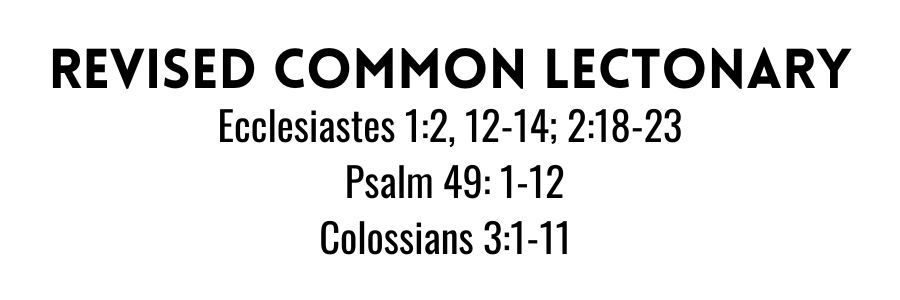
Ecclesiastes, Psalms, Colossians

Was the writer of Ecclesiastes depressed? It seems so. After all he had done to pursue wisdom, he realises that everyone dies.

What was the purpose of studying so much and creating so much wealth? Will it be appreciated by those left behind? Even wealth gets squandered by unwise heirs. 

So, what’s the purpose of all that hard work and effort?

When we look at the wise, they die; fool and dolt perish together and leave their wealth to others.

Psalms 49:10

On the other hand, Colossians suggests that we stop pursuing worldly pleasures and goals, and focus our time and energy on “things above”.

Set your minds on the things that are above, not on the things that are on earth

Colossians 3:2

So, what is the meaning of life? Is it futile to pursue wisdom and wealth? Is this all vanity (futility) as the author of Ecclesiastes suggests? 

Or is there something meaningful that we can do and create here and now that will leave a legacy behind?

The true pursuit of wisdom

First, what is wisdom? Is there a difference between worldly wisdom and divine wisdom? Earthly wisdom or godly wisdom?

Who do you consider to be wise?

Is someone with a Master’s degree considered to be wise? Or are they merely educated?

In business, there’s a DIKW pyramid – data, information, knowledge and wisdom. Data is meaningless, unless you can actually draw some conclusions from it that you can use to guide your future actions.

Data is the foundation, information is processed data, knowledge is information with context, and wisdom is the application of knowledge to make informed decisions. 

So, in the context of business, wisdom is not knowledge, but the application of knowledge into decision-making. 

In a similar fashion, education is merely a means to an end: hopefully, getting an education will teach you how to transform knowledge into wisdom – wise decision-making. 

Worldly Wisdom or Divine Wisdom?

So, what about this divide between earthly wisdom and godly wisdom? 

Do you want to be counted wise, to build a reputation for wisdom? Here’s what you do: Live well, live wisely, live humbly. It’s the way you live, not the way you talk, that counts. Mean-spirited ambition isn’t wisdom. Boasting that you are wise isn’t wisdom. Twisting the truth to make yourselves sound wise isn’t wisdom. It’s the furthest thing from wisdom—it’s animal cunning, devilish plotting. Whenever you’re trying to look better than others or get the better of others, things fall apart and everyone ends up at the others’ throats.

James 3:13-16, The Message

If you ask me for my favourite books of the Bible, they would be these:

  • James
  • Proverbs
  • Job
  • Ecclesiastes

Do you see any similarities in them? Yes, they all talk about Wisdom.

And still, Ecclesiastes suggests that even the pursuit of Wisdom is meaningless and futile. 

As we know it, the author of Ecclesiastes (thought to be Solomon, but perhaps not) was also one (if not the principal) of the authors of Proverbs. 

And in the end, he says it’s all vanity. What’s the point of pursuing wisdom?

Or as Psalms suggests: what’s the point of building up an estate and wealth to leave to your children? 

What do we truly live behind when we go? Is there any point to “living with purpose” or “finding your purpose” in life and creating a legacy to leave behind? 

Is pursuing holiness enough?

Colossians suggests that we should pursue individual holiness. But how does Colossians define this individual holiness?

What does it mean to be renewed in wisdom and become a new self?

I find it fascinating that the defintion we are given focuses most on what we leave behind and stop doing. When we stop all of these bad habits, though patterns and emotions, we open up space for the new.

Put to death, therefore, whatever in you is earthly: sexual immorality, impurity, passion, evil desire, and greed (which is idolatry).
But now you must get rid of all such things: anger, wrath, malice, slander, and abusive language from your mouth.
Do not lie to one another, seeing that you have stripped off the old self with its practices and have clothed yourselves with the new self, which is being renewed in knowledge according to the image of its creator.

Colossians 3:5, 8-10

As it says here, stripped off the old self with its practices and habits. And then you can put on your clean clothes.

“seek the things that are above”

Colossians 3:1

What are we seeking? Divine Presence in our lives.

And how can we be filled with the Divine Spirit? Only by making room! To make room in our life for the Divine, we have to let go of whatever is holding us back.

What are the personal obstacles in your thoughts, feelings and actions that inhibit the Spirit from flowing freely in your mind?

To be full of the Spirit

In order to demonstrate the fruit of the Spirit fully – love, joy, peace, patience, kindness, goodness, faithfulness, gentleness and self-control – we have to let go those emotions and thoughts that are their archnemesis.

  • To be full of love, I have to first let go of hate.
  • If I want my joy to overflow, I first have to finish grieving for whatever I think I deserved and didn’t receive, as well as find a place of acceptance of what is.
  • To be full of peace, I release my anxiety and that pressing need to have everything now. I recognise any greed that I have – whether it be for things, results or even knowledge and wisdom.
  • If I want to have patience, I must learn to persist in the face of trouble, delay or even suffering. It’s an internal strength that I gather that allows me to face whatever may come, and still love othes in spite of my circumstances. I let go of the longing for immediate results, and recognise that everything is for my good. 
  • To be full of kindness, I have to let go of my ego, pride, anger and wrath. I release all malice and slander from my thoughts, emotions, words and actions. And I certainly refrain from abusive language coming out of my mouth!
  • If I am committed to being filled with goodness, I must first release sexual immorality, impurity, passion, evil desire, and idolatry.
  • And when I claim that I have faithfulness, I let go of lying to myself and others, and instead demonstrate loyalty, steadfastness, and trustworthiness.
  • Likewise, when I am filled with gentleness, I get rid of all those rough edges of my emotions and tongue. I learn to speak gently, rather than harshly, and I curb my anger, wrath and hatred completely. 
  • Finally, the crux of it all becomes impeccable self-control. I have control over my mind and thoughts, my emotions and especially my tongue and the words of my mouth. 

This is why Colossians focuses on what we have to get rid of in our lives. Take out the old, in order to be full of the new. If you want to think on things above, you have to stop thinking about all the things below. 

What is Wisdom and a Meaningful Legacy?

Let’s go back to Ecclesiastes and the lamentations of “This is all futile and useless”. 

sometimes one who has toiled with wisdom and knowledge and skill must leave all to be enjoyed by another who did not toil for it.

Ecclesiastes 2:21

So, all that hard work, even applying your knowledge and skill for wise decision-making, sometimes is reaped by those who don’t deserve it.

Perhaps you died and a distant family member reaps rewards rather than the children you expected. Or your business is taken over by outsiders. The bank forecloses on your house and leaves your children without a roof over their heads.

So, what is meaningful? What do we leave behind that truly matters?

I would guess that it’s the impact we have on the lives of others. Especially when that impact carries far into the future, beyond the span of our lives and the generations that followed us. 

Think for a moment, for example of the authors of the Bible: thousands of years later, we are still reading those words. Even the authors of political, ethical and scientific books are read hundreds and thousands of years later.

But it’s not just books and writers that leave a legacy – there are many who impacted lives that were illiterate, and yet their deeds are know all over the world, living on as legends and stories that we continue to share. 

Jesus may have been born humbly, and we have no works written by him… yet every year we continue to celebrate his birth and coming to this earth, as well as his teachings and his sacrifice.

His divine wisdom and legacy are clear to each one us.

So the question for you today is: what meaningful legacy are you creating and leaving?

who are you, definitions, define, yourself, God, carpenter, Jesus, others, expectations, rise, fall, I am, presence, Presence, practice, practising, meditation, prayer

Just a carpenter

How many of you today have felt that you have just received a huge new learning, something that has truly transformed your life, and you share it at home — and no one is listening?

Or maybe you have started a new diet and it is really working for you… you are excited about it, and share it with those who know you best… and they just don’t get how important this discovery is for you?Read More »

Sermon: Boasting in my Weakness

“Boasting in my Weakness” – Really?

LECTIONARY:

  • 2 Corinthians 12: 2-10

A teacher said to her students in class one day,

“Boys and girls, there is a wonderful example in the life of the ant. Every day the ant goes to work and works all day, a busy life. And in the end, what happens?

Little Johnny replies, “SOMEONE STEPS ON HIM.”

We live in an era in which life is a constant struggle. Everyone  wants to be healthy and strong; nobody likes to be sick, weak, depressed or worried. And yet, we face problems and tragedies; we struggle to live up to expectations – whether our own or those imposed by others.  We’re not quite who we think we should be. Just like Paul in his letter to the Corinthians.

Take a moment and put this in context: this letter to Corinthians was not written in a vacuum. When Paul wrote this letter (which by the way is his 4th letter, not the second), he didn’t pen in the chapter and verse designations. Those were added much later in history. So chapter 11 and chapter 12 are one continuous thought.  In chapter 11, Paul writes about the suffering he has endured because of the name of Jesus. He tells the Corinthians that he has been imprisoned for preaching the gospel; he has been whipped on several occasions; he had been beaten with rods. He tells them that on one occasion the Jews stoned him; and left him for dead. But he survived (probably with deep lacerations and broken bones.) Paul was shipwrecked three times, spending one night in the open seas. He experienced intense times of suffering and yet found strength.

It is apparent as you read this part of 2nd Corinthians, that some in the church in Corinth were questioning Paul’s authority as an apostle. “Not good enough.”  So in Chapter 11, Paul tells about all the things he could boast about, both good and bad, that make him an apostle. But in Chapter 12 the tone changes, because he is not living in the past.  Our past history and our past glories are all fine and well, but the real question is “who are you today?”.  Paul is writing this letter to the Corinthians when he is no longer in sparkling health and strength.  Who keeps singing “Glory Days” by Bruce Springsteen?

The church in Corinth has these “super apostles” or “big shots” that were criticising Paul. Paul responds, admitting that he was not a trained speaker, (2 Cor. 10:10), implying that the so-called super-apostles were trained speakers. One of their favorite criticisms of Paul seems to have been that he was not very impressive in presence or speech.  Paul warned the Corinthians against the pretense that knowledge can create. Toe to toe with these orators, Paul would fail. In many respects, his writing also lacked sophistication and talent.

And yet Paul says, he will boast about his weaknesses.  We feel unhappy and worried about our weaknesses, but somehow he has accepted his weakness in a positive way and so he is able to boast about it.  And he even accepts that he needs it long-term. In order to remain focused on God, rather than himself and his exploits, Paul has this “thorn in his side”. He prayed repeatedly and yet the thorn remained in his life. I don’t think that ‘three times’ means Paul said three prayers but that he spend three seasons in prayer pleading with God to remove this from his life.  And yet he has an unanswered prayer.

  • How many times could we cite that we are thankful for our unanswered prayers?
  • How often do our prayers tend to focus on making life easier and softer and rarely are for the kind of difficulties that would challenge us and make us grow spiritually.

None of us wants to really be moved outside of our comfort zone, and so we react to life’s situation by rejecting the difficulty.  Paul, for all his abilities and mighty use by God, could not escape the fact that he was human, and thus inevitably susceptible to weakness.

Paul doesn’t like it.
He can’t change it.
And God won’t remove it.

Had Paul focused on the injustice of this torment in his life, he could have become a very bitter man, consumed by how unfair this harsh and excessive situation had become for him.  But Paul not only accepted his negative circumstances but he also expresses his joy and happiness over them.

  • What is your hurt story?
  • What behavior keeps you from where you need to be?

I hate looking weak or insufficient. I particularly loathe being wrong, especially when the mistake I’ve made has public ramifications. What will people think?  God forbid that someone realise how far behind I am at work, or that I get upset and short-tempered with my daughter when I’m tired, or that I can’t seem to get things right in my marriage, or that I don’t think quickly on my feet and always come up with the perfect rebuttal three days later!  I get frustrated by these deficiencies and perceived weaknesses – I’m inadequate and useless.  And so, since I don’t like to feel this way, I adopt a fake persona that I hope others will see (or that they will at least pretend to see, because I pretend to see the fake persona they put forward).

We live in a world where all the photos of models in magazines are Photo-shopped to perfection, where there’s a special model for hands, and another for backs and another for legs.  Where there are body doubles for actresses in Hollywood for those close-up shots or for the action or dance scenes – each one showing a perfection that perhaps the actress doesn’t actually have.

Boasting in weakness goes so against the way the world operates today. We don’t boast to our peers about our weaknesses or in a job interview. Typically, when we’re asked to focus on our weaknesses in an interview, we are trained to say – “Well, I would say that I’m stubborn, and I just don’t give up until I’ve finished the project that I’m working on to successful completion.”  or “I care too much about my work, and don’t have a good work-life balance.” – or whatever we think the perfect answer to the question is.

In our conversations with our friends, we don’t say, “Hey! Turns out I’m really bad at empathy and I’m totally self-centered. Isn’t that great?”

So, let’s each take a moment to reflect – what is your greatest weakness? What are you truly ashamed of?

  • I’m self-centered, frigid, insensitive and withdrawn;
  • I speak too loudly and sometimes have inappropriate social awareness;
  • I hate confrontation and so don’t deal with issues in a timely manner;
  • I don’t take criticism well;
  • I shut down and reject others;
  • I ride rough-shod over other people’s feelings in order to get what I want;
  • I can’t handle change and am stuck in a rut;
  • I take things personally;
  • I can’t say no and am always overloaded;
  • I’m condescending and treat others badly;
  • I have poor leadership skills;
  • I manipulate others;
  • I hold on to hurt feelings and dwell on them;
  • I overreact  …

Each one of us has something that we try to hide and pretend isn’t there. And if it’s a habit that we’re trying to break or a type of reaction that we know is wrong, whatever you do, don’t label it as “SIN”, so passé!  No one “sins” anymore… No one is a “sinner”.

Let me put it this way – the Bible says if you know what is right and you don’t do it, it’s sin – so, when you’re on that diet for your diabetes and you know you shouldn’t eat that chocolate bar and ice cream, that’s sin – not necessarily for someone else, but for you.  Because you know that it’s bad for you!  And yet you insist…

For how many of you, has ignoring and trying to hide this weakness, bad habit or character flaw actually worked?  As much as we may hate it, ignoring our weakness doesn’t make them go away. How many of you notice a character flaw in another person and say nothing, because you’re polite?  You see someone faking it and you go along with the charade, because you want them to go along with your charade?  They say there’s “nothing wrong” and you say “okay”, because it’s the easy way out.

If I took the time to actually ask, and they answered me honestly, I might have to do something about it!  I might then have to care for this person later, and ask how they are doing again… and then hear the truthful answer!  And it’s so much easier to just accept the “nothing wrong” and “okay” and carry on as if nothing had happened.

But that’s not who we are supposed to be!  We’re not supposed to be shallow and callous people, living on a surface, pretending that the weaknesses don’t exist.

When I don’t have enough love in my life, God reminds me that God is LOVE – it’s unlimited! I may be frigid and uncaring, but when I’m filled with God’s love there’s more than enough to go around!  I can be filled to overflowing – because God created me to be His vessel.  It doesn’t matter how much love I have, the question is “how much love does God have?”And so, it is when I can truly say “this is my weakness” that I allow God to shine through!  When I finally accept – “this is how I am”, I’m wonderfully and perfectly made, and God just wants to shine through all the cracks in my character, then I can truly boast in my weakness.

When I don’t have enough patience, God reminds me that He is PATIENCE – unlimited…

When I am filled with anger, God reminds me that He is goodness and kindness… unlimited…

I would invite all of you, during our coffee time after the service, to take a moment and share with someone your weakness, (yes, that one that you are SO ashamed of) and how God can shine through you, in spite of yourself!