
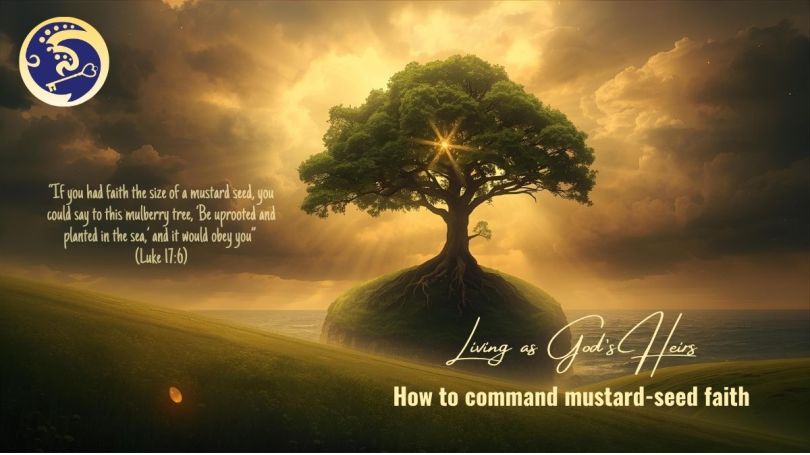
There’s a powerful thread weaving through Habakkuk, Psalm 37, 2 Timothy, and this Gospel: faith isn’t a timid plea—it’s a bold command from God’s heirs.
Let’s pray:
Creator of all, open our eyes to our identity as Your children. Ignite our mustard-seed faith to uproot the impossible. Amen.
Mustard-Seed Authority: Faith That Commands
Imagine the apostles, exhausted from Jesus’ teachings, blurting out, “Increase our faith!” (Luke 17:5). They’ve seen miracles, but the world’s weight—oppression, division—feels too heavy.
Jesus doesn’t hand them a faith-booster shot.
He says, “If you had faith the size of a mustard seed, you could say to this mulberry tree, ‘Be uprooted and planted in the sea,’ and it would obey you” (Luke 17:6).
That’s wild.
Not “ask God to move the tree.”
Command it.
Expect obedience.
Then He pivots to a parable:
“Who among you would say to your slave who has just come in from plowing or tending sheep in the field, ‘Come here at once and take your place at the table’?
Luke 17:7-10
Would you not rather say to him, ‘Prepare supper for me; put on your apron and serve me while I eat and drink; later you may eat and drink’?
Do you thank the slave for doing what was commanded? So you also, when you have done all that you were ordered to do, say, ‘We are unworthy slaves; we have done only what we ought to have done!'”
At first glance, this feels like a humility slap: Don’t pat yourself on the back for basics.
But dig deeper. This isn’t our posture toward God—it’s a caution against entitlement.
And yet, we are not groveling servants begging favors.
John 1:12 declares: “But to all who received him, who believed in his name, he gave power to become children of God.”
Power.
Authority.
As sons and daughters, we command with expectation, rooted in the Father’s will.
Think of Nigeria, where over 7,000 Christians have been slaughtered this year by jihadists like Boko Haram—villages razed, churches in flames, largely ignored by global headlines. Chaos screams, “Where’s God?”
Yet Jesus invites us: As His kids, command protection over those believers.
Uproot the violence.
Expect it done—not as beggars, but heirs.
This commanding faith pulses through our readings. Let’s stand on the ramparts with Habakkuk.

Standing on the Ramparts: Visionary Faith Amid Violence
Habakkuk stares at a broken world:
“O LORD, how long shall I cry for help, and you will not listen? Or cry to you ‘Violence!’ and you will not save? Why do you make me see wrongdoing and look at trouble? Destruction and violence are before me; strife and contention arise”
Habakkuk 1:2-3
Sound familiar?
In Panama City, violence scars Curundú and El Chorrillo—200-250 murders this year, gangs trapping the poor at the bottom of Cerro Ancón and in 4 de Julio, while Albrook, Clayton, and the top of Cerro Ancón sit safe, gated, untouched. It’s injustice, raw and next door—the rich insulated, the poor bleeding.
How long, O Lord?
Habakkuk doesn’t crumble. “I will stand at my watchpost and station myself on the rampart; I will keep watch to see what he will say to me” (Habakkuk 2:1).
He demands God’s answer.
And it comes:
“Write the vision; make it plain on tablets, so that a runner may read it. For there is still a vision for the appointed time; it speaks of the end and does not lie. If it seems to tarry, wait for it; it will surely come; it will not delay.”
Habakkuk 2:2-3
This isn’t passive waiting—it’s defiant faith.
Galatians 4:7 reminds us: “So you are no longer a slave but a child, and if a child then also an heir, through God.”
Slaves fear; heirs inherit visions.
Habakkuk’s rampart is our prayer closet, our street corners in Curundú.
Write God’s vision for Panama City: Peace in El Chorrillo, equity from Cerro Ancón’s base to summit.
Command it as heirs—expect the delay to shatter.
Church, what’s your rampart? A neighborhood vigil? Advocating for the poor?
Stand there, not in fear, but visionary authority. Because this faith doesn’t fret—it fruits.
From Fret to Fruit: Stillness in the Storm
Psalm 37 meets us in the envy trap: “Do not fret because of the wicked; do not be envious of wrongdoers” (Psalm 37:1).
Fretting is spiritual quicksand—sinking us into anxiety over evil’s apparent wins.
In Nigeria’s silent slaughter—7,000 Christians gone, militants prospering—it’s tempting: Why them, Lord? Why not us?
The psalm flips it: “Trust in the LORD and do good; live in the land, and enjoy security. Take delight in the LORD, and he will give you the desires of your heart. Commit your way to the LORD; trust in him, and he will act” (Psalm 37:3-5). Then: “Be still before the LORD, and wait patiently for him; do not fret over those who prosper in their way” (Psalm 37:7). And the gut-punch: “Refrain from anger and forsake wrath. Do not fret—it leads only to evil” (Psalm 37:8).

Fretting breeds anger, wrath, evil. What’s the opposite? Galatians 5’s fruit of the Spirit:
- Instead of fret’s anxiety, choose peace and patience.
- Swap anger’s heat for kindness and gentleness.
- Ditch wrath’s rage for love, joy, and self-control.
Galatians 4:7 frees us: “So you are no longer a slave but a child, and if a child then also an heir.”
Slaves fret; heirs bear fruit.
For Nigeria’s persecuted, don’t rage—pray kindness over killers, peace over pain.
In Panama City, when Albrook’s luxury mocks Curundú’s cries, be still.
Commit your way.
As God’s kids, command fruitfulness: Delight in Him, expect heart-desires fulfilled. Watch justice shine like noonday (Psalm 37:6).
This fruitful heirship ignites Timothy’s fire.
A Spirit of Power: Boldness Over Fear
Paul writes to Timothy, a young leader facing trials: “For this reason I remind you to rekindle the gift of God that is within you through the laying on of my hands” (2 Timothy 1:6). Then the powerhouse: “For God did not give us a spirit of cowardice, but rather a spirit of power and of love and of self-discipline” (2 Timothy 1:7).
Fear shrinks us—cowardice in chaos. But Romans 8:15-16 declares: “For you did not receive a spirit of slavery to fall back into fear, but you have received a spirit of adoption. When we cry, ‘Abba! Father!’ it is that very Spirit bearing witness with our spirit that we are children of God.”
Adopted!
Not slaves trembling, but kids crying “Abba!” with power.
In Panama City, where Curundú and El Chorrillo bleed from gang violence while Albrook, Clayton, and Cerro Ancón’s top rest easy, this spirit empowers us.
Don’t pray timidly—command justice.
Rekindle your gift: Love for the lost, discipline against division. Suffer boldly for the gospel, expecting God’s guard (2 Timothy 1:12).
Church, rekindle today.
For Nigeria’s churches in flames, pray power. For our city’s streets, command healing. As heirs, expect it.
Commanding as Heirs: Uprooting the Trees
Let’s pull the thread: Luke’s mustard seed commands creation.
Habakkuk stands visionary on ramparts, heirs writing justice over Panama City’s divides—from Curundú and 4 de Julio’s pain to Cerro Ancón’s safe summit. Psalm 37 trades fretting over Nigeria’s persecuted for fruitful stillness. Timothy’s power-spirit, rooted in adoption, banishes fear.
We’re not unworthy slaves begging. John 1:12 grants power as God’s children. Romans 8 seals our heirship. Galatians 4:7 frees us from slavery. This is commanding faith: Tiny as mustard, potent to uproot mulberry trees of violence, injustice, fear.
What tree blocks you? A divided marriage? Addictive chains? Our city’s inequities? Command it: “Be uprooted!” Expect obedience, because Abba backs you.
This week, act:
- Pray boldly for Nigeria’s protection—7,000 lives lost, but faith endures.
- For Curundú and El Chorrillo, intercede for peace, equity. Write your vision. Bear fruit. Rekindle power.
Church, may we live as heirs, not slaves—commanding with mustard-seed faith.

 Divine Presence: Letting the Infinite flow in my life