
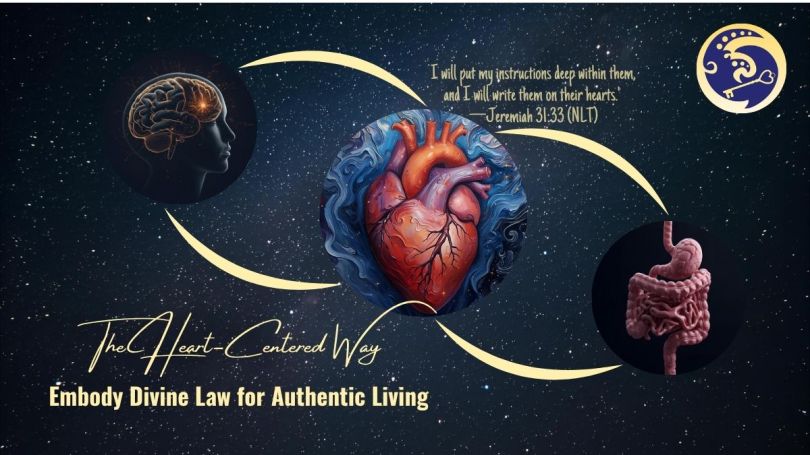
In a fragmented world where decisions pull you in every direction—scheming strategies clashing with visceral drives and fleeting emotions—the heart-centered way invites you into the transformative rhythm of Divine Presence.
As Jeremiah 31:33 declares, God promises to inscribe His Divine Law not on stone tablets, but deep within your heart, unlocking authentic living as a flow of embodying faith that reshapes your core. Crucially, this isn’t rigid rule-keeping; it’s an inner transformation fueled by the Holy Spirit within, granting spiritual freedom to navigate life’s complexities with coherence and joy.
Drawing from the wisdom of Psalm 119’s honey-sweet meditation and 2 Timothy’s equipped endurance, we’ll explore how this New Covenant blueprint harmonizes your God-given centers—mind, spirit, and drive—for decisions that sow abundance and ripple love outward.
The Promise of Divine Presence: Awakening to the New Covenant
The prophet Jeremiah stood at the breaking point of a nation. Israel and Judah were in exile, a consequence of continually breaking the covenant God had established through Moses. That covenant—etched onto stone tablets—was a good and perfect law, yet it remained external. As a result, it was a law you could fail to keep, leading to cycles of obedience, failure, and punishment. The law was out there; the problem was always in here.
However, Jeremiah offers a vision of divine reset, a New Covenant that is unlike the old. God says: “The days are surely coming, says the Lord, when I will make a new covenant… I will put my law within you, and I will write it on your heart; and I will be your God, and you shall be my people” (Jeremiah 31:31-33).

This promise is the ultimate invitation into Divine Presence. It’s not about geography or temple rituals; it’s about intimacy. God moves the legal center of the universe—His governing Divine Law—from a scroll locked away in an ark to the deepest core of your being. Consequently, this is the difference between obeying a rulebook out of fear and aligning your very desires with God’s will out of love.
The shift means that knowing God is no longer a privilege of the few—a priest or prophet—but an intuitive reality for you: “for you shall all know me, from the least of you to the greatest” (v. 34).
Moreover, the New Covenant is God’s revolutionary act of grace, promising not only an inscribed heart but also full forgiveness: “I will forgive your iniquity, and remember your sin no more.” This foundational grace is what makes true inner transformation possible.
You are freed from the paralysis of generational blame (“The parents have eaten sour grapes, and the children’s teeth are set on edge,” v. 29) to take ownership of a life now written and defined by God’s love and presence.
From Exile to Inner Transformation: Your Blueprint for Spiritual Freedom
This shift from the external law to the heart-inscription is God’s blueprint for spiritual freedom. While the old law was a schoolmaster, pointing out our failure, the Divine Law written on your heart through the New Covenant is an embodying faith, empowering you to succeed.
Imagine a sophisticated navigation app: the old law gave you a paper map that was always getting lost or ignored. By contrast, the Divine Law is the GPS installed directly in your consciousness. It updates in real-time. Therefore, it doesn’t just tell you when you made a wrong turn; it guides your step before you even take it.
The result is spiritual freedom—not the freedom from all rules, but the freedom to live fully into the loving intent of the Law. Ultimately, it transforms rigid obedience into flowing, authentic living. This inward law, powered by Divine Presence, becomes the core operating system of your life, harmonizing the chaotic signals from your mind, heart, and gut into a single, coherent response. It turns following God from a stressful performance into a peaceful, heart-centered living that is guaranteed by grace.
The Holy Spirit within: The Power to Live an Embodied Faith
The profound promise of the Divine Law being inscribed on the heart immediately raises a critical question: How is this massive inner transformation achieved? The simple, divine answer is the presence of the Holy Spirit within.
The New Testament makes it clear that the Holy Spirit is the active agent who writes the Law of God onto the new heart (Romans 8:4-6; 2 Corinthians 3:3, 6). If the new covenant is the blueprint, the Holy Spirit is the master architect and builder, shifting your core from a self-serving mechanism to one capable of embodying faith—a practical, daily living-out of God’s presence.
Furthermore, this embodiment isn’t just a mental assent; it is fully integrated. Paul reminds us that our bodies are temples of the Holy Spirit within (1 Corinthians 6:19), implying that your very physical design is meant to facilitate a life of Divine Presence.
This truth—that God empowers transformation through your embodied experience—is powerfully illuminated by the modern framework of coherence, drawn from multiple Brain Integration Techniques (mBraining). This model posits that you possess three distinct intelligence centers, often called the “three brains”:
- Head (Cerebral Cortex): The center for Cognitive intelligence (analysis, foresight, strategy).
- Heart (Intrinsic Cardiac Nervous System): The center for Emotional/Relational intelligence (values, compassion, connection).
- Gut (Enteric Nervous System): The center for Instinctual/Mobilizational intelligence (core identity, self-preservation, drive).
Therefore, the constant chaos in your life often stems from these three centers “voting” against each other: a head-led plan ignores the heart’s empathy, or a gut-led reaction overrides the head’s wisdom. Ultimately, the Spirit-led life, the life of authentic living, is one where the inscribed Divine Law leads these three centers into coherence.

The Holy Spirit within works within this triune system to align your thought, feeling, and drive. He ensures that your head meditates on truth (Psalm 119:97), your heart is anchored in love, and your gut is propelled by boldness Over fear (2 Timothy 1:7). The rest of our journey will explore this harmony, proving that the Law on the heart is not an abstract spiritual concept but God’s practical toolkit, enabling a robust, heart-centered living for every corner of your world.
Heart-Centered Living in Action: Coherent Decisions Across Your World
Heart-centered living is not a passive, mystical state; it is a coherent state of being that produces effective action. It is the practical outworking of the Divine Law written on your heart, resulting in Generative Wisdom—the kind of wisdom that integrates foresight (Head), compassion (Heart), and conviction (Gut) to actively create positive outcomes.
When your three intelligence centers—the logical head, the relational heart, and the instinctual gut—are aligned by the Holy Spirit within, your decisions cease to be fragmented. This immediate benefit means you move from the paralysis of confusion to the flow of authentic living. This coherence yields Generative Wisdom—a dynamic process where the whole is greater than the sum of its parts, allowing you to sow abundance where scarcity once reigned.
The promise of Jeremiah is that this alignment, this inner transformation, is available to you wherever you are. Therefore, your calling is to allow that inscribed law to inform your daily rounds.
Let’s look at how this coherence manifests across various aspects of your life, transforming mundane activities into acts of embodying faith.
Divine Wisdom at Home: The Heart-Led Anchor with Proverbs 31 Depth
The home is often the most chaotic and exhausting arena of life, where exhaustion battles the pull to connect, and gut reactions frequently outpace reasoned responses. Whether you are the one holding the home front—mapping school runs amid work calls, or stirring pots while prayers simmer for a wayward child—the heart-law speaks straight to you: “I will be your God, and you shall be my people” (Jer. 33:33). Ultimately, this covenant love fuels your ache to nurture without the accompanying resentment.
Here’s how to apply Divine Wisdom as a Heart-Led Anchor in your family life:
- Heart (Compassion & Values): Your heart is your default setting, prioritizing relationships and connection over efficiency. The heart-led decision is to pause, breathe, and remember the deepest value: Love Your Neighbor (starting with those under your roof).
- Head (Foresight & Planning): Divine Wisdom incorporates the head, sharpened by meditating on the law (Psalm 119:97). Consequently, this allows you to anticipate the meltdowns or budget squeezes ahead. Your head charts the strategy for a resilient family—setting boundaries and scheduling the essential family huddle that prevents resentment from building.
- Gut (Mobilization & Conviction): The gut provides the steady, mobilized drive needed for consistent, patient action. This means your gut’s boldness over fear ensures that love lands effectively, backed by persistent action, enforcing necessary boundaries or gently addressing old family fractures.
The Coherent Outcome: Without your head, your love is scattered. Without your gut, fear-frozen inaction stalls progress. Therefore, with the Divine Law cohering the three, your embodying faith turns home management into a quiet, effective ministry where generations are rooted and the covenant is made real.
Generative Wisdom in the Marketplace: Embodying Faith with Integrity
From the cubicle to the construction site, the marketplace demands that your embodying faith translate into practical justice, equity, and ethical conduct. Whether you’re coordinating teams or bidding on jobs, the heart-law redirects your focus from the grind to grace, requiring Generative Wisdom tempered by boldness over fear to maintain Integrity.
- Heart (Compassion & Values): The heart-led professional views your colleagues and crew as kin, not resources. Fuelled by Jeremiah’s promise of full forgiveness, your heart means feedback becomes fuel for growth, and compassionate curiosity replaces managerial distance. In business, this insists on honoring your crew with fair wages, echoing Love Your Neighbor, not just the bottom line.
- Head (Foresight & Planning): A wise head is required to be sustainably compassionate. Dipping into Psalm 119’s meditation, your mind plans with equity in view. You audit workloads for fairness, anticipate supply chain snags, or forecast material hikes—refusing to let short-term pressure compromise quality or ethical standards. In short, you design systems that embody justice and long-term viability.
- Gut (Mobilization & Conviction): This is where boldness over fear is crucial. The gut ensures follow-through: it stalls the snappy, frustrated email and instead propels a quick, honest huddle to resolve a conflict. Similarly, in leadership, it drives you to take a stand—renegotiating subcontracts for sustainable timelines, or refusing a client whose unethical demands compromise your values, carrying out your ministry fully (Timothy 4:5).
The Coherent Outcome: When your mind, heart, and gut align, your business or administration achieves efficacy with dignity. Integrity transforms transactions into relationships. Jobs finish strong, teams become tighter, and your professional conduct becomes a witness to the abundance sown by the Divine Presence.
Generative Wisdom in Learning: Motivated Steps Toward Authentic Living
If you are navigating lectures, late buses, and the tension between group projects and personal setbacks, Generative Wisdom provides a profound advantage. The internal inscription of God’s law turns learning from a solo scramble into a community endeavor, propelling you toward authentic living.
- Heart (Compassion & Values): Gut motivation may surge for the cram session, but Jeremiah’s promise of belonging tempers it. The heart-law draws you to notice and include the quiet one at the table (“they shall all know me,” v. 34). Therefore, your heart drives you to seek connections that build up, prioritizing mentorship and genuine relationship over transactional networking.
- Head (Foresight & Planning): The head is essential for blocking pitfalls. Drawing on the Psalm’s wisdom, your mind plots out study bursts around necessary rest, blocking the overreach of burnout (119:101’s evil-avoidance). Crucially, it defines your why—connecting a challenging project to your larger purpose, ensuring your path is directed by truth, not just trends.
- Gut (Mobilization & Conviction): The gut propels the bold asks and the persistent effort. It provides the energy to face an intimidating course or to try a new field. In turn, it fuels the natural overflow of tutoring a peer or speaking up for a marginalized view (Timothy 4:2’s persistent encouragement).
The Coherent Outcome: Effective learning is whole-person learning. Your authentic living ensures that your grades climb, your bonds build, and your faith slips in sideways, making your educational experience a testament to the integrated life.

The Fruit of Heart-Centered Living: Outcomes of Divine Law Embodied
The ultimate test of the heart-centered living you’ve explored isn’t how well you can define your three centers, but the fruit that your decisions bear. The Divine Law written on your heart is not an end in itself; it is the seed that produces a life that is both joyful and effective. This is the key difference between a life of rigid, external rule-keeping and a life of overflowing authentic living.
The psalmist’s exuberant declaration, “Oh, how I love your law! It is my meditation all day long. Your commandment makes me wiser than my enemies, for it is always with me” (Psalm 119:97–98), illustrates this outcome. The law ceases to be bitter medicine and becomes sweeter than honey to the mouth (v. 103), stirring a deep aversion to falsehood (“I hate every false way,” v. 104). This inward delight is what generates the courage and endurance that Paul urges upon Timothy.
When your Head, Heart, and Gut are synchronized by the Holy Spirit within, the inner transformation yields the kind of abundant life Jesus promised. This life is marked by the concrete, observable characteristics known as the Fruit of the Spirit: love, joy, peace, patience, kindness, goodness, faithfulness, gentleness, and self-control.
Humility as the Posture: Cultivating the Fruit of the Spirit in Decisions
To cultivate this fruit, you must begin with a posture of humility. Humility is the essential condition for coherence because it acknowledges that none of your three intelligence centers is infallible on its own.
The Pitfall of the Head: When your head operates in isolation, it becomes impetuous—prideful in its logic, refusing to acknowledge emotional data or spiritual direction. Consequently, your decisions are rigid, lacking the gentle texture of patience and kindness. Humility forces your head to consult the Divine Presence in your heart before analyzing the spreadsheet.
The Pitfall of the Heart: Your heart operating alone becomes overly idealistic or impetuous, sacrificing long-term peace for immediate emotional gratification. Without a doubt, without the stabilizing force of your head’s foresight and your gut’s anchor in core self-control, it produces fleeting joy, not enduring Spiritual Freedom.
The Pitfall of the Gut: The raw, unaligned gut is often ruthless—focused only on survival or selfish gain. It mobilizes action without love or justice. However, Humility allows your gut’s power to be guided by the love and gentleness of the Spirit, ensuring that your boldness over fear is always tempered by self-control.
Humility thus acts as the connective tissue that aligns your centers, allowing the full Fruit of the Spirit to ripen. It turns the powerful energy of your gut into faithfulness, the analysis of your head into Generative Wisdom, and the emotion of your heart into love, ensuring that every decision is a harmonious reflection of the law inscribed within.
Integrity in Motion: Boldness Over Fear for Enduring Witness
The coherent, heart-led life doesn’t stop at inner harmony; it translates into integrity in motion, creating an enduring witness in a world plagued by cynicism. This integrity requires boldness over fear—the spiritual courage to act fully and truthfully, as urged by Paul to Timothy: “Proclaim the message; be persistent whether the time is favourable or unfavourable… do the work of an evangelist, carry out your ministry fully” (2 Timothy 4:2, 5).
In 2025, this witness is desperately needed in public life. When you embody the Divine Law, you are honest about your supply chain, you advocate for fair policies, and you ask hard questions about Ethical AI and data justice. In essence, this is the courage of the integrated soul, where your Gut’s conviction is softened by your Heart’s compassion and informed by your Head’s Generative Wisdom.
This Integrity rebuilds community. It enables you to resist the temptation to succumb to “itching ears”—the distractions and myths Paul warned about—and instead, stand firm on the truth inscribed within. The result is an effective faith that makes the New Covenant visible: not through sermons alone, but through relationships and transactions marked by trustworthiness and boldness over fear.
Love Your Neighbor: The Outward Ripple of Spiritual Freedom
The ultimate outward ripple of heart-centered living is the realization of the greatest commandment: Love Your Neighbor. When the law is written on your heart, you experience spiritual freedom from the bondage of selfishness, enabling you to pour into the lives of others.
The grace received through the New Covenant is contagious. Jeremiah promised not just personal restoration, but the sowing of new life in the community (Jeremiah 31:27). Consequently, your coherent decisions become the seeds of this abundance, challenging the scarcity mindset of the world.
- When you plan with equity, you sow kindness.
- When you choose compassion over profit, you sow peace.
- When you invite the lonely one in, you sow joy.
This Spiritual Freedom is your call to action: The path to authentic living is paved with small, coherent decisions made under the Divine Presence.
Your Invitation: Choose just one area this week—a crew conversation, a family crisis, a tough deadline—and apply the principles of the heart-centered way. Let the inscribed law be your guide, turning an old struggle into a new demonstration of Divine Presence.
Stepping into Authentic Living: Your Invitation to the Heart-Centered Way
The Heart-Centered Way is more than a spiritual concept; it is an active invitation to live the life God has already inscribed within you. The power of Jeremiah’s prophecy, the joy of the Psalmist’s meditation, and the urgency of Timothy’s charge all converge on one point: your authentic living is God’s desired outcome.
You are no longer bound by external rules or fragmented decisions. Instead, you are empowered by the Divine Law written on your heart, equipped with spiritual freedom, and ready to step fully into your calling. The journey begins with the simple, humble choice to let the Holy Spirit within align your mind, heart, and gut.
This week, answer the invitation. Choose one area of chaos or conflict in your life—at home, at work, or in your studies—and commit to making a coherent decision. Let the inscribed law be your guide, turning an old struggle into a new demonstration of Divine Presence.
A Prayer for Inner Transformation: Aligning with Divine Presence
The heart-centered life is one of constant renewal. Use this simple prayer to anchor your intention and invite the inner transformation promised by the New Covenant:
Covenant God, my mind is noisy, my heart is restless, and my drive is often selfish. I receive the Divine Law You have written on my heart. I ask the Holy Spirit within to align my head, heart, and gut, establishing Your Divine Presence as my anchor.
Let my thoughts be sharpened by Your truth, my feelings be fueled by Your love, and my actions be propelled by Your Boldness Over Fear.
I claim the Psalmist’s resolve: “I hate every false way.” Equip me to live with Integrity and Humility, so that my every decision may bear the Fruit of the Spirit and be an act of Love Your Neighbor.
Align me now, O Lord, to live the Heart-Centered Way for Authentic Living. Amen.

 Divine Presence: Letting the Infinite flow in my life