generative wisdom,being wise,death,a time for everything,a time to heal,actions,all is meaningless,all is vanity,ask yourself this,awareness,being compassionate,being kind,career,choices,decision-making,desires,discovering your purpose,education,riches,spiritual healing,

How to Create a Lasting Legacy: The True Pursuit of Wisdom

Is the pursuit of wisdom and creating a lasting legacy worth it?

If we read Ecclesiastes 1, we might think it’s all an exercise in futility. 
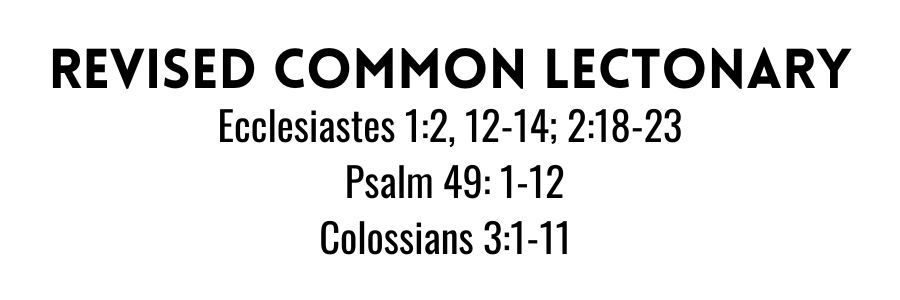
Ecclesiastes, Psalms, Colossians

Was the writer of Ecclesiastes depressed? It seems so. After all he had done to pursue wisdom, he realises that everyone dies.

What was the purpose of studying so much and creating so much wealth? Will it be appreciated by those left behind? Even wealth gets squandered by unwise heirs. 

So, what’s the purpose of all that hard work and effort?

When we look at the wise, they die; fool and dolt perish together and leave their wealth to others.

Psalms 49:10

On the other hand, Colossians suggests that we stop pursuing worldly pleasures and goals, and focus our time and energy on “things above”.

Set your minds on the things that are above, not on the things that are on earth

Colossians 3:2

So, what is the meaning of life? Is it futile to pursue wisdom and wealth? Is this all vanity (futility) as the author of Ecclesiastes suggests? 

Or is there something meaningful that we can do and create here and now that will leave a legacy behind?

The true pursuit of wisdom

First, what is wisdom? Is there a difference between worldly wisdom and divine wisdom? Earthly wisdom or godly wisdom?

Who do you consider to be wise?

Is someone with a Master’s degree considered to be wise? Or are they merely educated?

In business, there’s a DIKW pyramid – data, information, knowledge and wisdom. Data is meaningless, unless you can actually draw some conclusions from it that you can use to guide your future actions.

Data is the foundation, information is processed data, knowledge is information with context, and wisdom is the application of knowledge to make informed decisions. 

So, in the context of business, wisdom is not knowledge, but the application of knowledge into decision-making. 

In a similar fashion, education is merely a means to an end: hopefully, getting an education will teach you how to transform knowledge into wisdom – wise decision-making. 

Worldly Wisdom or Divine Wisdom?

So, what about this divide between earthly wisdom and godly wisdom? 

Do you want to be counted wise, to build a reputation for wisdom? Here’s what you do: Live well, live wisely, live humbly. It’s the way you live, not the way you talk, that counts. Mean-spirited ambition isn’t wisdom. Boasting that you are wise isn’t wisdom. Twisting the truth to make yourselves sound wise isn’t wisdom. It’s the furthest thing from wisdom—it’s animal cunning, devilish plotting. Whenever you’re trying to look better than others or get the better of others, things fall apart and everyone ends up at the others’ throats.

James 3:13-16, The Message

If you ask me for my favourite books of the Bible, they would be these:

  • James
  • Proverbs
  • Job
  • Ecclesiastes

Do you see any similarities in them? Yes, they all talk about Wisdom.

And still, Ecclesiastes suggests that even the pursuit of Wisdom is meaningless and futile. 

As we know it, the author of Ecclesiastes (thought to be Solomon, but perhaps not) was also one (if not the principal) of the authors of Proverbs. 

And in the end, he says it’s all vanity. What’s the point of pursuing wisdom?

Or as Psalms suggests: what’s the point of building up an estate and wealth to leave to your children? 

What do we truly live behind when we go? Is there any point to “living with purpose” or “finding your purpose” in life and creating a legacy to leave behind? 

Is pursuing holiness enough?

Colossians suggests that we should pursue individual holiness. But how does Colossians define this individual holiness?

What does it mean to be renewed in wisdom and become a new self?

I find it fascinating that the defintion we are given focuses most on what we leave behind and stop doing. When we stop all of these bad habits, though patterns and emotions, we open up space for the new.

Put to death, therefore, whatever in you is earthly: sexual immorality, impurity, passion, evil desire, and greed (which is idolatry).
But now you must get rid of all such things: anger, wrath, malice, slander, and abusive language from your mouth.
Do not lie to one another, seeing that you have stripped off the old self with its practices and have clothed yourselves with the new self, which is being renewed in knowledge according to the image of its creator.

Colossians 3:5, 8-10

As it says here, stripped off the old self with its practices and habits. And then you can put on your clean clothes.

“seek the things that are above”

Colossians 3:1

What are we seeking? Divine Presence in our lives.

And how can we be filled with the Divine Spirit? Only by making room! To make room in our life for the Divine, we have to let go of whatever is holding us back.

What are the personal obstacles in your thoughts, feelings and actions that inhibit the Spirit from flowing freely in your mind?

To be full of the Spirit

In order to demonstrate the fruit of the Spirit fully – love, joy, peace, patience, kindness, goodness, faithfulness, gentleness and self-control – we have to let go those emotions and thoughts that are their archnemesis.

  • To be full of love, I have to first let go of hate.
  • If I want my joy to overflow, I first have to finish grieving for whatever I think I deserved and didn’t receive, as well as find a place of acceptance of what is.
  • To be full of peace, I release my anxiety and that pressing need to have everything now. I recognise any greed that I have – whether it be for things, results or even knowledge and wisdom.
  • If I want to have patience, I must learn to persist in the face of trouble, delay or even suffering. It’s an internal strength that I gather that allows me to face whatever may come, and still love othes in spite of my circumstances. I let go of the longing for immediate results, and recognise that everything is for my good. 
  • To be full of kindness, I have to let go of my ego, pride, anger and wrath. I release all malice and slander from my thoughts, emotions, words and actions. And I certainly refrain from abusive language coming out of my mouth!
  • If I am committed to being filled with goodness, I must first release sexual immorality, impurity, passion, evil desire, and idolatry.
  • And when I claim that I have faithfulness, I let go of lying to myself and others, and instead demonstrate loyalty, steadfastness, and trustworthiness.
  • Likewise, when I am filled with gentleness, I get rid of all those rough edges of my emotions and tongue. I learn to speak gently, rather than harshly, and I curb my anger, wrath and hatred completely. 
  • Finally, the crux of it all becomes impeccable self-control. I have control over my mind and thoughts, my emotions and especially my tongue and the words of my mouth. 

This is why Colossians focuses on what we have to get rid of in our lives. Take out the old, in order to be full of the new. If you want to think on things above, you have to stop thinking about all the things below. 

What is Wisdom and a Meaningful Legacy?

Let’s go back to Ecclesiastes and the lamentations of “This is all futile and useless”. 

sometimes one who has toiled with wisdom and knowledge and skill must leave all to be enjoyed by another who did not toil for it.

Ecclesiastes 2:21

So, all that hard work, even applying your knowledge and skill for wise decision-making, sometimes is reaped by those who don’t deserve it.

Perhaps you died and a distant family member reaps rewards rather than the children you expected. Or your business is taken over by outsiders. The bank forecloses on your house and leaves your children without a roof over their heads.

So, what is meaningful? What do we leave behind that truly matters?

I would guess that it’s the impact we have on the lives of others. Especially when that impact carries far into the future, beyond the span of our lives and the generations that followed us. 

Think for a moment, for example of the authors of the Bible: thousands of years later, we are still reading those words. Even the authors of political, ethical and scientific books are read hundreds and thousands of years later.

But it’s not just books and writers that leave a legacy – there are many who impacted lives that were illiterate, and yet their deeds are know all over the world, living on as legends and stories that we continue to share. 

Jesus may have been born humbly, and we have no works written by him… yet every year we continue to celebrate his birth and coming to this earth, as well as his teachings and his sacrifice.

His divine wisdom and legacy are clear to each one us.

So the question for you today is: what meaningful legacy are you creating and leaving?

Life and death are in the power of the tongue, speak life, every cell in your body

Life and death are in the power of the tongue

I’ve been somewhat unsettled in recent weeks hearing masses around the world chanting “I can’t breathe”. I believe in the power of the tongue in creating wellness and illness in our bodies.

I pin my hopes on George receiving justice: what was done to him was an abomination. I firmly believe that the systems that stand in place to perpetuate injustice and prejudice should be exposed and torn away—all the wrongs of those who are silenced and told that their opinions don’t matter.

I wasn’t going to write this post. This has been sitting in my drafts for two weeks. Not my place to comment. I didn’t want to be one to criticise.

But does holding back my voice not make me part of the problem, rather than contributing to a solution? So, let me say this clearly:

I am horrified by the continued use of the slogan”I can’t breathe“.

On the one hand, it’s great for the media. On the other hand, do those chanting it consider the double-edged sword it can be for their health?

Words spoken by masses with strong emotions: powerful stuff.

Calling into existence that which is spoken.

The question is: what does it create?

What spells are we casting?

We laugh at “abracadabra” – but many believe that the word actually has meaning and power.

Scholars who support the Hebrew etymology say that abracadabra is a corruption of the Hebrew, ebrah k’dabri, meaning “I will create as I speak,” ie that the act of speech will magically create new realities. … the words and letters of the Hebrew alphabet have the power to create.

Abracadabra, https://www.thejc.com/judaism/jewish-words/abracadabra-1.466709

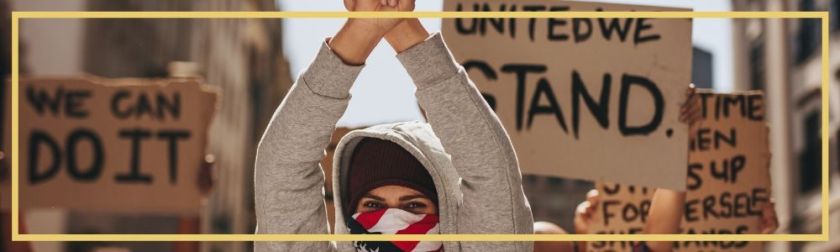
life and death, Every cell in your body is eavesdropping on your thoughts & words, i can't breathe, #icantbreathe, united we stand, we can do it

Similarly, you may scoff at those that use affirmations and recite promises to themselves or God, claiming a blessing or healing.

But what if words and thoughts and emotions do have power?

This is particularly true of words spoken full of emotion.

What if I can’t breathe has power?

The first reference I can find to this slogan arises in late 2014, shortly after the asphyxiation of Eric Gardner by a police officer. His last words “I can’t breathe”, were raised like a mantra in the protests that followed in New York City.

“There was this quote staring me in the face, and that’s something that should be the quote of the year,” Shapiro recalled.
So the Yale Law Library’s associate director and lecturer revised his 2014 list, placing “I can’t breathe” in the top slot. His widely cited annual list, which is intended to capture the political and cultural mood of the country each year, serves as a supplement to “The Yale Book of Quotations,” originally published in 2006.

‘I can’t breathe.’ Eric Garner’s last words are 2014’s most notable quote, according to a Yale librarian

Unfortunately, when I took a quick look at the 2014-15 flu deaths for that same period, there was a small spike – from the usual 36,000 a year up to 51,000. Mere coincidence? Quite likely. There are probably a million factors that played a part in the increase. Again in 2017, when the book “I can’t breathe” by Matt Kaibbi comes out, and Queen Ifrica publishes her song “I can’t breathe”: we get another spike up to 61,000 flu deaths. Probably irrelevant.

However, at this moment in history, following on the heels of mass sickness caused by a little-studied virus, we have angry crowds chanting “I can’t breathe”. We have media pushing fear and uncertainty. We have politicians using fear for personal safety and security for their platforms and personal gain.

So, if our words do have power and every cell of our body is eavesdropping on our thoughts, emotions and words – recreating what we declare into existence – how important then are the words that we choose to chant in protest?

Justice for George becomes much more powerful than I can’t breathe if we believe that we have a hand in creating an outcome!

every cell in your body is eavesdropping on what you think, say, do and feel

Every cell in your body is eavesdropping.

In the same way that our mind is aware of everything that goes on in our body, our body and cells are listening and experiencing our thoughts, emotions and words. Unfortunately, our body takes those thoughts, emotions and words literally.

Our cells don’t differentiate when we are protesting from when we are having a phone call or merely meditating alone. Your body experiences your thoughts, emotions and words as they are. You can’t tell your body “I was just joking”.

Like a child that doesn’t understand sarcasm, our body responds to what was said and doesn’t take a joke. It takes everything we feel, say and think quite seriously.

In many different teachings, we find the effects of emotions on our organs:

  • anger: affects the liver
  • fear: affects the kidneys
  • grief: weakens the lungs
  • worry: affects the stomach
  • stress: wreaks havoc on your heart and mind

Examine, for a moment, how your words spoken with emotion are affecting different parts of your body.

Consider your inner child and the children around you:

We all have the voice of an inner critic stuck in our heads – and quite often it’s the voice of a parent, teacher or someone we respected or feared as a child. The voice that our child hears now is the voice that will become their inner critic in the future.

Do we want our children to have an inner voice that says “I can’t breathe”?

consider the impact of words on children

What are our children hearing and experiencing in the chants and protests? How are we explaining the situation to them? What conversations do we have that allow understanding, compassion and wisdom to guide the experience?

Consider a child: how do you build them up after you’ve stripped them down with words said in anger? Think for a moment about any relationship where words have been spoken in anger: if you don’t move past the hatred into love, understanding and acceptance, what footing is your relationship on?

The protests in Panama are not about Black Lives Matter: they are about the lock-down and people going hungry. I have it so much easier in what I have to explain! But I still have to explain to my daughter the images, emotions and even violence that she is witnessing if she catches the news.

At the same time, I explain how incredible our bodies and immune systems are! I talk about how we eat, and even how our emotions and thoughts can help us stay healthy and strong. I check myself any time I notice that I am feeling fearful or anxious: careful not to stuff it down but to release it. I don’t need my daughter to latch onto my fear or anxiety!

In the same way, I have to relate and quieten that inner child of my own: that part of me that feels insecure in any way.

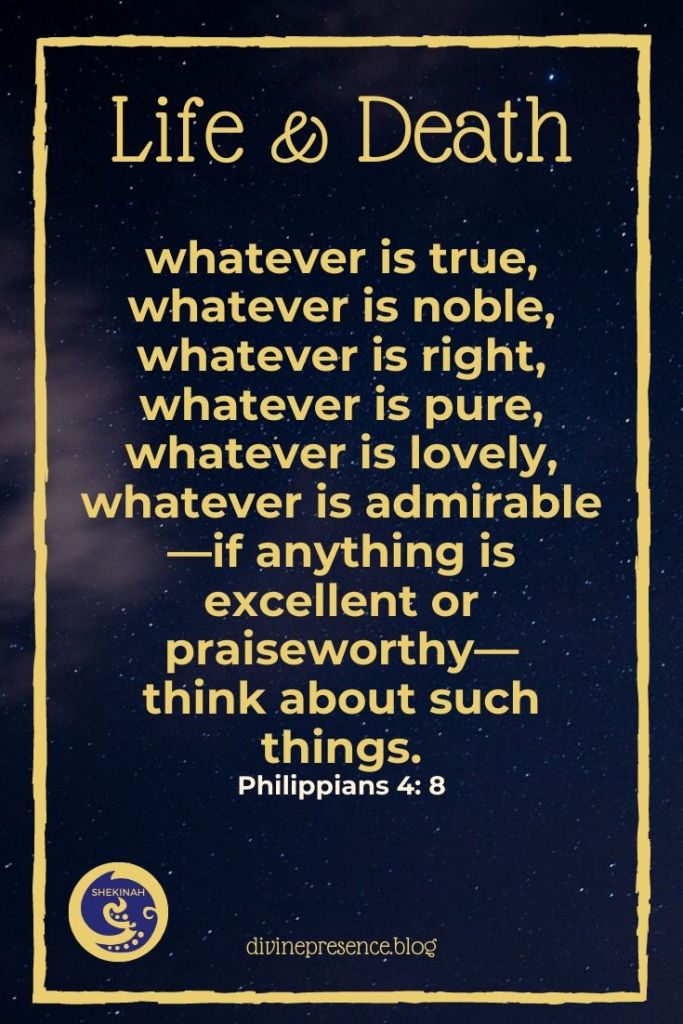
Philippians 4:8, whatever is true, whatever is noble, whatever is right, whatever is pure, whatever is lovely, whatever is admirable—if anything is excellent or praiseworthy— think about such things.
Whatever is true, whatever is noble, whatever is right, whatever is pure, whatever is lovely, whatever is admirable—if anything is excellent or praiseworthy— think about such things.

The power of your thoughts

Your thoughts influence your words and your actions. Long before you choose to do something, you have probably considered it multiple times.

Think, for a moment, about words that you spoke to someone in anger. How many times had you thought that before you actually said it? Then, in a moment of rage and slightly out of control (or perhaps in control but no caring about the consequences) you actually said what you’ve been thinking for a while. You voiced how you truly felt. Maybe it wasn’t the whole picture. But it started with thoughts that you have mulled over.

Consider the effect of thinking “I can’t breathe”, with all the nuances that it carries. Perhaps one of those nuances is that the system is unjust and doesn’t allow you to speak your mind.

If you regularly think “the system is unjust”, are you motivated to change it? Or do you get caught in a feeling of hopelessness? Notice the difference between thinking “I can participate in changing this unjust system” versus thinking “the system is unjust”.

Have you noticed how all your thoughts influence your emotions and your words? If your thoughts control your actions, then they have a role to play in creating your future! The action you take has a direct impact on your results.

The power of our emotions when mixed with words.

Our words are so much more powerful when they are spoken with emotion. It doesn’t matter if you are creating and destroying.

Anger at injustice can provide us with the strength and courage to embark on a journey that we might otherwise never take. Unfortunately, anger can also eat us up on the inside if we bottle it up, rather than channelling and releasing it.

Before becoming a bitter person: this was probably an angry person. Over time, the fire of the anger dies down, but the embers continue to burn within. The dissatisfaction and discontent are still there, unresolved. After the explosion of rage burnt out, bitter ashes and disillusion are left.

When we start a journey to transform our community, we may embark on it out of anger and frustration at the current situation. It is terrific to shout out to the world:

This is wrong! Wrongs must be righted!

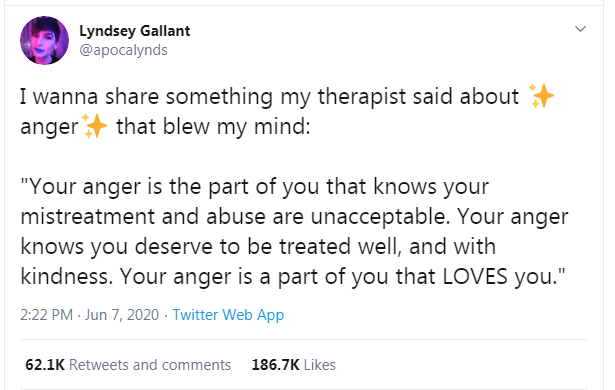
"Your anger is the part of you that knows your mistreatment and abuse are unacceptable. Your anger knows you deserve to be treated well, and with kindness. Your anger is a part of you that LOVES you."
“Your anger is the part of you that knows your mistreatment and abuse are unacceptable. Your anger knows you deserve to be treated well, and with kindness. Your anger is a part of you that LOVES you.” https://twitter.com/apocalynds/status/1269711325749563399

But at some moment, love and compassion for our community need to replace that anger against the aggressors as the driving force of change. When we fail to recognise that our passion is driven by love and stay only in the rage, we miss an opportunity to grown in greater love and compassion.

Revolutions begin in angry protest and perhaps even rioting but have to end in love and compassion to build!

Man must evolve for all human conflict a method which rejects revenge, aggression and retaliation. The foundation of such a method is love.

Martin Luther King, Jr.

Make sure your thoughts, emotions & words serve your goals.

I love that injustice has awoken people to stand up and make a difference in their worlds. But if I could ask just one thing, it would be this:

Choose your words carefully, especially those spoken with emotion.

I want to hear the masses chanting:

Justice for George!
We can do it!
United we stand.
Black lives matter!

Fighting for justice!
We stand for justice.
We demand justice!

Respect me.
My voice matters!

I’m sure you could make a better list of powerful statements that could create change, without cursing your body or those supporting you.

And when we are done tearing down what no longer serves us, let’s build communities of compassion, love and kindness. Communities that are safe for our children, and that allow us to learn what it means to love our neighbour as ourselves.

Your words can either speak life, or your words can speak death. Our tongues can build others up, or they can tear them down

Life & death are in the power of the tongue.

Prov. 18: 21

pay attention, words, sight, heart, health, guard your heart, bring healing, tongue of the wise, as a man thinks, so is he, a cheerful heart, good medicine,

If I look to Proverbs for Wisdom, these are but a few of the reminders about the power of our thoughts, emotions and words:

Proverbs 12:18
The tongue of the wise brings healing.

Proverbs 23:7
As a man thinks, so is he.

Proverbs 4:23
Above all else, guard your heart, for everything you do flows from it.

Proverbs 4:20-22
My son, pay attention to what I say; turn your ear to my words. Do not let them out of your sight, keep them within your heart; for they are life to those who find them and health to one’s whole body.

Proverbs 17:22
A cheerful heart is good medicine, but a crushed spirit dries up the bones.

love is kind, celebrating World Kindness Day, practising kindness, being kind, good deeds, compassion, being compassionate, thinking of others, do unto others, be kind to yourself, practice kindness, show kindness, spread kindness, how to practice kindness and compassion, love is kind meaning, compassion and kindness, compassionate and kind, loving and kind, habits of kind people, benefits of kindness, importance of kindness, ways to make kindness a habit, the power of kindness

Love is kind: celebrating World Kindness Day

Yesterday, November 13, was World Kindness Day. And after 9.00 p.m., when I hadn’t yet finished writing this blog post, I decided that the greatest act of kindness and self-care for myself was to go to bed!

Today, like most days, I’m up at 4.00 a.m. My body has decided that this new schedule works better!

I’m adapting to not staying up till 11.00 p.m., burning the candle at both ends – learning that kindness starts not with others, but showing compassion to myself. Especially since me tired and cranky, lacking in sleep, is not putting my best foot forward to be kind to others!

Kindness is a habit that starts with me being fully rested – at least to the extent that it is available to me!

I am loving the early mornings.

The stillness and quiet.

Being awake before the birds even start their morning songs! Hearing that first chirp of bird song, and then others waking and joining in.

Being still and knowing that I AM is within me, all around me, and having the opportunity to ask how I can best express love in the world today.

Why does kindness matter?

Find me a Christian who is not kind – and I will challenge them to their face that they are not a true Christian. At the very least, they are failing to be renewed by the transforming of their mind!

Anyone who does not love does not know I AM, because I AM is love.

1 John 4:8

End of story.

And from 1 Corinthians 13, we know that Love is Kind.

I accept that there are more verses in the Bible that speak to the kindness of God than the kindness of man.

Kindness is forgiving

Nonetheless, the verses that speak about our challenge to be kind are crystal clear that kindness goes hand-in-hand with forgiveness. Your measurement of commitment to being Christ to others is whether you accept forgiveness and grant forgiveness to others.

For example:

… be kind and merciful, and forgive others, just as God forgave you… 

Ephesians 4:32

If you want to understand better this idea of “do unto others as you would have them do unto you”, get very clear about the role that kindness, mercy and forgiveness play in your daily habits.

Consider how well you have mastered holding firm to kindness as a way of being.

love is kind, practising being kind, learning to be kind, kindness and truth

Don’t mistake kindness for niceness

In Proverbs we find:

Do not let kindness and truth leave you. Tie them around your neck. Write them upon your heart.

Proverbs 3:3 (NLV)

So, when we speak truth, it must be with kindness. And in order to be kind, we need to hold onto truth. Anything less is inauthentic. Is there any real kindness without truth?

We are told to speak the truth with love, with compassion and empathy. And that seems to be harder in our culture as we have lost the ability to have difficult conversations. We’ve learnt not to talk about politics or religion at the dinner table, but now that’s extended to we simply don’t talk about them. Then we wonder why society has lost the ability to speak about controversies with respect and kindness.

But, by the same token, if we are busy being nice, we might leave out the truth. Because that’s nicer. But it ignores the sense of betrayal that the other person gets when they find out the truth. It’s not always possible to simply be agreeable and not ruffle any feathers.

Living as a people-pleaser – always being nice – is exhausting. When the resentment starts – the niceness ends.

It’s much better to choose kindness with truth – which may be somewhat uncomfortable as you navigate learning how to be kind while being authentic, but the long-term benefits far outweigh the risks. Practising kindness includes being kind to yourself. It’s not just good deeds and being nice to others.

Kindness stands hand-in-hand with justice

The same way that kindness requires truth, it also requires justice. It doesn’t have to be a harsh and unforgiving justice, but it does require that injustice be stopped in its tracks.

Practising kindness may be as simple as standing up for someone in your community or school against bullying, or making a stand with part of your community for their right to be heard and given a fair audience.

He has told you, O man, what is good—
    and what does the Lord require of you,
but to do justice and to love kindness,
    and to walk humbly with your God?

Micah 6:8 (MEV)

Perhaps you need to attend that community meeting. Or kindness might just be showing up at your local animal shelter and taking care of the rescues who no one has taken time to share love and justice with.

How can you choose today to show kindness and spread kindness in your community?

What does it look like for you when it goes hand-in-hand with justice?

love is kind, compassion and kindness, compassionate and kind, kind and loving

Kindness is patient, Spirit-filled living

But the fruit of the Spirit is love, joy, peace, patience, kindness, goodness, faithfulness, 23 gentleness, self-control …

Galatians 4:22-23 (RSV)

Can you practice kindness, thinking of others, without patience? What would it mean that love is kind, if you have no patience or no self-control?

Imagine, if you can, someone impatient, with no self-control, trying to be kind.

Consider, for a moment, kindness without gentleness and goodness.

The fruit of the Spirit all go hand-in-hand: in order to have one, you have to practice all of them. And as much as I would love to say you get baptised in the Spirit and it all magically changes and you become magically transformed into having all of those qualities at all times – my experience in life has been otherwise.

Much like a potter moulds the clay, we are moulded by life.

For better or for worse.

We get to choose whether we allow life’s lessons to teach us how to practice kindness and compassion in every situation – or whether we will simply react. Compassion and kindness are not learnt in a vacuum, but in our every day experiences.

In fact, spiritual growth is not what happens when you are ardently praying and studying. Spiritual growth is what happens when you are facing life’s storms!

  • It’s how you respond when someone is trying your patience.
  • The way you speak to someone when you haven’t had enough sleep.
  • How you choose love rather than anger, when another person is baiting you

Compassion and kindness show up every day as habits, the habitual way that you respond and react to life’s situations.

Practising kindness each day

Kindness is not something to practice and celebrate one day of the year!

It is the every day sweetness of life.

If you can’t be anything else – be kind.