sunlight, streetlamps, more light, firelight, candlelight, torchlight, incandescent light, illuminate, floodlights, light is metaphore, knowledge, truth, the age of enlightenment, growth, light is energy, force, light is light, make straight, in the beginning was the Word, life, the light of men, the light shines in the darkeness, let there be light, breath of life, light of the Spirit, joy, giving, radiant

Sunlight is said to be the best bleach and streetlamps the most effective police officers…

Lectionary Readings:
  1. Isaiah 61:1-4, 8-11
  2. Luke 1:46b-55
  3. 1 Thessalonians 5: 16-24
  4. John 1:6-8; 19-28

Growing up here in Panama, I went to Boarding School in Chame. As a child, after playing games or skating on the basketball court, we’d head back to our dorms, taking the shortest way back straight across the soccer field.  Pitch dark – although probably only 7.30 or 8.00 p.m.  Not something I wanted to do alone!

I remember (probably on more than one occasion), walking back across that field, and my friend Marion would let out a screech or scream and take off running, and I would scream and bolt for the buildings and the lights.  In overtaking her I would notice she was doubled over with laughter, but that wouldn’t really sink in until I was safely standing, out of breath, on the porch under the lights.  She’d eventually show up, still laughing.  I was so predictable: waiting for those unseen snakes or ghouls or scary monsters to grab me out of the dark.

I’m not afraid of the dark, I’m just scared of what might be hiding in it.

Today I want to speak about the LIGHT.

Ever since mankind crawled out of the primordial slime, we’ve cried: “More light.”

Sunlight. Firelight. Candlelight. Torchlight. Neon, incandescent light that banishes the darkness from our caves, homes; lights that illuminate our roads, dangerous intersections and treacherous corners; and even lights that turn on when you open the door scaring the bogey man out from inside our refrigerators. Floodlights for our sports arenas. Tiny flashlights for those books we read under the covers when we’re supposed to be asleep.

Light is so much  more than watts and foot-candles. Light is metaphor: knowledge and truth (the age of enlightenment); light is life and growth (photosynthesis, vitamin D); light is energy and force; and light is light.

There was a man sent from God, whose name was John.  He came as a witness to testify to the light, so that all might believe through him.   He himself was not the light, but he came to testify to the light.

The Pharisees said to him: “Who are you? Let us have an answer for those who sent us.  What do you say about yourself?”

He said “I am the voice of one crying out in the wilderness: ‘Make straight the way of the Lord.’”

This is our third week of Advent, our celebration of the birth of Jesus: the way, the truth and the life.  The gospel of John starts with these words of Truth:

In the beginning was the Word, and the Word was with God, and the Word was God… Through Him all things were made… In Him was life, and that life was the light of men.  The light shines in the darkness…

Notice the connection with Genesis 1?

Now the earth was formless and empty, darkness was over the surface of the deep… And God said, “Let there be light” and there was light. God saw that the light was good…

And to Genesis 3?

The Lord God formed the man from the dust of the ground and breathed into his nostrils the breath of life, and the man became a living being.

I want to start today by quickly reviewing the dichotomy of light versus darkness, in all its metaphors. Take a moment to reflect on these contrasts. What images come to mind as I read these words of Light and Darkness?

Doubt Anxiety Nightmares Despair London winter Dimness Depression Fear Tiredness Lethargy Captivity Blindness Haunted  Sickness Grief Sadness Deception  Heavy-hearted Addicted Imprisoned Contaminated Hatred Ignorance Consumed Hungry Famine

Faith Peace Courage Energy Dreams Freedom Hope Health Sunshine Sight Brightness Pleasant Contentedness Truth Joy Happiness Light-heartedness  Free spirit  Pure Love Knowledge Rejuvenated  Plenty Satisfied

Light is a force and energy, whereas darkness is merely the absence of this force and energy.  So, when the Bible says that God is LIGHT, what are the author’s trying to communicate to us?  It doesn’t say that God is LIKE light, or God is “surrounded by” light, or “God has a great big electric generator so He can sit in the spotlight”, it says “God IS light”.

Light is the essence of God – the same way that man is flesh and blood.  This light is self-existent, God possesses this power in and of Himself.  It has no external source. God is pure light, not diluted or mixed in any way with evil, hatred, untruth, ignorance or hostility. God is light is not a theoretical assertion about the nature of God, but a statement that drives us to the heart of what God is like: God is pure light.

God is the source of all living things.  God is truth and enlightenment.

If we briefly look at some of man’s encounters with God in the Bible, we can see a little better this Light and its many meanings.

Think of Moses’ first encounter with God: the burning bush. The bush was on fire, but was not consumed by the flames.  God has his full attention – but didn’t have to destroy anything in order to do so.

The children of Israel got a glimpse of the glory of God at Mount Sinai:

under his feet was something like a pavement made of sapphire, clear as the sky itself… but the cloud covered the mountain, and the glory of God looked like a consuming fire on the top of the mountain.

This was all a little much for the children of Israel, especially when Moses came down from Mount Sinai with a radiant face, and they were afraid to come near him.  A little like Jesus’ transfiguration  on the mountain with Moses and Elijah.  A bright cloud enveloped them… and when Peter, James & John heard the voice, they fell facedown to the ground, terrified.

On the other hand, think now of David, and his beautiful psalms. Here we find at least three metaphors:

  1. Picture God “clothed in garments of light”, symbolising the One who is pure, righteous and holy (there is no dirtiness, nothing to taint or contaminate God).
  2. God’s revelation through spoken and written word gives light: “Thy Word is a lamp to my feet and a light to my path.”; offering moral guidance and direction for how to live.
  3. Light symbolises also salvation: “God is my light and my salvation, whom shall I fear? The LORD is the strength of my life; of whom shall I be afraid?”

Or how about Isaiah:

The sun shall be no more thy light by day; neither for brightness shall the moon give light unto thee: but the LORD shall be unto thee an everlasting light, and thy God thy glory.

Did you ever notice that most of the prophets start with “The word of the Lord came to…”, except for Ezekiel. Have you noticed Ezekiel’s spaceship?

I looked and I saw a windstorm coming out of the north – an immense cloud with flashing lightening and surrounded by brilliant light.  The centre of the fire looked like glowing metal, and in the fire was what looked like four living creatures (with faces and wings – each of the four had the face of a man, the face of a lion, the face of an ox and the face of an eagle) – so it didn’t matter which way they were facing, they were always facing forward.  The appearance of the living creatures was like burning coals of fire or like torches.  Fire moved back and forth among the creatures; it was bright and lightening flashed out of it.  The creatures sped back and forth like flashes of lightening.

Spread out above the heads of the living creatures was what looked like an expanse, sparkling like ice, and awesome… Then there came a voice… Above the expanse over their heads was what looked like a throne of sapphire, and high above on the throne was a figure like that of a man.  I saw that from what appeared to be his waist up he looked like glowing metal, as if full of fire, and that from there down he looked like fire; and brilliant light surrounded him.  Like the appearance of a rainbow in the clouds on a rainy day, so was the radiance around him.

This was the appearance of the likeness of the glory of the Lord.  When I saw it, I fell facedown…

I’m somewhat relieved I haven’t had THAT encounter with God!  And then sent out to preach against the injustice and evil of man…

And what about Paul? While breathing out murderous threats against the disciples, on the road to Damascus suddenly a light from heaven flashed around him, sending him to the ground.  When he got up and opened his eyes, he couldn’t see.  And for three days he was blind.  Three days to sit in quiet and solitude, and meditate on the meaning of his life.  Three days to sit and think about what he’d been shown when he saw the light.  Three days to wonder if the light was going to be the last thing he ever saw.

And yet, without light, none of us can see.  Our eyes are useless in the pitch dark.  Our sense of hearing and smell and taste and touch are unaffected by the darkness – but take away the light, and we are all blind.  We need the reflection of light off objects to be able to see them.  Light = sight.

You know, and I know, we each need that encounter with the LIGHT.

Some of us will find that light burning within us, but like the burning bush, this light doesn’t consume us. It is the Light that sends us out to rescue those who are prisoners or slaves, whether they are addicts, those imprisoned by poverty, those bound by depression or those just in need of love.  This light from within feeds itself and gives us energy and light, but it doesn’t destroy us. It is the light of life!  The light of the Spirit! The light of joy and giving! This is the Light that we are called to share with our fellow man. Don’t hide this light under a bushel.  We are not to be mirrors of this light – this light is meant to burn inside each of us!

Some of us will fall on our faces, before the purity and power of the LIGHT, and simply worship.  And when we walk away, after being in God’s presence you will be radiant, transfigured.  Perhaps scary for others to see, but we will be RADIANT.

Some of us need to walk in the light, as David did: the light that guides each footstep and guides our path. We all need the words of truth.

Others will find in the Light that place of safety and security, the salvation that they so desperately need.  The light that lifts them out of depression or addiction.  The light that sets them free.

Some of us may be in that place where it seems that there is no light from the sun, and then we will hear, as Isaiah did “the LORD will be an everlasting light”.

Others of us will need to see the supernatural, like Ezekiel. That light that takes our breath away – and when it’s done, empowers and emblazons us to stand up and speak out against the injustices in the world.   That takes us to fight for the 13 million people in the Horn of Africa that are starving because of the drought; the drive and motivation to face the starving refugees of Somalia; the motivation to stand up in “occupy” and say I disagree with the financial powers that be, “this is wrong”; or whatever message is laid on our hearts regarding the injustices and inequality in this world.

We need that Light that moves us to pray for the family in England of the man who after losing his job went home and shot his wife and daughter and 2 other children and then turned the gun on himself, leaving 2 orphaned children in the hospital to deal with the horror of the future without a father or mother or sister.  And yet others will be called to minister directly to the grieving.

Some of us need that jolt of lightening like Paul, that stops us in our tracks, and makes us take time out from our endeavours and goals and plans, and the rat-race we call life, to make us rethink the direction that our life is heading in.

But more than anything, ALL of us need to be plugged into the LIGHT, the energy, the life-force.  We are all like stand-alone computers, that until we are plugged in to the electricity, we can’t do anything, and unless we’re connected to the network, there’s a limit to how much information or data we can access.  We all need to be plugged in and connected.

We read in first John 1: 5-7

This is the message we have heard from Him and declare to you: God is Light; in Him there is no darkness at all.  If we claim to have fellowship with Him, yet walk in the darkness, we lie and do not live by the truth.  But if we walk in the light, as He is in the light, we have fellowship with one another, and the blood of Jesus… purifies us from all sin.

I ask each of you to take a moment right now, before we go on with this service, to meditate on what God’s Spirit reveals to you.  How are you called to respond this Christmas season?

Some of us will be called, like Isaiah to proclaim:

The Spirit of the Lord God is upon me, because I have been anointed by the LIGHT; the LIGHT has sent me to bring good news to the oppressed, to bind up the broken-hearted, to proclaim liberty to the captives, and release to the prisoners; To proclaim the year of the LIGHT’s favour… to comfort all who mourn; … to give them a garland instead of ashes, the oil of gladness instead of mourning, the mantle of praise instead of a faint spirit. For the LIGHT loves justice, and hates robbery and wrongdoing; the LIGHT will faithfully give them their recompense. … I will greatly rejoice in the LIGHT, my whole being shall exult in my God; for the LIGHT has clothed me with the garments of salvation, and covered me with the robe of righteousness…   For as the earth brings forth its shoots, and as a garden causes what is sown in it to spring up, so the LIGHT will cause righteousness and praise to spring up before all the nations.

Others, will, like Mary proclaim:

My soul magnifies the Lord, my LIGHT, and my spirit rejoices in God my Savior, for the LIGHT has looked with favor on the lowliness of this servant. Surely, from now on all generations will call me blessed; for the Mighty One has done great things for me…  His mercy is for those who fear him from generation to generation. He has shown strength with his arm; the LIGHT and TRUTH has scattered the proud in the thoughts of their hearts. The Mighty One has brought down the powerful from their thrones, and lifted up the lowly; the LIGHT has filled the hungry with good things, and sent the rich away empty. The Mighty One has helped his servant … in remembrance of His mercy.

And finally, from Paul we are reminded:

Rejoice always; Pray without ceasing; Give thanks in ALL circumstances, knowing that this is the LIGHT’s will for you. Don’t quench or put out the Spirit of Light by allowing darkness to take hold in your life; Do not despise the words of the prophets, but test everything that you are told and hold fast to what is good and true; abstaining from every form of evil.  And know that the God of peace Himself will sanctify you entirely; that your spirit and soul will be kept sound and blameless, no matter what happens or how crazy this world gets.  Because the one who is call THE LIGHT has called you, and the LIGHT is faithful and true, and will do this.
everything beautiful, relationship with God, no Bible, how did Abraham discover God, Pentateuch, Psalms, Isaiah, Jeremiah, gospels, epistles, Muslims, Christians, Jews,infinite all-powerful God, building faith, living, true God, infinite in being, perfection, most pure spirit, invisible, immutable, immense, eternal, most absolute, but one God, no god other than Him, compassionate and merciful, reflect with care, timelessness of God, creation of time, a time for everything, a time to plant, a time to kill, a time to heal, a time to tear down, human heart, be happy, do good

Everything beautiful in His time…

Lectionary Readings:

1-     Joshua 24: 1-3a, 14-25

2-    Psalms 78:1-7

3-     Matthew 25: 1-14

I often wonder what our relationship with God would be like if we had no Bible. Think about it for a minute – other than your relationship with God, what friendship or relationship comes with a guide-book?

So, how on earth did Abraham discover God and become God’s friend? He had no Pentateuch, Psalms, Isaiah or Jeremiah, no gospels or epistles from Paul to help him along his way.

We read this morning in Joshua:

‘…Long ago your ancestors, including Terah the father of Abraham and Nahor, lived beyond the Euphrates River and worshipped other gods. 3 But I took your father Abraham from the land beyond the Euphrates and led him throughout Canaan…[1]

How did Abraham, living in a family that worshipped other gods, discover God for himself?  Why do we have Jews, Muslims and Christians believing in this infinite all-powerful God, building faith and rituals and traditions on the God described in the Westminster Confession?

One & only,(a) living, and true God:(b) who is infinite in being and perfection,(c) a most pure spirit,(d) invisible,(e) without body parts,(f) or passions,(g) immutable,(h) immense,(i) eternal,(k) incomprehensible,(l) almighty,(m) most wise,(n) most holy,(o) most free,(p) most absolute,(q) working all things according to the counsel of His own immutable and most righteous will…”[2]

Even if we read the Koran we find:

“Your God is but one God. There is no god other than Him, Compassionate and Merciful. In the creation of the heavens and the earth, in the alternation of night and day, in the ships that ply the seas to the benefit of man, in the water sent down from the heavens to revive the earth after its death, in the different species of animals scattered across the earth, in the rotation of the winds, in the clouds that are subordinate to God’s command between heaven and earth, in all of this, there are signs for men who use their intellects.”[3]

“Tell men to reflect with care and see what things the heavens and the earth contain.”[4]

The Bible says that if I seek God, I’ll find Him.  How long is building my relationship with God supposed to take?  There are supposed to be signs for those who use their intellects to see God – but where am I supposed to look? When will God’s work in my life be done?

In answer to my question, how did Abraham discover God for himself, I found some light shed in a couple of legends that are sometimes recounted to Muslim children.  I told one of those legends this morning to the children, and now I want to tell the 2nd one to you. Then I’m going to relate these to our Bible readings this morning.

Here goes:

In the days of mighty King Nimrod, there lived in Mesopotamia a young man named Abraham. Now, Abraham’s father was an idol maker named Terah Azar, who carved the wooden gods worshipped by his people. But Abraham was a believer in the one God, and not in the gods made by hand.

Azar would send Abraham and his other sons to sell his idols in the marketplace. But Abraham would call to the passersby, “Who’ll buy my idols? They won’t help you and they can’t hurt you! Who’ll buy my idols?”

He’d also mock the gods of wood: take them to the river, push their faces into the water, and command them, “Drink! Drink!”

Abraham would ask his father, “How can you worship what doesn’t see or hear or do you any good?”

Azar replied, “Dare you deny the gods of our people? Get out of my sight!”

“May God forgive you,” said Abraham. “No more will I live with you and your idols.” And he left the house of his father.

Now, the time came for one of the festivals of that town. The people gathered in their temple and placed offerings of food before their gods.

Abraham walked among them, saying, “What are you worshipping? Do these idols hear when you call them? Can they help you or hurt you?”

But their only reply was, “It is the way of our forefathers.”

“I am sick of your gods!” declared Abraham. “Truly I am their enemy.”

When the people had gone out, Abraham took some of the food and held it up to the idols. “Why don’t you eat?” he mocked them. “Aren’t you hungry? Speak to me!” And he slapped their faces.

Then Abraham took an axe and chopped the idols to pieces—all except for the largest idol, of course, the chief god of the people. And he tied the axe to the hand of that idol.

When the people returned, they were shocked to find their gods broken up and scattered about the temple. Then they remembered how Abraham had spoken, and they sent for him.

“Abraham,” said the head man, “was it you who did this?”

“Surely it was someone!” he replied. “Their chief stands there with an ax in his hand. Perhaps he grew jealous and destroyed the rest. But why don’t you just ask him?”

The head man said, “You know they neither strike nor speak.”

“Then why worship gods that you make?” demanded Abraham. “Worship instead the Maker of all!”

But few of the people would listen. Abraham was seized and brought to King Nimrod for punishment.

When Nimrod had heard the accusers, he turned to Abraham. “Who is this mighty God you spoke of?”

“He it is Who gives life and death,” answered Abraham.

“But I too give life and death,” said Nimrod. “I pardon a guilty man sentenced to die—then I execute one who is innocent!”

“That is not the way of my Lord,” said Abraham. “But listen to this: Each morning, my Lord brings the sun up in the east. Can you make it rise in the west?”

Then Nimrod grew angry. He had a great fire built, and he ordered Abraham to be tied up and thrown into it. But the fire only burnt away the ropes, and they saw Abraham sitting peacefully among the flames. Beside him was an angel in Abraham’s likeness, comforting and protecting him.

After that, Nimrod did not dare try to harm Abraham again. Abraham returned to his town, where he gathered those who believed in the one God. Then he set out west, placing all faith in the Lord.

And so… As in Genesis, we find Abraham setting out to the west from beyond the Euphrates.

The timelessness of God came up one morning in our discussions in adult Sunday school – our clocks are set by the earth’s rotation around the sun, and our tides and seasons by our orbit around the sun and the moon’s orbit around the earth.  So, if God created the earth, the sun, the moon and the stars, then it goes without saying that God created time: the hours, minutes, and seconds of our day– and therefore God is timeless – above and beyond our restraints of time.

In Matthew 25 we read about the 5 wise and the 5 foolish virgins waiting for the bridegroom to arrive – to light the way for the bridal party.  The 5 wise virgins had enough oil and the 5 foolish virgins burnt out their lamps and had to run off to get more.  While they were gone, the bridegroom arrived and by the time they got back, it was too late – they were no longer needed.  The 5 foolish virgins made one small mistake – they acted on their expectations, rather than acting with forethought.  They expected the bridegroom to show up at a certain time.  Not in his time – when they expected him to.  They were ready now… he should be here now… “oh, what could possibly be taking them so long?”  “They should have been here hours ago.

Think about it like this:

15 years ago we didn’t have cell phones to coordinate with each other.  Let’s say us girls were getting together to go shopping for Christmas tree ornaments, and we organised to meet at Albrook Mall at 10.00 a.m. Saturday morning, at the entrance by the supermarket.  Everyone would be there at 10.00 a.m., because if you weren’t there on time, you would know if we were still at the mall or whether we’d moved on from there over to El Dorado, or if we’d decided to go to Caledonia to see if we could find better bargains.  Then we would organise a time, and whoever failed to be there was out – unless, of course, the one that’s missing is the one that has the car!

So, imagine this wedding… you’re waiting for the bridegroom – an essential part of the wedding! Without him, nothing gets started.  And while you’re waiting, you run out of oil… Now, he’s an essential part of the wedding – but are the lamp-bearing virgins “essential”?  No… they’re part of the wedding, but one more or one less – the show can go on without them.  The bridegroom has arrived, the procession leaves… and whoever went out for oil gets left behind.

So… How about you and God?

Are you expecting God to act “on your timetable” or have you come to understand your minor role in Act 2011?

Is your attitude: “I prayed about it, and I need the answer by next week, OK God?” Or are you working on God’s time?

Psalms relates: that for God 1000 years is like a passing day, as brief as a few night hours.[5]  I found on the internet where someone actually worked out what that meant – if 1000 years is one day, then one minute in heaven-time equals 8.33 months on earth.  So, when God’s response to your prayer is “I’ll be with you in just a minute” you know how long you’re supposed to wait?

Solomon, in Ecclesiastes 3 explains it:

1 There is a time for everything, and a season for every activity under the heavens:

2 a time to be born and a time to die, a time to plant and a time to uproot, 3 a time to kill and a time to heal, a time to tear down and a time to build, 4 a time to weep and a time to laugh, … 5 … a time to embrace and a time to refrain from embracing, 6 a time to search and a time to give up, a time to keep and a time to throw away, 7 a time to tear and a time to mend, a time to be silent and a time to speak,

10 I have seen the burden God has laid on the human race. 11 He has made everything beautiful in its time. He has also set eternity in the human heart; yet no one can fathom what God has done from beginning to end. 12 I know that there is nothing better for people than to be happy and to do good while they live. 13 That each of them may eat and drink, and find satisfaction in all their toil—this is the gift of God. 14 I know that everything God does will endure forever; nothing can be added to it and nothing taken from it. God does it so that people will fear him.

15 Whatever is… has already been, and what will be… has been before; and God will call the past to account.

Solomon, the philosopher and wise man, the King – looked on the world and on creation, and saw God in it; got a glimpse of eternity.

When I read the Hebrew Scriptures, I get a feeling of how quickly generations pass.

You have made my days a mere handbreadth; the span of my years is as nothing before you. Each man’s life is but a breath[6].

In our Psalm this morning, we read about what our ancestors have told us, and how we are to pass these experiences on to the next generation.  Our job on this earth is to learn from the past and build for the future, while understanding the eternity which is set in our hearts.

In business, we talk about leaving a legacy – what legacy are we leaving? What have we learnt about God and our relationship with Him that we are leaving to those who will come after us? If each new generation were to write another book of the Bible, what would it say? How could we describe what we have learned about God to others, to make it easier for someone else to understand?

I want to finish this morning revisiting our reading from Joshua 25 – that I’ve taken a little of literary license with:

Respect God and serve Him faithfully.  Throw away your gods – stop chasing after more money, fame and fortune, keeping up with the Joneses, fitness and health, making a fashion statement – and focus on the truly important and eternal things in life.  If this change of lifestyle (focusing on the eternal and leaving a true legacy) seems undesirable to you, then choose for yourselves today who you will serve: Money? Intelligence & Knowledge? Fame & fortune? The Joneses? Fashion? Fitness? Pleasure? The big “I” – me, myself, and I?

But as for me and my family – we’ve decided we’re going to focus on our relationship with God and how to translate that into everything we say and do.

All the people answered – “No, we won’t get caught up in the present and material world and forsake God and chase after meaningless pursuits! We’ll remember what we were before and what God has done for us, the miracles we’ve experienced; His protection and guidance in all our travels.  We’re going to make this commitment too, because He is our God.” 

Joshua warned them: “You won’t be able to serve God – He’s holy and perfect and without any faults or weaknesses.  And he expects the same from you! God won’t just overlook and forgive your intentional rebellion and sins – when you decide to forsake the eternal and run after money or fame & fortune, or get so caught up with running your business that you forget that there’s more to life than the bottom line.  If you start looking to the material world for your happiness and satisfaction, you’ll be headed for disaster: it will be the end of you, and you’ll lose everything that you’ve built and learned in your relationship with God. Remember the eternal. 

But the people were adamant: “No, we’ve decided. We’re going to serve God.” 

And so Joshua responded to everyone present: You are witnesses against yourselves – YOU’VE chosen God for yourselves (I didn’t choose Him for you.  I didn’t force Him on you.  It’s your free-will choice). Worship Him. 

And they responded – “We are witnesses…. We’ll worship God. What He says, we’ll do.”

We have each been given the gift of God’s Spirit – and the right to be called Children of God. Do we accept the gift?

Having accepted this, it’s our responsibility daily to tend to this Spirit – the continual flow of the relationship we have – keeping it constant and flowing.  Eternity has already started for each of us – it’s not some unknown moment of the future.

Our relationship with the Creator, with the Eternal –This is what really matter. 

Even in the mundane, we need to find that pearl of growth and change that lights our way, so that we can light the way for those that will come after us.

Each day of our lives should be lived as if it were our last: THIS is the day that will decide my future.  I’m ready and prepared to live this day filled with the Spirit!  Seeking and finding God. Not just reading my Bible – but actually building on my relationship with a living God. Building on yesterday’s foundations, and making room for tomorrow’s dreams.

Being the lamp that is shining in our community and lighting the way for others to follow.  Believing that God makes everything (even me) beautiful in His time… and working toward that final finished product.

It’s only when we truly know and understand that we have a limited time on earth — and that we have no way of knowing when our time is up — that we will begin to live each day to the fullest, as if it was the only one we had.[7]


[1] Joshua 25: 2-3

[2](a) Deut. 6:4; I Cor. 8:4, 6; (b) I Thess. 1:9; Jer. 10:10; (c) Job 11:7, 8, 9; Job 26:14; (d) John 4:24; (e) I Tim. 1:17; (f) Deut. 4:15, 16; John 4:24, with Luke 24:39; (g) Acts 14:11, 15; (h) James 1:17; Mal. 3:6; (i) I Kings 8:27; Jer. 23:23, 24; (k) Ps. 90:2; I Tim. 1:17; (l) Ps. 145:3; (m) Gen. 17:1; Rev. 4:8; (n) Rom. 16:27; (o) Isa. 6:3; Rev. 4:8; (p) Ps. 115:3; (q) Exod. 3:14.

[3] (2:163-164)

[4] (10:101)

[5]Psalms 90:4

[6]Psalms 39:5

[7] Elisabeeth Kubler-Ross

Jehovah Jireh, my provider, Pentateuch, Joshua, Judges, grumbled, complained, fussed, griped, groaned, kvetched, muttered, mumbled, moaned, protested, spluttered, snuffled, snivelled, eat our fill, never gossip, prayer request, how blessed are you, counted your blessings, count your blessins, health, sanitation, read, write, sign their names, Master's degree, needs, roof, clothing, food, security, poverty, riches, blessed by God, enough, God provides for us day-to-day, earthly desire, insecurity, store up for a rainy day

Jehovah Jireh – my provider

Lectionary Readings:

1- Exodus 16: 2-15
2- Matthew 20: 1-16

You may recall, last time that I spoke, I gave a 5 minute summary of the Pentateuch, Joshua and Judges.  And one of the recurring themes throughout these 7 books was that the children of Israel grumbled, complained, fussed, griped, groaned, kvetched, muttered, mumbled, moaned, protested, spluttered, snuffled and snivelled.  And yet, God still came through for them.

Our reading this morning from Exodus 16, starts with:

The whole congregation of the Israelites complained against Moses and Aaron in the wilderness.
If only we had died… in the land of Egypt, when we sat by the fleshpots and ate our fill of bread; for you have brought us out into this wilderness to kill this whole assembly with hunger.

Our course, Christian don’t complain, the same way we never gossip.  Have you ever actually heard a Christian say: “I don’t like what God’s given me!”?  or: “I can’t believe God is taking me down this road! It’s not like I have a lesson I need to learn…”
Of course not.
At least, that’s not HOW we complain…
We merely vociferously express our discontent with what God has given us, couched as a “prayer request”, so that others can pray about it with us.
I want to ask you today:

How BLESSED are you?  Have you counted your blessings lately?

Let me give you a short-list of how blessed I am:
1- I am married to a good man, with strong family ties; and he loves me!  He makes me feel special and loved.
2- Both of my parents are still alive, and more importantly – still together.  My nephew Luka-James was born September 7th, no C-section required, my brother was able to cut the umbilical cord, and both mother and child are healthy with no complications.  I now have 6 nephews & nieces, ranging from a few days to 21 years old.
3- I have a fantastic network of friends and loved-ones, who are there for me in my times of need, helping to work through problems or issues that I may have.
4- I have my health!
5- There are 925 million hungry people in the world, mostly living in Asia and Sub-Saharan Africa.  I eat well: nutritious, regular, balanced meals, 3 times a day, and snacks when I’m peckish.  My fridge & pantry are usually full.
6- 80% of the world’s population lives on less than $10.00 a day – that’s less than $300.00 a month.  So, how blessed are you?
7- More than 660 million people live without sanitation, and live on less than $2.00/day, and more than 385 million on less than $1.00/day.  My comfortable 3 bedroom apartment, with 3 bathrooms, running water, and flushing toilets is looking really nice!
8- There are about a billion people that cannot read and write or sign their names: I am blessed with having 2 law degrees, and struggling to finish my thesis for my Master’s degree.
9- In the world, with a population of 7 billion, there are only 812 million people that own cars.  I’m one of them.

I am truly blessed.

My needs: roof, clothing, food & security – they are all taken care of.
This reminds me of Proverbs 30, verses 7 to 9:

Two things I ask of thee; deny them not to me before I die:
#1 – Remove far from me falsehood and lying;
#2 – give me neither poverty nor riches; feed me with the food that is needful for me, lest I be full, and deny thee, and say, “Who is the LORD?” or lest I be poor, and steal, and profane the name of my God.

That is to be truly blessed by God. A magical word: “enough”.
So – how does God deal with the complaining Israelites in our reading from Exodus?  He gives them what they need: raining bread from heaven every morning with the early morning dew, so that they could simply have enough for each day.  But with a test: can they follow instructions?

Collect only enough food for today; BUT, on the day before the Sabbath, collect enough for both days.
How well do you think the children of Israel did at following those instructions?
Yeah – you’re right – they failed miserably.

There were some that stored the manna on the first day, and found to their disgust on day 2 that it was rotting, with worms, and smelt awful; and yes, there were those that didn’t collect before the Sabbath, and went hungry on that day… and there is a “note” made in Exodus “How long will you refuse to keep my commandments & instructions?”

Every evening quails came up and covered the camp, and so they had bread and meat to eat.  And they ate manna, every day, for 40 years.

2 simple lessons:
#1: GOD PROVIDES FOR US DAY-TO-DAY.
#2: HE TAKES CARE OF OUR NEEDS – EVEN IF NOT QUITE THE WAY WE WANT.

Our earthly desire and insecurity lead us to want to store up for “a rainy day” that extra so that we will never go without.  But God has promised us food each day.  Day-by-day we are to present ourselves before God.

Day-by-day we ask for strength, for patience, for understanding and wisdom, for that special anointing of the Holy Spirit, for power – enough for today.
Jesus warns in Luke 12:15:

Take heed, and beware of all covetousness; for a man’s life does not consist in the abundance of his possessions.

And then goes on to say in verses 22 to 30:

… do not be anxious about your life, what you shall eat, nor about your body, what you shall put on.  For life is more than food, and the body more than clothing.  Consider the ravens: they neither sow nor reap,… and yet God feeds them.  Of how much more value are you than the birds! … But if God clothes the grass which is alive in the field today and tomorrow is thrown in the oven, how much more will He clothe you, O men of little faith!  And do not seek what you are to eat and what you are to drink, not be of anxious mind.  For all the nations of the world seek these things; and your Father knows that you need them.

Most of us struggle with the concept of God provides:
• I’m self-sufficient!
• I work.
• I earn a salary.
• I go to the grocery store and buy my food with the money that I earned.

Where is God in this?

Maybe it’s easier to see God when you live and work on a farm: where you depend on the rain and sun and frost at just the right time, because the change in weather can either mean bounty or lost crops.
Have we lost touch with Jehovah Jireh?
Deuteronomy 8 warns:

He gave you manna to eat in the desert… to humble and to test you… You may say to yourself: “My power and the strength of my hands have produced this wealth for me.”  But remember the Lord your God, for it is He who gives you the ability to produce wealth.

Or maybe, we don’t notice God’s hand in providing for us, because we’re looking for the supernatural:
1- Manna raining down from heaven
2- 5 loaves and 2 fishes feeding 5,000
3- Ravens bringing food, when you’re hiding in a cave
4- Your oil and meal never running out during a famine
5- Or maybe like what God did in Exodus 3 – where the Egyptians gave the Israelis all their gold & silver and fine clothes as they were leaving.
6- Or maybe like in Ezra 1, where Cyrus (king of Persia) commands all the neighbours of the Jewish people that want to return to Jerusalem and  rebuild the temple that they should give them silver & gold, and goods and livestock and freewill offerings.

I’m going to try that sometime – go and tell all my neighbours that God says they should give me all their gold & silver & precious things.

7- Or maybe you’re looking for the big miracle, mentioned in Deuteronomy 6:
When the Lord your God brings you into the land He swore to your fathers… a land with large, flourishing cities you did not build, houses filled with all kinds of good things you did not provide, wells you did not dig, and vineyards and olive groves you did not plant….

How do you think that would go down with my neighbours?

Are you too busy looking for the supernatural to notice God’s hand in the everyday common & mundane life?
Do you see God’s hand: when you get or don’t get that promotion or new job that you’re after; when the offer you made on the new house got accepted; when the loan you needed to buy the car came through…
Or did you presume that was a result of your own hard work, just normal business practice.  That’s how life is, how things work…  it wasn’t a miracle…
But, I believe God takes care of us each day.

Phil says I’m a bit of a mystic – because I believe in a supernatural God.  And I do. I absolutely and completely believe in a God of miracles.  If the Bible says that you can move a mountain with faith the size of the mustard seed, the fact that I can’t move a mountain only tells me that I haven’t reached that level of complete trust and understanding of God where I know which mountain I’m supposed to move, when it has to be moved and where it’s supposed to be moved to.  Letting me move mountains right now would be dangerous (and probably irresponsible on God’s part.) How many environmental permits would I need to do this?

But I know that God does provide in unusual and miraculous manners.  When Mum & Dad were missionaries here, saying that they lived “by faith” seems an understatement.  When they got to Panama, and the mission leaders asked them how much had been pledged to them monthly, dad’s response was $2.00.  Yeap – that’s what they had in pledges.  The rest was going to be “by faith”.
Did I wear hand-me-downs?  You bet!  Did we eat a lot of veggies out of our own garden? Absolutely! Where there times where we had rice and beans, rice and beans, and rice and beans? Just ask my Mum!
And yet, when we left Panama to move back to New Zealand, we moved into a house that was ours.  We hadn’t bought it. But we moved into this 4-bedroom, 2-bathroom house, with about 1/5th of an acre of land around it, in dad’s home town.  About 1 block away from Jamie’s primary school, and maybe 8 blocks away from high-school.  Once we moved back, and dad had a job, this lady organised with the bank that held the mortgage for us to take over the mortgage, but ½ of the house was fully paid and gifted to us.
Don’t get me wrong – it wasn’t a mansion – it was in a humble part of town, with a rainbow of nationalities and backgrounds as neighbours.
I find it hard to complain about how God provided for us when we moved back to New Zealand without a dollar to our names.  We had furniture (second hand, perhaps a little worn, but comfortable); a friend of dad’s gave us an “indefinite loan” of a beat-up ol’ car, until we could buy one; dad got a job quite quickly (although a humble one), and we were settled.  Everything we needed was taken care of.  In all those years of my parents living “by faith” – I don’t remember going hungry.

Jehovah Jireh provides.

So now let’s talk about our second reading, the parable about the landowner that hires workers for his vineyard.  What can we learn from this about Jehovah Jireh, our Provider?
He hires one group of workers first thing in the morning – agreeing with them the wages for the work.
He hires another group at noon, at 3.00 p.m., and then at 5.00 – with each one agreeing the wages to be paid for the work to be done.
And at the end of the day, the foreman pays each of them the agreed upon wages.
Now, those that had worked all day, had something to say about receiving the same amount of wages:

These last worked only one hour, and you have made them equal to us who have borne the burden of the day and the scorching heat.

And the master replied:

Friend, I am doing you no wrong; did you not agree with me for the usual daily wage? Take what belongs to you and go; I choose to give to this last the same as I give to you.  Am I not allowed to do what I choose with what belongs to me?  Or are you envious because I am generous?

God provides for each of us in a different way – according to His purpose and plan – not according to our wants or sense of what is right and just.  We may look at other Christians and feel that they are more “blessed” than we are – but who are we to question what God has chosen to give to them?

And what about those murderers? Thieves? Drug dealers? Arms dealers? Those that traffic people and keep them in slave labour?  Why does God let them also have their food, roof and clothing?
Matthew 5:44-45 tells us:

Love your enemies and pray for those who persecute you, so that you may be sons of your Father who is in heaven; for He makes His sun rise on the evil and on the good, and sends rain on the just and on the unjust.

While it might not make any sense to me, God not only is providing for me, but He’s also providing for those guys that don’t believe in Him and don’t even realise that He’s providing for them!
Because He chooses to. And it is His to give.

And what about the gift of a relationship with God?  A murderer may, the night before his execution, turn to God… and we believe that this simple act of faith will be enough to save him.  Why does he get the same treatment from God that I do?

GOD’S RESPONSE: I make the sun rise on the evil and on the good; I send rain on the just and on the unjust.  Because I choose to. Because I am God.

Why do some Christians get to speak in tongues, have the gift of prophecy, or words of science or wisdom?
GOD’S RESPONSE: Take what belongs to you and go; I choose to give to this last the same as I give to you.  Am I not allowed to do what I choose with what belongs to me? Or are you envious because I am generous?

Why do some have the faith to lay hands on the sick and heal them, cast out demons, while others lack the supernatural touch and anointing?
GOD’S RESPONSE:  O ye of little faith!  I said that these signs will accompany those who believe…

We read in Romans 9: verses 14 to 21:

What shall we say then? Is there injustice on God’s part? By no means! …
“I will have mercy on whom I have mercy, and I will have compassion on whom I have compassion.”
So it depends not upon man’s will or exertion, but upon God’s mercy. For the scripture says to Pharaoh: “I have raised you up for the very purpose of showing my power in you, so that my name may be proclaimed in all the earth.”
So then he has mercy upon whomever he wills, and he hardens the heart of whomever he wills. You will say to me then, “Why does he still find fault? For who can resist his will?”
But who are you, a man, to answer back to God? Will what is molded say to its molder, “Why have you made me thus?”
Has the potter no right over the clay, to make out of the same lump one vessel for beauty and another for menial use?

And so, each of us can say with confidence:

My God will supply all of my needs, according to His riches in glory.

In quick summary:
1- As Christians there is no room for complaining and murmuring, we are to be thankful and count our blessings
2- We are to present to God our needs, request our daily bread and whatever else we need each day
3- Our faith and trust should be in God, not in ourselves, our savings, our retirement plan, but like the Israelites we need to learn to trust God – one day at a time
4- There is no room for envy in life as a Christian – go back to point one – be thankful for what you are given and count your blessings.  Jehovah Jireh has promised to take care of your needs.
It’s because of this that we can give food to the hungry, give something to drink to the thirsty, welcome strangers into the safety of our homes, give clothing to the naked, take in the sick and care for them, and visit those in prison:

Because as we treat the lowest and most needy of all people, we are treating Jesus.

God is, merciful and gracious, God's mercy, offer your bodies, living sacrifice, holy and pleasing to God, spiritual act of worship, theology, God's character, Christian behaviour, how to behave, grafted branches, what to believe, transformed by the renewing of your mind, baptism, renewed, old self is dead, wretched man, Holy Spirit, let God be God, the Promised Land, wisdom, knowledge of God, mercy and grace, changing our perspective, potential

God is… merciful and gracious

I am, therefore I do.
Our reading from Romans 12 starts with:

Therefore, I urge you, brothers, in view of God’s mercy, to offer your bodies as living sacrifices, holy and pleasing to God – this is your spiritual act of worship.

Most of us “know” Romans 12, verses 1 to 8 almost by heart.  In fact, when you’ve heard them repeatedly, ad nauseum, you actually switch off and stop paying attention. You think you already know it.
I’m always busy skimming ahead, searching for the “quick fix instructions”:  how to live a better Christian life? What do I have to DO?
And so, I jump over the first phrase “in view of God’s mercy” and I boldly grasp hold of “offer your bodies as living sacrifices, holy & pleasing to God”.  That’s the “what I’m supposed to do” – alright! let’s do it!
What’s interesting to note is that most of Paul’s teaching (I read this somewhere – and I’m amazed it actually stuck in my mind), the books of Romans, Corinthians, Galatians, Ephesians, & Colossians – all seem to be divided in 2 halves.
First half: Theology. God’s character or what Christ is or has done.
Second half: Christian behaviour – what to do. What to avoid.
Part I – answers the question: WHY?
Part II – answers the question: HOW?
Finally – the explanation of why I always enjoy the 2nd half of his writing much more than the first half.
If you look in my study Bible, you will find Galatians 5 & 6 heavily studied, while chapters 1 to 4 are hardly touched; the Mary’s of this congregation will enjoy Ephesians chapters 1 to 3 for study, meditation and prayer – and I’m sure that like me the Martha’s skip over those and go straight to chapters 4, 5 & 6 – where almost every single verse will give you instructions about what to do to be a better Christian.  You might also read Colossians 2, onward – where is says “continue to live in Christ, rooted and built up in Him”, you will be tempted to skip over Paul’s’ discussion of the Supremacy of Christ in chapter 1 and the beginning of Chapter 2…
My study Bible divides Romans in 2 parts: Chapters 1 to 11 (Part A – actually titled  – “What to Believe”) and Chapter 12 to the end (Part B – “How to Behave”).  ¿Notice how part A is always so much longer than part B?
And so, I skip over the reference in verse 1 of Romans 12 to God’s mercy (perhaps not having understood it, because Romans 11 just seems so dry… I mean, have you read it?  “The remnant of Israel”;  “ingrafted branches” and “all Israel will be saved”).  Come on Paul! Just get to the point!  What are we supposed to be doing here?
Of course, Paul DOES actually explain the importance of “what to believe”, in order to tell us “how to behave”.

Romans 12: 2 – … be transformed by the renewing of your mind. THEN you will be able to test and approve what God’s will is – His good, pleasing & perfect will.

The more I know God (and know “what to believe”), the better I understand the Creator, and the better I understand God, the more I am able to think like God, and the more I think like God, I am able to discern His will for me and my life.  And THEN I will know what to do!

So, Paul starts this Part B “How to Behave”, with a reference to Part A – what to believe (how to think). And this reference is “in view of God’s mercy”.
What mercy?
Well, the mercy he’s been talking about for the last 11 chapters of Romans that you skipped over because it’s oh… soo…  a little dry, perhaps?
Here’s your 20-second summary of chapters 1 to 11:  the foundations of Christian holiness & righteousness.  God is gracious and gives us a free gift of righteousness that we don’t deserve.  In faith, we believe in the Lordship of God and in His loving mercy to save us and count us as righteous through Christ.
Maybe a little too precise!
Let’s try the 1-minute summary:
Romans 1, 2 & 3 – You’re all a bunch of sinners.
Romans 4 & 5 – Not to worry, God did something about it.
Romans 6 – We identify with Christ in baptism, likening this to death, leaving our “old self” behind and being renewed into a new self.  Old self is dead.
Romans 7 – occasionally, however, the old self comes back to bite me, and as much as I try to be well-behaved and do what I’m supposed to, I keep messing it up. Woe is me! What a wretched man I am!  Oh… but that’s right, I’m not the one that’s supposed to be doing the work of transformation.
Romans 8 – the Holy Spirit is supposed to transform me – stop trying so hard to do it yourself and let God be God.
Romans 9, 10 & 11 – God’s plan of salvation isn’t limited to the Hebrew nation, but also the Gentiles.  God understands that man is sinful, but is gracious & merciful, and is going to take care of the salvation of man, because whatever man does will never be good enough.

God’s mercy for mankind is that man can re-establish the relationship with God and spend eternity in God’s presence, light and love.
So, there you have it – God is merciful & gracious.  That should be enough of an explanation to take care of the neuro-part of changing your way of acting.  Right?

I haven’t even begun to comprehend God’s mercy, but I see it best in the Old Testament:  Welcome to the bullet train ride, through Genesis to Judges in less than 5 minutes!
God and the angels are all in heaven.  Satan decides he’s the most beautiful creature ever created, and gets 1/3 of the angels to believe him.  They revolt against God – demanding an independent democracy, 2-party system, with elections every 5 years and the right to be re-elected.  God unilaterally overrules their motion, Satan and the fallen angels are banished from heaven.
God creates the heavens, earth, and light; sky, brings up dry land, and gets vegetation to grow on the land; creates the stars, sun & moon; creates the creatures of the sea, birds, and animals, livestock, etc., and then makes his masterpiece – man in his own image.  He gives man dominion over the living creatures.
Satan is jealous – why didn’t he get one of those worlds?
God sees that man is lonely, and so makes a woman for him.
Satan’s really jealous now!
Then Satan sees opportunity: a chance to get more power and followers.  He tricks the woman into disobeying God, seeking to become like God herself – and Adam with her.
Ha! Got them!  Commit the very same sin for which Satan had been banished:  man gets banished from the Garden of Eden.  Satan’s elated –if you can’t rise to the challenge, bring them down to your level.
But God, in His great mercy, keeps His Word and yet manages to re-establish his relationship with man, by sacrifices of innocent blood of a lamb:
Cain & Abel, the gardener and the shepherd, make their offerings to God.  Cain gets angry and hurt when God favours Abel’s offering, and kills his brother.  Rather than killing Cain, God in his mercy marks him with a special mark, so that others will not kill him.
God establishes a special friendship with Abram, and promises him that his descendants will occupy Canaan.  They move to Egypt because of the famine, and there they grow and multiply, but because the Pharaoh is scared of them, he makes them into slaves.  God, in His mercy, hears their cries and remembers his promise to Abram, and sends Moses to lead them out of Egypt.
When getting out of Egypt proves a little harder than just telling Pharaoh to let them go, and Pharaoh orders harder labour, the Israelites complain against Moses & Aaron. Satan starts smiling, opportunity knocks… where there’s complaining there is rebellion and sedition.
After 10 plagues on Egypt and more hardship, Pharaoh tells them all to leave and get out, and God is merciful and gracious: the people of Egypt gave them all their articles of gold and silver.
They camp by the Red Sea and Pharaoh chases after them.  The Israelites are terrified and complain to Moses – Did you bring us to the desert to die?  But God is merciful, and delivers them from the Pharaoh and his army, and they celebrate with songs and dance.
3 days later and the water in Marah is bitter, so they grumble to Moses “why isn’t everything perfect? I’m a Christian – I shouldn’t have any problems”. God is merciful, and shows Moses a piece of wood, to make the water sweet.
After 6 weeks of travel, they start to grumble and complain – they have no food. God, in His great mercy, rains down manna from heaven.  They get bored with the manna, “Rice & beans with sardines, again? Back in Egypt we had McDonalds, SushiExpress, vegetarian delights, and Italian cuisine”, and oh… how they complain, but God, in His mercy, gives them quail to eat.
They reach the Desert of Sin: no water, they complain… and God, in His mercy, tells Moses to strike the rock and water gushes forth.
Because there are 600,000 men as well as women & children, God gives Moses the 10 commandments and some other rules.  In the 40 days Moses is up on Mount Sinai, the children of Israel get impatient, the complain… Moses obviously isn’t coming back and they make a golden calf. Satan throws a massive party!
God suggests to Moses that He will destroy them all, but Moses reminds God of His promises to Abram, and so God relents and is merciful.  They get the 10 commandments on the tablets of stone.
When they get to the Promised Land, the 10 spies forget that their mission was to tell the people HOW to invade Canaan, and suggest that they shouldn’t even try.  Forget everything that God has done so far! All those miracles, they’re worthless.  Not near strong enough to defeat these giants!
They complain and rebel against Moses.  God threatens to destroy them all.  Moses reminds God of His promises, and God in his mercy does not strike them all dead.  Instead, He forgives them, but removes the GPS unit from the camels and so they wander the desert for 40 years, with a little complaining and a few rebellions along the way.

You can almost HEAR the women saying “I told you to stop and ask for directions, but no… you’re not lost… which is why we’ve run into this same oasis 3 times in the last 8 years. No… we’re not going around in circles!  Men! We could have asked those Bedouins for directions and been there already.”
Joshua leads them victoriously into the Promised Land.  They take Jericho by the power of God, with the walls miraculously crumbling down.  But, as we always do when faced with a seemingly normal situation, when the Gibeonites come to them demanding peace, they forget to ask God’s opinion and made a treaty. When they discover they’ve been tricked, it was too late.
Oops.
Nonetheless, God, in His mercy, still helps them to conquer all of the land that they were promised.
Once they were settled into the Promised Land, they became complacent, and failed to drive out all the remaining peoples. Satan re-establishes his residence in the high-places.  God appears at Bokim, reminding them of the covenant He had made with them “I will never break my covenant with you, and you shall not make a covenant with the people of this land, but you shall break down their altars.”  But the people of Israel had disobeyed. They repented and God, in His mercy, accepted their sacrifices and forgave them.
A new generation was born, that didn’t know personally what God had done for Israel, and they started to worship Baal and other gods of the people around them.
God allows other nations to raid their lands and plunder it.  But God, in His great mercy, raised up judges who saved them out of the hands of these raiders.  But they didn’t always listen to the judges, and quickly turned to worshipping other gods.  Whenever God raised up a judge, he was the judge and saved them out of the hands of their enemies as long as he lived, because God had compassion on them as they groaned under those who oppressed and afflicted them.  But when the judge died, the children of Israel would forget God and go back to following other gods.

God in His mercy and grace eventually sends Jesus as the ultimate sacrifice, Satan’s ecstatic when the Jews send Jesus to be crucified on the cross!   When it’s too late, Satan realises that God had an ulterior plan, taking the battle right down into the depths of hell to beat Satan on his own ground, and raising Jesus from the dead.
Never quite seems to work out for him!  God somehow manages to play by the rules and still win! It’s just not fair!
And because the Israelites failed to accept Christ, salvation comes to the Gentiles as well.
By faith in God & His mercy, anyone can re-establish the relationship with God.
And so we read in Romans 11, verses 33 to 36:

Oh, the depth of the riches of the wisdom and knowledge of God!  How unsearchable His judgements, and His paths beyond tracing out!  Who has known the mind of the Lord?  Or who has been His counsellor?  Who has ever given to God, that God should repay Him?  For from Him and through Him and to Him are all things. To Him be the glory…

So, there, I’ve said it.  God’s great mercy and grace is simply this –we can accept His transformation by the renewing of our mind, by the simple act of believing, changing our perspective of how we view ourselves.
Forget about that Romans 7 man or woman, the “sinner” – defeated – unworthy.  Of course you can’t fulfil the law!
See yourself through God’s eyes – the potential of what you COULD become if you allowed GOD to transform and change you.  Don’t focus on what you are right now, on your failures and weaknesses of the past.  Live in the present, today, and look to your future – be transformed by the renewing of your mind.

I’d like to finish today, by reading Romans 12, verses 1 to 8, to you, remembering God’s great mercy. This is from the version “The Message”.
So, here’s what I want you to do, God helping you:
Take your everyday, ordinary life – your sleeping, eating, going-to-work, and walking around life – and place it before God as an offering.  Embracing what God does for you is the best thing you can do for him.
Don’t become so well-adjusted to your culture that you fit into it without even thinking.  Instead, fix your attention on God.  You’ll be changed from the inside out.
Readily recognise what He wants from you, and quickly respond to it.  Unlike the culture around you, always dragging you down to its level of immaturity, God brings the best out of you, develops well-formed maturity in you.
I’m speaking to you out of deep gratitude for all that God has given me, and especially as I have responsibilities in relation to you.
Living then, as every one of you does, in pure grace, it’s important that you not misinterpret yourselves as people who are bringing this goodness to God.  No, God brings it all to you.
The only way to understand ourselves is by what God is and by what He does for us, not by what we are and what we do for Him.
In this way, we are like the various parts of a human body.  Each part gets its meaning from the body as a whole, not the other way around.  The body we’re talking about is Christ’s body of chosen people.  Each of us finds our meaning and function as a part of His body.  But as a chopped-off finger or cut-off toe we wouldn’t amount to much, would we?  So since we find ourselves fashioned into all these excellently formed and marvellously functioning parts in Christ’s body, let’s just go ahead and be what we were made to be, without enviously or pridefully comparing ourselves with each other, or trying to be something we aren’t.
If you preach, just preach God’s Message, nothing else; if you help, just help, don’t take over; if you teach, stick to your teaching; if you give encouraging guidance, be careful that you don’t get bossy; if you’re put in charge, don’t manipulate; if you’re called to give aid to people in distress, keep your eyes open and be quick to respond; if you work with the disadvantages, don’t let yourself get irritated with them or depressed by them.  Keep a smile on your face.

Like it says above:
The only way to understand ourselves is by what God is and by what He does for us, not by what we are and what we do for Him.
The more I know God (and know “what to believe”), the better I understand the Creator, and the better I understand God, the more I am able to think like God, and the more I think like God, I am able to discern His will for me and my life.  I recognise my gifts – And THEN I know what to do!

Now go out – by God’s mercy – and serve others as you were meant to!

inexplicable pure, perfect love, passion in your heart, anguish in mind, uncertainty, doubt, an element of despair, God's love, infinite in being, perfection, pure spirit, invisible, passions, immense, eternal, incomprehensible, almighty, most wise, most holy, most free, searches our hearts, knows the mind of the Spirit, God works for the good of those who love Him, called according to His purpose, God is for us, God has chosen, at the right hand of God, God's essence, unadulterated love, tough love

inexplicable pure, perfect love

Those who believe that they believe in God, but without passion in their hearts, without anguish in mind, without uncertainty, without doubt, without an element of despair even in their consolation, believe in the God idea, not God Himself. ~Miguel de Unamuno

My friend, pastor Franc Ortega, suggested that trying to explain God’s nature is venturing where angels fear to tread.  I’m starting to think he might be right…
Today, I want to venture into talking about God’s love, His essence, His nature.  And I feel is so shallow, not even getting close to what I wanted to achieve.

We read in the Westminster Confession:
There is but one only, (a) living, and true God:(b) who is infinite in being and perfection,(c) a most pure spirit,(d) invisible,(e) without body parts,(f) or passions,(g) immutable,(h) immense,(i) eternal,(k) incomprehensible,(l) almighty,(m) most wise,(n) most holy,(o) most free,(p) most absolute,(q) working all things according to the counsel of His own immutable and most righteous will…”

I can see in this a small glimmer of what we read in Romans 8  this morning:
…the Spirit helps us in our weakness.  … And He who searches our hearts knows the mind of the Spirit, because the Spirit intercedes … in accordance with God’s will. 
…And we know that in all this, God works for the good of those who love Him, who have been called according to His purpose.  …
If God is for us, who can be against us? …will He not also… graciously give us all things?  Who will bring any charge against those whom God has chosen?… Who is He that condemns? Christ Jesus, who died… is at the right hand of God and is also interceding for us.  Who shall separate us from the love of Christ? Shall trouble or hardship or persecution or famine or nakedness or danger or sword? …
No, in all these things we are more than conquerors through Him who loved us.  For I am convinced that neither death nor life, neither angels nor demons, neither the present nor the future, nor any powers, neither height nor depth, nor anything else in creation, will be able to separate us from the love of God…

So, what is God’s love?
We all know the passage of 1 Corinthians 13… what Love is… But, I want us each to have a personal experience with it today.

You will each find in your bulletin, a little yellow card.  As you will notice, there are blanks in it (if the side facing you is in Spanish, you can turn it over and find English on the other side).  I want you to all put your name in the blank. For example: Beth is Patient; Beth is kind.

So, let’s do this together then:
________________ is patient;
________________ is kind;
________________ is not envious or boastful or arrogant or rude.
________________ does not insist on her/his own way;
________________ is not irritable or resentful;
________________ does not rejoice in wrongdoing, but rejoices in the truth.
________________ bears all things, believes all things, hopes all things, endures all things.
________________ never ends.

Now… I don’t know about you, but it makes me feel a little like a hypocrite and liar.

I may strive to be those things, but that’s not my true nature.  I may be able, when consciously trying, be some of those things, some of the time, but I cannot for the life of me live 24/7 in that state.

Many make the mistake when writing or speaking about God’s love of seeing it as amiable weakness, a good-natured indulgence: somehow reduced to sickly sentiment, patterned after human emotions.  But if this were true, then God would be fickle, and every place in the Bible where it states that God is unchanging would be a lie.

I don’t think this is God’s essence.  In a general sense, yes: God loves all of creation (the universe, the cosmos).
But, God’s love is more than this: it is pure, unadulterated love – a love that pulsates through death and life, that breaks through the path of angels, demons and powers, a love that is timeless, making the present and the future irrelevant, a love that is greater than any height, depth or anything else in creation.  It doesn’t matter where we go or what we do, it can reach us at the ends of the earth.

Think of going to the mall with a group of friends, and stopping at the food hall to have lunch:  one of you can ask for sushi, while another has vegetarian stir-fry and another one Indian cuisine or just a good ol’ hamburger and fries.  Most us would like God to be like that.
Where I can come to with my requests or order for the day, and simply ask and get what I want.
But true love doesn’t work that way… not really…
Pure love is often harsh.  Seemingly uncaring.

Parents call this “tough love”.  We all have our experiences with tough love – whether on the giving end or the receiving end.  And if on the receiving end, it sometimes takes us years to understand the “love” that was shown to us.

Jeremiah 31: 3 reminds us:
I have loved you with an everlasting love; I have drawn you with loving-kindness.
And yet… God lets us choose whether or not we want to accept His love.

First John:
God is love.  Whoever lives in love, lives in God and God in Him.  … There is no fear in love.  But perfect love drives out fear, because fear has to do with punishment.  The one who fears is not made perfect in love.

If I truly trusted in God, understood the magnitude of His presence and love, I would have no fear.  I would have trust that His will is for my good.

Thankfully, God is not sitting there waiting for me to get my act together, God hasn’t washed his hands of me until I straighten up and stop making mistakes.  No, God understands me fully and completely.  His loving eyes look past my acts and look straight into my heart and mind, at my motivations, my fears, my uncertainties.  God doesn’t get impatient with me.

David says:
O Lord, you have searched me and you know me.
You know when I sit and when I rise, You perceive my thoughts from afar.
You discern my going out and my lying down; you are familiar with all my ways.
Before a word is on my tongue, You know it completely, O Lord. …
Where can I go from your Spirit? Where can I flee from Your presence?  

I know that even failing just once, just one act of impatience or lack of kindness, makes me unworthy to stand before the power of this love.  And yet God still loves me, because that is the very nature of his being.  God is love.

Exodus 34: verses 6 and 7 teach us:
The Lord, the Lord, the compassionate and gracious God, slow to anger, abounding in love and faithfulness, maintaining love to thousands and forgiving wickedness, rebellion and sin…

I know the definition of true love – and yet, I focus on MY problems and MY needs, I am self-seeking and rude to other people, easily angered when my plans don’t work out the way I wanted, holding a grudge against that person that I am sure rained on my parade – even if accidentally?

Where do I get the nerve to insist that God allow me into His presence carrying all of my personal baggage with me? I want God to let me contaminate His presence of pure love?

Jesus teaches us:
For if you forgive men when they sin against you, your heavenly Father will also forgive you.  But if you do not forgive men their sins, your Father will not forgive your sins.

Hate, anger, envy, bitterness and other negative feelings towards others hurt me more than what they affect the person towards whom they are directed.

Like my friend, I want God to prove His love for me by pulling me back from the brink of disaster, rather than accepting that He wants me to love myself enough not to walk over the edge.

God’s love doesn’t mean I get to walk through life totally unscathed.  It means that I have a choice about how I will react to the injuries and scars.

It’s only when we understand the magnitude of God’s love – the purity & perfectness of this agape – that we can begin to understand our gospel reading today.
Matthew 13: 44-52
The kingdom of heaven is like treasure hidden in a field.  When a man found it, he hid it again, and then in his joy went and sold all he had and bought that field. 
Again, the kingdom of heaven is like a merchant looking for fine pearls.  When he found one of great value, he went away and sold everything he had and bought it.

When I recognise the power of the love that God is, then I start to understand that I need to get rid of everything that is “me, me, me”, so that I can be filled completely with the purity of this perfect love.  I will sell all I have just to have this one treasure.

I can’t make this decision for someone else – I don’t go out and buy the field or the fine pearls for anyone other than myself.  What I have discovered is for me alone.  I may tell others about it.  I may share with others.  But I can’t choose for anyone else.
1 John 4 tells us:
The one who does not love does not know God, for God is love.

Let’s go back to our yellow cards in your bulletin, and this time I want you to fill in the blank with your favourite name for God, whether that be Yahweh, the Almighty, Elohim, Creator, the Lord God, Jehovah, the Prince of Peace, as you feel closest:
Jehovah Jireh is patient;
Jehovah Rapha is kind;
Jehovah Nissi is not envious or boastful or arrogant or rude.
Jehovah Shammah does not insist on her/his own way;
Jehovah Raah is not irritable or resentful;
Jehovah Tsidkenu: does not rejoice in wrongdoing, but rejoices in the truth.
El Elohe Israel bears all things, believes all things, hopes all things, endures all things.
The Great I AM never ends.

When I understand the nature of God, the immensity of God’s love, the purity and perfection of the choice to love, it’s easier to understand my need to be emptied of myself and filled with God’s Spirit.
You may remember that I started this morning with a quote:
Those who believe that they believe in God, but without passion in their hearts, without anguish in mind, without uncertainty, without doubt, without an element of despair even in their consolation, believe in the God idea, not God Himself.

Seeing that God is perfect and pure love should cause anguish in my mind, uncertainty as to my ability to please God by my own naïve efforts, doubt as to whether I will ever be fully filled with God’s love that drives out all fears… it leads me to understand my guilt before God for my negative feelings and harbouring bitterness, my unworthiness, my failures … but if I believe that this is what God truly is, then I have to believe that God is able to transform me.  It doesn’t depend on me… God has already done it.  God is willing and able to overflow this love into me, if I am willing to say yes, I want to be emptied so that I might be filled.

I want His Spirit to help me in my weakness, to know that in all trouble, hardship, persecution, famine, nakedness, danger or sword that God works for the good of those who love Him in spite of it all.
I want to conquer all of these things, because I believe in God’s perfect love:
For I am convinced that neither death nor life, neither angels nor demons, neither the present nor the future, nor any powers, neither height nor depth, nor anything else in creation, will be able to separate me from the love of God…
Because that love lives inside of me; it IS me.

choose life, thy will be done, have it your way, doubting God, painful trial, you are suffering, rejoice, overjoyed, god, goddess, dazzling, radiant, immortal creature, energy, joy, wisdom, love, boundless power, mere human beings, God has been making it grow, earthly life, all religions are true, a better Christian, child of God, relationship with God, personal transformation, eternal life, gift of forgiveness, omnipotent, onmiscient, ever-present God, no other gods, loving God, walking in His ways

Choose life

C.S. Lewis said:

“There are two kinds of people: those who say to God, “Thy will be done,” and those to whom God says, “All right, then, have it your way”. ”

For those of us who have a hard time saying “Thy will be done” C.S. Lewis identifies:

We may be thinking about those verses in 1 Peter chapters 4 & 5 that say:  “Beloved, do not be surprised at the painful trial you are suffering… but rejoice that you participate in the sufferings… so that you may be overjoyed when His glory is revealed.”  “… those who suffer according to God’s will should commit themselves to their faithful Creator and continue to do good.”   “and the God of all grace, who called you to His eternal glory in Chris, after you have suffered a little while, will Himself make you perfect, strong, firm and steadfast.”

C.S. Lewis goes on to say:

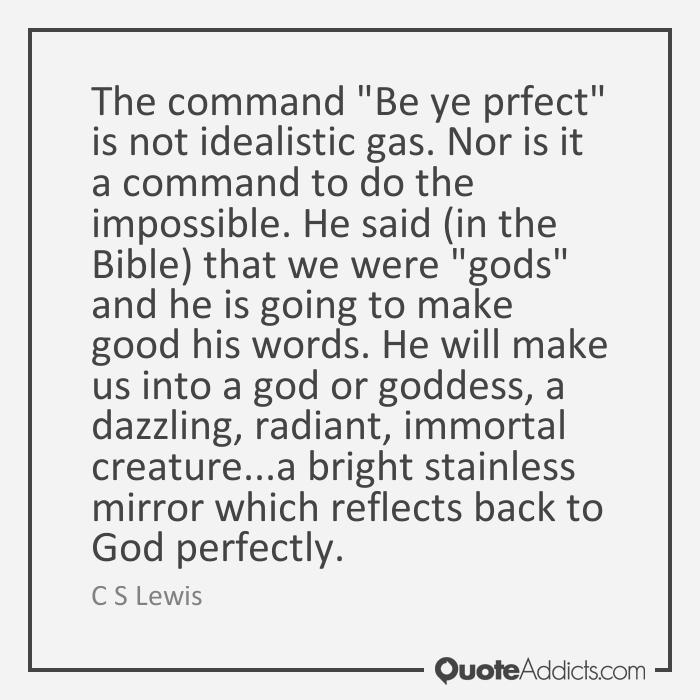
“If we let Him–…we can prevent Him, if we choose–He will make the feeblest and filthiest of us into a god or goddess, a dazzling, radiant, immortal creature, pulsating all through with such energy and joy and wisdom and love as we cannot now imagine, a bright stainless mirror which reflects back to God perfectly (though, of course, on a smaller scale) His own boundless power and delight and goodness. The process will be long and in parts very painful; but that is what we are in for. Nothing less.”

cslewisOur 4 lectionary readings have a common theme: they demonstrate to us how simple and yet profound the choice presented in the Bible is.
1st Corinthians 3, verses 3 to 7:

You are still worldly.  For since there is jealousy and quarrelling among you, are you not worldly?  Are you not acting like mere humans? For when one says “I follow Paul” and another “I follow Apollos” are you not mere human beings?  What, after all, is Apollos? And what is Paul? … I planted the seed, Apollos watered it, but God has been making it grow.  So neither the one who plants nor the one who waters is anything, but only God, who makes things grow.

We are not to get caught up this earthly life, or on whose teachings we follow, who is right or wrong.

Gandhi said:

“all religions are true … So we can only pray, if we are Hindus, not that a Christian should become a Hindu … But our innermost prayer should be (that) a Hindu should be a better Hindu, a Muslim a better Muslim, a Christian a better Christian.”

Spiritual maturity is being able to admit “God makes me grow” – not what I do. I am not “trying” to become a “child of God”: I already am a child of God. We have all been redeemed and bought with a price.  Our objective is not to win salvation; our objective is to become more Christ-like.  As my relationship with God evolves, I realise that salvation, sanctification and justification is about personal transformation.  I am not looking forward to eternal life when I die: eternal life began the day that I accepted God’s free gift of forgiveness.

But, am I allowing God to work in me or holding Him back?  Do I love myself and God enough to become a dazzling, radiant, immortal creature, pulsating all through with such energy and joy and wisdom and love as I cannot now imagine? Or am I caught up in this world?

In my adventure of getting to know the omnipotent, omniscient, ever-present God, Deuteronomy 30: verses 15 to 20 sheds light on my relationship with God.  Deuteronomy means “the second giving of the law.” In this Book, Moses repeats the law of God for those who will cross the Jordan into the Promised Land.

If you recall, before going up Mount Sinai to receive the 10 Commandments, Moses challenged the Children of Israel with the basic rules. Exodus 23:25 “Worship the Lord your God and His blessing will be on your food and water.  I will take away sickness from among you, and none will miscarry or be barren in your land.  I will give a full life span.”  And so, in Exodus 24: 3: “they responded with one voice, “Everything the Lord has said, we will do.

A couple of days later, while Moses is up on Mount Sinai getting the 10 Commandments, these same people ask Aaron to make them the golden calf.  Who here can honestly say they’ve never done this? “Everything the Lord has said, we will do” except for the “no other gods”, or whatever your favourite exception is.  We promise God one thing, and days later have completely failed.

So, here we have Moses, in Deuteronomy 30, repeating the law of God to the new generation; he offers them a choice:

See, I set before you today life and prosperity, death and destruction.  For I command you today to love the Lord your God, to walk in His ways and to keep His commands, decrees and laws… This day I call heaven and earth as witnesses against you that I have set before you life and death, blessings and curses.  Now choose life, that you and your children may live, and that you may love the Lord your God, listen to his voice, and hold fast to Him.  For the Lord is your life…

This passage is about my relationship with God, not about material prosperity. No magic formula for worldly success.  Nor was this was some “altar call”.  This was a call to surrender, each new morning, to Him.  “Choose life” refers to loving God, hearing Him, walking in His ways, keeping His torah, holding fast to Him and not going astray (each morning, each moment of each day).  It’s a radical difference – a life-style choice.

Psalms 119, verses 1 to 8 remind us.

1-     Blessed are they whose ways are blameless, who walk according to the law of the Lord.

2-    Blessed are they who keep His statutes and seek Him with all their heart.

3-    They do nothing wrong; they walk in His ways.

4-   You have laid down precepts that are to be fully obeyed.

5-    Oh, that my ways were steadfast in obeying your decrees!

6-    Then I would not be put to shame when I consider all your commands.

7-    I will praise you with an upright heart as I learn your righteous laws.

8-    I will obey your decrees; do not utterly forsake me.

Even David, a man after God’s own heart, admits that he is NOT perfect in obeying God’s decrees.  He feels put to shame when he considers God’s commands.  “I’d love to say I am obeying fully, but I’m messing up”.  If we are truly honest with ourselves, obeying God’s Word is challenging.  It’s a very high standard!  The Bible is the mirror in which we see our own inadequacies.

David admits he’s still learning God’s law, and finishes with “I will obey your decrees; do not utterly forsake me.”  Don’t give up on me God; I’m going to keep on trying.  We know David had some serious slip-ups in keeping God’s commandments.

He coveted his neighbour’s wife.

He committed murder.

So, how is it that he’s the man after God’s own heart? Well, firstly, although he obviously went through a period of rebellion (more than just a couple of months… maybe more than a year). He was far, far from God.  Yet, when Nathan confronts him, he repents.  There is true remorse, grief and shame.  There is a certain tenderness that comes with this repentance.  Surrender.

We see it again in Peter, who rejecting Christ 3 times, realises his rejection and rebellion, and goes out weeping bitterly.  Somehow, having reached the bottom, Peter was able to put aside his pride, accept Jesus’ forgiveness: was able to bow down and surrender.

Sai Baba said:

“Give up all bad qualities in you, banish the ego and develop the spirit of surrender.”

As a child of God, in our walk to become more Christ-like, we have to understand the importance of the spirit of surrender to God:  “Choosing life.”

Jesus makes it clear, in the sermon on the mount, that it’s not about legalistic fulfilment of the law.

It’s not enough just to know the law.  Last week we read: “let your righteousness surpass that of the Pharisees”.  Pharisees followed the letter of the law; even added a few for good measure. What have we humans done with God’s law?

Let’s see:

The Law of Moses established that we should fulfil our oaths:  Human interpretation says: “if I don’t make an oath, I don’t exactly have to tell the truth”.

Likewise, with respect to divorce:  what was “objectionable” enough about a woman to warrant divorce?  There were different views between various rabbinic schools:

One said:  A man may not divorce his wife unless he has found unchastity in her, for it is written, Because he hath found in her indecency in anything.

Another said: [He may divorce her] even if she spoiled a dish for him, for it is written: Because he hath found in her indecency in anything.

And yet another: Even if he found another fairer than she, for it is written (and this translation is a little more liberal than “because he had found in her indecency in anything), And it shall be if she find no favour in his eyes.”

And so Jesus explains that the true meaning of the law is to honour God, not just with your actions, but also with your thoughts, your motives and your attitudes.  What does it mean to “Choose Life”? Even Gandhi taught:

Before the throne of the Almighty, man will be judged not by his acts, but by his intentions.  For God alone reads our hearts.

These rules from the Sermon on the Mount are deeper and more personal than the laws of any country.  It delves deep into the innermost part of man, where only God sees.

We may think that our “thought life” is our own, hidden from others.  We indulge in “my thoughts” –save a little space, some room, for us to live in our little indulgences.  This hypocrisy of a secret thought life! – One way on the inside and another on the outside – This deep corruption and confusion is not “choosing life”.

We see another example of this when Jesus rebukes us for holding onto our anger, rather than choosing the higher way.   What do I choose to do with my anger?  Do I deal with it?  Buddhist teachings warn:

“Holding on to anger is like grasping a hot coal with the intent of throwing it at someone else; while holding it, you’re getting burned.”

Jesus says there is no real point in priding myself on the fact that I have never actually killed someone. Why? Well, because unresolved anger leads us to sin: saying “Raca” (empty head) or “you fool” (moron) – My angry, thoughtless words KILL my relationships, chipping away at the trust and love.

Jesus values our earthly relationships – important enough that he says we should leave worshipping God and go and make things right with our neighbour or brother.  We are to actively seek reconciliation.

True happiness and fulfilment comes from putting our relationship with God right and then our relationships with all of those around us.

Sai Baba says:  “Once we surrender our mind to GOD completely, HE will take care of us in every way.”

How do I really put into practice, in all aspects of my life, the grace that I have received, living a life of righteousness and holiness before God?  How do I “do justice, love mercy, walk humbly with God”?  I “know” (head knowledge) it means to desire Him above all else: He demands first place in my life.  No half-hearted or part-time love: “just Sunday mornings.”

Much like Christ says in the gospels to the young rich ruler:  No one is good except one–God. You know the commandments: ‘Do not murder,’ ‘Do not commit adultery,’ ‘Do not steal,’ ‘Do not give false testimony,’ ‘Do not defraud,’ ‘Honor your father and mother.’”  The young ruler said to him, “Teacher, I have observed all these things from my youth.”
Jesus looking at him loved him, and said to him, “One thing you lack. Go, sell whatever you have, and give to the poor, and you will have treasure in heaven; and come, follow me, taking up the cross.”

This isn’t the first time we’ve seen “choices” in the Bible.  Genesis: starts with the exercise of free will.  We can choose to eat the forbidden fruit or not – our eyes will be opened: but… will we like what we see?

Augustine said:

“When people choose to withdraw far from a fire, the fire continues to give warmth, but they grow cold.  When people choose to withdraw far from light, the light continues to be bright in itself but they are in darkness.  This is also the case when people withdraw from God.”

God doesn’t want me to pick and choose when I will love him, or under what conditions.  I am to Love God with all my heart and with all my soul and with all my strength.

I’m happy to be a Mary sitting at Jesus’ feet lapping up all the teachings.  I enthralled by His teachings.  But that’s not enough: how do I let go of earthly things, daily struggles, and become a dazzling, radiant, immortal creature, pulsating all through with such energy and joy and wisdom and love as I cannot now imagine?

If I loved God, really, truly, loved HIM, I wouldn’t have any problem keeping His commandments; I would have complete faith in Him and His Word, put absolute trust in Him.  I’d allow Him to guide me, not snatch the reigns back when things get tough.  I would surrender all and trust Him, be filled with His light, and let it shine through me into the lives of others around me.

We know (head knowledge) that “things” cannot give us life – they don’t satisfy the inner longing of our soul.  No harm in trying, right? And so, like the rich young ruler, we distance ourselves from God, putting our trust in our “security”.

True righteousness is more than just legal or external obedience.  It’s not about seeing how much I can “get away with” and still be considered “righteous”.  Wrong-doing arises because of the mind.  But if my mind is transformed, wrong-doing has no place to live.  God’s righteousness is concerned with His “shalom” – well-being, peace and harmony.  This is His righteousness: a peaceful, life-giving relationship with God.  I want, this day, to choose life.

And so, as C.S. Lewis said:

“He will make the feeblest and filthiest of us into a god or goddess, a dazzling, radiant, immortal creature, pulsating all through with such energy and joy and wisdom and love as we cannot now imagine, a bright stainless mirror which reflects back to God perfectly … His own boundless power and delight and goodness. The process will be long and in parts very painful; but that is what we are in for. Nothing less.”

And so, I repeat:

So, as you walk out of here today, which of the 2 types of people do you choose to be?

Those that say to God: “I choose to surrender and banish my ego. I trust you to do the best for me and to give me the strength I need for whatever You have in store, however painful the growth process may be. I want to become more Christ-like. Thy will be done.

Or those to whom our Father in heaven, with great sadness in His heart says, like as to the rich young ruler, “All right then, have it your way”.

Remember: When we lose God, it’s not God who gets lost.

forgiveness, lessons in forgiveness, what if Christ had hopped down from the cross, what do we learn from jesus, Father forgive them, forgiving

What if Christ had indeed hopped down from the cross?

Opening prayer:

Almighty and Everlasting God, with Paul we pray that you would fill us with the knowledge of Your will through all spiritual wisdom and understanding – that we may live a life worthy of you and in every way pleasing to you – a life in which we bear fruit in every good work, and acquire strength, endurance,  patience and a joyful heart – a heart that gives thanks to you in every situation.  We thank you for what you reveal to us through the study of Your Word as we continue in our search for the truth. That our peace may be made full. Amen.

What if Christ had indeed hopped down from the cross?

It is said that “one of the great, unique features of Christianity is that it is a religion of God coming down to us, totally unlike other religions where we have to raise ourselves up to a godly plane. Christianity is light shining in the darkness. It is not the darkness trying to become light…”

Many of us struggle with the Christian life, the whole “nailing the old self to the cross with Christ” – it is a constant battle to “Be holy, as I am holy”.  Wouldn’t it be nice if the Bible asked us to “Be self-righteous…”?  But no… we are called to be holy, to be vessels of His light, and all the while the spiritual man within us battles against “the dark side”.

Did I say I nailed my old self on the cross with Christ? Face it, while Biblically my old self is reckoned dead at Calvary, this morning, as I woke up, it reared it’s ugly head, it was still alive and kicking and in need of being nailed back on that cross again and told to “stay there”…  so that I can be a loving, joyful, peaceful, patient, kind, and faithful Christian, filled with gentleness, humility and above all with control over myself, my mind, my emotions, my reactions, and my desires.

So, what can we learn from today’s readings?

Let’s consider Luke 23:

We all know the reading well,  Jesus at Calvary (the Skull), how He was mocked and challenged to get down off the Cross, and of those eternal words that are engraved on our hearts:  “Father, forgive them; for they do not know what they are doing.”

This morning I want to consider the implications of “What if…”.

What if…  Christ had not said “Father forgive them, for they know not what they do”?

What if Christ, having said in Gethsemane “Father, if you are willing, take this cup from me; yet not my will, but yours be done.”, had then reached the Cross and come down from it as challenged to do by the Pharisees and religious leaders, by the Roman soldiers, by the thief nailed with him?  Judgement day arrived early…

How would our Bible read today if these events were not as recorded in Luke 23?  What would it mean to be a follower of Christ, if Christ hadn’t died on that cross?  There would be no books of Acts, the Epistles… would the book of Revelations have been written?  What would have become of Peter, who denied Christ 3 times?  What would have become of doubting Thomas? Would he then have believed?

I want to start by looking at our concept of forgiveness, and the influence that Christ’s forgiveness, right at that crucial moment has on us:  How would you interpret Isaiah 38:17 “…in love you have delivered my life from the pit of destruction, for you have cast all my sins behind your back.”, if Jesus hadn’t died on the cross?  How far behind God’s back would you say He had cast your sins?  Would you really believe that God was a forgiving God; that He forgives and forgets?

If Christ had been silent at that moment, I could say, “I’m not making amends, It’s her fault, she has to say sorry first”, or  “I’m the one that’s hurt and offended, I’m the victim here, Why do I always have to be the one to say Sorry and I forgive you?”.

But no, Jesus had to go and ruin it all for us, and put the bar very, very high… No arrogance. No pride. No bitterness.  Just forgiveness.  An outpouring of love.

When you look at the gospels, Jesus was always preaching forgiveness:  to the paralytic Jesus said “Friend, your sins are forgiven you”; to the woman caught in adultery: “woman, your sins are forgiven”; in prayer: “forgive us our trespasses as we forgive those who trespass against us”.

Daniel 9:9 tells us “The Lord our God is merciful and forgiving, even though we have rebelled against him”.  What kind of merciful and forgiving God would you believe in, if not for the example of Christ?  Psalms 103:12 “As far as the east is from the west, so far has he removed our transgressions from us.”

In Matthew 18:22 Christ responds to Peter when asked about forgiveness: “I do not say to you, up to seven times, but up to seventy times seven.”  So, when another person offends us, we are to forgive that person for that one offence 490 times (in a single day), and if today he repeats the office, I have to forgive him once more 490 times.  It’s a state of being, not an action. Not something I say.

My perception of what forgiveness is has been shaped by Christ’s forgiveness on the cross. His compassion.  His empathy.  His understanding.

Christ could see that the soldiers were following orders; they didn’t know who he was or what he was; trained to survive wherever they were stationed.

Christ saw Pharisees and Scribes that had spent years studying “the Law”, but that never allowed the law to change them on the inside.  They had head knowledge, but no heart knowledge.  And even though they had orchestrated his death, he still felt compassion for them.  He was able to look further than what they were doing to him right at that moment in time… He was clear about God’s will and his role in fulfilling it.

Christ saw a thief and murderer who was scared, who was hardened by the life he had chosen, … and who would use bravado to cover his fear. That like a dog that is backed into a corner, will lash out and attack another, rather than show how vulnerable he really is.

And Christ forgave.

Without this moment, without this event, we would never have had Acts 7:60 (Stephen, being stoned): “Lord, do not hold this sin against them.”  Where would Stephen have learnt this kind of forgiveness, if not from Christ?  And the apostle Paul, that day a young Pharisee looking on and approving the stoning, holding the coats of those killing Stephen, what would have become of him?  There would have been no apostle Paul if there was not Christ dying on the cross.

Would we (gentiles) have the news of the gospel of Christ if Stephen had not been stoned to death and been able to forgive those that were doing so?  Would salvation have only been, then, for the Jews?  Without the Apostle Paul, what New Testament Epistles would we have?  What would replace: Ephesians 4: 31-32: 31 “Get rid of all bitterness, rage and anger, brawling and slander, along with every form of malice. 32 Be kind and compassionate to one another, forgiving each other, just as in Christ God forgave you.”  What would become of Colossians 3:13 “Bear with each other and forgive whatever grievances you may have against one another. Forgive as the Lord forgave you.”

Matthew 6:14-15 tells us: “For if you forgive other people when they sin against you, your heavenly Father will also forgive you. 15 But if you do not forgive others their sins, your Father will not forgive your sins.”  Mark 11:25 “And when you stand praying, if you hold anything against anyone, forgive him, so that your Father in heaven may forgive you your sins.”

Where would we be without Hebrews 12: 14 and 15? “14 Follow peace with all men, and holiness, … 15 Looking diligently … lest any root of bitterness springing up trouble you…” If I fail to forgive, bitterness will take root in my heart…

When we withhold forgiveness, we imprison ourselves.  Jesus understood the power of forgiveness: it frees me and the person that I have forgiven.  Forgiveness: in Greek, the power to loose, to free, to cast off chains.

Philip Yancy tells of an immigrant rabbi: “Before coming to America, I had to forgive Adolf Hitler”.  “Why?”  you might ask. The rabbi went on: “I did not want to bring Hitler inside me to my new country.”

When I fail to forgive, I carry that person (and the bitterness) inside me.  I build the walls of my own prison.  And so today, I am thankful to Christ for His forgiveness.

But what if…  Christ had hopped down from the Cross that day, if he had given the Roman soldiers and the Pharisees “what for…”, what religion would we have today?  What of… bowing to God’s will and counting the cost?

Mark 8:34 and Matthew 16:24 tell us “If any man will come after me, let him deny himself, and take up his cross, and follow me.”  What would that mean to you today, if Christ had hopped down from the cross on that day and demonstrated his power?

What would have happened to the veil in the temple, hiding the holy of holies from the human eye?  Would it have been ripped in two that day?  Would we believe in direct access to God, or burnt sacrifices, incense and offering atonement for sins?  Or would that just be for the children of Israel, with all of us living with our pagan beliefs?  Would we believe in a loving and forgiving God, that is holy and found the way to reconcile us to Himself?

Without Luke 23: 33-43 there would be no book of Philippians, chapter 2, verses 5 to 8:  Let this mind be in you, which was also in Christ Jesus:  Who, … made himself of no reputation, and took upon him the form of a servant, … he humbled himself, and became obedient unto death, even the death of the cross.”

What if, instead of that, we had Christ on the cross saying: “ok, cut the crap! I am here to enforce God’s will and deliverance!  You think you’re big strong soldiers? You think your swords and spears scare me?  You have no authority over me.  You don’t REALLY think you can kill me do you?  Let me show you who’s really Boss…” Would lightning have sprung from the sky?  Would the angels have slain all present?  Would Christ have judged all those that deserved judgment? Think of the implications:  No more Pharisees, no more Roman invasion of Israel… no more freedom from sin through that blood sacrifice.

So… Why doesn’t Jesus save himself? He can raise the dead, walk on water, heal the sick, turn water into wine… Why not jump down? Jesus wasn’t a miracle worker. He’s not an entertainer; He wasn’t here to amuse and amaze.

Remember Luke 4:9-13? Then the devil took (Jesus) to Jerusalem, and placed him on a high pinnacle of the temple saying, “If you are the son of God, throw yourself down from here, for it is written: ‘He will command his angels, concerning you, to protect you,’ and ‘On their hands they will bear you up, so that you will not dash your foot against a stone.’  Jesus answered him, “It is said, ‘Do not put the Lord your God to the test.’

If … you are who you say you are… If… you are the Son of God… If you have the power…  and yet, Jesus rejects this temptation.

What does it mean to believe in a Saviour who doesn’t save himself?

I would like to have a saviour who would come to the rescue, kill the bad guys, cure the disease, end the injustice, and solve every painful circumstance. But salvation is not an event – it’s not a miracle that rescues us from pain.

Salvation is about re-establishing our relationship with God, about becoming a vessel of light.  It has nothing to do with the circumstances in which we find ourselves.  Am I sitting in fields of green, surrounded by sunshine and happiness? Great! But how’s my faith?  Am I suffering from the death of a loved one, the prolonged illness of a parent or child?  Terrible… but how is my relationship with the Everlasting?

Is there commitment? – founded on the hope, wholeness and well-being that comes from being grounded in my faith. Jesus was here to show us the way to a relationship with God, a relationship that endures, survives and persists through all the ups and downs of my changing circumstances.

It wasn’t about power:  ¿Remember that Peter drew his sword the night before, to protect his Christ and leader?  And Jesus’ response: “Put the sword into the sheath; the cup which the Father has given Me, shall I not drink it?”

We often have the power to do things differently – we’re in a situation where we know we’re right, “I know someone that can make you do it”.  The nice thing about power is that when you have it, you can use it.  Or you convince others that you have it, and then you don’t actually have to use it.  But if someone isn’t convinced that you really have the power, that you really can make them minced meat, then sometimes we feel “forced” to show our hand, just to shut them up.

If Christ had not obeyed God’s will on that day, would my obedience to God be optional?  Is it convenient? Do I feel like it? Is the cost too high?  Can I stay in my comfort zone?

To be followers of Christ means that we deny ourselves, we obey God’s commands, even when it’s to our detriment, when the personal cost to ourselves is high.

We who follow Christ are the difference in the world:  the ones that kneel down and wash another’s feet.  We cannot discriminate.  We are no longer to follow our every whim and addiction, living capriciously or aimlessly.  We are to care for those less fortunate than ourselves, with generosity of spirit for all.

As a follower of Christ, we forgive the drunk driver who killed our son or daughter in a hit and run accident (and we pray for him); we forgive our sister for those bitter and twisted words that she said in a moment of anger and pain, we have empathy and do not hold it against her; we forgive the boss that curses us and take a moment to say a prayer for him and his family.

We read in Jeremiah that God promises to gather together the remnant of His flock, to raise shepherds over them, that we should fear no longer, or be dismayed or have anything missing.  This deliverance: YHWH Tsidkenu – the Lord is our righteousness.  Righteousness, when it refers to God, speaks to His nature, the saving and healing activity of God.  God shows His righteousness by making us whole, by forgiving us, keeping His promises to us.   The true purpose of our liberation and our freedom is to worship and serve God without fear.

Colossians reminds us that we are to be made strong with all the strength that comes from God’s glorious power, prepared to endure everything with patience (even when it’s unjust mocking and abuse), while joyfully giving thanks to our everlasting, ever loving Creator.  We are to share in the inheritance of saints in the light – allowing the light to shine through us, remembering that our God has rescued us from the darkness, that we have redemption and the forgiveness of sin.

Jehovah Tsidkenu, before all things, is our source of healing and empowerment.  We are not expected to do it on our own.

Our joy is not the power of influence and control, but the power of love that flows brings transformation.  Love lies at the heart of the universe and is God’s wisdom and will.  And that is what we see when we visualise Jesus hung on the cross between two thieves, being mocked by the soldiers, by the religious leaders, by the thief at his side.

We see that Jesus, the one that could forgive; He gives us the hope of our salvation and freedom from the chains of bitterness, envy, pride, arguing, hatred and strife.  Freedom from the darkness within us… to be vessels of light… and for this we are thankful.

does your religion forget god, power of God, power of the divine, divine presence, practising the power of divine in our life, ignoring those who need help

Does your religion forget God?

“Does your religion forget God?”

As I stand up here this morning, I am reminded about why Jeremiah said to God “I don’t know how to speak; I am only a child”.  Well, maybe not a child, but Mum & Dad are sitting in the congregation listening, and I feel like a child. Are they going to like what I said? What are they going to say in the car on the way home?

Like Jeremiah, I feel that there is something important to share this morning, for the strengthening, encouragement and comfort of each one of you.  So, with some fear and trembling, I dare to ask “Does your religion forget God?”

When I read Luke 13: 10-17, titled: A Crippled Woman Healed on the Sabbath, I wonder whether I am the crippled woman or the Synagogue ruler.

For a moment, I want to consider the crippled woman.  Luke tells us:

  • She was crippled by a spirit (other translations mentions that it was a spirit of illness or infirmity).  This doesn’t mean demon possession: it’s more like the torment that Job endured when Satan afflicted his body.
  • For 18 years she’s been suffering!
  • She’s bent over, unable to straighten up – Now, If you get Ankylosing Spondylitis (a chronic progressive form of arthritis distinguished by inflammation and stiffness) today’s medicine can relieve the pain, but not actually cure the condition.
  • She was in the synagogue on the Sabbath
  • Finally, she was standing somewhere at the back, because Jesus had to call her forward.

I wonder how this spirit of illness attached itself to her: did it start attacking her slowly, surreptitiously, taking over her health a little at a time, so that she didn’t notice it at first?  Or did it crash in and knock her over and out, that she was overpowered and unable to fight back? For 18 years, she lived with this condition, probably in reluctant acceptance… something uncomfortable, but irreversible.

Sighing: “Oh well, this is my lot in life, I’ll just have to live with it”.

“It’s been this way for so long, I’ve learnt to live with it. In fact, I’m almost beginning to notice the benefits of this condition: SEE – I have a really good view of the floor for sweeping and mopping, it’s easy to do the laundry and the washing, I can pick up the kids clothes and toys easily, I don’t bump my head much on the low-handing doors or cupboards, preparing the food over the wood fire is effortless, and all the rest of the household chores are easily handled from here. I know I shouldn’t complain: there are a lot of others that are much worse off than me.  Overall, I’d say I’m doing pretty well: But, sometimes I wonder what the blue sky looks like, and I miss seeing rainbows.”

Is that why she wasn’t rushing to ask Jesus to heal her?  Had she lost hope, over the 18 years?  Maybe she’d prayed about it, when she was first afflicted by the pain and the spirit of illness, but there was no answer, and she decided that God was much too busy with other people and other problems and hers was just a little problem.

While there is the possibility that she relished her infirmity and felt that she was better than others, or she enjoyed feeling sorry for herself, I don’t think this was her view.  Given her reaction to the healing, “she straightened up and praised God”, I think she’d given up hope, but there was just that tiny, small, almost unspoken wish, that MAYBE, just maybe, Jesus will notice me and say or do something.  Maybe she was too scared or nervous or ashamed to ask for healing or speak to Jesus.

What we know is that she had the courage to step up and come forward.  When Jesus called her, not knowing whether he would call her to bless her, to question her, to rebuke her, or to speak with her, she came forward.  What do I do when Jesus asks me to step forward?  Do I cower in the background, hoping he’s talking to someone else?  Do I hide behind another?  Or do I walk forward to receive his Word and his healing touch?    What do you do when Jesus speaks to you?  Do you even realise that it is Jesus speaking?  Or think, “oh, he’s talking to someone else”?

Or maybe you’re so overcome by the problem, the weight on your shoulders, your human condition that you can’t drag yourself into Church.  And you say to yourself, I went to Church last week, and he wasn’t there and he didn’t talk to me, so why’s it going to be any different this week?  Are you busy looking at the earth? Stooped over? Looking down, instead of looking up?  Are your eyes fixed on God or on your own condition and its results?

Let’s have a look at the Synagogue ruler:

We know that he was INDIGNANT about Jesus healing on the Sabbath.  I remember reading somewhere that righteous indignation is usually 1% righteous and 99% indignation.  He’s so indignant, in fact, that he doesn’t even address Jesus and directs his speech to those present: “There are 6 days for work: so come and be healed on THOSE days, not on the Sabbath.”  Was the synagogue ruler right?  We know that the rules about the Sabbath are repeated or clarified 12 times throughout Exodus, Leviticus, Numbers and Deuteronomy.

Exodus 20 “Remember the Sabbath day by keeping it holy. Six days you shall labour and do all your work, but the seventh day is a Sabbath to the Lord your God.  On it you shall not do any work…”  Exodus 23 “ … so that your ox and your donkey may rest, and the slave born in your household… may be refreshed.”  Chapter 34: “… you shall rest; even during the ploughing season and harvest you must rest.”  And Exodus 35:  “Do not light a fire in any of your dwellings on the Sabbath day.”  In Leviticus 23: “a Sabbath of rest, a day of sacred assembly.  You are not to do any work; wherever you live…”  In Numbers we read of a man found collecting fire wood on the Sabbath, who Moses had stoned outside the camp, “as the Lord commanded Moses”.   This was SERIOUS!  The Sabbath was to be kept holy, set apart for God.

But the real nitty gritty rules, how to put it into practice, were rules made by man (yes, probably the lawyers)… These clarified that “rest” meant you couldn’t walk more than about 1.5 km from your home, but if you left food for 2 meals at the 1.5 km mark, you could walk another 1.5 km on from that point, since it was now your “dwelling”.

And yet we also find in the Bible, exceptions to this rule:

  • Leviticus 24:5-9 – the Levites were to present to God fresh bread EACH day, including on the Sabbath, for which they were to light fires and cook, even on the Sabbath.
  • In John 7, verses 22 and 23 we find that it was acceptable for a baby boy to be circumcised on the Sabbath
  • And in Matthew 12 we read that if a sheep falls into a pit, any owner would pull it out.

The Mischnic tractate “Sabbath” has precise definitions for the purpose of determining what was allowable and not allowable on the Sabbath.  And I’m sure that the synagogue ruler had memorised them all!   We all know his kind: they’ve been in and around churches for decades.  He doesn’t see this healing as an “act of God”, but rather a natural act of healing (that somehow must therefore be work).  How much criticism, condemnation is there in churches, excluding the possibility that it is God working the miracle, healing, restoration or freedom from bondage?

So, we have the crippled woman and the synagogue leader; now let’s have a look at Jesus:

I find it curious that the woman was not up the front, looking to get healed.  Jesus singled her out of the crowd, and called her forward.  He must have known that this was going to get a rise and reaction out the Pharisees, scribes or other synagogue leaders.  I believe he was taking the opportunity not just to heal her, but to bring restoration as well by confronting a problem.

The synagogue leader plays right into his hands and overreacts.  Just when the woman is praising God (not Jesus, but God), the synagogue leader steps up and tells everyone that the healing services in this church will only be held from Sunday through Fridays. “There won’t be any healing services held on the Sabbath. It’s NOT God’s will that anyone be healed on the Sabbath.”

And so Jesus, the Lord of the Sabbath, that same Lord that has already said previously in another synagogue and to another group of Pharisees that the Sabbath was made for man, and not man for the Sabbath, confronts him with:  “You hypocrites!”

I don’t know about you, but I might be a little embarrassed, maybe even a little offended!  I’m standing in MY synagogue, in front of MY friends and cronies, I’m the big fish in this little pond, and this guy (that I probably hadn’t even invited to come and teach) steps up to the microphone, takes over the teaching, and on top of that calls this woman forward from the back, who is OBVIOUSLY a sinner, (in case you hadn’t heard, she’s crippled by a SPIRIT), and he heals her, ON THE SABBATH.

To make matters even worse, Jesus insinuates that this woman has as MUCH right as I do to salvation and freedom?  He categorically states that she is a daughter of Abraham!  As if she was somehow at the same level as the sons of Abraham.

Without mincing his words, Jesus asks if this woman, whom SATAN (not herself through her sin) has kept bound for 18 long years, doesn’t have the right to be set free on the Sabbath day from what bound her?  (I’m sure the synagogue ruler wanted to say: “Well, maybe, but Not in MY church!”).

So, I come back to the question that I started with:  Does your religion forget God?

The 10 Commandments, they start with “You shall have no other gods before me” and “You shall not make for yourself an idol in the form of anything…”.  I’m certain that the synagogue leader firmly believed that he had no idols or any other gods.  He knew the laws and followed them religiously.  And I imagine that in the crippled woman’s house, we would have found no idols or other images.

And yet, in a way, each of them had something that held their attention, that defined them:

  • The woman was burdened, weighed down under the circumstances of her life.  She was living in defeat, possibly sapped on strength and vitality.   I imagine she felt like an outcast, maybe a hunchback, and probably in pain.  Probably the vertebrae of her spine were fused together.  And so, she’s come to accept this bondage – she accepts her condition.  She forgets that God is over and above all, even though she still somehow clings to that slender thread of belief that somehow, in the synagogue, she will still find the answers.  But she has given-in; she’s no longer asking God to be bigger than the problem.  The problem is obviously bigger than God.
  • The synagogue leader, on the other hand, has a god or idol that is much easier to identify (at whom we can point the finger): his ego, his knowledge of the scriptures, ME, ME, ME.  I AM.  I KNOW, I OBEY, I FOLLOW. He wants to keep control of the synagogue: he wants everyone to obey and follow the law the way he does. His way.

And just because we don’t assist religious temples dedicated to nonexistent deities, we think we are free from idolatry as well.  Our biggest idol, in secular society today, is what encourages us to worship ourselves:  greed, jealousy, self-indulgence, selfishness, pleasure, pride, arrogance, injustice, self-pity, hate, anger, and such like.  We work for money, for pleasure, for power, for importance, for a sense of self-worth or self-importance.   Our lives are centred and revolve around ME, MY FAMILY, MY JOB, MY CAREER, MY FEELINGS, MY SALARY, MY RAISE, MY REPUTATION, MY IMPORTANCE, MY EFFORTS, MY HOUSE, MY DECISIONS, MY WAY… and even go so far as to be about MY GOOD WORKS, MY MISSIONS EFFORTS, MY CONTRIBUTIONS, MY INTERPRETATION OF THE BIBLE, MY WALK OF FAITH, MY SUFFERING, and so on.

How far is my religion from actually loving and serving the Almighty God?  What do I need to be freed from, like this woman, to be like Jeremiah and accept that before God formed me in the womb, He KNEW me and set me apart for a special purpose even before I was born?  Am I living in the freedom that I have through the salvation of Christ Jesus?  Or am I still focused on the idols or bondage and burdens of my life?  Am I fulfilling my calling in Colossians 3: 12-15:  “Put on then, as God’s chosen ones, holy and beloved, compassion, kindness, lowliness, meekness, and patience; forbearing one another and, if one has a complaint against another, forgiving each other; as the Lord as forgiven you, so you also must forgive.  And above all these put on love, which binds everything together in perfect harmony.  And let the peace of Christ rule in your hearts, to which indeed you were called in the one body.  And be thankful.”

From personal experience I can tell you that when I started to examine my life, and identify those IDOLS that I put ahead and are more important than God, it startled me.  There were the obvious idols: my ego and pride, my career as a lawyer, my intellect, my achievements, my relationships… Susy (my Chihuahua) – on a pedestal of love.  My finances and my business – because we all know, my professional life and my relationship with God are mutually exclusive, right?  God is for Sundays and devotional time each morning or evening, and then from 8 to 5 I work and am a professional.  There’s no reason for the two to overlap or meet!  I tithe my money to the Church, and what I do with the rest of it is mine to decide, right? What does Christ mean he wants to be Lord of ALL?

On the one hand, I know that Jesus came to bring liberty to the captives and healing to the sick, as well as to save each man from sin.  He wants us to be His followers.  But, for some reason, we overlook that this means a radical life-changing experience.  Galatians 3:3 warns all Christians not to be foolish “… After beginning with the Spirit, are you now trying to attain your goal by human effort?” The Holy Spirit was sent to help us, so that we wouldn’t rely on our human effort alone, becoming self-centred.

God asks us to put HIM first, Lord of ALL… we are each faced with a decision: Do I trust God enough to hand over my business? Do I really trust Him? Who is God that I should trust Him?  What does it really mean to hand over my life, my finances and business to God?

This life-changing decision is now about asking God for His opinion and His permission, and there is no longer any sphere or area of life which is exclusively MINE, where God doesn’t have a part!  It means that before I go to work each day, I put the day before Him in prayer and ask Him for His strength and guidance, rather than depending on my own wisdom.  I must have the courage to do things differently: look at problems, issues and people from His perspective, not mine.

When we decide to put God first in our lives, as Jesus would have us do, we realise that it’s no longer MY synagogue, or MY burdens and bondage, but that we are to live under HIS freedom.  We are to show His love to every man, woman or child, not just those that we believe deserve it or are entitled to it. He is an equal opportunity freedom fighter.

Jesus knows that it’s not ONLY our possessions that may get in the way of our relationship with God, but also our self-pity, our sense of self-worth, our hopelessness, our piousness, our knowledge and human intellect.

At the end of the day, Jesus is looking for all of us to accept His deliverance, to have a new identity, and to give the praise to whom it is really due: to God, as the crippled woman did and those that saw her healing.  Having a personal relationship with Jesus, being His follower, means living in freedom from bondage and trusting in Him, so that it is no longer I (or me) but Christ working through me. He would have us all say, as we did in our prayer of confession at the beginning of the service, with the security that we trust Him in every area of our lives:

In you, O Lord, I have taken refuge; let me never be put to shame. Rescue me and deliver me in your righteousness; turn your ear to me and save me.  Be my rock of refuge, to which I can always go; give the command to save me, for you are my rock and my fortress. For you have been my hope, O Sovereign Lord, my confidence since my youth.  From birth I have relied on you; you brought me forth from my mother’s womb. I will ever praise you.  (Psalms 71: 1-6)

A friend is someone who knows all about you and still loves you.