
Inside out, Romans, Matthew, reject, rejected, gifts, calling, mercy, listen, understanding, practicing presence, squeeze, news, environment, true colours, masks, fears, anger, healing, love, fear, mouths, words, tongue, practicing presence, Shekinah

Sermon: Inside Out

READINGS:

    • Romans 11: 1-2a; 29-31
    • Matthew 15: 10-11; 15-20


This week, in the news from Charlottesville and then Barcelona, we see far more fear and hatred in the world than we are comfortable with. This is not the world that I want my daughter to grow up in. The unfortunate reality is that we are in an environment today where people have become comfortable showing us what they really hold on the inside – they are letting it come to the surface and showing their “true colours”. While I’m repelled by it, I’m also a little relieved that the masks are off – now that we know you have these fears and anger on the inside, let’s talk about them. Let’s talk about healing. Let’s talk about a love that casts out all fear!

Our readings this morning dealt with 2 particular topics:

  1. We each have a gift and calling from God that are irrevocable; and
  2. Whatever comes out of our mouths, comes directly from our hearts!

We are all like lemons: a lemon has some wonderfully positive characteristics; it’s full of vitamins, it can help your liver deal with bile, it can cleanse your bowels, you can use it to bleach your hair (if you don’t mind it getting dried out), we put “real lemon juice” in our dish-washing liquid and our furniture oil; it is considered anti-bacterial. On the other hand, it’s also sour, acidic, tart, astringent and in some cases just plain bitter! When you squeeze a lemon, what you get out is lemon juice – because that’s what is inside.

And when you or I are put under pressure and squeezed – the “real” you comes out: that which is really inside of you! And, like the lemon, you have some wonderful qualities, gifts and calling; and other parts of you are sour or bitter or not so pleasant.

STRENGTHS & WEAKNESSES strengths, weaknesses, talents, gifts, serving others, learning, growing, born again, rebirth, transformed, renewing, God, Spirit, healing

Before I talk about your gifts and your callings, I want to remind you that our strengths and our weaknesses are usually connected: they can’t be looked at as independent attributes.  For example: your stubbornness is the determination that gets things done; your creativity is probably somehow tied to your day-to-day chaos; your inconsistency may allow you to remain flexible; your calm may be seen by many as emotionlessness. Many adventurers are seen as being irresponsible; someone who is realistic may tend to be negative and pessimistic; and someone who is self-confident may easily become arrogant.

Behind all of this, is the heart and the intentions of the heart! Is the heart coming from a place of love, caring and calling? Or is the heart  coming from a place of lack, fear and ego?

There is a story that is told of an old Cherokee teaching his grandson about life:

“A fight is going on inside me,” he said to the boy.  “It is a terrible fight and it is between two wolves. One is evil – he is anger, envy, sorrow, regret, greed, arrogance, self-pity, guilt, resentment, inferiority, lies, false pride, superiority, and ego.”
He continued, “The other is good – he is joy, peace, love, hope, serenity, humility, kindness, benevolence, empathy, generosity, truth, compassion, and faith. The same fight is going on inside you – and inside every other person, too.”
The grandson thought about it for a minute and then asked his grandfather, “Which wolf will win?”
The old Cherokee simply replied, “The one you feed.”

WHICH “I” ARE YOU FEEDING?

If you have followed me so far, you will realise that every one of your weaknesses might actually be a strength – a gift that God has given you to help you fulfill your calling. They say that the best moment to plant a tree was 20 years ago; but if you didn’t do it 20 years ago, the next best day is today. If you haven’t identified your calling in life, today is the best day to sit down and identify what you were called by God to do. Every single person that is born was born with a purpose to fulfill on earth! Everyone.

“Each one should use whatever gift he has received to serve others, faithfully administering God’s grace in its various forms.” 1 Peter 4:10

You have your gifts and talents. You were given enough. But if you are busy feeding your heart anger, envy, sorrow, greed, arrogance, self-pity, guilt & ego – that is what will win. When you are put under pressure and squeezed, that is what will show to the world!

So, when you look at your gifts and talents, and you identify your calling: then you have to strive to perfect those gifts. Use it, or lose it? Anyone that has ever tried to learn a musical instrument knows what no matter how much talent you have, without practice it’s impossible to improve. There are hours of practice of techniques, until muscle memory takes over instead of having to think about each movement. They say it takes some 10,000 hours to become a master! If you look at your spiritual gifts and your Christian life – how far along the path are you investing 10,000 hours to master being a Christian and following in Jesus’ footsteps?

If you considered a University degree – 4 years of study, which is about 8 months out of the year, let’s say 8 hours a day, 5 days a week? That would be about 5,500 hours that you spent only to reach a bachelor’s level of education. Most of us would not consider a recent University graduate to have mastered anything yet. So, when it comes to your spiritual life and transformation, when it comes to what you have inside your heart, why do you expect it to be so easy?

BEING “BORN AGAIN”

rebirth, transformation, patience, struggle, effort, hard work, mercy, gifts, calling, God, listen, understand,, mouth, heartI know for myself, there is this lingering idea that when you are “born again” you become a new creation! Suddenly it’s all easy, right? But if you remember, about 2 months ago we were studying Romans 7, verses 14 to 25, where Paul was agonizing over how he wanted to do good and yet was doing exactly what he didn’t want to do! It was a constant struggle. But as you get to know your strengths and weaknesses, as you cultivate yourself – you practice, sharpen, and develop – then your heart becomes transformed closer each day to the calling that God has for you.

But I would dare to say that “being reborn” is simply “the first day of the rest of your life”. As today is. As tomorrow will be when you wake up tomorrow morning. So use your gifts well. The gifts and talents that God has given you  are not for your own benefit, they’re for the benefit of other people. My gifts are for your benefit. Your gifts are for my benefit. You are to use those gifts in the service of other people. God has given you a special role in this world: you have a special contribution to make that others cannot replace!

1 Corinthians 7: 7 reminds us:

each person has a special gift from God, of one kind or another.

LIVING FROM THE HEART:true, honest, just, pure, lovely, good, virtue, praise, meditation, heart, words, mouth, acceptable, Lord, gifts, talents, focus, meditate, excellent, praiseworth, English speaking, Sunday service, Panama City, Panama

As we read in Romans 11:

I ask, then, has God rejected his people? By no means! … God has not rejected his people who he foreknew.
For the gifts and the calling of God are irrevocable.

God has NOT rejected us! God’s love abounds for everyone: the gifts and calling are irrevocable. But it depends upon us to make our way back to God’s calling and to use the gifts we are given. It is up to us to get ourselves back on track with the forgiveness, healing and help that God has promised throughout the entire Bible. We may reject ourselves. We may reject others. But God is love: God is not ONLY loving. God is love. This means that God cannot help but love us. We are all children of God, called according to God’s purpose. May our hearts and minds reflect this calling.

We read in Psalm 19, verse 14:

May the words of my mouth and the meditation of my heart, be acceptable in your sight, O Lord.

David knew well that what he meditated on, in his heart, would control the words that came out of his mouth. As you take stock of your gifts and talents, as you identify your calling and purpose, how you are called to serve others, then you will find the focus on which you are meant to meditate, ruminate, ponder, consider, reflect and think. And as you spend more time, thinking on things which are true, noble, right, pure, lovely, admirable, excellent, praiseworthy, just, commendable: when you are squeezed by life – that is the fruit that will come out of your mouth from your heart! I trust, as we all leave today, that we will go forth to our calling, using our gifts as we were meant to do.

Readings:

  • Romans 11: 1-2a; 29-31

I ask, then, has God rejected his people? By no means! … God has not rejected his people who he foreknew.
For the gifts and the calling of God are irrevocable. Just as you… have now received mercy… so they now, by the mercy shown to you, they too many now receive mercy.

  • Matthew 15: 10-11; 15-20

Then he called the crowd to him and said to them, “Listen and understand: it is not what goes into the mouth that defiles a person, but it is what comes out of the mouth that defiles.”
But Peter said to him, “Explain this parable to us.”
Then he said, “Are you also still without understanding? Do you not see that whatever goes into the mouth enters the stomach and goes out into the sewer? But what comes out of the mouth proceeds from the heart, and this is what defiles. For out of the heart come evil intentions… false witness, slander [gossip, lying, cursing, blasphemies, evil speaking, complaining, railings, perjury, impiety of speech]. These are what defile a person, but to eat with unwashed hands does not defile.”

Sermon: Rejoicing in Sufferings

READINGS:

  • Romans 5: 1-8
  • Matthew 9:35 – 10:8
  • Psalm 100

REJOICING IN SUFFERINGS

I invite you to think for a moment about that Olympian champion, the one that sat on the sofa every day watching TV, checking their internet, and reading books.  The one that slept in every morning, had a full cooked breakfast, eating anything they wanted, when they wanted, partying with their friends any time they liked, and taking it easy. On the day of the meet, the simply went out and effortlessly won gold because they were just the best.

What do you mean you never heard of that guy?  Apparently it’s not that easy to be an Olympian Gold Medalist! There may be suffering involved on the road to glory: it takes work, effort, consistency, perseverance, and faith to become perfect and complete, lacking nothing! Rapid success stories happen, true. But the reality is that most “overnight successes” come at the end of years of hard work and those witnessing the “success” part too readily assume the “overnight part.”

Joy comes in spite of our pain! To have joy in spite of difficulties and struggles  is not to deny pain; it is to recognize that they can co-exist. The same way a pregnant mother can go through the agony of childbirth and still have joy in thinking about what is to come. She knows that there is a beautiful light and life at the end of these painful hours.

This morning, Paul says that we are to “Rejoice” in Suffering!  And the reason that Paul gives for this is that suffering produces “endurance”: in other words

  • intestinal fortitude
  • grit
  • perseverance
  • stamina
  • tenacity
  • gutsiness
  • resilience

Paul  goes on to say that this endurance will produce character, and character produces hope, and out of hope comes an outpouring of love into our hearts.

James 1, verses 2 to 4 say something similar:

My brethren, count it all joy when you fall into various trials, knowing that the testing of your faith produces patience. But let patience have its perfect work, that you may be perfect and complete, lacking nothing.

I want to talk  this morning about cultivating resilience, which enables us to remain positive and focused. Resilience is a quality that allows some people to be knocked down by life and come back stronger than ever – they rise from the ashes, rather than letting failure overcome them and drain their resolve: a basic ingredient for happiness. So, Paul tells us to “rejoice in our sufferings” – note: he doesn’t say you will only suffer once.  There will be sufferings – did you hear the S? And yet, we are to rejoice, because this is how we learn and grow!

Paul says suffering will lead to endurance, and this will, in turn, lead to having character (that is, who you really are, when all the layers are peeled away – when no one else is looking!).  Said another way:  suffering produces steadiness, steadiness produces reliability, and reliability produces hope.  If we prove ourselves to be reliable, even in the face of hardship – there is hope!

How many of you here today have survived every day of your life so far in spite of the ups and downs?

Amazing! You have survived everything that life has thrown at you so far!  Every one here today is a survivor.  But here’s the challenge: it is not enough just to be here – you should be better for it!  Better equipped, greater patience, more understanding, a higher level of emotional intelligence, empathy for your fellow man or woman.  How do you make this happen, faster and easier on yourself and those around you?

For starters, I would say that the first step is acknowledgement: recognizing that you are in a situation that is outside of your comfort zone and that makes you feel that you are under threat.  The reason I say this is that when you are in denial, “this isn’t happening to me”, it’s impossible to actually act!  You can’t make any decisions about something that isn’t happening to you!   So, step one is admitting that you have a situation.

But I invite you to be careful in your choice of words: transform “hardship” into “challenge”, giving yourself the possibility of seeing opportunity and to make this a productive situation. What do you want life to look like on the other side of this adversity? Remember: your success rate so far is 100%: how will you come out of this one?

Step two, is getting a handle on your emotions.  The signs of a resilient person is that when they are in a difficult situation, they keep calm, evaluate things rationally, and come up with a plan, and so they can act.  The biggest emotion we have to face is fear – fight or flight or lizard brain (paralyzed by fear, shutting down).  Imagine how many times the word “fear” is dealt with in the Bible!  John 14: 27 says

Peace I leave with you; my peace I give you.  … Do not let your hearts be troubled and do not be afraid.

Or Joshua 1:9

Have I not commanded you? Be strong and courageous.  Do not be afraid; do not be discouraged…

Or even Psalm 23: 4

Yea, though I walk through the valley of the shadow of death, I will fear no evil

Our human response is we try to hide our fear – we mask it:

  • with anger (anger feels much more powerful than fear!);
  • with frustration (“I don’t know what to do” sounds better than “I know what to do, but I’m too scared to do it”);
  • with stoicism (I’m bearing this – rather than getting off my butt and doing something about it, because I would hate to make a decision and be wrong).

When you identify your fear or fears, you can then identify the possibilities that lie on the other side: opportunities. Managing  emotions requires that we grow deeply in emotional intelligence – so much to learn from difficult circumstances!

The third step in resilience is a little crazy: you need to be delusional! And by that I mean: you need to set the bar to recovery WAY HIGH! Crazy successful people and people who survive tough situations are all overconfident. And by overconfident I mean… a delusional sense of self-worth.  But wait!! – wasn’t step one and step two about acknowledging where you are and what you are feeling?  Yes. But now I am asking you to go all out in believing:

I can do all things through Christ who strengthens me…

Yes, you need to clearly understand and acknowledge the situation, but be overconfident about YOUR ability to get yourself through and out of the situation successfully.  Remind yourself of your strengths and accomplishments. Remember: so far your success rate at making it through difficult days and situations is 100%.What does successful look like this time?

Step 4 in the process is something continual: Preparation.  Whether you are in a difficult situation or not, you should always be in preparation.  Luke 12:35 reminds us:

Be dressed in readiness, and keep your lamps lit.

And likewise, 2 Timothy 4:2

… be prepared, in season and out of season…

It’s impossible to prepare for the unknown, but we can constantly improve ourselves, practicing good habits and overcoming our bad habits.  Habits are what will come through in times of difficulty.  Think of common habits you have: breathing, walking, putting on your seat belt…

When I was 22, I spent 7 hours preparing and training for the most important 10 seconds of that day.  I arrived at 8 a.m., with a group of about 20 other people, and we trained, over and over and over again, lying on the floor, standing up, hanging from harnesses in the air… and when they felt that we were actually ready, they put us all in an airplane, with parachutes on our backs.  And when we reached an altitude of over 3,000 feet, one by one, we jumped out of the plane.

I have complete amnesia about those first five seconds of the jump – no sense of falling, no sense of the wind rushing past my face, nothing!  All I remember is my security check: arms in position, knees bent, one thousand, two thousand, three thousand, four thousand, five thousand, Check (over my right shoulder), check (over my left shoulder).  Parachute properly deployed!  We were static line jumping, in our first solo jumps from the plane.  I do remember the last 5 vital seconds of the experience – the landing.  There are really only 10 seconds in a jump that are the most important:  the first 5 and the last 5:  making sure your chute is open (otherwise releasing that chute and deploying the reserve – if that happens, go back to step one!), and landing on the ground.  You don’t want to collapse your chute 3 stories up in the air, otherwise you could break both femur’s as you plummet down straight onto your legs! But we spent 7 hours preparing for those 10 seconds – and hardly any time at all on how to actually control your parachute, turns and having fun.  Just pay attention to your headset and what the instructor is saying and you’ll be fine.

What does your preparation for the hard times in life look like? Does it bring you hope?  I had hope as I jumped out of the plane – not one, but two parachutes on my back, and knowing that I knew exactly what to do if there was a problem with the first one.  I was as ready as I could be.  There is an amazing adrenaline rush on the other side of fear!

Step five, is kind of obvious: hard work! Whatever the situation is that is bringing you suffering, there are things you will need to do! Whether it is the loss of a loved one, loss of a job, a drop in income, or the ending of a relationship, there is work to be done. After acknowledging the situation, and facing your fear or pain or loss, and getting delusional about your ability to survive this, relying on all the preparation that you have brought to this moment in your life: you have to actually stand up and do what needs to be done!

Proverbs 14:23 reminds us:

All hard work brings profit, but mere talk leads only to poverty.

It’s not enough to talk about what needs to be done and what you are going to do. You actually have to do it! I understand the desire just to stay in bed and pull the covers up over your head and give in to mind-numbing sleep!  I am sure that we have all been there – plagued by the depression.  Step one:  get up!   Take the first step!

Survivors take great joy from even their smallest successes. That is an important step in creating an ongoing feeling of motivation and preventing the descent into hopelessness.”

It is those small victories that carry you forward – one more step, one more challenge, one more day.

And finallyhelp: there’s a time to receive help and there’s a time to help others. Having caring, supportive people around you acts as a protective factor during times of crisis. It is important to have people you can confide in. And sometimes, in our most challenging moments, what our souls and spirits need is to reach out and help others. It is when we find a sense of purpose in our lives that we transform the most. For example:

After her 13-year-old daughter was killed by a drunk driver, Candace Lightner founded Mother’s Against Drunk Driving (MADD). Upset by the driver’s light sentence, Lightner decided to focus her energy into creating awareness of the dangers of drunk driving.

I’m thankful for her impact – she reached me, as a teenager, teaching me two important lessons: never drive drunk and never, ever get in the car with a drunk driver.  So, I was usually the designated driver.  Candace Lightner will never know me, or the thousands of teenagers whose lives she saved: but she made a difference! Are you making a difference?

This is where we find hope and an outpouring of love in our hearts!

Sermon: The Good Shepherd

Welcome to the Good Shepherd Sunday, the fourth Sunday of Easter (or the third Sunday after Easter if you prefer), where every year we remind ourselves of a special relationship that we have with our Creator.  Each year, we read on Good Shepherd Sunday two particular readings:

  • Psalm 23:  The Lord is my Shepherd
  • John 10: 1-10

Throughout our three-year cycle of the Revised Common Lectionary, while we may read different Epistles or different Prophets, the reading of the Psalm and this particular Gospel remain unchanged.  So I would like us to consider, this morning, what we can learn from them regarding our day-to-day living, because being of the Christian faith isn’t something you do on Sundays: it’s how your live your day-to-day life.  And the Creator’s offer to “shepherd” us is not something that we only need on Sundays: it’s a protection, guidance, purpose, security, blessing, and healing that should happen every day for each of us.

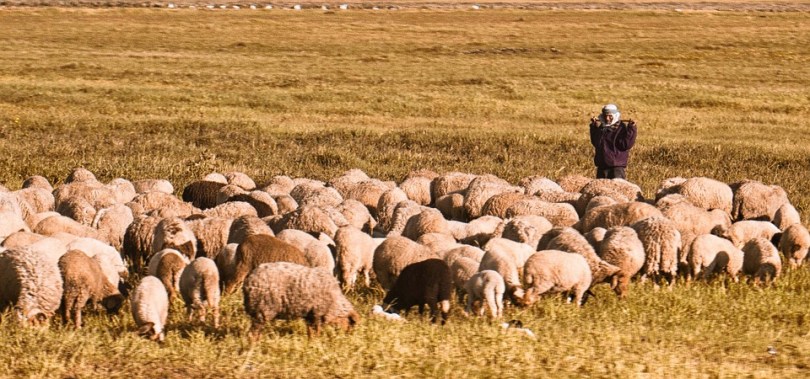
In the Old Testament, like in the book of Exodus, Yahweh is represented as a shepherd.  The prophets Isaiah and Ezekiel compare Yahweh’s care and protection of His people to that of a shepherd.  “He is like a shepherd feeding his flock, gathering lambs in his arms, holding them against His breast and leading the mother ewes to their rest” (Is. 40:11).

I would like to start with some thoughts, briefly, regarding the Gospel from John, and then focus on Psalm 23.

10:1 Very truly, I tell you, anyone who does not enter the sheepfold by the gate but climbs in by another way is a thief and a bandit.
10:2 The one who enters by the gate is the shepherd of the sheep.

John starts chapter 10, speaking metaphorically of us as sheep and of the Christ as our shepherd, and he begins with entrance into our lives.  John reminds us that the legitimate way into our lives is through the gate: anyone who climbs in by any other way is a thief and a bandit.  Leaders may enter our lives through false pretenses, lies, manipulation, false promises, deceit, masquerade, pressure, threats, or playing on our fears (think of political leaders, electoral promises, fears that are preyed upon), but I AM enters our lives through the relationship that we voluntarily establish with God’s Presence, drawing our spirit into Oneness with God’s Spirit.  It is only in the presence of pure love that we can openly and willingly open the door our hearts, souls and spirits, to become one with the Holy Spirit, voluntarily.

10:3 The gatekeeper opens the gate for him, and the sheep hear his voice. He calls his own sheep by name and leads them out.

Whose voice are you listening to? Maybe you are listening to political commentary, webinars, self-help gurus, podcasts by your favorite fitness guru. But do you take time in your day to listen to the voice of the Shepherd?  Is your life so busy and so caught up that there is no time for silence?  If you are feeling like you are a hamster on a wheel, maybe it is time to start saying “no” and learning to enjoy the Silence and stillness of “Be Still and Know that I AM that I AM”.  The promise we have in John 10 is that I AM will call you by name and lead you out, but in order for this promise to be fulfilled, you need to actually hear I AM’s voice.  That means time in silence.  Time in prayer.  Time in quiet peace and meditation.  And once you hear I AM’s voice, then you will hear where he wants to lead you.  Not your plans, but I AM’s plans and leadership.

10:4 When he has brought out all his own, he goes ahead of them, and the sheep follow him because they know his voice.
10:5 They will not follow a stranger, but they will run from him because they do not know the voice of strangers.”

Do you know and hear the voice of I AM?  Or have you become so deaf to this voice that you are following the voice of strangers?  Searching for an earthly shepherd to take care of you, to allay your fears, to give you safety and security?  Who is your shepherd?  When we start to only follow the voices and advice and direction from our leaders, we start to believe that only they can hear the voice of the Shepherd and we simply do what they are telling us.  It’s certainly easier this way, we can abdicate “responsibility” and if anything goes wrong, “it was their fault”: certainly nice to have a scapegoat.  And that’s a sermon for another day…  Are you running from the strangers and following the voice of the Shepherd?  Or have you become so accustomed to the voice of the stranger that you have stopped following the voice of the Shepherd?

As I said at the beginning, I want us to turn now to Psalm 23, and go through this line by line, understanding a little bit more today our relationship with I AM.  Some of you may be wondering why I have used I AM so frequently through my sermon this morning:  God’s name is almost always translated LORD (all caps) in the English Bible. But the Hebrew would be pronounced something like “Yahweh,” and is built on the word for “I am.”  So every time we read or hear the word “Yahweh”, or our poor translation of it as “LORD” in the English Bible, you should think: this is “I am”, reminding me each time that God absolutely is. “YHWH Raah” – I AM, my Shepherd.

And Psalm 23 starts with this:

The Lord is my shepherd,

I AM is my shepherd.  I want you to think about this “I AM” for a moment.  This I AM is the same I AM that Moses encountered at the burning bush;  this is the I AM that the children of Israel followed out of Egypt and through the desert.  This is the I AM that is the way, the truth and the life. This is “I am the bread of life”.  “Truly, truly, I say to you, before Abraham was born, I am.” (John 8:58). I am the light of the world.  I am the door of the sheep. “I AM the good shepherd.The good shepherd gives His life for the sheep.” (John 10:11) I am the resurrection and the life.  “You call Me Teacher and Lord; and you are right, for so I am. (John 13:13). I am the true vine.  “I am the Alpha and the Omega,” says the Lord God, “who is and who was and who is to come, the Almighty.” (Revelation 1:8).  I am the first and the last.   That’s our shepherd: all-powerful, all-knowing, all-loving, all-presence.

This verse speaks about our relationship with I AM. And I would like to invite you, for a moment, to consider your idea of who and what God is.  If we are to effectively pray, listen and communicate with God we need to become clear on exactly who and what we think God is, and become clear about our feelings toward God.  Religions around the world typically classify God as Thou/You, Me (the indwelling Spirit), or He/She/It.

This first view of God: Thou/You – is “Our Father, who art in Heaven”.  The second view of God, is problematic for some Christians, as it views God as being within us, and yet we profess that we believe the Holy Spirit to abide inside us, and say “not I, but Christ that lives in me”.


And that third face of God is the Omni-Presence of God in all of life:  I AM the way, the truth and the life.  It is the breath of life that we breath each moment of every day.  As Christians, we are quite fearful of this face of God, seeing religions that are idol worshipers, because they focus on God in things and creation.  Yet, we fail to see that this is God:  “In the beginning was the Word, and the Word was with God, and the Word was God.”  God, as Omni-Presence does not mean God in the air, “around” all things… it is God IN all things.  It is God that is IN this pulpit, it is God IN the floor, it is God IN the pew-bench on which you are seated, it is God in your car, in your steering wheel, in the gear shift.  It is God in your home, in your sofa, in your bed.  It is God in each bird, each butterfly, each mosquito (sorry… terrible example!). We say we believe God to be Onmi-Presence, but then when we talk about God, we seem to limit God to just being in the air “around”, rather than literally EVERYWHERE.

Let me try to explain this a little better:  you stand on a beach looking out at the vastness of the Ocean.  There are waves breaking on the shore, and in each wave that breaks on the shore, you will find the Ocean.  You take a bucket and you fill it with water, and in this water you will also find the Ocean.  If you took just one drop of that water, it would still be part of the Ocean.  Now, that drop of water is not the whole Ocean, obviously.  But how do you separate that drop of water from being Ocean.  And that, for me, is the Omni-Present God:  God is much more than JUST the bird or the butterfly or the mosquito… but God is there!

And having said all of this, I will admit, I don’t understand God: I don’t even begin to. God remains unfathomable to me!  I cannot wrap my tiny human brain around a definition that even comes close!

So, I invite you this morning to answer this question this week:  Who or What is God for you?

I apologise that I have spent so much time discussing this first verse of Psalm 23, that it will not leave me much time to go through the rest of the lines of Psalm 23, but I felt that “how we see God” is the very crux of how we interpret Psalm 23.

I AM is my shepherd,

And so, let’s continue with Psalm 23:

I shall not want.

Some translations write this as “I have everything I need” or “I lack nothing”.  YHWH Jireh, my provider.  I AM, my provider.  Are you allowing God to provide for you? Physically? Mentally? Spiritually?  Do you allow God to nourish your soul?
As a parent, I reserve the right to say “no” to all the whims and requests of my daughter. She would love ice cream, M&Ms and candy every day: I think about the teeth, the enamel and vitamins and minerals.  She will not lack anything, she will have everything she needs.

Do you accept that God may say “no” to your whims and fancies?

He makes me lie down in green pastures,

Are you resting with God?

He leads me beside still waters.

Are you following God beside still waters, so that God can refresh your soul?

He restores my soul;

How do you allow God to heal you?  YHWH Rapha: I AM that healeth.

He leads me in paths of righteousness,

We sing “Jesus take the wheel”, but do you let God actually drive?  You ask for guidance, but do you follow the guide?  “No, not there!  That’s not where I want to go… I want you to take the wheel when I’ve already got myself into trouble – just get me out of this and then give me back my steering wheel!”

For His name’s sake.

Are you living a purpose driven life?  I AM that I AM… His name’s sake…

Yea, though I walk through the valley of the shadow of death,

Sometimes, on the road to greener pastures there will be trials and hardships and difficult paths.  Do you trust I AM?

I will fear no evil;

I will fear no evil.  This is a powerful declaration!  I will fear no evil.  How often do we allow fear to dictate our lives?

For You are with me,

YHWH Shammah – God is faithful, omni-present, everywhere we are.

Your rod and Your staff, they comfort me.

The rod and the staff – they are for fighting off the wolves, the lions and the bears.  And for stopping us from going down the wrong path, to pull us back us (sometimes around the neck) when we’ve started to go over the edge.  Sometimes pulling us kicking and screaming from the edge, when we don’t realise we are about to step over the edge.

You prepare a table before me in the presence of my enemies,

We have hope and abundance and moments of rejoicing!  Do you enjoy those feasts that God provides?

You anoint my head with oil;

We are consecrated to God.  Do you live your life as a consecrated child of God?

My cup runs over.

Are you truly thankful?

Surely goodness and mercy shall follow me all the days of my life.

You are blessed – richly blessed!  Goodness and mercy follow you – do you show goodness and mercy to everyone in your life?  Do your acts reflect this goodness and mercy you have received?

And I will dwell in the house of the Lord

God is everywhere… you dwell in his house at every moment of every day.  Not just while you are here in the house of the Lord which is this building. But every moment. Do your actions and thoughts reflect that?

Forever.

Eternity… it’s a long time.

As you leave today, consider this:

  • Who, what and where is God for you?
  • What is your personal definition of God?
  • What does that definition mean for your relationship with God?  With others?
  • Who are you listening to? Do you recognise the Shepherd’s voice?
  • Do you allow the Shepherd to guide you?  To provide what you need?
  • Do you give thanks for the rich blessings, allowing goodness and mercy to shower those who come into contact with you?

Be blessed in every way!


Originally in the sermon, but then edited out to make it more understandable:

In The Three Faces of God we read:

“Most of us are familiar with three different perspectives from which to approach and describe God. These perspectives determine whether we address God in the first, second, or third person:
God as Ground of Being is the First Face of God. It is the experiential “I”—God within us, or God immanent.
God as an entity to whom we relate and pray to is the Second Face. It is God as “Thou” or “You.”
God present in the manifest world as the Web of Life, as Nature, as All That Is, is the Third Face. It is ‘He/She/It’ and is understood through our senses.”

This book, the Bible, attempts to teach us that God is all three.  We know this as the Trinity: God, as Holy Spirit, is the “I” within each one of us, the “not I but Christ that liveth in me” that connects directly with our spirit, bringing us to complete Oneness with God.  When we completely still, when we allow ourselves to finally connect, it is the still small voice that speaks to us.  God as the Father we know as Thou or You, this is the God that we pray to.  In many senses, it is the God we have a relationship with – some see God as a Santa Claus, that we make our requests to, others see God as an angry or justifying abuses.  The Three Faces of God reminds us:

“It’s the unhealthy version of the Second Face of God that has created so much trouble throughout history. Since medieval times and within hierarchical religions, the Second Face of a judgmental God who metes out punishments and rewards has been used as a weapon to marginalize, kill, emotionally wound, and control people and circumstances. Abuse of the Second Face of God resulted in a judgmental superbeing before whom we all stood as sinners.”

“Yet by rejecting the Second Face of God relationship entirely, we miss the richness offered by a healthy version. This is an understanding of God with whom we can experience personal and intimate relationship in our daily lives, to whom we can express gratitude and love and surrender. It’s God as unconditionally loving parent, comforter, supportive friend.”

Sermon: Dry Bones

READINGS:

Image result for images valley of bones

So, this morning we’ve heard the reading from Ezekiel: the Valley of Bones, and we’ve also heard the story of the raising of Lazarus.  Given that they were long readings, my sermon this morning is going to be adequately short, because I know we don’t want a repeat of last week’s service where we kept you here for an extra half hour!

I am going to have a quick look at the Valley of Bones, which we are presented with in Ezekiel.  Now, when you read Ezekiel, you don’t so much read it, as you do see it, it’s filled with imagery, like the song: “Ezekiel saw the wheel, way up in the middle of the air”?  You know – that’s where the UFO people get their Biblical foundation for UFO’: the wheel in Ezekiel is said to be a UFO.

That aside, God was always telling Ezekiel to do really bizarre things, and the valley of the bones is one of those cases.

So, many sermons have been written the Valley of the Bones, using it to talk about Church revival, vision, purpose and passion ; and many more sermons regarding broken dreams, promises, relationships and reviving those broken parts of our lives!  But this morning, I don’t want to illustrate or tell you which one to apply it to.  I only want to give you some very basic lessons in how to apply it:

  • First and foremost:  It all starts with God, not us.

The hand of the Lord was upon me, and He brought me out by the Spirit of the Lord, and set me down in the middle of the valley; it was full of bones.”

While I realise that the analogy is often made about our lives or our Church being a valley full of dry bones, there are special moments when God takes us to have a look at this and wants us to see if as such.  And there’s a moment for God to act upon it, and if we try to do this in our own time and by our own strength, it’s very unlikely to work.

There’s an importance to listening and being open to the timing and vision that God has, not our own desperation of wanting to make things change. Are you open to God’s time and being where God wants you to be?

  • Secondly: God gives Ezekiel a promise to believe in:

Prophesy to these bones, and say to them, O dry bones, hear the word of the Lord. Thus says the Lord God to these bones: Behold, I will cause breath to enter you, and you shall live. I will lay sinews upon you, and will cause flesh to come upon you, and cover you with skin, and put breath in you, and you shall live; and you shall know that I am the Lord.

Have you had a promise from God in your life that you haven’t seen happen yet?  Has God given you a vision of what God plans to do, that you’ve been waiting to see come into fruition and maybe you are tired of waiting?  This is not a culture and a world where we understand “wait” very well. We want it, and we want it now, no matter what piece of our life it is. For us to be able to hang onto a promise of God in the tough times takes trust, or faith if you prefer. There are many promises and declarations throughout the Bible that we don’t even have to wait for new ones.

  • Thirdly, there’s opening our mouths and declaring what we’ve been promised – the same way there is obedience in doing:

So I prophesied as I had been commanded…”

It’s no good to just keep silent: how many of you have seen the studies with water or plants and the experiments with the power of words? What are you saying in your life?

  • Then, we start to see results, but sometimes it’s not a full result, and there’s still more to be done – we can’t stop half way through.

“… and as I prophesied, suddenly there was a noise, a rattling, and the bones came together, bone to its bone. I looked, and there were sinews on them, and flesh had come upon them, and skin had covered them, but there was no breath in them.”

So, I had this promise from God, and I started declaring it as I believed I was supposed to, and God raised an army from a valley of dried bones, but there’s no life in it… Maybe the jobs not done yet!

  • So, Ezekiel looks back to God, and God gives him new instructions:

Then He said to me, “Prophesy…”

Do it again, but differently this time!

We live in a society where we are used to quick results, where satisfaction is immediate – where the internet should be at least 6 GB otherwise we have to wait more than 1 second for the browser to open and that’s just too long!  But many times, in life, finding your passion or your vision – re-finding your passion when you’ve lost your way, when you’re burnt out and lackluster, takes much longer than just a moment!  Often, there are many steps in the process.

  • And remember to breathe!

“Prophesy to the breath. Prophesy, mortal, and say to the breath, Thus says the Lord God: Come from the four winds, O breath, and breathe upon these slain, that they may live.” I prophesied as He commanded me, and the breath came into them, and they lived, and stood on their feet, a vast multitude.”

Most of you know, that the Hebrew word “rauch” refers to the “breath”, but also refers to “wind” and is another word for “spirit”.  This one word has all these beautiful meanings that are all one and the same:  It was the ruach of God that hovered over the waters at creation. It was the ruach of God that came into Adam and gave that clay life. It was the ruachof God that blew like a mighty wind at Pentecost. And it’s the ruach of God that Ezekiel asks to come and breathe upon these slain, that they may live.

When you breathe, remember you are breathing in the breath of God, his life-giving breath.  The breeze that comes through these church windows: that’s the Spirit of God reaching out to touch you. That as you take a breath and you see wind, or you sense the Spirit within you, it’s all the same thing. How different our lives might be if we were conscious of breathing God in and out when we were outside.

For existence to become life, we need the breath of life – the Spirit to fill us.  It’s not enough for us to have bones, or to build a skeleton from those bones.  It’s not enough to cover those bones with sinew and muscles and skin!  We need the breath of God that animates us, that causes us to truly live, and not just to be connected bones.

If we are not a Spirit-filled church, it’s not enough to have a clear vision, purpose and passion.  We can have a structured leadership and a great organization, we can have ministries and teams that are all pulling together and working perfectly – but without the breath of God, we still won’t be able to get anything done.


FINAL ASIDE:

I want to leave you with this final thought regarding the breath of life (it’s from a sermon by Barbara Brown Taylor):

If you have studied earth science, then you know that our gorgeous blue-green planet is wrapped in a protective veil that we call the atmosphere, which separates the air we breathe from the cold vacuum of outer space. Beneath this veil is all the air that ever was. No cosmic planet-cleaning company comes along every hundred years or so to suck out all the old air and pump in some new. The same ancient air just keeps recirculating. Which means that every time any of us breathes, we breathe stardust left over from the creation of the earth. We breathe brontosaurus breath and pterodactyl breath. We breathe air that has circulated through the rain forests of Kenya, and air that has turned yellow with sulphur over Mexico City. We breathe the same air that Plato breathed, and Mozart and Michelangelo, not to mention Hitler [or Stalin or Mao]. Every time we breathe, we take in what was once some baby’s first breath, or some dying person’s last. We take it in, we use it to live, and when we breathe out it carries some of us with it into the next person or tree or blue-tailed skink who uses it to live.”

Sermon: Abundance of Grace

How many of you are awake this morning?  I’m looking for a show of hands here…

How many of you were awake while Betsy read the 7 verses from Romans 5: 12-17?  English Standard Version.  It seems amazing that the entire message of the Bible, from Genesis to the end,  is found here, all summed up neatly in seven verses.

If you all understood it, I don’t need to give you this sermon, and we can go straight to the offertory (we’ll skip the prayers) and then head downstairs to the coffee break.  How does that sound?

How many of you think you don’t need to hear this sermon?

How many of you think you can stay awake until I finish the sermon?

We’ll see how you all go with that, shall we?  …

This morning I’m going to take you on an intellectual (read: scientific journal mumbo jumbo), winding maze through one of the toughest texts that I’ve ever had to prepare for.

I am going to try to give you an explanation that you can hopefully understand…  although I am going to rely a bit on my high-school science as it relates to DNA sequencing in the human body and a very basic knowledge of NLP (NeuroLinguistic Programming).

I want to start with the idea of the “Original Sin” and the effect of that “Original Sin” on mankind and how that is passed down from generation to generation.  Verse 12 of Romans 5 starts with

“just as sin came into the world through one man, and death through sin, and so death spread to all men”

We’ve all been taught that Adam had everything he needed to live eternally, but that because of his sin in the garden of Eden, life becomes finite instead of infinite – death enters the world.

And I want to add to that mix the verse from Exodus 34:7 (ESV) that says:

Keeping steadfast love for thousands, forgiving iniquity and transgression and sin, but who will by no means clear the guilty, visiting the iniquity of the fathers on the children and the children’s children, to the third and the fourth generation.”

And I’ve wondered to myself how that might be possible on a molecular and physical level – can science explain what the Bible says happened to Adam because of sin and to all mankind, through the passing of the sin from generation to generation?  How does Adam’s bad nature get down to me all these millennia later? Well, some say, it’s like pollution or poison poured into a river. If a company dumps hundreds of liters of mercury into a river, then no matter how far downstream you go, you still get mercury poisoning.

Now – today I’m not going to give you a definition of sin – or even discuss what Adam’s sin was – trying to become like God, transgressing the Commandment God gave him, or whether sin is simply missing the mark of the most perfect version of yourself that God created you to be (like the archer that fails to hit the target).

What I want to look at is the effect that sin has upon us, as a human race, and then briefly touch about the gift of Abundance of Grace that we are promised in Romans 5: 17.

Our bodies have 3 billion genetic building blocks, or base pairs, that make us who we are. And we are somewhere between 99.5 to 99.9% similar to the person next to us.  A printed version of your entire genetic code would occupy some 262,000 pages! Of those pages, only some 500 would be unique to you. So how much of that do you think you inherited from 20 generations back?  How similar does that make you to the person sitting behind you?

And it seems that in 2017, scientists are getting closer to having the answers as they study the effects of stress and life-styles on our DNA codes and sequencing.  And now it seems that there is a reason for this, on 2 levels: epigenetics and the shortening of our telomeres (the protective casing at the end of a strand of DNA).   The field of epigenetics refers to the science that studies how the development, functioning and evolution of biological systems are influenced by forces operating outside the DNA sequence, including intracellular, environmental and energetic influences (and by energetic, I also mean the emotional forces that affect our bodies organs, such as when we get angry, are upset, or stressed and tired, especially for long periods of time).

Since the 1970s, researchers had known that the tightly wound spools of DNA inside each cell’s nucleus require something extra to tell them exactly which genes to transcribe, whether for a heart cell, a liver cell or a brain cell.

One such extra element is the methyl group, a common structural component of organic molecules. The methyl group works like a placeholder in a cookbook, attaching to the DNA within each cell to select only those recipes —  genes — necessary for that particular cell’s proteins. Because methyl groups are attached to the genes, residing beside but separate from the double-helix DNA code.  Originally these changes were believed to occur only during fetal development. But it has already been shown that DNA can be added to in adulthood, setting off a cascade of cellular changes resulting in cancer, diabetes or other illnesses.  Not only that, but epigenetic change could be passed down from parent to child, one generation after the next (hence you find the reference in the Bible that the sins of the fathers are passed down to the son to the third and fourth generations). A study from Randy Jirtle of Duke University showed that when female mice are fed a diet rich in methyl groups, the fur pigment of subsequent offspring is permanently altered. Just by playing with the diet, they could alter the colour of the fur of the mice.  Now, what if emotions, such as guilt, could play a similar role?

The medical field has already shown that stress has this particular effect.  Telomeres are a protective casing at the end of a strand of DNA. Each time a cell divides, it loses a bit of its telomeres. An enzyme called telomerase can replenish it, but chronic stress and cortisol exposure decrease your supply. When the telomere is too diminished, the cell often dies or becomes pro-inflammatory. This sets the aging process in motion, along with associated health risks.

Now we all know that old wives tale that tells a young pregnant woman not to cry during the pregnancy because her child will bear the effects of it through their entire life – but now science is beginning to understand that the negative effects of stress begin before conception.  A baby’s intrauterine environment is shaped by a mom’s pre-existing physical health. There have also been several studies looking at maternal health and telomeres in offspring: the higher a mom’s prenatal anxiety, the shorter the baby’s telomere length (i.e. the shorter the life span).

According to the new insights of behavioral epigenetics, traumatic experiences in our past, or in our recent ancestors’ past, leave molecular scars adhering to our DNA. Jews whose great-grandparents were chased from their Russian shtetls; a child whose grandparents lived through the ravages of a Revolution; young immigrants whose parents survived massacres; anyone who grew up with alcoholic or abusive parents — all carry with them more than just memories.

So what on earth does any of all this scientific mumbo jumbo have to do with the “Original Sin”, and Paul’s discussion of the original Adam and the posterior Adam (Jesus)?

Well, for starters – it explains how our genetic make up is affected by our habits, our environment, our diet, our stress, and even the stress and anxiety of being ashamed, berating ourselves, or failing to accept God’s forgiveness of our sins.  It explains how any resentment, bitterness or anger that we carry towards another person, when we fail to forgive, affects us to the most innermost of our being as David describes in the Psalms.

1. Your beliefs influence your behavior.  

One of the most basic ways that beliefs can shape reality is through their influence on behavior—no quantum physics or molecular genetics knowledge required.  Beliefs about your basic character—who you are as a person on a fundamental level—can be especially powerful. Research suggests that while guilt (feeling that you did a bad thing) can motivate self-improvement, shame (such as that felt by Adam & Eve in the garden), tends to create a self-fulfilling prophecy, reducing hope and undermining efforts to change, leaving you stuck in the rut of the very behavior you are ashamed of.

And your behavior will directly impact you with respect to your habits, whether they are good habits, or bad habits.

2. Your feelings directly affect your DNA:   

“When we have negative emotions such as anger, anxiety and dislike or hate, or think negative thoughts such as ‘I hate my job,’ ‘I don’t like so and so’ or ‘Who does he think he is?’, we experience stress and our energy reserves are redirected,” and I’m not talking about a positive redirecting. Part of our energy reserves, which otherwise would be put to work maintaining, repairing and regenerating our complex biological systems, which you probably know as your “body”, are used to confront the stresses these negative thoughts and feelings create, leaving your body unattended.

On another level, science is now beginning to understand that humans have multiple brains: the one you know in your head, your heart brain (which generates much of your energy field), and your gut brain.  So, when you are feeling heavy-hearted, what effect is this physically having on your DNA and body – how is it affecting the helix structure of your DNA strands?  When you are in a gut-wrenching panic or suffering constant anxiety, what effect is this having on the nutrients that are getting to your cells and DNA on a molecular level?

3. You may choose, or not, to accept the abundance of God’s grace:   

The entire Bible is about the transformation of man… having been made perfect, having become imperfect, and having reached perfection once more in the person of Jesus Christ.  Having loved perfectly: God and others – fulfilling the 2 greatest laws of the Bible:  To Love the Lord your God with all your heart, soul, mind & strength, and to love your neighbour as yourself.  And how Jesus came to make the way for us to become perfect also in Him, breaking the curses so that they are no longer passed down to future generations, allowing us to re-write the code and become truly transformed, by the renewing of our mind (which will, of course, affect our bodies and even down to our DNA).

There is only one question:  are you willing to allow God’s grace to truly sweep through your life and transform you: To practice abiding in His presence on a daily basis until you reach a level of peace that transcends all human understanding, guarding your heart and mind in His love? 

Let’s pray.


Sources and further reading:

Sermon: Love Thy Neighbour

As you know, when I talked earlier this month, I spoke about Social Justice, in light of Isaiah 58 and the call to prayer and fasting that was pleasing to the Lord.  In the current political climate, in the US as well as in Panama, where there is such a backlash against “immigrants” and “illegals” and so much discrimination, I find it challenging that once again today’s readings focus on aspects of social justice and what it means to be a follower of Jesus and to really and truly love our neighbour.

We all know pretty well the text in Matthew, chapter 22, where one of the Pharisees asked Jesus about the greatest commandment of the law, to which Jesus replied (Matthew 22: 36-40):

Love the Lord your God with all your heart and with all your soul and with all your mind.’ This is the first and greatest commandment. And the second is like it: ‘Love your neighbor as yourself.’ All the Law and the Prophets hang on these two commandments.

The ENTIRE message of the Bible can be summarised in this short paragraph!  You can ignore all of the small print of the Bible, if you just do these 2 things.  Easy, right?

Maybe not so easy, because we find that in another part of the Gospels, (Luke 10: 22 and following) a lawyer who wished to justify himself by asking “who is my neighbour?”, to which Jesus responded with the parable of the good samaritan.  I’m not going to look at, this morning, “who is our neighbour” – but rather focus on what it means, in a very practical sense, to love your neighbour.  What is the visible expression of your love for God and the commandments that were given to the people of Israel through the Law and the Prophets?

In Romans 13, verses 8 to 10, Paul says:

8 Owe no one anything, except to love each other, for the one who loves another has fulfilled the law. For the commandments, “You shall not commit adultery, You shall not murder, You shall not steal, You shall not covet,” and any other commandment, are summed up in this word: “You shall love your neighbor as yourself.”10 Love does no wrong to a neighbor; therefore love is the fulfilling of the law.

Our readings this morning, especially from Leviticus, give a context to the response that Jesus gave the Pharisee and then his conversation with the lawyer and the parable of the Samaritan.  When Jesus spoke of “Love your neighbour as yourself” he was making reference to these particular verses from Leviticus 19, which would have been well known to the Pharisee and also to the lawyer. We might not know them so well; so I’d like us to take a moment to review the verses we read this morning and the examples of what it means to love your neighbour in a very practical sense.

  • Verses 9 and 10 – be kind to the poor and the alien by leaving something for them in your fields and vineyards: do not reap to the very edges, do not gather the gleanings that fell, do not go over your field a second time picking up what you missed and do not pick up what has fallen.  The poor and the alien still have to work for it, but it is made easy for them to find and forage for food.
  • Verses 11 & 13: teach us compassion and absolute honesty and justice in our relationships
    • no lying
    • no fraud or dealing falsely
    • no stealing
    • no defauding
    • and don’t keep for yourself an employees wages until the next day – always pay on time.

It’s interesting this last point, because under the Law it was perfectly legal to pay the labourer the next day for his work – you didn’t have to pay him the same day.  But God’s law says – it’s just and right to pay him that day, so that he can take food home to his family.  It wasn’t about what was legal, it was about what was right.

According to an article I read recently, it says that a persons lies 2 to 3 times every 10 minutes.  Yes, mostly totally white lies:  “How are you doing?”  “I’m great!” – the lie may be the person asking how you are doing – when they really don’t care, or the lie may be the “I’m great” when they really aren’t feeling that way…  And of all the lies we tell, 25% of those lies are for the sake of the other person!  Very thoughtful of us, isn’t it!

Nietzsche said:

What upsets me is not that you lied to me, but that from now on, I can no longer believe you.

  • Verse 12:  Don’t swear in God’s name
  • Verse 14:
    • don’t curse the deaf
    • don’t put a stumbling block before the blind

It’s very easy to make fun of someone that can’t hear what you are saying or see what you are doing, but that doesn’t make it right.  Verse 14 reminds us to treat every person with empathy according to their situation and not take advantage of any weaknesses that they might have.

  • Verse 15:  be just and judge your neighbour with justice
    • do not be partial to the poor
    • do not defer to the great
  • Verse 16:
    • Do not speak badly of others
    • Do not profit at your neighbour’s expense
  • Verse 17:
    • Do not hate in your heart anyone of your family
    • If your neighbour makes a mistake, be the one to tell him so that you aren’t an accomplice to his actions.    When you give feedback to an employee, do you care about them enough to tell them the hard truths, the mistakes or omissions that they are making that are holding them back from doing better?  Do you love someone enough to tell them that they are messing up and that they need to turn their life around?  Or do you just want to be seen as the nice person that loves them just the way they are?   Loving your neighbour is more than just being nice – it’s also practicing tough love, to become all that they can be.

Imagine, if you will for a moment, your child:  when they make a mistake you correct them – because you love them enough that you want them to grow and learn.  You know that this mistake now may cost them dear later on in life and so you make a point of having the hard conversations now, so that later on in life they do better.

Do you do the same with other people in your life?  Or is that simply not your problem?

  • Verse 18:
    • no taking revenge
    • no holding grudges

And it ends with “but you shall love your neighbour as yourself: I am the Lord.”

Because God is God, you should do this!  Because God is love and we are children of God, we do this!

Matthew 5, part of the Sermon on the Mount, illustrates this love for your neighbour in greater depth.  If you haven’t already done so, re-read the entire sermon on the Mount!

In today’s passage, we read the following:

  • turn the other cheek if someone strikes you
  • give your cloak and not just your coat
  • go the 2nd mile
  • give to everyone who begs from you
  • do not refuse anyone who wants to borrow from you
  • love your enemies
  • prayer for those who persecute you
  • be perfect, as your heavenly Father is perfect

Because if you only love those who love you, what reward do you have?  If you greet only your brothers and sisters, what more are you doing than others?  God sends rain to all: the righteous and the unrighteous – and so, as children of God, we should follow this example and not only treat well our family and friends, but treat everyone well.   The Bible tells us to love our neighbours, and also to love our enemies – probably because, generally speaking, they are the same people!

So, make an effort today to love your neighbour:

  • your homeless neighbour
  • your immigrant neighbour
  • your poor neighbour
  • your uneducated neighbour
  • your gay, lesbian, trans neighbour
  • your jewish neighbour
  • your right wing neighbour
  • your fundamentalist Christian neighbour
  • your athiest neighbour
  • your disabled neighbour
  • your drug addict or alcoholic neighbour

And let us all remember, 1st John 4: 20

If anyone says “I love God” but hates his brother, he is a liar; for he who does not love his brother whom he has seen, cannot love God whom he has not seen.  

Let’s pray.

Sermon: Prayer & Fasting

This morning we are looking at Isaiah once again, but now a chapter towards the end.  You may recall that as a whole book, I explained that it can be viewed as 2 parts, chapters 1 to 39, and then from chapter 40 to the end.

As a whole, Isaiah addresses the Babylonian exile of the Israelites over about 50 years (more than 1 generation), and how this exile fulfilled God’s plan of judgment, but more importantly:  restoration.  The Israelites are now busy rebuilding their homeland, and yet they still don’t quite get it (does that resound with any of you?).

It seems like they’ve fallen back into the pits that the Pharisees continued suffering with over 500 years later! The tragedy is that they believe they are doing all the right things and that it’s God who is letting them down!

Let’s read verses 2 and 3 again:
Yet they seek me daily,
and delight to know my ways,
as if they were a nation that did righteousness
and did not forsake the ordinance of their God;
they ask of me righteous judgments,
they delight to draw near to God.
‘Why have we fasted, and thou seest it not?
Why have we humbled ourselves, and thou takest no knowledge of it?’

So, they are praying every day and reading their Bible “as if they were righteous and were obeying God’s rules” and they ask God for righteous judgments and delight to draw near to God.

But they’re confused.

They are even fasting, not just praying.

Fasting is good, right?

It shows how serious your prayers are!  And the Israelites are convinced that they will please God and bring favor. In fact, so much so, that they made this into an ancient practice and instructed it as a pious act – fast and humble yourself before God.

So, why is God rebuking them?  How could God possibly not be pleased?

Well, there may be one or 2 small issues that they need to review in their lives.  Small things like social injustice, failing to share what they have with those who have not, failing to bring the homeless into one’s house, or give clothing and shelter to the naked… maybe reconciliation issues pending with family or loved ones, and failing to help the afflicated.

God doesn’t have a little book in which there’s a checklist:

  • So… check – Reynaldo has fed the hungry one – so, he doesn’t need to do that again for 5 years.
  • Ah yes, Connie has given clothes to the poor – so she’s good now for 3 years.
  • Look, how sweet, Betsy has brought a homeless person into a restaurant and bought them a meal – she won’t need to do that every again in her entire lifetime.

It doesn’t work like that, does it?

These are more than one-time actions:  they are a way of life.  Behaviours with broad social consequences – actions that will restructure our relationship.

God couldn’t care less for singular, pious acts – he is looking at the Church to dismantle the entire structure of injustice!

And the Church doesn’t refer to this building.  The building isn’t called in Matthew to be the Salt of the Earth, and give flavor to everyone around it.

The Church is made up simply of the people that are in it!

Isaiah 58, verses 3 to 6 remind us:

Behold, in the day of your fast you seek your own pleasure,
and oppress all your workers.
Behold, you fast only to quarrel and to fight
and to hit with wicked fist.
Fasting like yours this day
will not make your voice to be heard on high.
Is such the fast that I choose,
a day for a man to humble himself?
Is it to bow down his head like a rush,
and to spread sackcloth and ashes under him?
Will you call this a fast,
and a day acceptable to the Lord?

There’s no point in going through the motions of a Christian life, if you are not becoming each day more like Christ.

Out of curiosity, have any of you EVER been accused of being too Christ-like?

Sometimes, being called a “Christian” can be more of an insult (referring to being sanctimonious rather than filled with the Spirit), but have you ever heard of someone saying about another Christian – “What I really can’t stand about him/her is that they are just too much like Christ?”

Traditions and systems are not all bad – but when they become rituals that are void of meaning, they lose their effectiveness.

Isaiah calls the people of Israel to a new way of life:  “the fast that God has chosen”.  It’s no longer a periodic fast day that is set aside to punctuate ongoing life – but it’s a new relationship with life and with all that it in it!

58:6 Is not this the fast that I choose: to loose the bonds of injustice, to undo the thongs of the yoke, to let the oppressed go free, and to break every yoke?
58:7 Is it not to share your bread with the hungry, and bring the homeless poor into your house; when you see the naked, to cover them, and not to hide yourself from your own kin?

Instead of stopping eating food for a day, or doing the fast of Daniel for 3 weeks, or giving up red meat for Lent, God calls the people of Israel to stop the daily practices which block their relationship with God and their fellowman:

  • Stop domination and taking advantage of others
  • Stop blaming others
  • Stop talking behind someone’s back
  • Stop complaining
  • Stop being so self-centered and focused on self-satisfaction
  • Stop your feeling of entitlement
  • Stop your blindness to your privilege

The fast that God is looking for in our lives is the one that calls for vigilance for justice and generosity- each and every day!

Verses 8 to 12 remind us that we work (actions) on our relationships with our fellow man, and THEN it follows that our relationship with God grows deeper.  The barriers that we build between ourselves and our fellow man and the very same barriers that block our relationship with God! It’s impossible to have a relationship with God without having a full relationship with each other!  Your piety or righteousness is not disconnected from everyday life.

The way that you treat the waiter, the security guard, the beggar is just as important as your prayers or reading the Bible.

58:8 Then your light shall break forth like the dawn, and your healing shall spring up quickly; your vindicator shall go before you, the glory of the LORD shall be your rear guard.
58:9a Then you shall call, and the LORD will answer; you shall cry for help, and he will say, Here I am.
58:9b If you remove the yoke from among you, the pointing of the finger, the speaking of evil,
58:10 if you offer your food to the hungry and satisfy the needs of the afflicted, then your light shall rise in the darkness and your gloom be like the noonday.
58:11 The LORD will guide you continually, and satisfy your needs in parched places, and make your bones strong; and you shall be like a watered garden, like a spring of water, whose waters never fail.
58:12 Your ancient ruins shall be rebuilt; you shall raise up the foundations of many generations; you shall be called the repairer of the breach, the restorer of streets to live in.

We say to God “Lord, give me patience” and then are upset when he responds with, okay – this is the way that I teach patience.  “Here, have a 5 year old!”.

We say to God “Lord, give me abundance” and then you don’t understand when God asks you to be generous.

We say to God “Lord, make me an instrument of your peace”, and then fail to mediate a discussion in the office, or ask for forgiveness when another feels offended.

Prayer is so much more than just making our requests known to God – it’s going out into the World and LIVING the lessons each day.

Sermon: Handling Failure

Last week’s sermon focused on Isaiah 49, verses 1 to 7 and in particular verse 4.

But my work seems so useless! I have spent my strength for nothing and to no purpose!

As part of that sermon, we looked at the warning that Jesus gave the disciples on the night of the betrayal, that on this night ALL of them would desert him.  Which they did after the was arrested, in spite of Peter’s assertion that while everyone else might desert Jesus, he would be faithful.  And we watched Peter fail.

I reminded  you that Jesus expected them to fail and wasn’t judging them for their weakness.  In fact, he knew it was a lesson that they needed to learn.  I ended that sermon asking the following 2 questions, that I would like to address this morning:

How do you handle failure? What do you do in the face of fear?

The first thing I would like to remind all of us is that we don’t grow through our successes:  we learn from our mistakes and failures.  Think of Peter, and his many mistakes and opportunities to learn:

  • This is the disciple that gets out of the boat and starts sinking when he takes his eyes off Jesus and looks at the storm
  • The one that rebuked Jesus for talking about his crucifixion and death
  • Was told “Get behind me Satan” by Jesus
  • Promised that he would never desert Jesus and yet denied him 3 times
  • Even doubted when he saw the empty tomb!

Failure… and yet this was the rock on which Christ chose to build the church!  Because he got back up and learnt from those mistakes.

John Maxwell wrote a book a good few years ago now titled “Failing Forward: how to make the most of your mistakes”.  If you haven’t read it, I would encourage you to scrounge a copy and take time to learn how to make better mistakes!  Sorry – how to make the most of the mistakes you’ve made.

I would start with looking at 2 aspects of the mistakes and failures in our lives:

  1. How do you view your failure?
  2. How do you respond to your failure?

HOW DO YOU VIEW YOUR FAILURE?

There are 2 ways we can look at our mistakes and our failures.

We can react like Adam and Eve:  It was the serpent’s fault, it was the woman you gave me who caused this, and play the blame game.  Maybe it was your staff’s fault, the secretary, the economy, the supplier that failed to deliver on time. Many times, we try to hide or conceal our failures, living our lives covering up or becoming prisoners of pretense.  It’s hard to learn from something that you are hiding from!

Or we can look at it like David: “I have sinned”, with true repentance in his heart.

The second part of looking at and viewing your failure, is whether you can look at it as actions and decisions and not circumstances or part of who you are.  When David says “I have sinned”, he talking about his actions and his decisions – he doesn’t say “I am a failure, my life is a disaster”.  He takes responsibility for his his actions, but doesn’t automatically assume that this is his entire life.  He doesn’t take this on as a complete way of being:  believing that therefore he can succeed at nothing!

How do you talk about your failure and yourself?

  • I just can’t keep going
  • I’m ready to quit, walk away and not look back
  • Why are people always doing this to me?
  • Why does God allow this to happen to me?
  • I’m just such a failure, idiot, etc.
  • I’m so stressed, I just can’t handle this.
  • There’s just not enough time, there’s no way I could get this done.
  • How could I be so stupid?  Look at the mess I made!

If you heard someone else talk about you the way you talk about yourself, you would probably stand up for yourself!  But we often talk toxicly without even realizing what we’re doing.  When you beat yourself up, a blunder or a moment becomes a hurricane of failure!

How you handle setbacks in life will shape you: will you focus on the failure or on the change that you need to make?  Will you allow it to define who you are, or choose to become someone that will overcome? Like I mentioned last week, most of the so-called heroes in the Bible were ordinary people who accomplished extra-ordinary things!  They were humans who overcame their weaknesses and mistakes and went on to learn to do greater things.

It’s one thing to identify the behavior, actions, attitudes that are wrong and another thing entirely to self-deprecate ourselves.  It’s not the same to say “I’m an idiot that just ruined my career”, as saying “That was a really poor choice of words and I could have done better”.  Life is much more than just an event or a series of events:  no one is a total failure and no one falls all the time.

This season, this moment does not have to be final: if you throw in the towel, it’s final.  But a ball game isn’t over until the last man is out!

I’d like us all to try a little experiment this morning, to show you the power of your words.


HOW DO YOU RESPOND TO FAILURE OR MISTAKES?

If you have viewed your failure as “it was inevitable”, or “there was nothing I could do” or “it was someone else’s fault”, there’s a strong possibility that you could allow anger, bitterness or resentment to grow inside, and be destined to repeat the same mistake again.  If we live on the defensive, like King Saul in 1st Samuel, justifying ourselves and our actions, it’s hard to learn the lessons.

In particular, when we look at King Saul, we find someone who never takes responsibility for his mistakes – I didn’t keep the animals alive, the people did.  I only did it because the people pressured me to do it.  And more so, his “repentance”, if you can call it that, seems to have no interest in the cause (or why he really did it) and therefore no cure for it!  One of the beauties of poor decision making is that if you can identify the cause of your weakness, you can make better decisions in the future.

Remember this:

“A mistake repeated more than once is a decision.”

“Those who fail to learn from history are doomed to repeat it.”

Or you can choose to learn from this, growing wiser and making better decisions in the future.  We can look at why we failed and when we failed.  We may have to follow back a chain of events to get to that first decision that set us up on the wrong path.  The decision we put off when we should have made a choice.

But when we admit our failures, we conquer pride.  There’s possibilities of change.

We read in Isaiah 9, verse 2 earlier:

“ºThe people who walked in darkness have seen a a great light; those who lived in a land of deep darkness on them light has shined.”

Now, it’s true that the process of learning, picking yourself up, dusting yourself off and getting back into the game may be painful.  I never promised that it wouldn’t hurt a little!  But I’m saying it will be worth it!  The kid on the bike may have grazed his knees, those of you who are still working out and getting fit as part of your 2017 resolutions are still feeling the pain in your muscles as you train!

Hebrews 12, verses 11 to 13 remind us:

“All discipline for the moment seems not to be joyful, but sorrowful;  yet to those who have been trained by it, afterwards it yields the peaceful fruit of righteousness.  Therefore, strengthen the hands that are weak and the knees that are feeble, and make straight the paths for your feet…”

Become more like Christ will stretch you – and stretching will take you outside of your comfort zone.  It’s going to be uncomfortable and sometimes even painful.  God uses everything in our lives to transform us into the people He means for us to be – mistakes and failures should be responded to as learning experiences, rather than being considered character traits.  It’s not who you are – it’s what you did or what happened to you.

THERE IS ALWAYS A THIRD WAY – AVOIDANCE

Some people will do anything not to fail, even doing nothing.  The person who does nothing will certainly not fail… they risk nothing.  But there is no gain, no lesson, no wisdom to be gained in sitting on the sidelines!  They become just like the servant in Matthew 25 that hid his talents in the ground, well at least I’ll still have them!

They say that the only thing worse than a quitter is the man that is afraid to begin!  Achieving low aims, low goals, can be a greater failure than aiming for a higher target, and missing!   You will always miss 100% of the shots what you fail to take!

Have you ever heard anyone say:  “I achieved everything I have because I am a perfectionist.”?  Probably not!  That’s because it’s not until you are free to fail that you are free to succeed and do greater things!


I want to close this morning with the analogy of an acorn.  When an acorn looks at itself and the possibilities that life offers, it may see itself just as an acorn, or it may dream of one day becoming an oak tree.  So you take that acorn, and you throw it in the ground, maybe you put a little dirt over it.  It’s not very nice to have dirt thrown on you!

That acorn may choose that it’s not willing to change, and it’s not willing to let go of being an acorn.  But in order to become an oak tree, that acorn needs to die!  It has to die to its littleness and smallness and embrace the idea that God gave it the divine possibility of becoming a great oak.  But becoming a great oak means letting go of what it is right now.  Being willing to let God transform it into something completely new and different.

You can either choose to hold onto and embrace who you are today and your ideas of what you are, or you can embrace the vision that God has of who he would have you be, letting go of what you are today, risking failure in order to learn, moving outside of your comfort zone, and taking a chance of becoming that strong oak that God envisions you being.

Lets pray!

Sermon: Laboured in Vain

I have laboured in vain, I have spent my strength for nothing…

Over one hundred years ago, Teddy Roosevelt gave what would become one of the most widely quoted speeches of his career.  In addition to touching on his own family history, war, human and property rights, Roosevelt railed against cynics who looked down at men who were trying to make the world a better place.  People like Isaiah, trying to turn the people of Israel back to God, and yet failing miserably at it.

Teddy Roosevelt in this speech said:

“A cynical habit of thought and speech, a readiness to criticize work which the critic himself never tries to perform, an intellectual aloofness which will not accept contact with life’s realities—all these are marks, not … of superiority but of weakness.”

Life is made up of challenges – for each one of us they are different!  And there is always going to be someone on the sidelines criticising your performance, as you struggle to be “wonder woman” or “super man”.  And that intimation of failure often causes us panic, even despair.

Failure is considered an unpardonable sin in a world where we sanctify the successful and worship winners.  Everybody wants to succeed – no one wants to be considered a failure!  How many people do you know whose life goal is to fail?  But this emphasis on success can put an enormous stress on us.  No one wants to be called a failure.  If I fail, what will happen to me? What will others think?  Will they reject me?  Are they going to think I’m worthless?   And yet, our responsibility is to rise from mediocrity to competence, from failure to achievement.

Simply put:  your task on earth is to become your best version of you.  You are unique.  God made you specially just like you – there is no one else exactly like you – and you have a special purpose on this earth, otherwise God would not have made you and put you here! And if you haven’t done it already, you need to take a day or two and sit and medidate (in silence – and for pity’s sake, stop talking and turn off the mobile devices!), and listen to hear what that purpose is.  The Bible of full of examples of ordinary people who did extraordinary things. We’ll talk more about that next week!

The world has a few examples of failures that went on to do some remarkable things:

  • I’m sure you’ve all heard of that guy Henry Ford, bankrupted 2 automobile industries and ruined all his chances of good investors.
  • Or maybe that guy Fred Astaire.  His first screen test didn’t go so well: “Can’t sing. Can’t act. Slightly balding.  Can dance a little.”
  • Then there’s that guy that had trouble adjusting to the culture and classes at Yale, so he dropped out.  He went back again later, and it still wasn’t for him, so he dropped out again.  His name’s Dick Cheney.  Never going to amount to anything!
  • Or there’s that single mother on welfare who was trying to write.  I think her name was J.K. Rowling or something.
  • Or that kid whose teacher told his mother he was “too stupid to learn anything”.  He was unfortunate enough to be called Thomas Edison.
  • And there’s that guy who was so frustrated trying to write his first novel, that he threw away the entire first draft!  His wife found this manuscript for a book “Carrie”, and rescued it from the trash.  You might have heard of him – Stephen King.

There’s a reason you are in church this morning – maybe you are stuck in a place of despair, ready to give up, not sure how to keep up the good fight. But men and women can change: once again we have a Bible full of examples of people who stopped in their tracks and had a heart change, which became a totally new person.  To mention a few of the better know examples from the New Testament:  Saul who became Paul; Simon who became Peter; Jonah (in spite of his best efforts to the contrary); Levi the tax collector who became Matthew the disciple.

But on the road to that transformation, there are holes.  And if we’re not careful, that hole becomes a rut.  And before you know it, you’re stuck in that rut, and your following that rut instead of the path that you’re supposed to be on, because it’s much more comfortable to stay in the rut than to try to get out of it.  And let’s be honest, sometimes getting out of that rut looks impossible!  You tell yourself, it just can’t be done! This is is – the best I can do, the most I can be.

Isaiah is in a rut (and feeling sorry for himself), in verse 4 of our reading this morning:

“But my work seems so useless! I have spent my strength for nothing and to no purpose.”

This is the same servant that said:

“Before I was born, the LORD called me:  from my birth he has made mention of my name.”

He knew what his calling was! He was predestined to do God’s work!  There’s an amazing amount of expectations upon him! And God gave him all the gifts and tools he needed for the task.  Remember verse 2:

“He made my mouth like a sharpened sword, in the shadow of his hand he hid me:  he made me into a polished arrow and concealed me in His quiver.”

I was MADE for this.

But his progress report in verse 4 is not very encouraging:

“My work  is so useless! I have spent my strength for nothing and to no purpose.”

Probably a good time just to go back to bed! The task is too great!  I’m inadequate.  I can’t do it!

Now the whole book of Isaiah can be divided into 2 principle sections:

  1. Part one is chapters 1 to 39, which address Israel’s continuing sin and rebellion, where their hearts are so hardened that no matter the strength of Isaiah’s tone and words, nothing will turn them. They became self-centered and inward-looking; they forgot their covenant.  They forgot they were a people belonging to God. Finally, Isaiah brings a message of judgement and exile – the Old Jerusalem is condemned and will be no more.
  2. Part two, chapters 40 to 66, opens with words of consolation “Comfort, comfort my people, says your God”.  It finishes with the emergence of the NEW Jerusalem.

So we see in Isaiah a transformation – from the old to the new:  the old Jerusalem is torn to the ground and then rebuilt as a new Jerusalem.  You see, when everything is stripped away, our spirit starts to show through, and then our relationship with God and the eternal comes clearly into focus.  Maybe right now you’re sweating and you can’t see the results of all your hard work: and instead of giving up, maybe it’s time to take a small rest and remember WHO you are and WHY you were put on this earth!

1 Peter (2:9-10) reminds us:

You are a chosen people… a people belonging to God… Once you were not a people, but now you are a people of God…”


And I have another little gem for you, God expects you to fail!  Yes, you heard that right: God doesn’t expect you to get it right the first time. In fact, he has an expectation that you are going to fall!

How many of you have children and have taught that child to ride a bicycle?

The first time you put them on the bike – did they get it right?  How many chances did they need to learn?  How many got it on the 2nd time? the 3rd? What do you mean it took 54 times before they learnt?

Well, why are you so hard on yourself?  Why do you expect to learn in just one go?  Let’s go back to the kid on the bike:  you have a little hill (without a main road down the bottom!), it’s a safe place to learn to ride.  So you have this kid who has finally mastered balance and steering (for the most part), and they riding down the hill now pretty well!  So you finally reach the moment when you think they are ready, and instead of pushing the bike back up to the top of the hill again for the kid, you tell, well, why don’t you ride UP the hill now?  And what’s the first thing that happens?  They fall off!  Because it’s easy to ride the bike down the hill and keep your balance when you have a little momentum!  But when you meet resistance and you have to keep your balance AND pedal hard, and you’re new at this, you fall over the moment you push too hard on the left side without adjusting your balance on the right side to counterbalance the force you’re using to get yourself up the hill!  Right?

And God knows this!  God’s been watching us since the Garden of Eden.  How many people has he seen fall off the proverbial bicycle since the world was created?

Matthew 26 reminds us that on the night of the betrayal, when Judas betrays Jesus and gets him arrested, that Jesus said to ALL the disciples (not just one of them, not just Judas):

Tonight, all of you will desert me.

We all remember Peter’s response to that, right? Oh no, not me!  I’m good.  Even if everyone else does.  I won’t.  I’ll be the man.  And in the garden, when Jesus is taken, Peter tries to live up to his word, taking out his sword and cutting off the ear of one of the soldiers.  I’m sure he’s flabbergasted when Jesus heals the ear!

But there was one lesson that Jesus hadn’t taught his disciples yet, and they needed to learn it the hard way – enough with parables and teaching. They needed to experience this first hand.

How do you handle failure?  What do you do in the face of fear?  

And that, ladies and gentlemen, is what we are going to talk about next Sunday.


I want to leave you with one parting thought today from Teddy Roosevelt’s speech in 1910:

“It is not the critic who counts; not the man who points out how the strong man stumbles, or where the doer of deeds could have done them better. The credit belongs to the man who is actually in the arena, whose face is marred by dust and sweat and blood; who strives valiantly; who errs, who comes short again and again, because there is no effort without error and shortcoming; but who does actually strive to do the deeds; who knows great enthusiasms, the great devotions; who spends himself in a worthy cause; who at the best knows in the end the triumph of high achievement, and who at the worst, if he fails, at least fails while daring greatly, so that his place shall never be with those cold and timid souls who neither know victory nor defeat.”

Let’s pray!

Sermon: 2017 plans

Happy New Years! Welcome to Day 1 of failed New Year’s Resolutions… a little cynicism for you… How many millions resolve to make a change in the new year and then fail in the first week?  Most of us see the New Year as a perfect opportunity to start over or to change bad habits. How’s the new diet going?  Did you start exercising this morning, or have you already started with “I’ll start on Monday!”? Oh, that’s right – Monday’s a public holiday – I’ll bet you’re starting on Tuesday, right?

I’ve been reading a lot recently about how to make (and keep to) your New Year’s Resolutions:

  • 29 New Year’s Resolution Ideas – Make This Your Best Year Ever!
  • Make Your New Year’s Resolutions Like a Boss 2017 – The Decision-Driven Secret
  • 6 Ways to Create (and keep) New Year’s Resolutions in 2017

I’m sure, as you look at all of your New Year’s Resolutions for 2017, there is a common thread throughout – they are your version of YOU as a better person: exercise, less television or internet or social media, more prayer, giving, serving, practicing gratitude…

This New Years, I want to remind you of the disruptions that happen in life, and those who live with and around us whose lives have been disrupted.  Remember Joseph and Mary, living in Bethlehem – probably rebuilding their new life in Bethlehem after the birth of Jesus.  I wonder…   Where was Joseph working? Had they started to build their own home or were they living in a rental?

And suddenly, in the midst of whatever life and plans and dreams Joseph and Mary had now rebuilt, an angel appears in the middle of the night in a dream and tells Joseph to flee to Egypt and remain there until they are told they can leave, because Herod intends to search for the child and destroy him.   And we know what the collateral damage of Herod’s fear was:  all children under 2 years old in and around Bethlehem.  Now, maybe that was only 20-30 children, if Bethlehem only had a population of 1,000 or so people – but that’s 20-30 too many!

A few weeks ago you may have seen the image of a couple and their baby from Aleppo, the father wearing patched pants and mismatched clothes, carrying a baby in a blanket that was much too large for the child, with the baby in one arm and an IV drip in the other.  The look of determination, shock, and yet emptiness in the father’s face.  A mid-eastern couple and their child, fleeing from violence – just like Mary, Joseph and the baby Jesus whose birth we have just celebrated last week. Displaced by a power struggle that really has nothing to do with them, and yet everything to do with them!

And how many displaced sojourners and aliens do we have in Panama at the moment?  People whose plans for their lives were disrupted by the situation in their homeland, who have now traveled to Panama, as Mary & Joseph traveled to Egypt, looking for a safer place to live, away from the imminent threat that their homeland held for them as a family.  There are over 90 verses throughout the Bible regarding the “sojourner” or the “alien”, and it’s good to be reminded of them:

LEVITICUS 19:33-34 ESV 

“When a stranger sojourns with you in your land, you shall not do him wrong. You shall treat the stranger who sojourns with you as the native among you, and you shall love him as yourself, for you were strangers in the land of Egypt: I am the Lord your God.

EXODUS 22:21 ESV

“You shall not wrong a sojourner or oppress him, for you were sojourners in the land of Egypt.

DEUTERONOMY 27:19 ESV 

“‘Cursed be anyone who perverts the justice due to the sojourner, the fatherless, and the widow.’

ZECHARIAH 7:9-10 ESV 

“Thus says the Lord of hosts, Render true judgments, show kindness and mercy to one another, do not oppress the widow, the fatherless, the sojourner, or the poor, and let none of you devise evil against another in your heart.”

LEVITICUS 25:35 ESV 

“If your brother becomes poor and cannot maintain himself with you, you shall support him as though he were a stranger and a sojourner, and he shall live with you.

Isaiah 16: 3-5 ESV

3“Give counsel;  grant justice; make your shade like night at the height of noon;
shelter the outcasts; do not reveal the fugitive;  4 let the outcasts of Moab sojourn among you;
be a shelter to them from the destroyer.  When the oppressor is no more, and destruction has ceased,
and he who tramples underfoot has vanished from the land,  5then a throne will be established in steadfast love,
and on it will sit in faithfulness in the tent of David one who judges and seeks justice and is swift to do righteousness.”

And yet, our world has become one in which we have all become like Herod, treating the outcasts and the sojourners and the aliens as if they were a threat to us – wanting them dead and out of our towns and countries: they should just go home, they don’t belong here!  They have come to take what is ours!  They are a threat to our comfort and power!  So we should destroy them before they destroy us.

And yet this is not what we are taught if we closely read everything that God ordered Moses and the people of Israel in the Old Testament, and certainly not in the light of today’s reading in Matthew: Jesus was that outcast, whose parents ran with him to Egypt as an alien and sojourner to escape the anger and threat of Herod.

This New Years, I invite you to remember:

“As one person, I cannot change the world; but I can change the world of one person.”


We are called to be Christ-like – to giving living water to the Samaritan woman, to heal the lepers, to feed the hungry, to dine with the tax-collector, to accept the Centurions’ request and command from afar…  Decide this day, what will you choose?  And each day in 2017, choose again and again!  One act a day to being the presence and love of Christ in this world!  Actively choosing each day to be this love.

Let us pray:

Creator God, today we remember that you taught us by your very example humility and simplicity in live.  As this New Year begins, focus our hearts on paying more attention to others and less on ourselves; listening first and talking later; offering constructive criticism, without complaining; performing acts of kindness each day.  We remember this day that you have granted us the gifts of the Holy Spirit so that we might show the fruit of the Spirit in this world, being the light and salt of the earth.  In the name of him who taught us by his very example. Amen.