resurrection, birth, rebirth, phoenix, death, growth, seed, tree, breakdown, break through

Resurrection

Easter has just passed, and while everyone was focused on Jesus’ resurrection I was busy thinking about my personal “death” and “resurrection”.  I don’t know about you, but it seems that every 6-7 years, life presents us with a “breakdown”: grow through this experience or be doomed to repeat it in 6-7 years time! They say that after every breakdown, comes a break through, and I think that this is very true for all of us, especially spiritually. Without the break down, we would never be forced to break through!

Over the past months, I have been convinced that I need to focus on my spiritual well-being, putting God, as Source and Substance first in my life. I find this to be particularly challenging. Source: as in source of my

  • income and substance,
  • energy and health,
  • emotions and feelings, and
  • source of my thoughts.

If I focus on one aspect of my life, I typically exclude the Divine from other aspects, unconsciously. So, I constantly find myself “going it alone”, and then try to come back to center. When I remember that the Infinite is the source of my abundance and finances, I forget about my health and well-being. When I focus on Divine as source of my emotions, I get caught up in my thoughts.

Death: releasing and renewing

So, over Easter, I was busy contemplating: what do I need to release and let go of? What beliefs and thoughts and feelings no longer serve me? What would I be better of without?

And even more importantly, perhaps, what do I need to forgive and release? What baggage am I carrying around, emotionally and in my thoughts, that needs to “die” in me and be released?

“Holding on to anger is like grasping a hot coal with the intent of throwing it at someone else; you are the one who gets burned.” — Buddha

The same goes for suffering, hurt and pain that we hold onto because it has become part of who we identify with. Who will I be if I let go of this? We talk about “renewal of our minds” and yet strangely consider it okay to hold on to those beliefs and habits which do not allow us to grow, renew and resurrect.

I started March on the right foot: a morning spent on World Day of Prayer in prayer and forgiveness. And yet, when we arrived at Easter, I was very aware that there was still work to be done in forgiveness and release. I needed to renew my mind even further. I needed to focus on forgiveness of self, and release and let go, so that I could move past mistakes of the past and grow.

Rising from the ashes like a phoenix:

We have developed, as a human race, many concepts of death and resurrection. We speak of rising like a phoenix from the ashes, and this symbolism exists across many cultures.  For the Greeks, it is the phoenix, but it is also the Benu bird of the Egyptians. For some, it is the Nimbus, closely related to the sun. The Jews has the Milcham, and the Persians had the Simurgh. Native Americans have the Thunderbird, Russians have a Firebird, and the Chinese have the Feng Huang. Finally, the Japanese have the HoHo bird. These are all symbols of resurrection after loss.

The phoenix is a legendary bird that can live for 500 years. Knowing that the end was near, the phoenix builds a funeral pyre for itself. It lies down on this pyre as it begins to die and burst into flames, consumed by the fire. Then, from the fire, the phoenix  emerges, renewed, purified, more beautiful and regal than before. And so the cycle of life would begin again, for another 500 years, dying, purifying, returning more beautiful than ever, into perpetuity.

And so, I have been ruminating about what has died or is dying in my life that it’s time to release?

What should I simply release and let go of, so that I can rise again, a more beautiful and better version of myself?

As a spiritual being in a human body, what does eternity and perpetuity look like?  If the Kingdom of Heaven is here: what does that look like in my life and experience?

Renewal & resurrection:

And so as Easter moves into Pentecost – a time in which we rejoice in the Oneness that we have with Wisdom and Comfort – I am invited to contemplate what my renewal and resurrection looks like.

  • Who am I when I am the best version of myself, living as my Creator intended for me to live?
  • Who am I after I have walked through the fire of purification, with eyes clearly fixed on my purpose?
  • What does my spiritual self look like when I leave behind that which no longer serves me and commit to being the Light in this world?

As I live in Presence each day, committing to Peace in my life, I am assured that I have everything that I need.  That the source of my abundance and sustenance, my emotions & feelings, my thoughts and my bodily health is Perfect. I am simply asked to allow the Light to fill me and flow through me.

Asking & getting

So, this morning I was watching a YouTube video by Lulu Minns, in which she was discussing “asking“: asking the Universe (God) for what you actually need and desire.  Sit down and clearly identify (specific numbers) your needs and your desires for the month to come (in my case, April 2018). And then, ask for it! Crunch the numbers, be specific, and ask for exactly what you need! Then get to work (obviously).

This description of asking for what I need hit a spiritual nerve with me: How am I doing with my “give us this day our daily bread“? Very vague. I say “give me this day my daily bread”. I pray it. But am I specific about what that actually is? Am I truly asking for what I need and want, being super clear and specific? No. Not at all. I’ll just leave that up to God, because God already knows what I need… Vague requests getting vague results. 

I’ve always excused myself, telling myself that I  am leaving the door open for God to bless me. But is this true? Or am I just being lazy? Does sitting down and getting specific about “this is what I need” for this day, this week and this month, make me more accountable? How motivated do I feel when I am specific about my needs? Acting responsibly requires that I identify what I really need, versus what I simply want. It also enables me to be realistic about “What do I need today?“.  It’s very easy to worry about everything – it’s not so easy to prioritise which ones really come first.

Proverbs 14:23 reminds us:

Hard work always pays off, mere talk puts no bread on the table.

When I sat down this morning, after watching her short video, with the office expenses and my personal expenses, and I got detailed about “this is what I need“, today, this week and this month, that was “hard work”, not just vain and empty words. But there was more than just the financial aspect of “this is what I need and desire”.

The bread referred to in Proverbs, as well as the bread in Matthew is not simply a physical bread to satisfy my stomach’s hunger.  When we pray “give us this day our daily bread“, we are actually asking for the sustenance of the day: the food, the shelter, the strength, the patience, the creativity, the motivation, the opportunities. Our “daily bread” represents our “necessities” of life. It may be the support that we need from another person, the encouragement to continue working hard. It may be a new contact that we need to make, or a door that we need to open.

And so suddenly, my question became: what do I need for today? As I look at today’s schedule, what I am supposed to work on and work through, what do I need? Strength? Focus? Creativity? Empathy? What am I truly asking for today? Do I truly trust God to be my Source and provide me with my daily bread?

As I have gotten more in touch with the idea of continually living in the present and Presence of the Divine, I have realised that that I need to differentiate between God as “source” and the actual channel of my “bread”. By this I mean: I could receive $100.00 from my work, or as a gift from someone, or from an investment – each one of these are different channels. But ultimately, all come from the Divine. Am I believing in the Divine or am I stuck on just one channel?

I have acquired a certain level of security knowing that my security or sustenance is coming from a particular channel (my work). But what happens when that channel gets blocked? Do I lose faith in God as our Source? I’ve been there. One door closed and suddenly my whole world has fallen apart.  But that’s not actually true. Just one door closed. But I was too reliant on that one door. Maybe even made an idol out of that door. It because “God” and Source.  And then that door closes, and I have been left feeling “God has abandoned me“.

So, this morning, as I looked at what do I need and want for this month, week and day, I started to identify my “ask“. This is what I need, here and now. This is what today holds: financially, emotionally, physically, and spiritually. This is what I need and these are the desires of my heart. And to sit back and expect Divine grace to fill it. As I sat in silence with those needs, light and illumination came.  “This” is where my focus and energy needs to go today, these are the things that need to be done.

We ask for our daily bread, and then we need to wait and hear the answer about which areas we need to focus on and work at. The hard work will pay off: but we need to be working on the right things. And it’s only in the silence that we can hear the answer of what that right thing is!

Prayer doesn’t change God. Prayer changes me!

Meditation: Romans 6: 6-7, 14

We need to remember that each day we are “born anew”, we die to sin and rise to Christ in us, the hope of glory.

Because we are shown grace and mercy, we have the possibility of dying to whatever holds us back, and rising again renewed and full of life and light.

Matthew 5: 13-15

13 You are the salt of the earth. But if the salt loses its savor, how can it be made salty again? It is no longer good for anything, except to be thrown out and trampled by men. 14 You are the light of theworld. A city on a hill cannot be hidden. 15  Neither do people light a lamp and put it under a basket. Instead, they set it on a lampstand, and it gives light to everyone in the house

But until we actually recognize that living in the Presence of our Creator actually means shining forth every day as light in this world, we are only surviving, instead of thriving.

Give us this day our daily bread

If you haven’t read Emmet Fox‘s book “The Lord’s Prayer“, I definitely recommend it.  This is the part about “Give us this day our daily bread”.  I particularly love his explanation of the thought:

“we have to recognize God and God alone as the Source and fountainhead of all our good. Lack… is always traceable to the fact that we have been seeking our supply from some secondary source, instead of from God Himself, the Author and Giver of life.”

Of course, that’s not necessarily “prosperity” or abundance, but it certainly is seeing God as our source of sustenance, our daily bread. If our reliance is upon God, we are indifferent to HOW we are provided for – the “channel”.  We train ourselves to look to God for all we need, knowing that the channel will take care of itself.

Matthew 6:33 (The Message)

“Steep your life in God-reality, God-initiative, God-provisions. Don’t worry about missing out. You’ll find all your everyday human concerns will be met.”
33 But seek first the kingdom of God and His righteousness, and all these things shall be added to you.

The Lord’s Prayer

Give Us This Day Our Daily Bread

Because we are the children of a loving Father, we are entitled to expect that God will provide us fully with everything we need. Children naturally and spontaneously look to their human parents to supply all their wants, and in the same way we should look to God to supply ours. If we do so, in faith and understanding, we shall never look in vain.

It is the Will of God that we should all lead healthy, happy lives, full of joyous experience; that we should develop freely and steadily, day by day and week by week, as our pathways unfold more and more unto the perfect day. To this end we require such things as food, clothing, shelter, means of travel, books, and so on; above all, we require freedom; and in the Prayer all these things are included under the heading of bread.

Bread, that is to say, means not merely food in general, but all things that man requires for a healthy, happy, free, and harmonious life. But in order to obtain these things, we have to claim them, not necessarily in detail, but we have to claim them, and, we have to recognize God and God alone as the Source and fountainhead of all our good. Lack of any kind is always traceable to the fact that we have been seeking our supply from some secondary source, instead of from God Himself, the Author and Giver of life.

People think of their supply as coming from certain investments, or from a business, or from an employer, perhaps; whereas these are merely the channels through which it comes, God being the Source.

The number of possible channels is infinite, the Source is One. The particular channel through which you are getting your supply is quite likely to change, because change is the Cosmic Law for manifestation. Stagnation is really death; but as long as you realize that the Source of your supply is the one unchangeable Spirit, all is well. The fading out of one channel will be but the signal for the opening of another. If, on the other hand, like most people, you regard the particular channel as being the source, then when that channel fails, as it is very likely to do, you are left stranded, because you believe that the source has dried up – and for practical purposes, on the physical plane, things are as we believe them to be.

A man, for instance, thinks of his employment as the source of his income, and for some reason he loses it. His employer goes out of business, or cuts down the staff, or they have a falling out. Now, because he believes that his position is the source of his income, the loss of the position naturally means the loss of the income, and so he has to start looking about for another job, and perhaps has to look a long time, meanwhile finding himself without apparent supply. If such a man had realized, through regular daily Treatment, that God was his supply, and his job only the particular channel through which it came, then upon the closing of that channel, he would have found another, and probably a better one, opening immediately. If his belief had been in God as his supply, then since God cannot change or fail, or fade out, his supply would have come from somewhere, and would have formed its own channel in whatever was the easiest way.

In precisely the same way the proprietor of a business may find himself obliged to close down for some cause outside of his control; or one whose income is dependent upon stocks or bond may suddenly find that source dried up, owing to unexpected happenings on the stock market, or to some catastrophe to a factory or mine. If he regards the business or the investment as his source of supply, he will believe his source to have collapsed, and will in consequence be left stranded; whereas, if his reliance is upon God, he will be comparatively indifferent to the channel and so that channel will be easily supplanted by a new one. In short, we have to train ourselves to look to God, Cause, for all that we need, and then the channel, which is entirely a secondary matter, will take care of itself.

In its inner and most important meaning, our daily bread signifies the realization of the Presence of God – an actual sense that God exists not merely in a nominal way, but as the great reality; the sense that He is present with us; and the feeling that because He is God, all-good, all-powerful, all-wise, and all-loving, we have nothing to fear; that we can rely upon Him to take every care of use; that He will supply all that we need to have; teach us all that we need to know; and guide our steps so that we shall not make mistakes.

This is Emanuel, or God with us; and remember that it absolutely means some degree of actual realization, that is to say, some experience in consciousness, and not just a theoretical recognition of the fact; not simply talking about God, however beautifully one may talk, or thinking about Him; but some degree of actual experience. We must begin by thinking about God, but this should lead to the realization which is the daily bread or manna. That is the gist of the whole matter. Realization, which is experience, is the thing that counts. It is realization which marks the progress of the soul. It is realization which guarantees the demonstration. It is realization, as distinct from mere theorizing and fine words, which is the substance of things hoped for, the evidence of things not seen

This is the Bread of Life, the hidden manna, and when one has that, he has all things in deed and in truth. Jesus several times refers to this experience as bread because it is the nourishment of the soul, just as physical food is the nourishment of the physical body. Supplied with this food, the soul grows and waxes strong, gradually developing to adult stature. Without it, she, being deprived of her essential nourishment, is naturally stunted and crippled.

The common mistake, of course, is to suppose that a formal recognition of God is sufficient, or that talking about Divine things, perhaps talking very poetically, is the same as possessing them; but this is exactly on a par with supposing that looking at a tray of food, or discussing the chemical composition of sundry foodstuffs, is the same things as actually eating a meal. It is this mistake which is responsible for the fact that people sometimes pray for a thing for years without any tangible result. If prayer is a force at all, it cannot be possible to pray without something happening.

A realization cannot be obtained to order; it must come spontaneously as the result of regular daily prayer. To seek realization by will power is the surest way to miss it. Pray regularly and quietly – remember that in all mental work, effort or strain defeats itself – then presently, perhaps when you least expect it, like a thief in the night, the realization will come. Meanwhile it is well to know that all sorts of practical difficulties can be overcome by sincere prayer, without any realization at all. Good workers have said that they have had some of their best demonstrations without any realization worth speaking about; but while it is, of course, a wonderful boon to surmount such particular difficulties, we do not achieve the sense of security and well-being to which we are entitled until we have experienced realization.

Another reason why the food or bread symbol for the experience of the Presence of God is such a telling one is that the act of eating food is essentially a thing that must be done for oneself. No one can assimilate food for another. One may hire servants to do all sorts of other things for him; but there is one thing that one must positively do for himself, and that is to eat his own food. In the same way, the realization of the Presence of God is a thing that no one else can have for us. We can and should help one another in the overcoming of specific difficulties – “Bear ye one another’s burdens” – but the realization (or making real) of the Presence of God, the “substance” and “evidence,” can, in the nature of things, be had only at firsthand.

In speaking of the “bread of life, Emanuel,” Jesus call it our daily bread. The reason for this is very fundamental – our contact with God must be a living one. It is our momentary attitude to God which governs our being. “Behold now is the accepted time; behold now is the day of salvation.” The most futile thing in the world is to seek to live upon a past realization. The thing that means spiritual life to you is your realization of God here and now.

Today’s realization, no matter how feeble and poor it may seem, has a million times more power to help you than the most vivid realization of yesterday. Be thankful for yesterday’s experience, knowing that it is with you forever in the change of consciousness which it brought about, but do not lean upon it for a single moment for the need of today. Divine Spirit is, and changes not with the ebb and flow of human apprehension. The manna, in the desert is the Old Testament prototype of this. The people wandering in the wilderness were told that they would be supplied with manna from heaven every day, each one always receiving abundant for his needs, but they were on no account to try to save it up for the morrow.

They were on no account to endeavor to live upon yesterday’s food, and when, notwithstanding the rule, some of them did try to do so, the result was pestilence or death.

So it is with us. When we seek to live upon yesterday’s realization, we are actually seeking to live in the past, and to live in the past is death. The art of life is to live in the present moment, and to make that moment as perfect as we can by the realization that we are the instruments and expression of God Himself. The best way to prepare for tomorrow is to make today all that it should be.

If you haven’t read this commentary on the Lord’s Prayer, I definitely recommend it.

Personal Covenant to live by

One of my homework assignments this week was to write a personal covenant with God.

A covenant is a two-way promise. God promises us certain blessings in return for our keeping the terms we accepted when making the covenant.

In considering my covenant with God, I looked at the following to draw inspiration:

In reading all of these, I came to the realization that our covenants with God actually start on God’s side and promises made, and on our side is our acceptance and fulfillment.  So, I chose 5 verses on which to base my personal covenant:

1- Jeremiah 29: 11 – I have had this on my vision board all year (2017), as part of my vision of who/what I am and the life I am building:

For I know the plans I have for you,” declares the LORD, “plans to prosper you and not to harm you, plans to give you hope and a future.

2- Psalm 46: 10

Be still & know that I AM

I got this tattooed on my back at the beginning of the year to remind myself of where my strength comes from!  With a phoenix rising out of the fire, and a reminder that out of the burning bush, God speaks to us with a small, still voice.

BeStill&KnowThatIAm

3- Jeremiah 31: 33-34

I will put My law in their minds, and write it on their hearts; and I will be their God, and they shall be My people. No more shall every man teach his neighbor, and every man his brother, saying, ‘Know the Lord,’ for they all shall know Me, from the least of them to the greatest of them, says the Lord. For I will forgive their iniquity, and their sin I will remember no more.

4- Joshua 1:9

 Have I not commanded you? Be strong and courageous. Do not be frightened, and do not be dismayed, for the Lord your God is with you wherever you go.

5- Philippians 4: 6-7, 9, 13, 19

Be anxious for nothing, but in everything by prayer and supplication, with thanksgiving, let your requests be made known to God; and the peace of God, which surpasses all understanding, will guard your hearts and minds through Christ Jesus.
The things which you learned and received and heard and saw in me, these do, and the God of peace will be with you.
13 I can do all things through Christ[a] who strengthens me.
19 And my God shall supply all your need according to His riches in glory by Christ Jesus.

And so, based on all of this, I decided to try to put into words my Covenant:

I am a strong woman, blessed with everything I need and having everything to give! I take to heart the promises of Divine Supply: I know that my every need is already taken care of and that God’s purposes in my life are to prosper me, plans for hope and a future. I release all anxiousness & worry, knowing that my prayers and gratitude have power on earth and in heaven.  My God will take care of my needs.
I promise to be still: I will allow the peace of God, which surpasses all understanding, to guard my heart and mind through Christ in me, the hope of glory.
I promise to learn and receive and do, to allow God’s law to be in my mind and written on my heart: to be a shining child of God, knowing God from the inside out! I accept that I have been chosen and called, and I respond, saying “yes”.
I am strong and courageous, things of this world do not frighten or dismay me, because God is in me, with me and for me, and God is with me wherever I may go.

accountable, Matthew, Romans, judgment, brother, sister, despise, judgment seat, heart, forgive, score, forgiveness, wronged, practicing presence, Shekinah, glory of the Lord

Sermon: Accountable before God

Readings:

This morning in Romans we read:

Why do you pass judgment on your brother or sister? Or you, why do you despise your brother or sister? For we will all stand before the judgment seat of God. … So then, each of us will be accountable to God.

And in Matthew we read:

So my heavenly Father will also do to every one of you, if you do not forgive your brother or sister from your heart.

The reading in Matthew started with:

Then Peter came and said to him, “Lord, if another member of the church sins against me, how often should I forgive? As many as seven times?”
18:22 Jesus said to him, “Not seven times, but, I tell you, seventy-seven times.

Some say that means that we have to forgive 77 times and others say that’s 490 times: seventy times seven.  So, imagine with me, for a moment, if God actually kept score of our forgiveness of each other, the same way that we keep score of how others have wronged us. How would that ledger look? Do you ever make it to forgiving someone 77 times for one offence? Ever?

forgiveness, behavior, heart, forgive, let go, let God, move on, grow, bitterness, anger, pain

And then imagine if God was as quick to pass judgment on us as we pass judgment on others. Romans asks us today, why do we despise each other? Some versions say “treat them with contempt”, others use the word “belittle” or “look down on”, and still other versions say “set at naught”. To set at naught means to treat as of no account, to disdain, to hold in disregard, to treat with ignominy, to hold as insignificant.

A loving Christian is meant to care, deeply, for others: family, friends, church members & neighbors. But when we go into survival mode, that vulnerability and authenticity get shut down. Poets have long claimed that hearts grow cold and become hardened:  we treat others with disdain and insignificance. In our attempt to protect ourselves from distress and dull the pain, we divest ourselves of caring and responsibility.

When broken people live together in a broken world, pain is inevitable for anyone who loves. The only way to avoid the crushing pain of a broken heart is to make your heart unbreakable. So, we become the person that says “I don’t care” or “whatever”, when the luxury of giving ourselves the time and space to feel is threatened. And much of this despising or indifference towards others comes from looking inwards at our hurt and pain, and the defense mechanisms that we naturally have to block this out: just stop feeling. And so our hearts become hardened. If you choose the becoming “unbreakable”, you will also choose to lose your compassion.

What is critical to remember is when a heart becomes hardened, the brain has its own reasons for pressing down upon vulnerable feelings. To feel sets the person up to get hurt and the brain is geared towards survival at all costs. To bring emotional defenses down, the heart must be softened. The question is how can this be done? For me, personally, forgiveness has played an incredible role. I have repeatedly worked with Ho’oponopono meditation, where you sit and repeat: “I love you, I’m sorry, Please forgive me, Thank you.” I’ve used this focusing on loving myself, loving others, loving God.

Forgiving and letting go is so much more than just my relationship with other people: a hardening of heart inevitably means I have hardened my heart towards God. And when you forgive yourself and others, truly forgiving them, you begin once more to experience God’s love and light in your life.

Jesus knew this: which is why he said we need to forgive an offense 77 times (or 490 if you read the KJV). If we want to be compassionate in this world, we need to allow people into our hearts. People will hurt you. People will take advantage of you. People will manipulate you. Not everyone and not all the time, but some will. And you have two choices: you can either choose to forgive or you can choose to become hard. You can’t have it both ways.  And forgiving is a hard practice: for most of us, it is not something we just do once and then we’re done. Hence the need to forgive again, and again.

When we remember the offense that the other person has committed against us, we have to repeat: practicing forgiveness. And for a while we will forget and let it go. But the memory of the hurt and offense will come back again, and we will have to repeat once more. And repeat once again. Not because you are going to leave yourself in a situation where that person will continue to hurt or take advantage of you, but because you are choosing a relationship with God over and above all things.

When you are consciously aware that such-and-such a person is “like this”: let’s say that they always ask you to lend them money and they never pay it back. When you make a decision to forgive them and also to keep that person in your life, you know that you will be exposed to more requests for money that will not be paid back. And then you have two choices:

  1. You can give them the money, as a gift, freely, with love; or
  2. If you cannot find it in your heart to give them the money lovingly, you can learn the life lesson of saying “no”. Of learning how to say “no” with love, without attacking them; without putting them down. Just “no”.

But if you give them that money with resentment, it’s like you are putting a curse upon them, because in your heart: you are cursing them and resenting them. If you are going to give, then give with love and joyously.  Make it truly a blessing.

1 John 4: 20 reminds us of this truth:

“Whoever claims to love God yet hates a brother or sister is a liar. For whoever does not love their brother and sister, whom they have seen, cannot love God, whom they have not seen.”

There’s a lot of emotional intelligence involved in being a true Christian! You have to set loving boundaries in your life: where you love yourself enough to be true to yourself, and yet you love God enough to be willing to do the work to be open, vulnerable and authentic. We say we love God, but then we’re not willing to let go of our pain and hurt. That’s mine – my precious. I’m holding onto that pain. I’m not letting it go, I’ve been carrying it around for so long now, it’s part of who I am.

We say we love God, but then we’re not willing to let go of our judgments and prejudices against others. Paul says in Romans 14: don’t judge those who are vegetarians, or those who eat pork, or those who honor the Sabbath differently from us. Are we supposed to respect the Sabbath on Saturday, or on Sunday? We live in a society where dressing in a nun’s habit is okay, but it’s not okay to dress in a hijab. A society where girls should be allowed to dress anyway they like – but it’s their own fault when they get raped for dressing seductively. If we read Romans 4, verses 2 to 4 from the version The Message, we read:

For instance, a person who has been around for a while might well be convinced that he can eat anything on the table, while another, with a different background, might assume he should only be a vegetarian and eat accordingly. But since both are guests at Christ’s table, wouldn’t it be terribly rude if they fell to criticizing what the other ate or didn’t eat? God, after all, invited them both to the table. Do you have any business crossing people off the guest list or interfering with God’s welcome? If there are corrections to be made or manners to be learned, God can handle that without your help.

So who are we to judge another by appearances? Everyone has been invited to God’s table and is to be warmly welcomed. Even those who have hurt us. Even those who have somehow betrayed us. Our accountability before God is individual – I will be judged according to what I have thought, said, done or failed to do in honor of God. You will be judged and held accountable for what you have thought, said, done, or failed to do for God.

I leave us with this parting thought about the way we live our lives, in forgiveness and compassion for all others who are invited to the table:

None of us are permitted to insist on our own way in these matters. It is God we are answerable to—all the way from life to death and everything in between—not each other.  (The Message – Romans 14:7-8)


Prayer and meditation

These past couple days I’ve been practicing spending ten minutes a day in meditation.  Some days have been easier than others.
But the practice has been all about creating new habits, getting into the habit of listening, rather than speaking. Being grateful, rather than asking for.  Being still and at peace.
And I’ve realised how much we like to keep busy.  Always running.  Always something else to do.
My quiet time, for so long now, has been a multi-tasking time. Not a quiet time. Not dedicated to letting my Creator speak with me. Always presenting a “to do” list and asking for God’s blessing on this list, to give me the strength I need, to help things flow smoothly…
But as I’ve started to learn to be quiet, just breathe, just be at peace, I’ve started to realise there is more to this. A joy to taking it slowly. And just being present.  Unhurried.

The power of prayer… how big is my faith?

Proverbs 18: 21
Death and life are in the power of the tongue…
(this verse I have memorised, although I can never remember the citation!) 
 
then… here’s what I read today (my verse for today was 2 Samuel 18:8, but obviously I read most of the chapter… and you have to get an idea of the context)
 
2 Samuel 18: 5 (David´s instruction to his army and generals before going into battle):  “Deal gently for my sake with the young man, even with Absalom”… (obviously, he still loved him as his son, even though his son had defied him and wanted him dead so he could be king)
 
2 Samuel 18: 7-8
7-There the army of Israel was defeated by David’s men, and the casualties that day were great–twenty thousand men.
8-The battle spread out over the whole countryside, and the forest claimed more lives that day than the sword.
now… just my suggestion… read that again!  (the forest did what? what kind of forest was it? did I just get transported into an enchanted forest in Lord of the Rings?)
 
And now… read verse 9:
9-Now Absalom happened to meet David’s men. He was riding his mule, and as the mule went under the thick branches of a large oak, Absalom’s head got caught in the tree. He was left hanging in midair, while the mule he was riding kept on going.
 
Now… I don’t want you to believe that I’m into paganism of ANY sort, but to me it’s VERY clear that God is not only the God of my heart, my spirit & my soul, but God is the God of the world (in every sense of it).  Of the rivers (dividing the River Jordan); the seas (drying the Red Sea); and the forests (He uses them as weapons at His will).  In Joshua 10, Joshua commands the sun and the moon to stand still…  “and there was no day like that before it or after it, that the Lord hearkened unto the voice of a man…” 
Taking the time to actually READ the Bible slowly, not hurrying through it as an obligation but looking for the “best kept” secrets and what people aren’t talking about is fascinating! 
How many times have I read this story of Absalom and failed to notice verses 8 & 9, and make the connection? 
 
And even the oak tree obeyed David’s request to “deal gently with … Absalom”.  (If you carry on reading, you see it was a rogue general that killed Absalom contrary to David’s order, not the forest.) 
And that’s the God that I’m starting to believe in… the one that I’m getting to know.  
 
So, when the Bible says (Genesis) that we have “dominion” over every living thing, what does this mean? And when Jesus commands us “have faith in God”, and then “… if you have faith and do not doubt, not only can you do what was done to the fig tree, but also you can say to this mountain, ‘Go, throw yourself into the sea,’ and it will be done.”; how little has my faith been? 
Where have I been all these years? 
Have I been so caught up in semantics and religion that I’ve tried to put God in a little box?
I’ve been asking for peanuts, when He’s willing to let us move mountains?   
 
Right now I feel like I’ve just been knocked down to the ground, and I’m sitting there shaking my head, trying to stand up and wondering where on earth that punch came from…
Like I said – shouldn’t I have already “known” this?  Haven’t I read these verses more than 5 times? 
No wonder Jesus kept saying to his disciples “o ye of little faith”! 
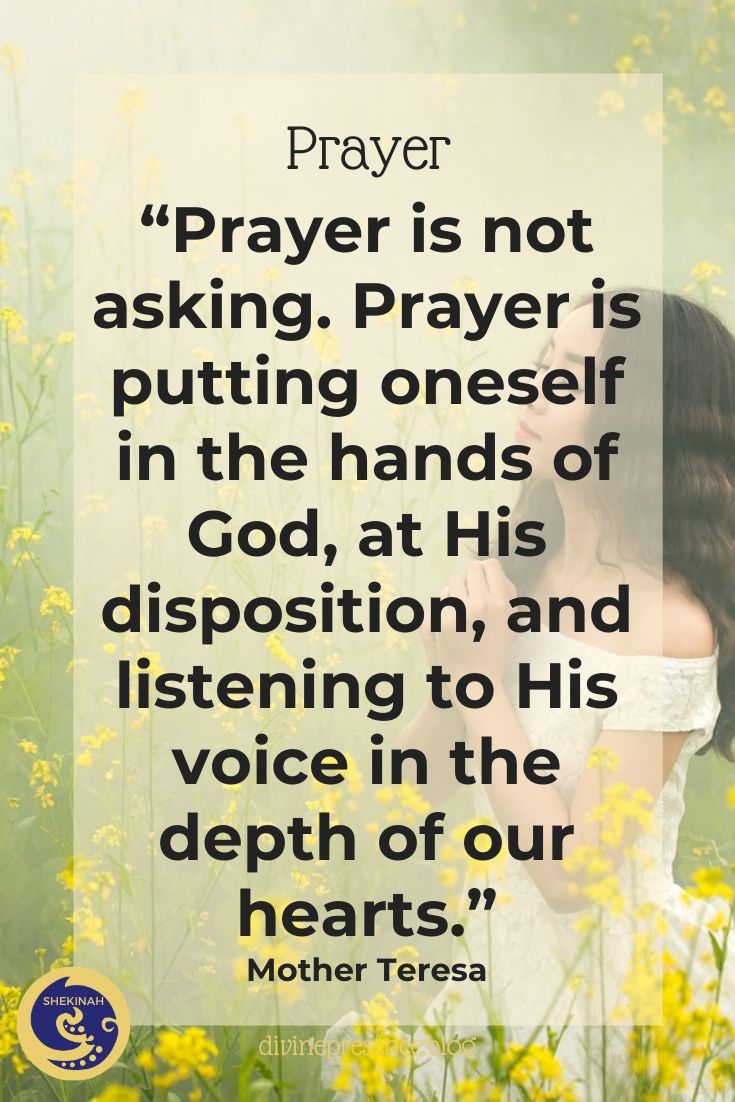
Prayer is not asking. Prayer is putting oneself in the hands of God, at His disposition, and listening to His voice in the depth of our hearts.
power of the trees, paganism, oneness, all creation, seas obey, the forests listen, the power of your words, divine presence, presence of the Divine, practising the presence of God, presence of Spirit

The forest

Proverbs 18: 21
Death and life are in the power of the tongue…
(this verse I have memorised, although I can never remember the citation!)
 
then… here’s what I read today (my verse for today was 2 Samuel 18:8, but obviously I read most of the chapter… and you have to get an idea of the context)
 
2 Samuel 18: 5 (David´s instruction to his army and generals before going into battle):  “Deal gently for my sake with the young man, even with Absalom”… (obviously, he still loved him as his son, even though his son had defied him and wanted him dead so he could be king)
 
2 Samuel 18: 7-8
7-There the army of Israel was defeated by David’s men, and the casualties that day were great–twenty thousand men.
8-The battle spread out over the whole countryside, and the forest claimed more lives that day than the sword.
now… just my suggestion… read that again!  (the forest did what? what kind of forest was it? did I just get transported into an enchanted forest in Lord of the Rings?)
 
And now… read verse 9:
9-Now Absalom happened to meet David’s men. He was riding his mule, and as the mule went under the thick branches of a large oak, Absalom’s head got caught in the tree. He was left hanging in midair, while the mule he was riding kept on going.
 
Now… I don’t want you to believe that I’m into paganism of ANY sort, but to me it’s VERY clear that God is not only the God of my heart, my spirit & my soul, but God is the God of the world (in every sense of it).  Of the riviers (dividing the River Jordan); the seas (drying the Red Sea); and the forests (He uses them as weapons at His will).  In Joshua 10, Joshua commands the sun and the moon to stand still…  “and there was no day like that before it or after it, that the Lord hearkened unto the voice of a man…”  Taking the time to actually READ the Bible slowly, not hurrying through it as an obligation but looking for the “best kept” secrets and what people aren’t talking about is fascinating!
How many times have I read this story of Absalom and failed to notice verses 8 & 9, and make the connection?
 
And even the oak tree obeyed David’s request to “deal gently with … Absalom”.  (If you carry on reading, you see it was a rogue general that killed Absalom contrary to David’s order, not the forest.)
And that’s the God that I’m starting to believe in… the one that I’m getting to know.
 
So, when the Bible says (Genesis) that we have “dominion” over every living thing, what does this mean? And when Jesus commands us “have faith in God”, and then “… if you have faith and do not doubt, not only can you do what was done to the fig tree, but also you can say to this mountain, ‘Go, throw yourself into the sea,’ and it will be done.”; how little has my faith been?
Where have I been all these years?
Have I been so caught up in semantics and religion that I’ve tried to put God in a little box?
I’ve been asking for peanuts, when He’s willing to let us move mountains?
 
Right now I feel like I’ve just been knocked down to the ground, and I’m sitting there shaking my head, trying to stand up and wondering where on earth that punch came from…
Like I said – shouldn’t I have already “known” this?  Haven’t I read these verses more than 5 times?
Learn character from trees, values from roots, and change from leaves.

Welcome to Shekinah: 24/7 prayer center

Thank you for visiting Shekinah 24/7. 

I had some serious doubts as to my sanity and whether or not I should even think about establishing a 24 hour-a-day, 7-day-a-week prayer center.  In fact, I wondered if it wasn’t just fanciful thinking that I should organise an ecumenical group of volunteers (and a place) to pray.  Just the over-whelming size of the task is daunting.  I will admit, the moment I voiced the idea, thoughts starting plaguing and bombarding me with reasons why it couldn’t be done. 

The next day, when I was searching for why I shouldn’t do it, I read Haggai 1: 4-8.  And there’s the answer I didn’t want to receive: 

Is it a time for you yourselves to be living in your paneled houses, while this house remains a ruin? Now this is what the Lord Almighty says: “Give careful thought to your ways.” 

“You have planted much, but have harvested little. You eat, but never have enough.  You drink, but never have your fill.  You put on clothes, but are not warm. You earn wages, only to put them in a purse with holes in it.”  This is what the Lord Almighty says: “Give careful thought to your ways.” 

“Go up into the mountains and bring down timber and build the house, so that I may take pleasure in it and be honoured”, says the Lord. 

So, I guess I have to stop procrastinating and make this 24/7 prayer room a reality.  I thought about naming it the Prayer Closet, since Jesus (in teaching us how to prayer) tells us to go into our room, close the door and pray (Matthew 6:6), but the idea of Shekinah is much bigger than that.  It’s about reviving all believers, irrespective of denominations.  It’s about recreating the revival of Zinzendorf in Moravia in 1727 and the 100 years that followed that revival.  It’s about the Wesley revival of the Methodist Church, and getting all of the denominations united in prayer for our country, for its leaders and for the needs of each man, woman and child in this country.

For more information about Zinzendorf, check out http://www.openheaven.com/library/history/zinzendorf.htm